
Blue Light: The Return of the Alpine A110
How Alpine Chose Philosophy Over Fashion

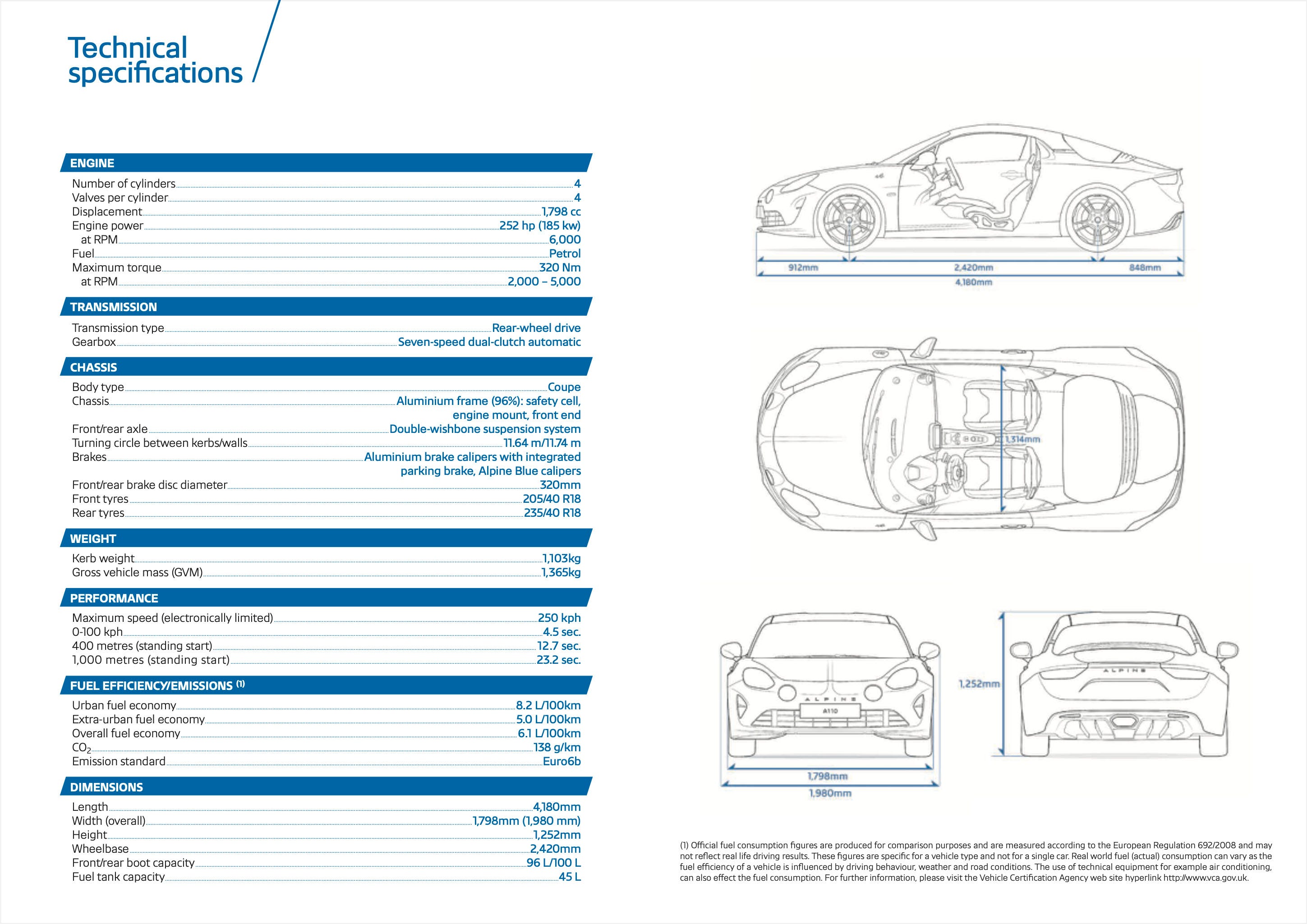
Alpine launched the A110 Première Édition in 2017, after a 22-year absence from the market. Limited to 1,955 units globally and priced at approximately £48,000, it immediately confronted the European sports car establishment with a question that hadn’t been asked in decades: what if the correct response to a world growing heavier, wider, and more comprehensively networked was to make something smaller, lighter, and more honest? Not simpler in the hairshirt sense. Not stripped-out and austere. But lighter in the way that only complete conviction allows: 1,103kg in road-going trim, with a 96-percent aluminium structure and maximum torque available from 2,000rpm. Against the 718 Cayman, the A110 was 300kg lighter. Against the Alfa Romeo 4C’s exotic carbon tub, it was not lighter, but it was considerably more composed on a rutted B-road. Against the Lotus Elise, it offered something the Norfolk machine never quite managed: a car you could live with on a Tuesday.
What Renault, and the small team in Dieppe who actually built the thing, understood was that the argument for lightness is not a technical argument. It is a philosophical one. This brochure makes that argument with twenty pages of restrained, confident, frankly rather beautiful graphic design, and a managing director’s letter that reads less like a foreword and more like a quiet promise.
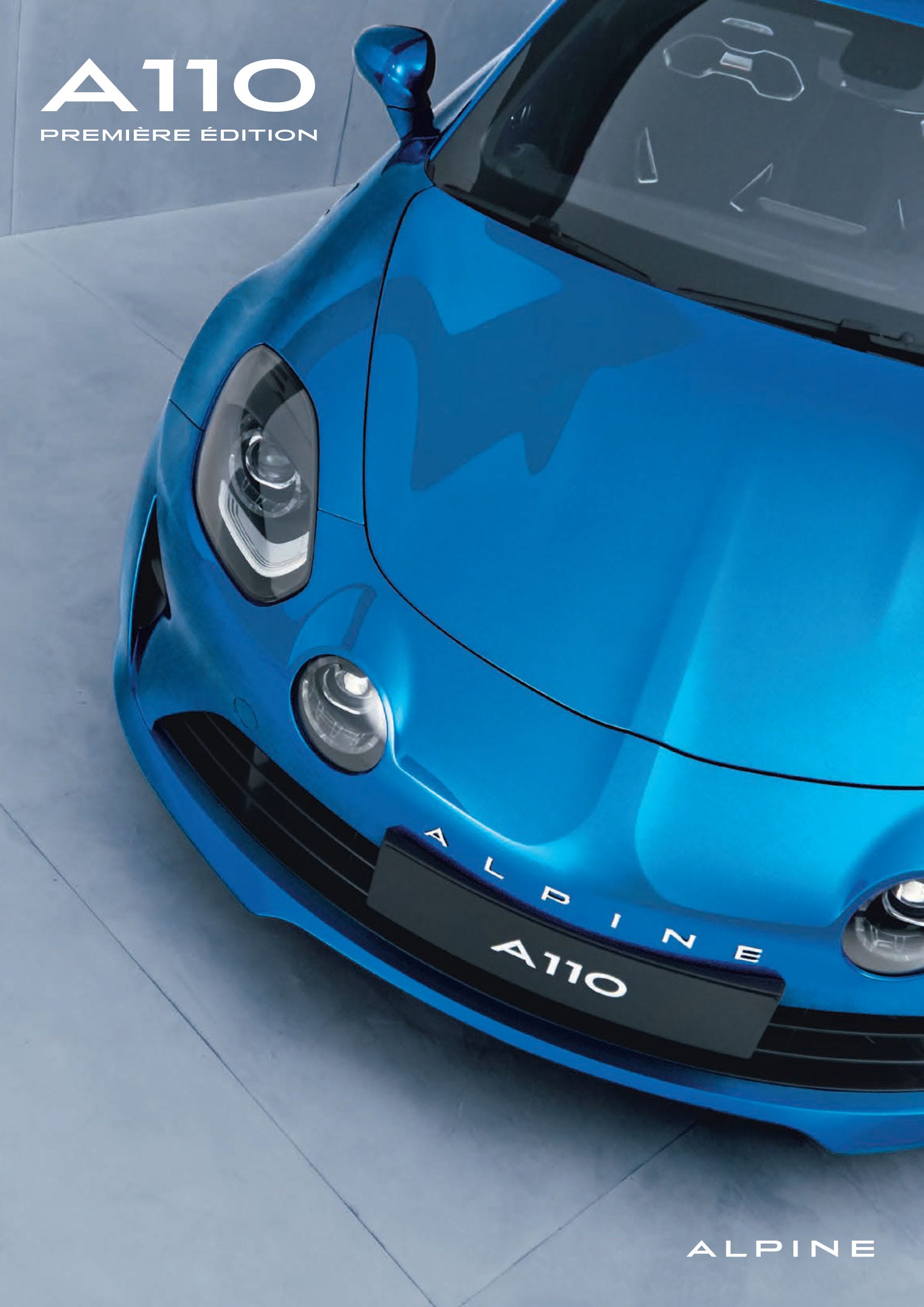
Dieppe Clinical
The A110 Première Édition brochure has the precise, cool temperature of an aluminium fabrication laboratory married to the romantic warmth of a French sports car with a genuine lineage. It is a difficult combination to sustain, and the brochure manages it with something approaching grace.
The colour palette is severe: Alpine Blue, deep black, and the occasional clean white, punctuated only by the Tricolore motif stitched, applied, and photographed at every available opportunity. French flags appear on C-pillars, on door panels, in embroidery, in the very structure of the brand identity. This is not nationalism as decoration. This is nationalism as engineering philosophy, the argument that the car’s spiritual DNA is non-negotiable and has been woven into every interior surface to prove it.
The typography is a cool, generous sans-serif set wide, with a great deal of deliberate breathing room between elements. White space is not used here because the designers ran out of content. It is used because the car is built on the principle of removed material, and the document that sells it is obliged to operate on the same logic. To pack these pages tightly would be to contradict the car’s central argument.
Photography alternates between two modes with no middle ground between them. The first is blurred motion: the car powering through alpine snow, shot from the roadside, the background streaked into abstraction, the A110 itself rendered in the particular shade of blue that makes you understand why the factory chose it as the signature colour. These images are emotional. They are asking you to remember something you haven’t yet experienced.
The second mode is static studio work: the car treated as industrial sculpture, lit hard against smooth concrete, headlamps dissected in close-up, the brake calliper isolated against a flat-grey background with the reverence of a jeweller presenting a watch. The brochure does not try to reconcile these two approaches. It lets them coexist.
“It’s here!” — The Letter That Isn’t Selling Anything
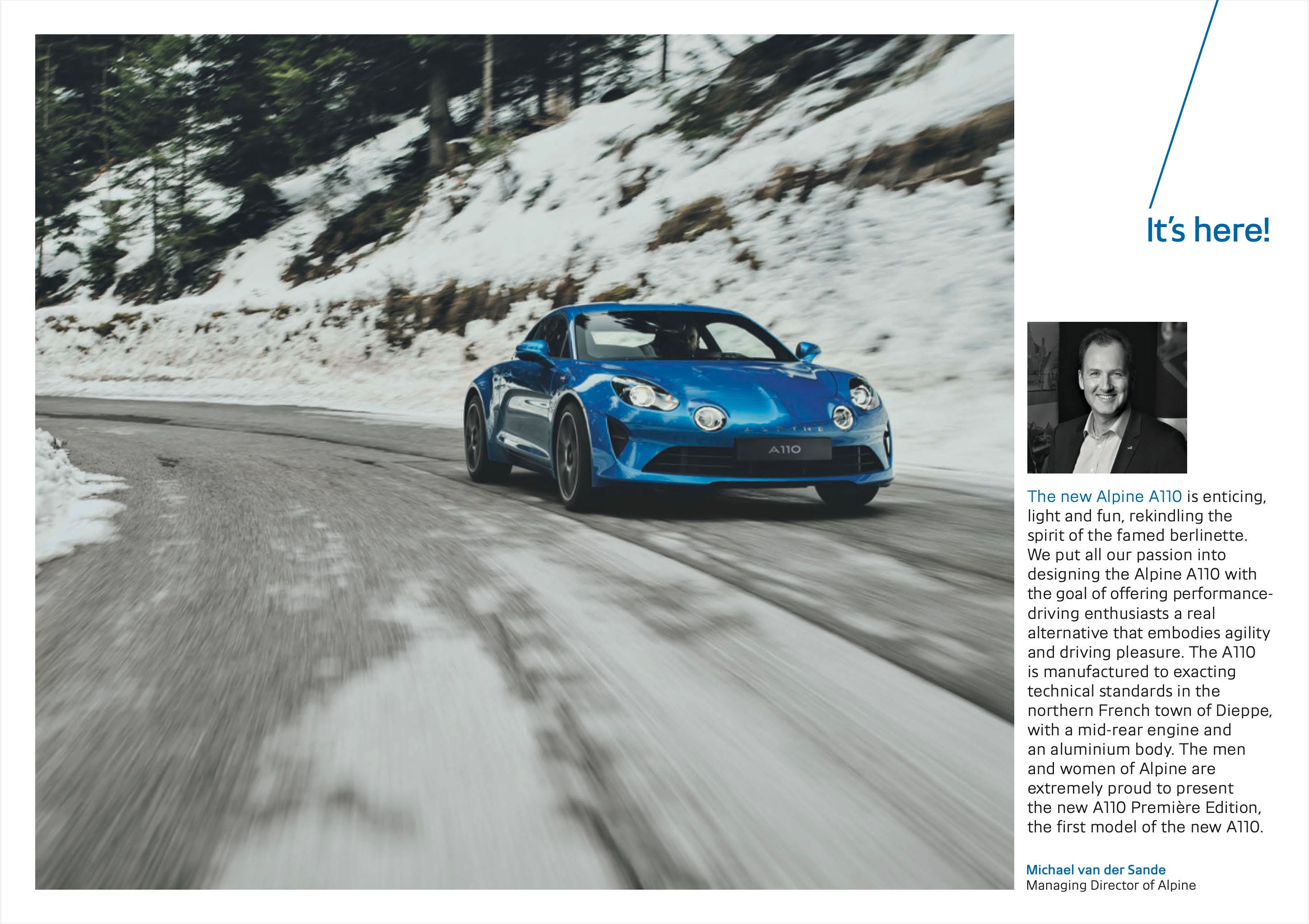
Page three of this brochure is a quietly confident opening statement. Michael van der Sande, then Managing Director of Alpine, contributes a letter that occupies the column below his photograph, which is small, black-and-white, and business-like.
The letter itself, reproduced in full in the brochure’s body text, not tucked into a footer, makes its central claim plainly: the A110 is “enticing, light and fun, rekindling the spirit of the famed berlinette”. Three adjectives for a reborn sports car. Enticing, light, and fun. No mention of power-to-weight ratios or lateral G-forces. No appeal to track-day capability or lap-time credentials. The word “light” sits between two emotional words, as if the engineering specification is the most natural thing in the world, which, for this particular car, it is. “We put all our passion into designing the Alpine A110 with the goal of offering performance-driving enthusiasts a real alternative that embodies agility and driving pleasure.”
A real alternative. In 2017, this phrase carried a specific meaning. The sports car market at that price point was effectively a Porsche conversation with occasional contributions from Lotus and Alfa Romeo. To position yourself as a real alternative was to acknowledge the gravity of Stuttgart’s pull while simultaneously arguing that there was another kind of gravity: the Dieppe kind, lighter and more playful, built by people who remembered what sports cars were for before they started needing software updates.
The Exterior: Sculpture With Aerodynamic Intent
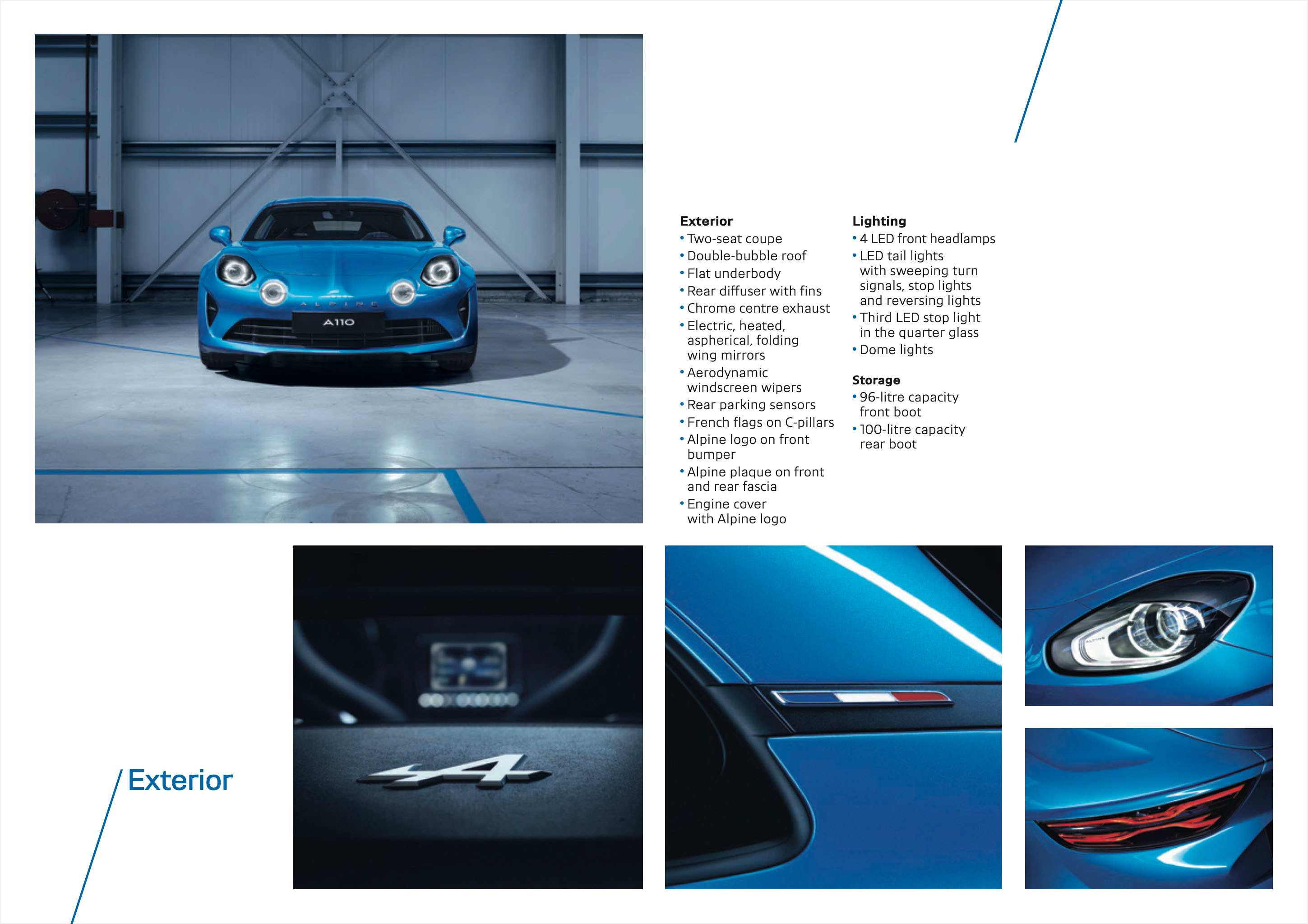
Pages four and five of the brochure are organised around the exterior specification in two clean columns beside a studio photograph of the car taken from directly ahead, occupying the left portion of the spread with the self-confidence of something that does not need to fill the room. The headlamp treatment, four circular LED units arranged in pairs, is a direct translation from the original berlinette, and the brochure offers no explanation for this. None is required.
The specification list is comprehensive but not boastful: double-bubble roof, flat underbody, rear diffuser with fins, chrome centre exhaust. These are the vocabulary of a car designed in a wind tunnel by people who understand that the absence of a rear wing is not laziness but restraint. A rear diffuser works harder than a fixed wing on a road car at legal speeds, and generates approximately none of the visual aggression that might lead a buyer to feel self-conscious in a supermarket car park.
The storage note is placed here with no apparent embarrassment: 96 litres at the front, 100 litres at the rear. Total: 196 litres, split across two compartments of which neither will accept a golf bag. The brochure does not linger on this. It states the numbers, acknowledges the split-boot architecture as an inherent consequence of the mid-engine layout, and moves on.
Engine, Performance, Transmission: The Technical Centre
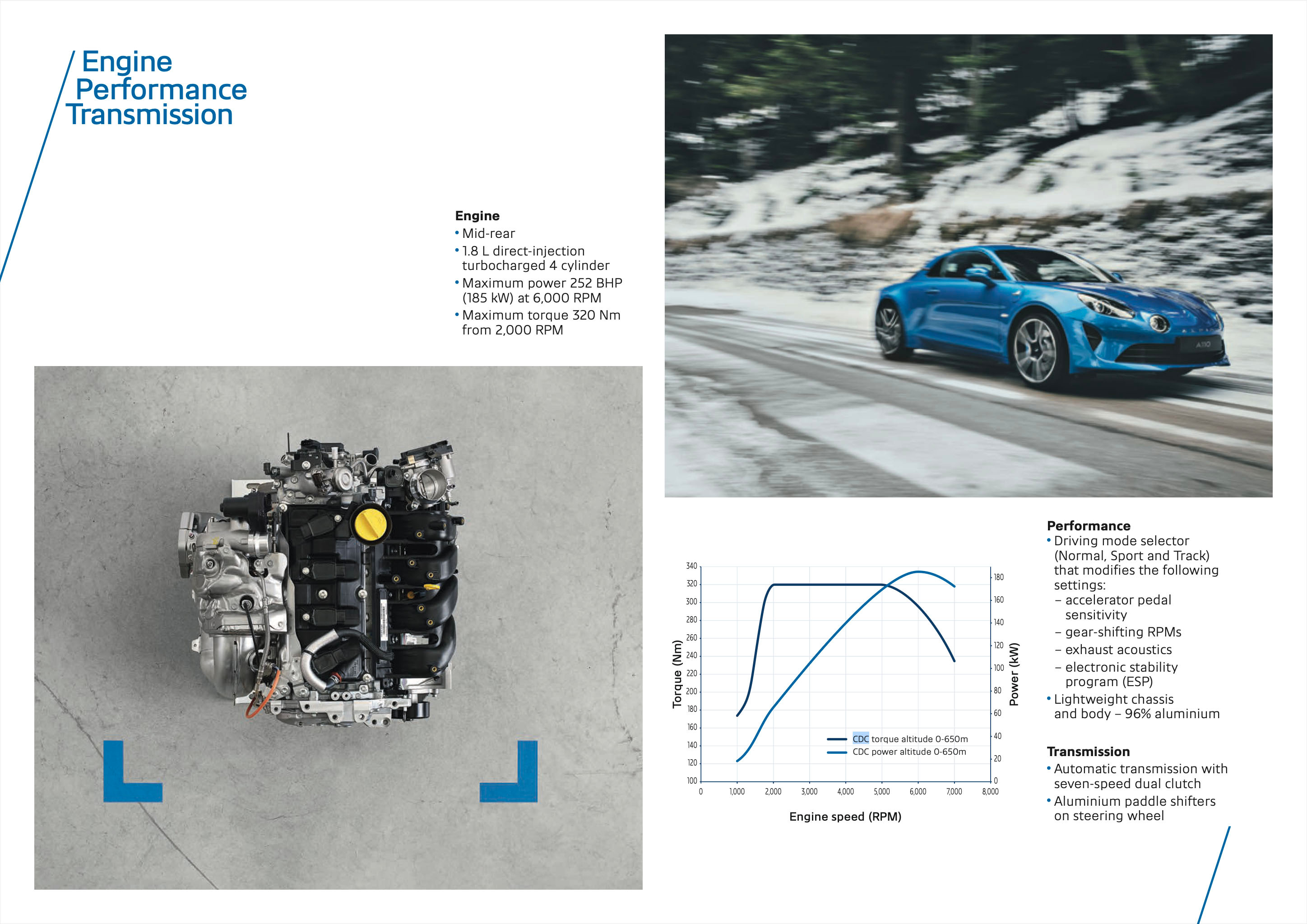
Pages six and seven are where the brochure reveals its structural confidence, because it devotes a full spread to the powertrain, presenting the engine in isolation on a concrete surface with photographic care that would not embarrass a contemporary exhibition catalogue. The 1.8-litre direct-injection turbocharged four-cylinder is photographed from above, all yellow coolant cap and complex aluminium castings, and it looks, in this light, like what it is: a serious piece of engineering that happens to share its fundamental architecture with the Renault Sport Mégane.
The brochure does not mention the Mégane. The brochure does not, in fact, mention Renault at all. This is a choice.
What it does mention is the torque curve, which is presented as a graph on page seven. The curve (at altitude 0-650m, the document specifies, which suggests someone was paying close attention to the conditions under which Alpine test drivers develop their preferences) shows maximum torque of 320Nm arriving at 2,000rpm and sustaining, essentially flat, to 5,000rpm. The breadth of that plateau is notable even by modern turbo standards: full torque available from 2,000rpm and sustained to 5,000rpm, meaning the driver has access to maximum pull across the entire practical rev range rather than managing a narrow window around a mid-range peak.
Maximum power is 252bhp at 6,000rpm. The brochure states this in the specification list without hyperbole. 252bhp, in a car of this weight, generates a power-to-weight ratio that sits somewhere in the region of a significantly more expensive mid-engined machine. The brochure does not do this calculation for you. It trusts you to understand what the numbers mean when arranged correctly.
The driving mode selector (Normal, Sport, and Track) is presented in the performance specification with four variables it controls: accelerator pedal sensitivity, gear-shifting RPMs, exhaust acoustics, and the electronic stability programme. This is a precise and telling list. It contains nothing cosmetic. No lighting modes, no suspension stiffness settings from a button (the A110’s passive dampers require no such theatre). These four parameters are the parameters that actually determine how a car drives, and the brochure’s decision to list them without elaboration is a statement of editorial confidence.
The transmission is a seven-speed dual-clutch automatic with aluminium paddle shifters on the steering column. There is no manual option. The brochure offers no apology for this.
Road Holding and Safety: The Geometry of Confidence
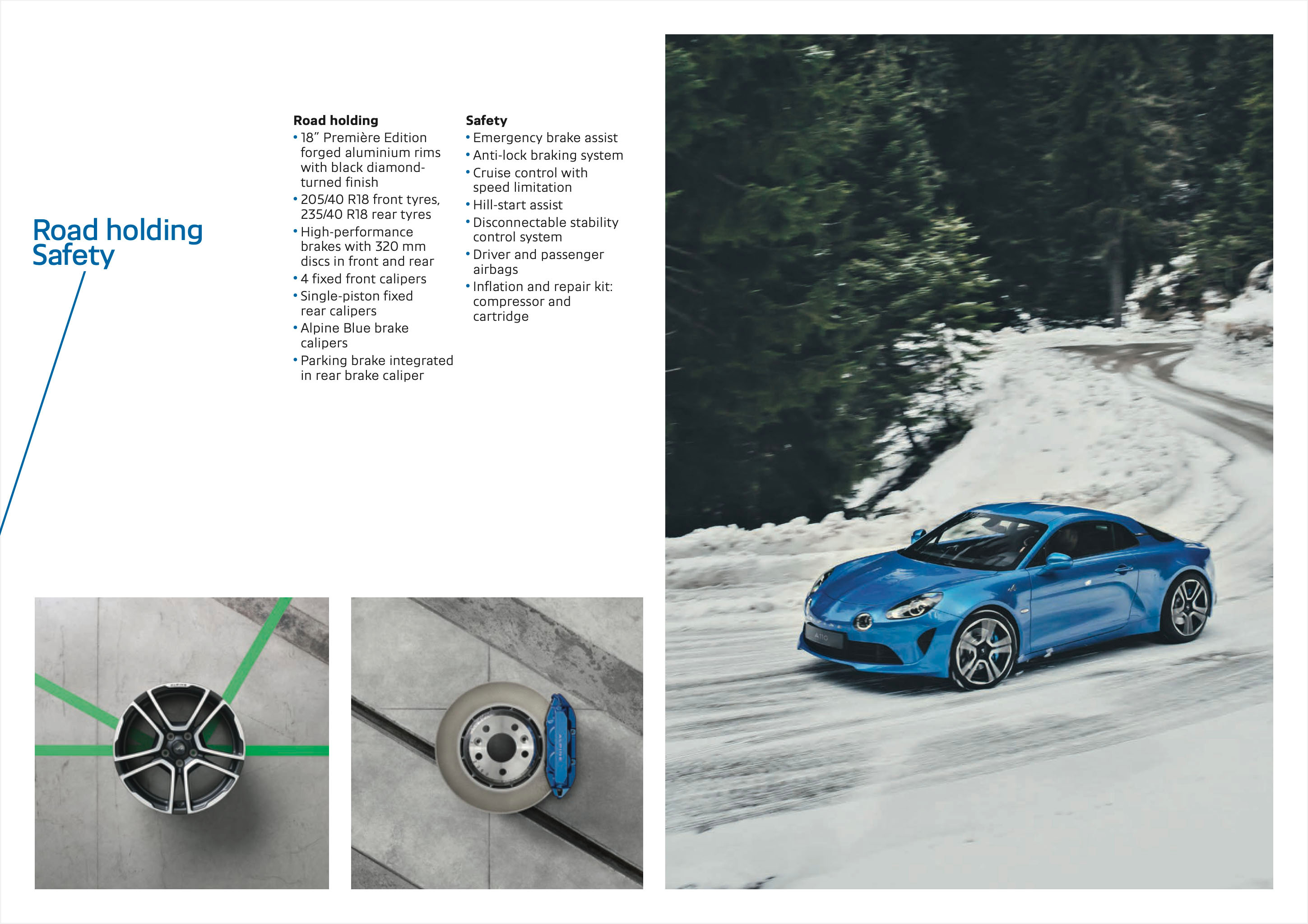
Page eight opens with the wheel specification: 18-inch Première Édition forged aluminium rims with a black diamond-turned finish, wearing 205/40 R18 fronts and 235/40 R18 rears. The tyre choice is technically interesting, though the document does not present it that way. It is simply listed.
What that rear width represents, for those inclined to parse it, is a philosophical decision by the engineers in Dieppe to allow the rear of the car to work: to steer, to rotate, to participate in the conversation between driver and road rather than simply following obediently. A mid-engined car with 265-section rear rubber is a car that understands corners as binary events, on or off, safe or not. A mid-engined car with 235-section rear rubber and properly calibrated double-wishbone geometry at all four corners is a car that has an opinion about corners, one that can be influenced, argued with, and agreed upon. The brochure does not say any of this. It gives you the number and trusts the rest.
Braking is handled by 320mm discs front and rear, with four-piston fixed front callipers and a single-piston fixed rear, all finished in the A110’s particular shade of blue. The parking brake is integrated into the rear calliper rather than occupying a conventional handbrake lever. This saves weight. Everything saves weight.
The safety specification is complete: emergency brake assist, ABS, cruise control with speed limiter, hill-start assist, and a disconnectable stability control programme. Driver and passenger airbags. The inflation and repair kit in lieu of a spare wheel, which again the brochure states without qualification. There is no room for a spare wheel and the engineers did not intend to make room.
Interior: The Ceremony of Aluminium
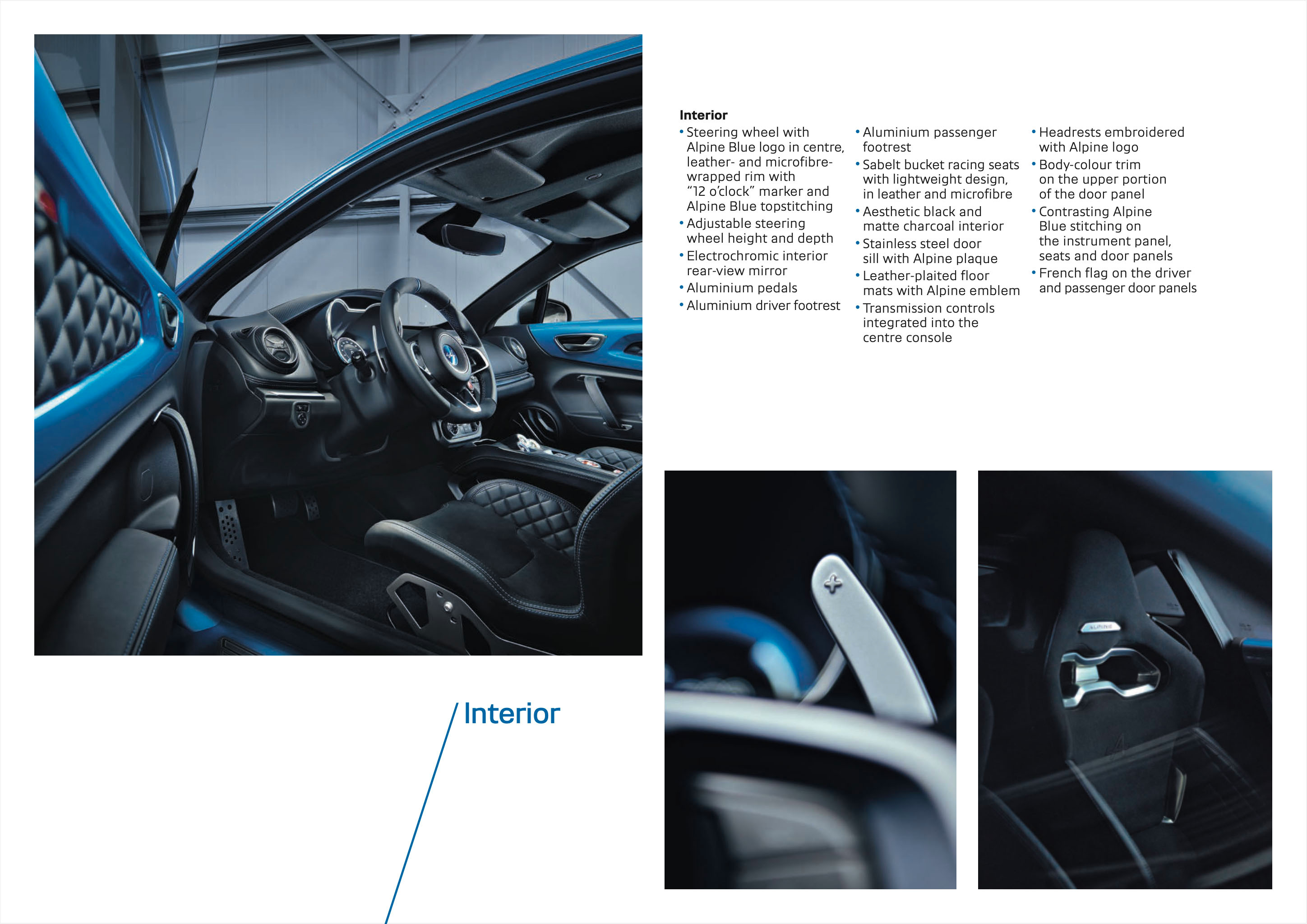
Pages ten and eleven are the interior spread. The main photograph, shot from the open driver’s door with the seat visible in the foreground and the passenger-side architecture beyond, is almost monochrome: black and matte charcoal with specific accents of Alpine Blue appearing in the car’s paintwork and the steering wheel logo. It looks like a place for deliberate work. It does not look like a living room.
The Sabelt bucket seats are lightweight racing items trimmed in leather and microfibre, and they carry embroidered Alpine logos at the headrests. The steering wheel is leather and microfibre-wrapped with a “12 o’clock” marker and Alpine Blue topstitching. These details are enumerated in the brochure with the straightforwardness of a technical specification. The 12 o’clock marker is not described as a motorsport reference. It is simply present. If you know what it means, you understand it. If you do not, you will learn.
The aluminium pedals and footrests (driver and passenger both, a detail that speaks to someone caring about the passenger’s experience as well as the driver’s) are noted without emphasis. The aluminium paddle shifter is photographed in isolation on page eleven’s lower strip, alongside a close-up of the seat. These components are treated as objects worth examining rather than surfaces to be photographed in passing.
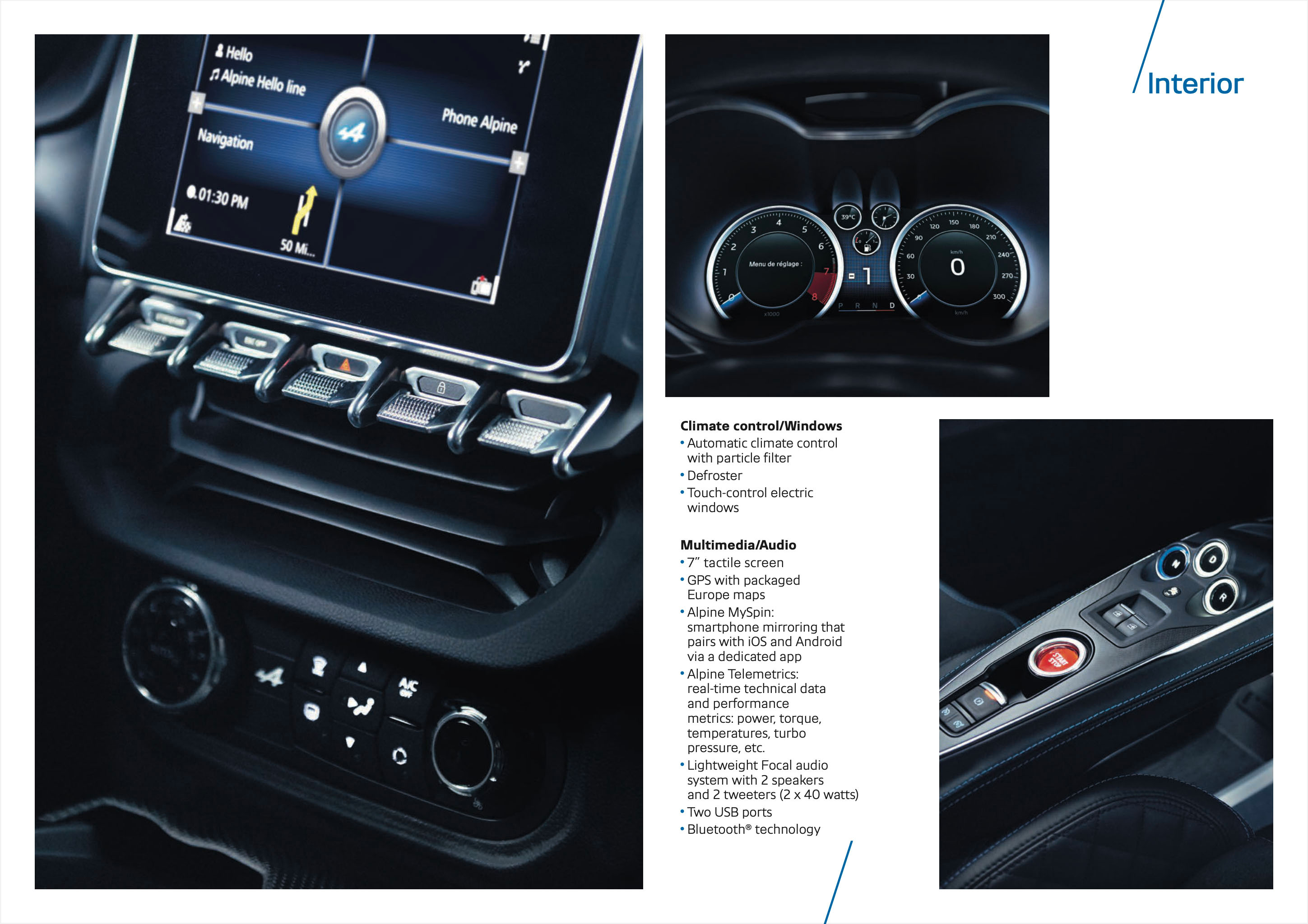
Pages twelve and thirteen continue the interior section with the multimedia and climate systems. The 7-inch touchscreen, GPS navigation, and Alpine MySpin smartphone mirroring are presented as contemporary necessities rather than selling points. What the brochure is genuinely proud of, and it shows, is the Alpine Telemetrics system: real-time technical data including power output, torque, temperatures, and turbo pressure. This is not entertainment technology. This is the infrastructure of a driver who wants to know what the car is doing while it does it.
The Focal audio system is described as “lightweight”. Lightweight is applied to the audio system. This is the A110 in one detail: even the speakers have been interrogated for grams.
Colours: Three Choices, One Right Answer
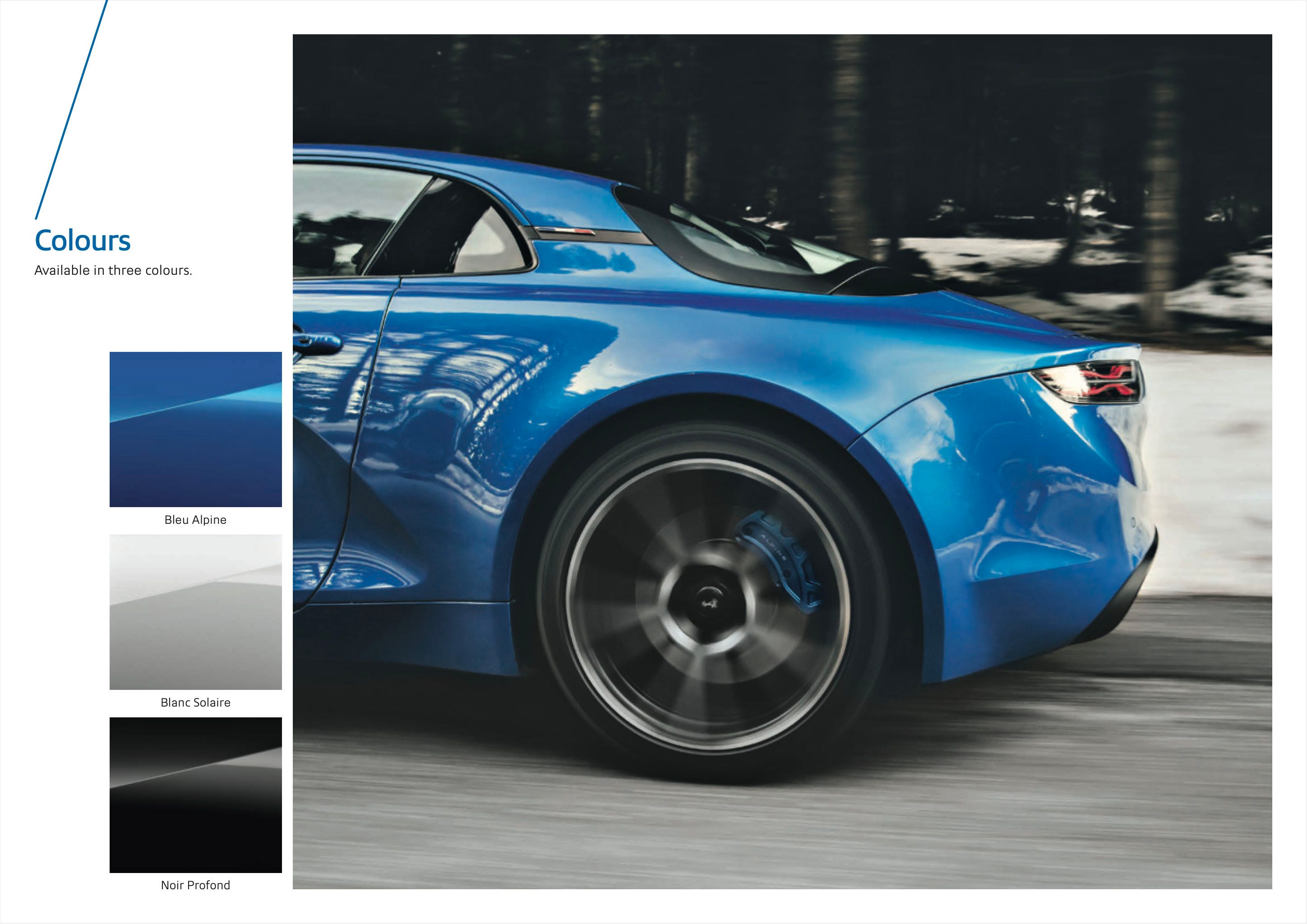
Page fourteen gives you three colours. Bleu Alpine. Blanc Solaire. Noir Profond. The brochure presents colour swatches of modest size, arranged vertically on the left margin, against the large full-bleed photograph of the car in motion: rear profile, in Bleu Alpine, on a winter road with dark conifers behind it. The image occupies more than three-quarters of the spread. The colour swatches are almost an afterthought. The brochure is telling you something.
The Rearview Mirror: Nine Years Later
The Forgotten Badge
The A110 Première Édition’s commercial difficulty was not that it was a bad car. It was, and remains, one of the most accomplished driver’s cars produced in Europe at any price point in the 2010s. The difficulty was that asking someone to spend £48,000 on a sports car built by a brand that, to the British buying public, had been absent for twenty-two years, was a harder sell than the engineering deserved.
The Porsche 718 Cayman was heavier, more expensive, and less playful. It was also a Porsche, a word that carries enormous weight. Alpine, by contrast, was a word that required explanation. The A110’s brochure, for all its confidence, could not resolve this. It could not make the Alpine badge mean what it meant in France, where the original berlinette remains a national automotive monument, because in the UK the heritage was not well known. The badge problem was real, and it was the one thing the men and women of Dieppe could not machine out of the equation.
The practicality question is a smaller issue but a persistent one. 196 litres of split storage, as noted, fails every version of the golf bag test. For buyers cross-shopping against the Cayman, which passes that test with room to spare, this was not trivial. The A110 asked you to reorganise your weekend around it. Most buyers at this price point prefer the car to reorganise itself around them.
Première Édition Teething Problems
Early production cars (2017-2020) developed corrosion issues in the wheel arches and around the front wishbone mounting points. An aluminium-intensive structure in a northern European climate requires careful attention to corrosion protection in the secondary structure, and the early cars suggest this attention was not uniformly applied. It is a solvable problem, and later production addressed it, but Première Éditions require inspection by someone who knows where to look.
The seven-speed dual-clutch transmission developed a reputation for gear-shift hesitation under certain conditions, and mechatronic unit failures have proven expensive. A car whose entire identity rests on frugality with mass sits uneasily alongside an expensive mechatronic bill, and in some ownership histories, it does exactly that.
The interior switchgear, including the indicator stalks, the window controls, and elements of the climate panel, came directly from the Renault Clio parts bin. At £48,000 in 2017, the premium buyer noticed. The brochure’s photography is clever enough to keep these components in soft focus or out of frame, which is aesthetically sound and commercially intelligent. The buyer who specified a Première Édition and then spent four years operating a Clio indicator stalk had legitimate grounds for a quiet grievance.
The Modern Classic Arrives Early
In 2026, a Première Édition in sound condition commands north of £40,000 on the open market. For a car that was new nine years ago at £48,000, this represents the depreciation curve of a car that people actually want.
The standard A110, in Pure and Légende trim, completed a remarkable act of market education, persuading the European press and the European driving public that lightweight engineering was not an exercise in nostalgia but a commercially viable alternative to the weight-inflation that had consumed every other class of performance car. The car won the argument.
The A110 also demonstrated, conclusively, that you could meet Euro6b emissions regulations without resorting to hybrid assistance, provided you committed absolutely to the removal of mass. This was not obvious in 2017. The prevailing assumption in the industry was that the combination of safety cell requirements, airbag legislation, infotainment mandates, and the general accretion of modernity would push every sports car past 1,300kg and toward some form of electrification as a compensatory measure. Dieppe proved this was a counsel of despair and not a law of physics.
The Première Édition, specifically, is considered a modern classic in the most literal sense: a production-limited first edition of a car that subsequently became a critical success, from a marque whose revival was commercially improbable and whose failure was widely predicted. The market has delivered its verdict with unusual clarity.
The brochure, in retrospect, is the right document for the car it describes. Twenty pages. Restrained. Confident. Lighter than everything around it. It does not try to argue itself into your hands; it simply presents the evidence and trusts that anyone who knows what they are looking at will draw the correct conclusion.
The men and women of Dieppe were, in this, entirely correct.
The Fine Print
I enjoyed this. I too, would probably go second-hand 911 or Caymen, if replacing my SLK, but I’m starting to get very curious about how the A110 would drive on a fast Scottish A Road.
I have also pencilled in a used Cayman or 911, and they would be the sensible choice. I was surprised how much the A110s are going for. Would love to try one.