A Work of Art: When Aston Martin's Gallery Piece Met The Nürburgring
Why the V8 Vantage was more than just a beautiful baby

Aston Martin hung a press shot of a Porsche in their boardroom. Not for admiration. For the same reason a boxer pins up a photograph of the man he intends to beat. The 997-generation 911 Carrera S was the benchmark, clinical, infallible, relentlessly competent, and the V8 Vantage, arriving in 2005 and refreshed here with a 4.7-litre engine for 2008, was Gaydon’s answer to the question: what if the sports car were a work of art?
The brochure opens on this declaration without embarrassment. “Aston Martin unites these qualities to create a car that is truly a work of art.” Not like a work of art. A work of art. The sentence sits alone on the third page, set in spaced sans-serif against white space so generously deployed it becomes a compositional choice. Which is, of course, exactly the point.
Crystalline Athleticism
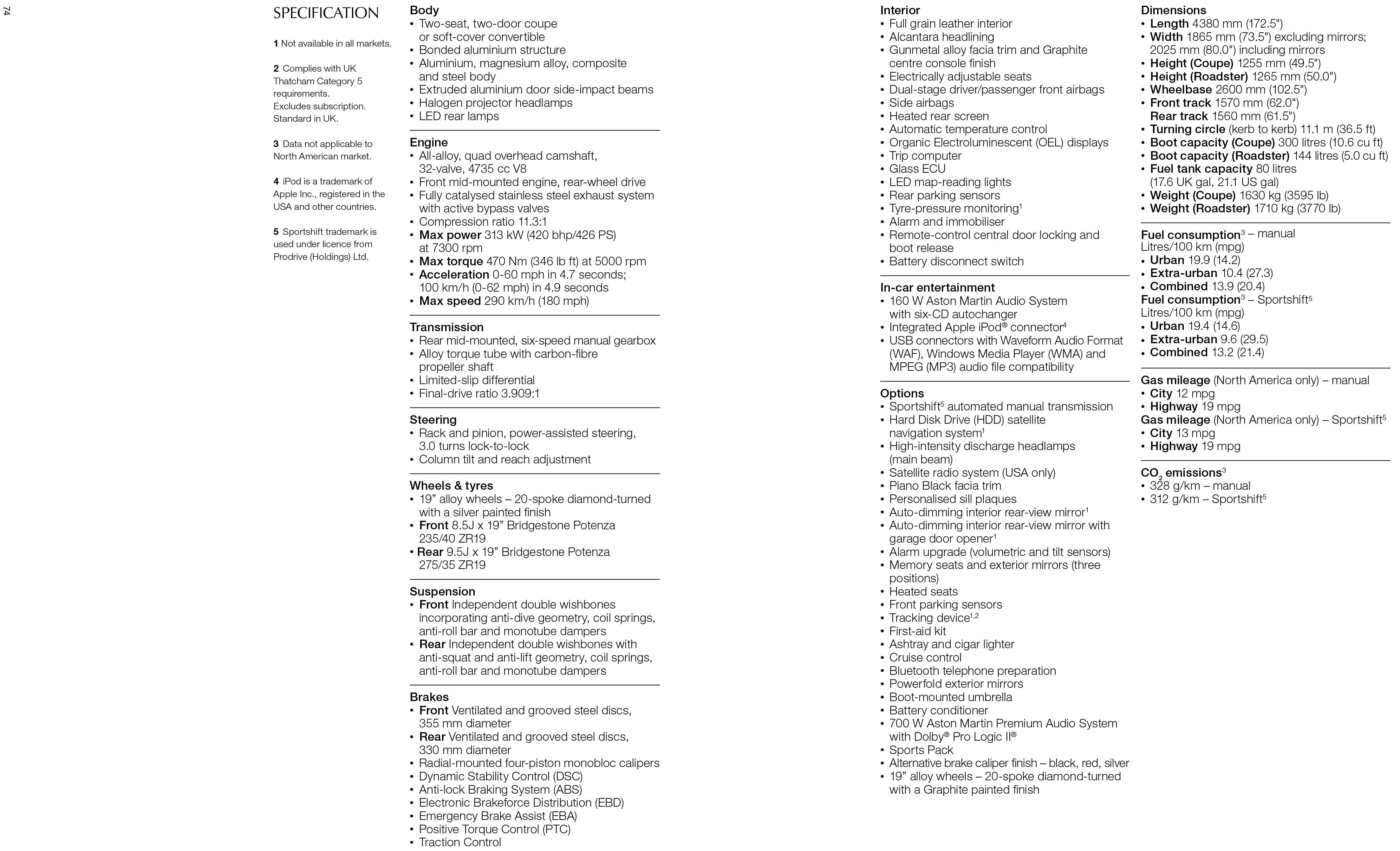
The visual language of the brochure holds cold, technical precision in one hand (the bleached-white studio pages, the engine components isolated like museum artefacts, the brake discs rendered as if for a metallurgy journal) and raw, organic muscularity in the other (the animal-like rear haunches, the overcast Icelandic landscapes where the car looks less parked than deposited by geological forces).
The photography makes the opening statement. Every landscape location, and there are many, seemingly shot across Iceland, the Dolomites and the glacial lagoon at Jökulsárlón, has been chosen for one quality above all others: drama without colour. The sky is always on the verge of something. The car is always on a black road or black volcanic rock. When the coupe appears in Magma Red on a Dolomite hairpin bend, it looks less like a car being driven than a flame caught mid-flicker.
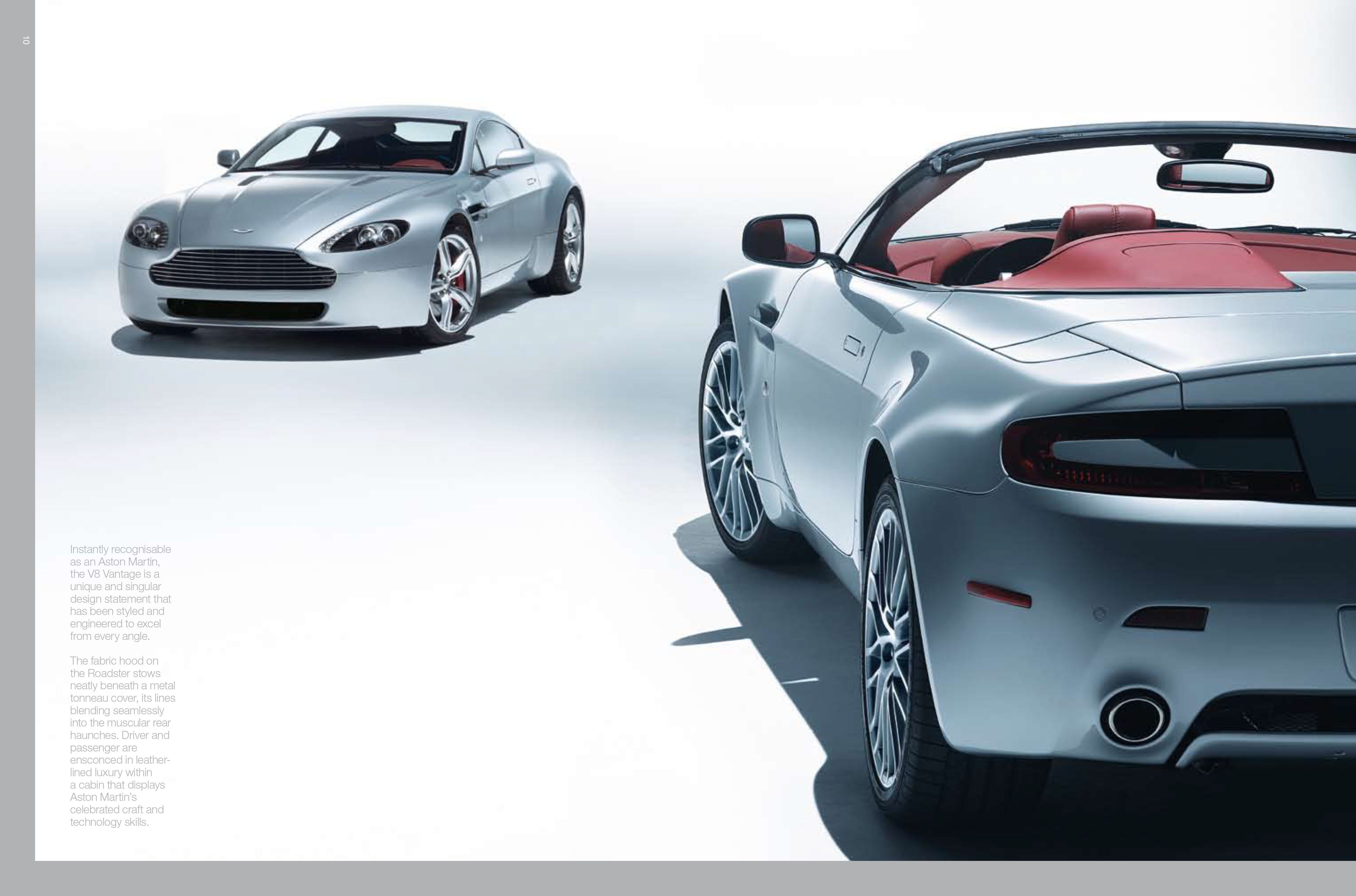
Then the studio pages arrive, and the visual tone shifts entirely. On page ten, the Coupe and Roadster are presented on a surface so white it absorbs the horizon. There are no people, no context, no lifestyle suggestion. Just the two forms, their shadows sharp and precise. The contrast is not accidental. The brochure performs the same oscillation the car itself performs: between the untameable (Iceland, the open cockpit, the sound of a V8 in a cold valley) and the controlled (the single-piece side pressings, the aluminium facia trim, the 200-millisecond gear change).
The typography is clean and undecorated, the colour palette almost entirely silver, grey and black until a Magma Red coupe or a Bitter Chocolate leather interior detonates into the sequence like a controlled explosion. White space is not merely used; it is deployed, as a photographer deploys shadow.
Power, Beauty, Soul
Three spreads, three landscapes, three qualities: the brochure is telling you that Power, Beauty and Soul are not a checklist but a philosophy, each one large enough to require its own horizon.
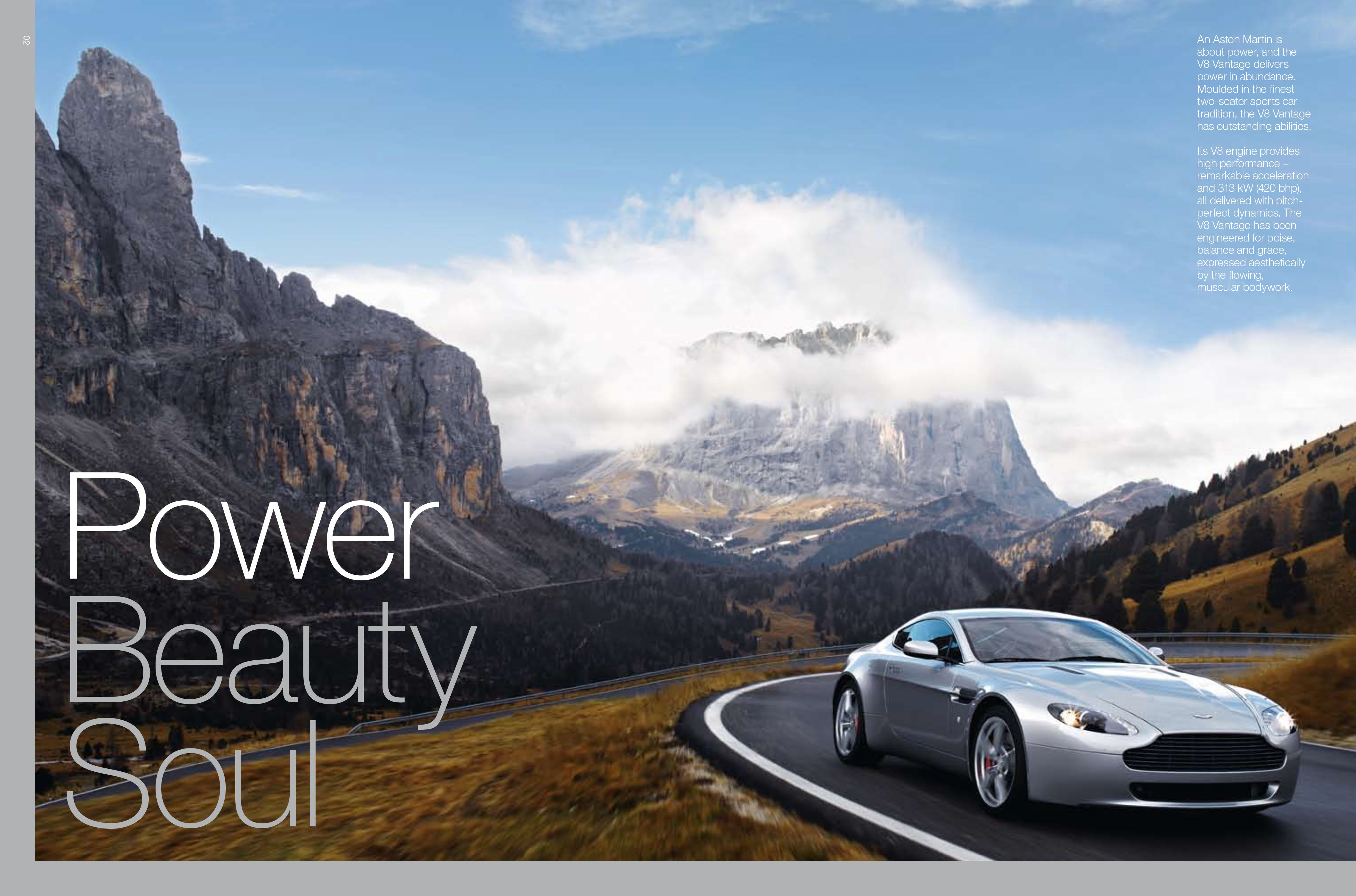
Power gets the Dolomites, the coupe cornering under a bruised sky. The accompanying text is a single short paragraph: “remarkable acceleration and 313 kW (420 bhp), all delivered with pitch-perfect dynamics.” The engine is the subject, but the mountain is the context. Performance here is not a laboratory result; it is a force of nature.
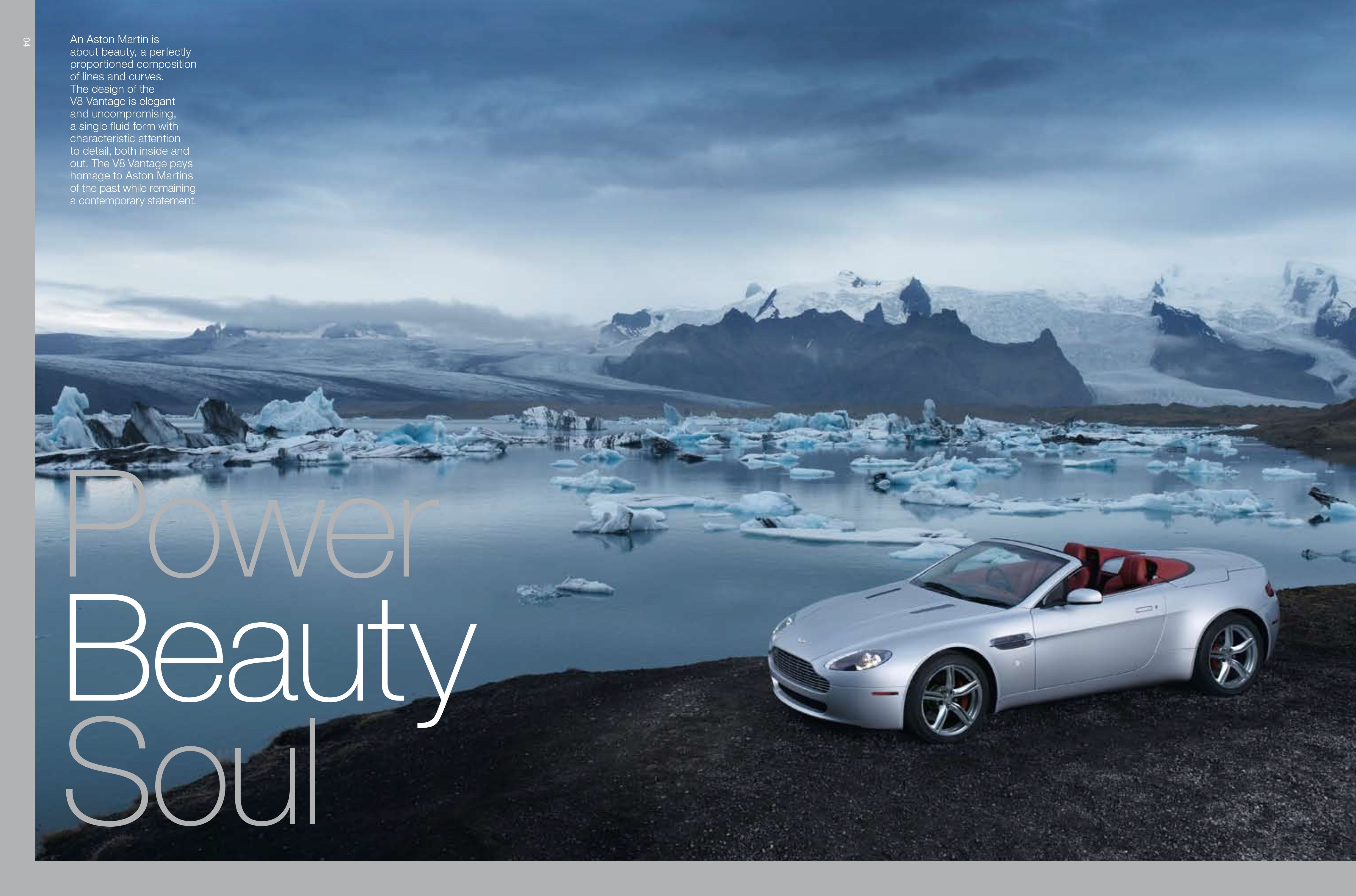
Beauty gets the glacial lagoon at Jökulsárlón, the Roadster parked on black lava with icebergs behind it. “A single fluid form with characteristic attention to detail.” The choice of location is precise: ice is the most architectural of natural materials, and the car’s surfacing, its minimal shut lines and seamless flanks, is being asked to hold its own against a frozen landscape that has been doing the same thing for ten thousand years.
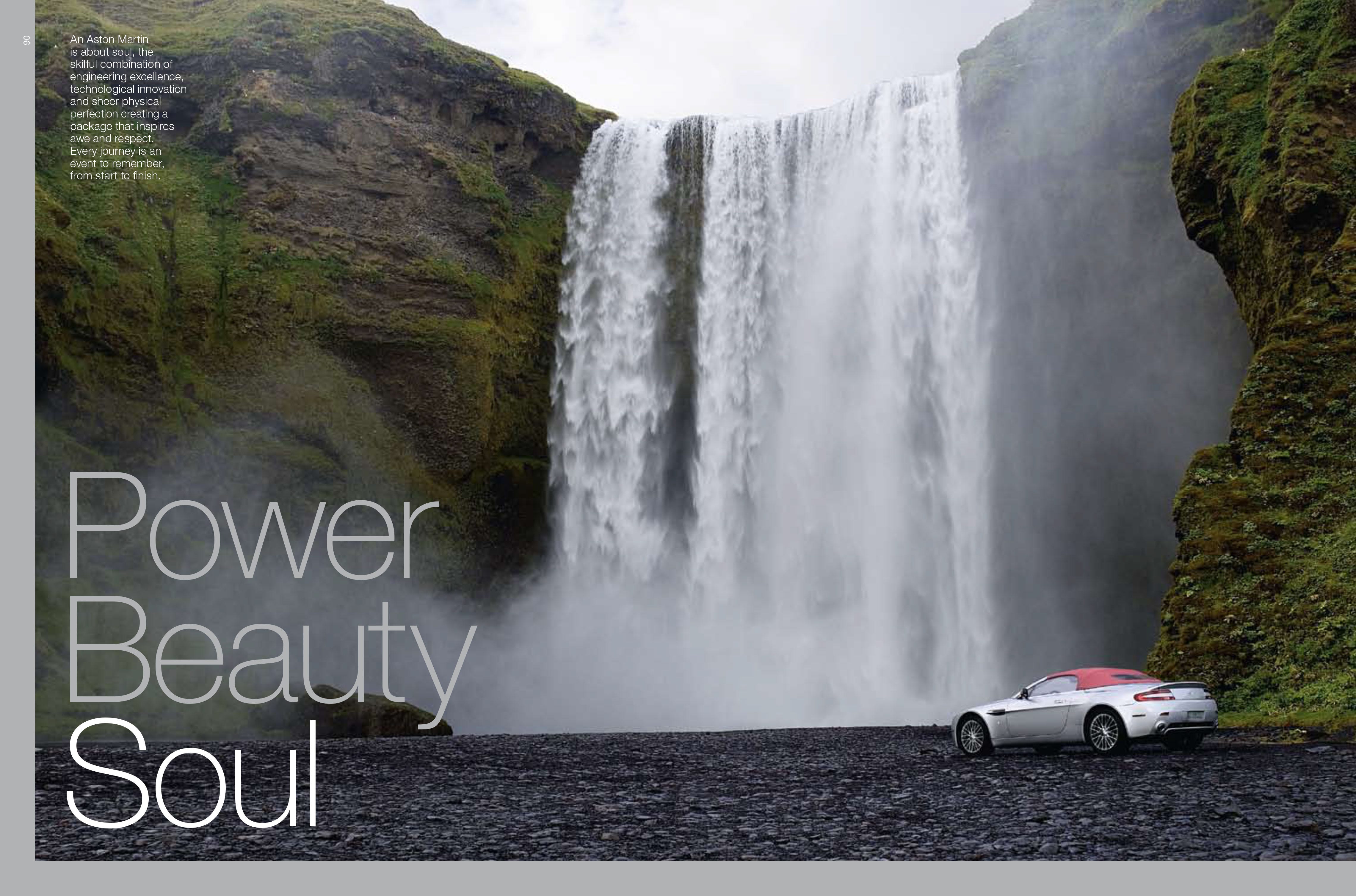
Soul gets a waterfall, the Roadster tiny at its base, dwarfed by the geology. “The skilful combination of engineering excellence, technological innovation and sheer physical perfection creating a package that inspires awe and respect.” Of the three landscapes this is the most humbling, and the most honest. The car is not competing with the waterfall. It is simply present in front of it, which is all Soul ever asks.
The Racing Credentials
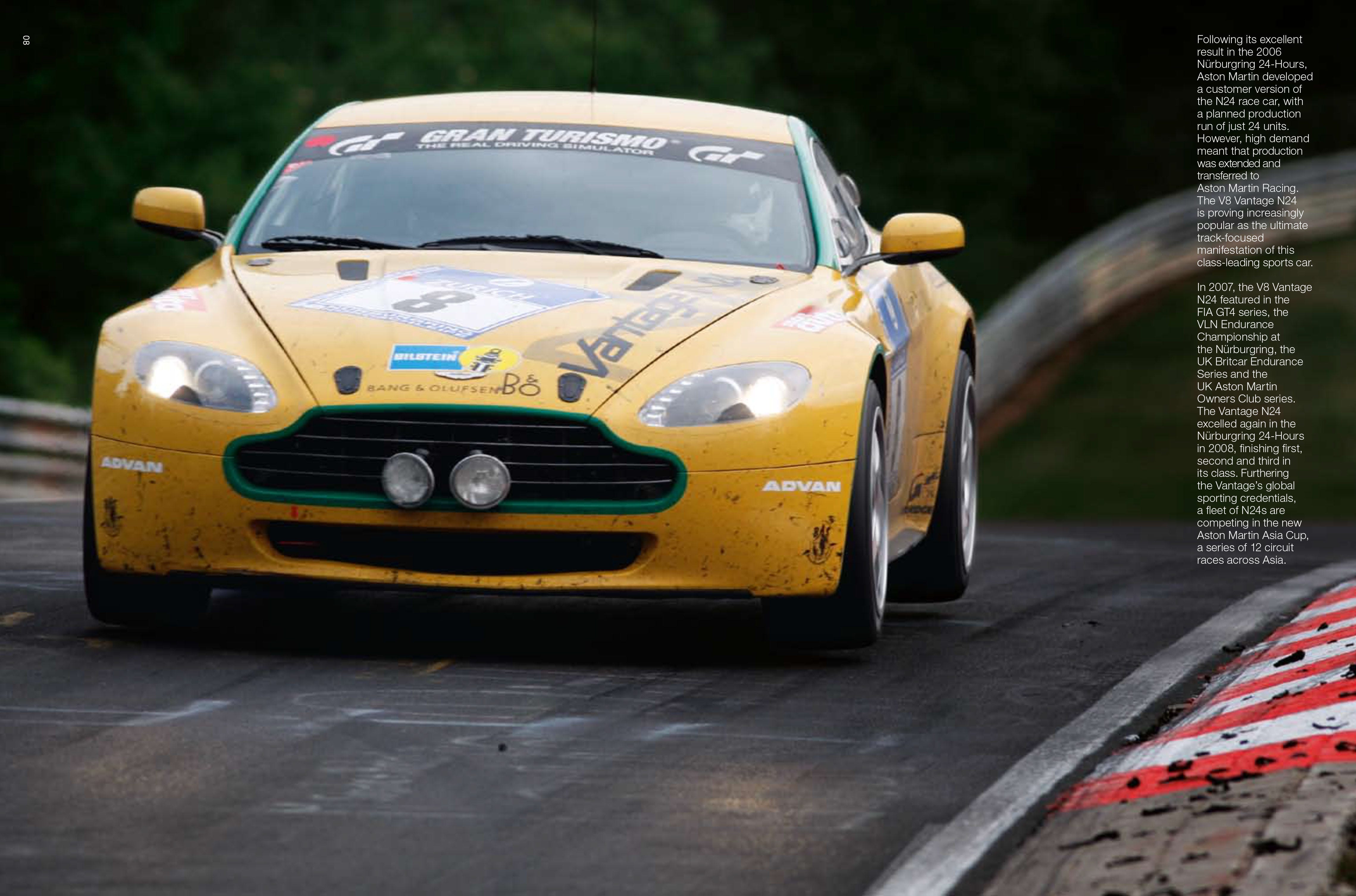
Before the car has been shown in detail, the brochure establishes its steel. The V8 Vantage N24, yellow, dirty, in full flight at the Nürburgring, the Gran Turismo livery somehow perfectly period-appropriate, occupies a full spread. The race record speaks plainly: first, second and third in class in the 2008 Nürburgring 24-Hours. “The ultimate track-focused manifestation of this class-leading sports car.”
This matters for a specific reason. The road car the brochure will subsequently present has been accused, throughout its commercial life, of being too beautiful for its own dynamic good: a car bought for its silhouette rather than its capabilities. The N24 page is the pre-emptive counter-argument. Whatever follows, whatever beauty and craftsmanship the next seventy pages celebrate, this page establishes that the bloodline traces to a circuit, not a gallery.
The Digital Handshake
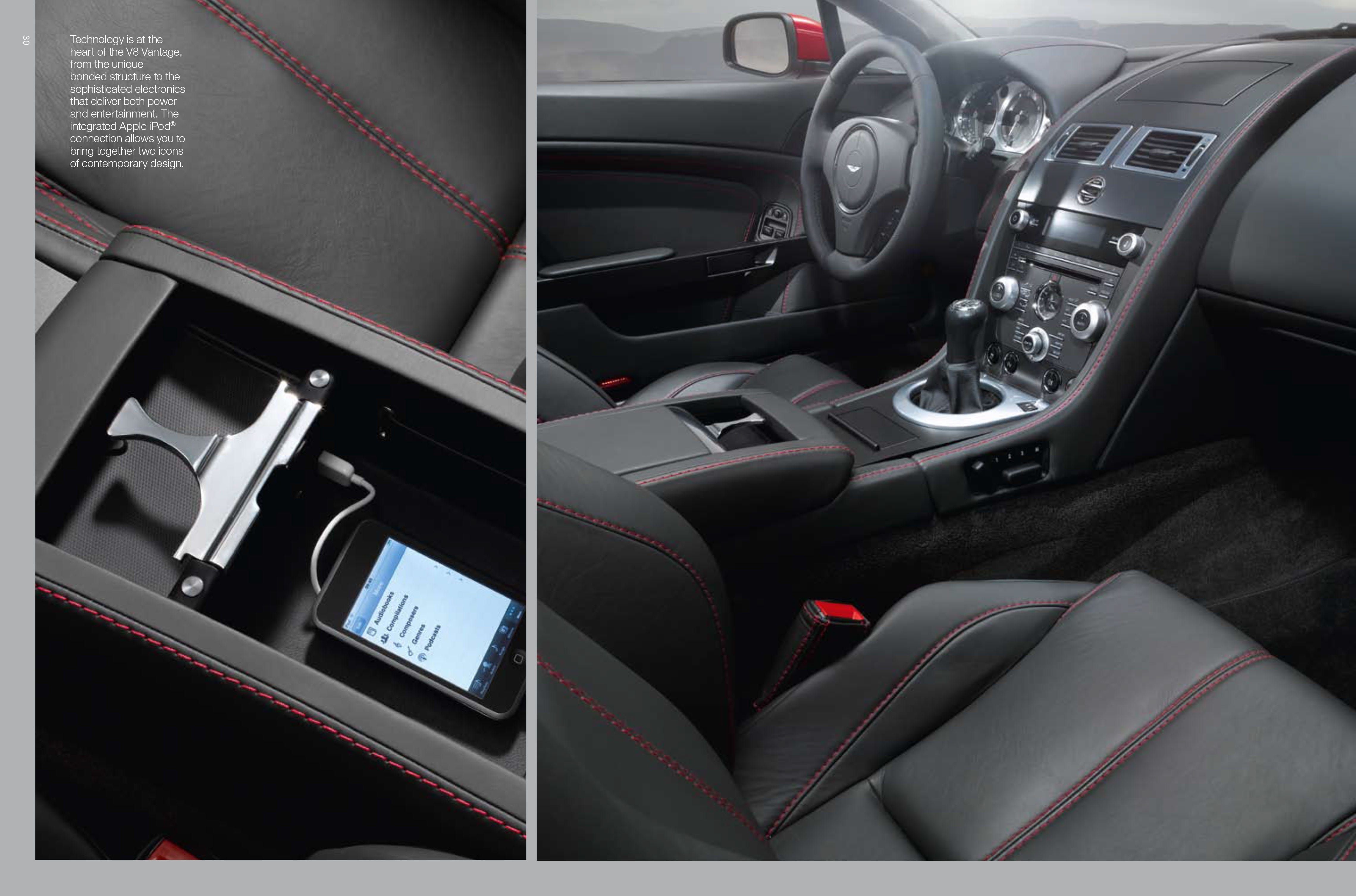
Here the brochure commits its only moment of peer recognition. Nestled in the leather armrest recess, captured in a close-up that treats the cable like a jeweller’s detail: an Apple iPod, first-generation touch. “The integrated Apple iPod connection allows you to bring together two icons of contemporary design.”
Icons of contemporary design. Aston Martin, an institution approaching its centenary, has elected to acknowledge a peer. The iPod was, in 2008, at its cultural apex, the object that had redefined what consumer electronics looked like and how they felt in the hand. By placing the two objects together and calling both icons, the brochure does something shrewd: it tethers Aston’s heritage not to the past but to the present. Two things that are beautiful and precisely made, in conversation with each other. From a 2026 perspective, the innocence of this moment is almost painful. Within four years the iPod would begin its long decline into obsolescence, the 30-pin connector would be discontinued, and this particular communion of icons would become a period artefact. But in July 2008, it was exactly right.
The Theatre of Ignition
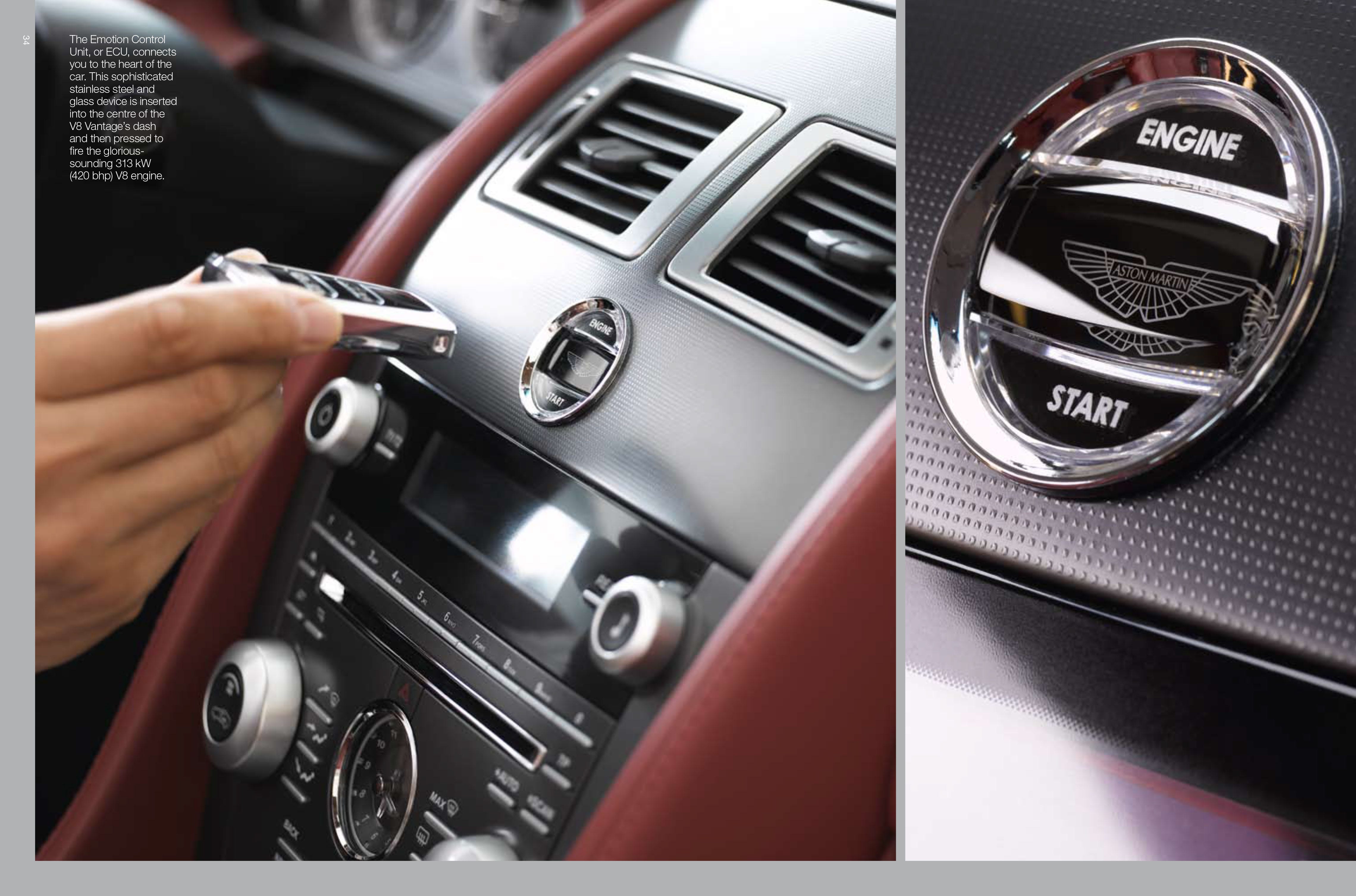
The Emotion Control Unit (the ECU, in Aston Martin’s deliberate act of acronym-squatting) earns a full spread. A hand is shown inserting a stainless steel and glass object into a docking station on the dashboard. The photography is intimate, almost surgical. The prose rises to the occasion: “This sophisticated stainless steel and glass device is inserted into the centre of the V8 Vantage’s dash and then pressed to fire the glorious-sounding 313 kW (420 bhp) V8 engine.”
The word “glorious-sounding” is doing considerable work in that sentence, embedded between two pieces of specification data as though the car’s voice were as measurable as its output. The ECU itself is described as being “designed to be as tactile and refined as a fine timepiece”. The key has been rebranded as a ritual object. This is the brochure’s most operatic claim: that the act of starting a car can be elevated into an event worth savouring. The Porsche 911’s key went into the left side of the steering column and turned. Here, the key is a glass and steel talisman you press into a socket, and it rises slowly back out when the engine stops, like a ceremonial sword being unsheathed.
The Red Interior
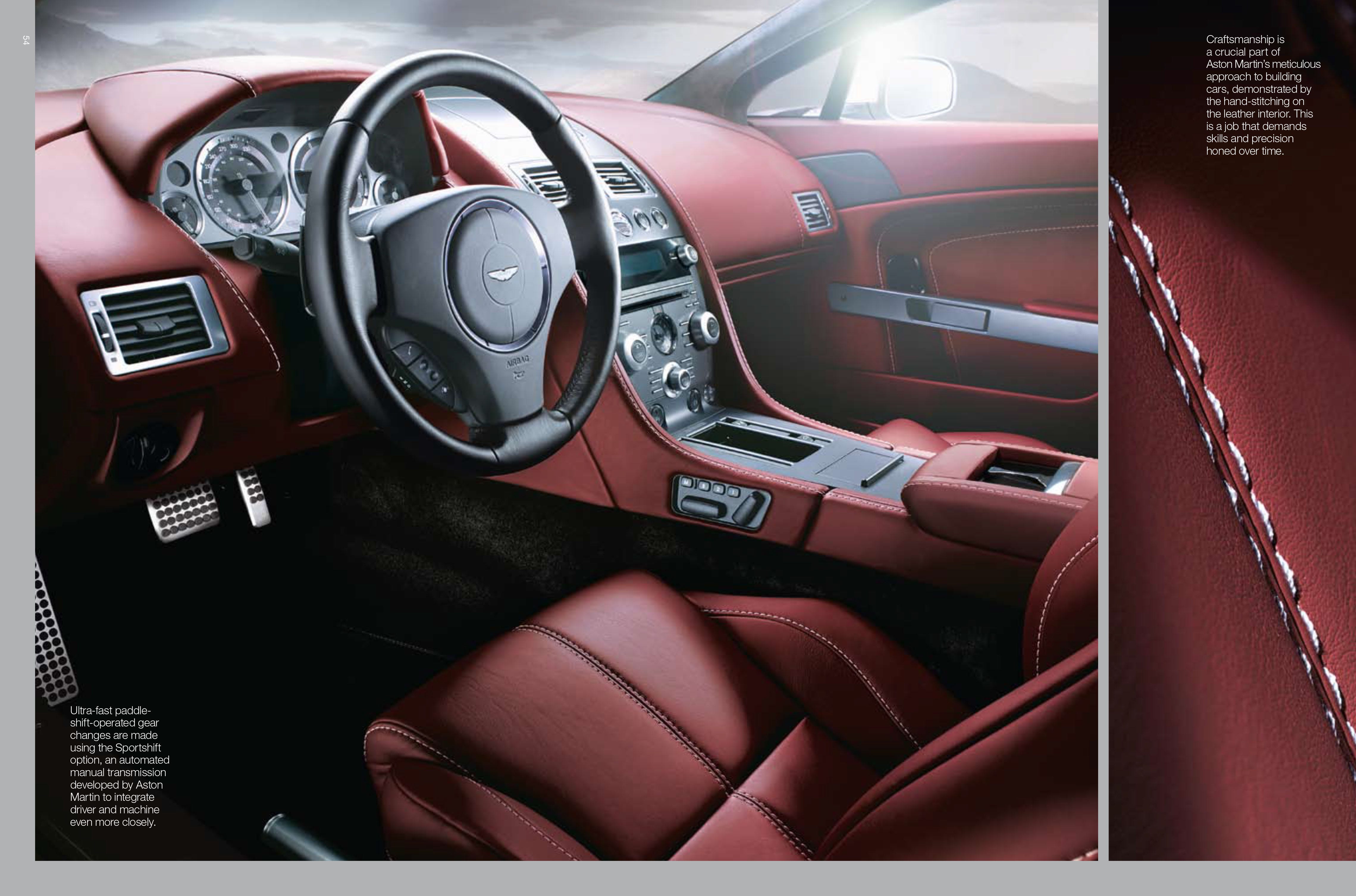
A double page in deep Magma Red leather with white stitching, the Sportshift cockpit photograph, marks the brochure’s most technically complex concession. “Ultra-fast paddle-shift operated gear changes are made using the Sportshift option, an automated manual transmission developed by Aston Martin to integrate driver and machine even more closely.”
The phrasing automated manual is carefully chosen. By 2008 the dual-clutch gearbox was already arriving from Volkswagen and Porsche, and the automated single-clutch sequential was acquiring a reputation for pedestrian behaviour in urban traffic. Aston Martin had staked its transmission future on this electro-hydraulic system, and the brochure defends the choice through omission: the complexity is celebrated (200-millisecond shifts, paddle operation, Auto Drive mode) while the mechanical nature of the clutch engagement, which would provide a generation of second-hand owners with expensive remedial bills, goes entirely unmentioned. The red leather is gorgeous. The brochure’s silence is eloquent.
Facing it, the hand-stitching detail: a close-up of the seaming on a leather surface, rendered almost as abstract photography. “This is a job that demands skills and precision honed over time.” The craftsmanship section is the brochure’s most insistent passage, returning throughout to the theme that machines cannot do what hands can do. “Machines can stitch leather, but they cannot do it with the same degree of care as experienced craftsmen.” This is a genuine argument, not marketing aspiration, and the brochure is wise enough not to oversell it. It states the position and moves on.
The Engineering Heart
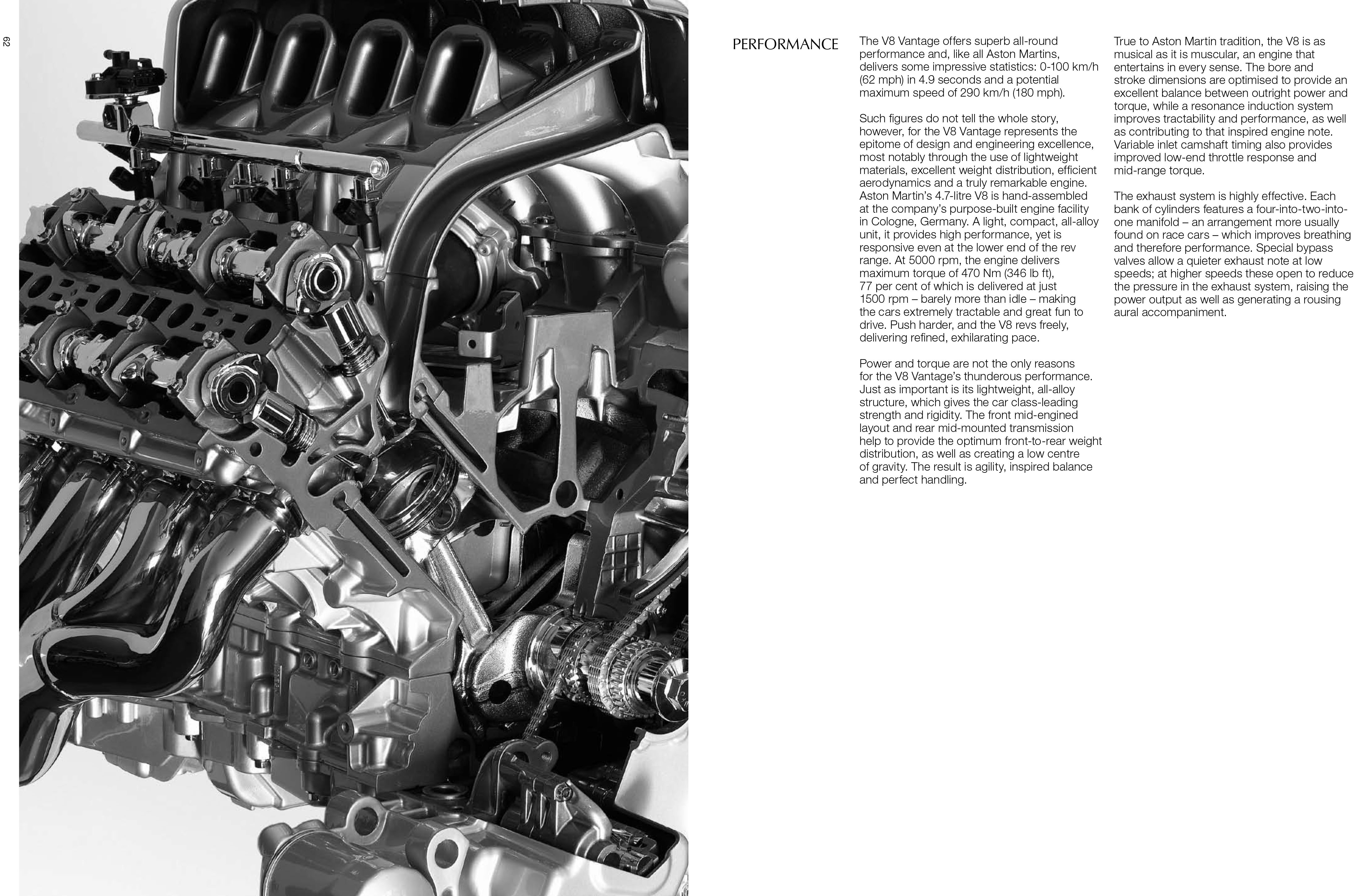
The engine photograph is rendered like an anatomical plate: a cutaway of the 4.7-litre V8, every component visible, photographed in high-contrast monochrome against white. The accompanying text offers the brochure’s most specific technical claim: “At 5000 rpm, the engine delivers maximum torque of 470 Nm (346 lb ft), 77 per cent of which is delivered at just 1500 rpm, barely more than idle, making the cars extremely tractable and great fun to drive.”
The phrase tractable and great fun is the only genuinely informal moment in the document, a brief lapse into human enthusiasm in a text otherwise committed to architectural calm. The 77 per cent figure is the brochure’s cleverest specification disclosure: it reframes the engine’s character entirely. This is not a car that demands to be wrung to its 7,300 rpm power peak. It is a car that responds from rest, that makes its power available like a promise kept in advance. Against the Porsche, whose flat-six demanded commitment to the upper registers, the Vantage’s V8 offers something different: an engine that communicates through music first, data second.
The Rearview Mirror
The Problem: Too Beautiful for Its Own Good
The V8 Vantage’s commercial life was shadowed by a label it could never entirely escape: the “baby Aston”. Relative to the DB9, it was entry-level. Relative to everything else on the road, it was extraordinary, but the luxury sports car market is not evaluated on its own terms, and buyers who stretched to the Vantage frequently did so for reasons the N24 race page would have found disappointing. The car’s genuine dynamic capabilities, the near-perfect weight distribution the brochure cites with justified confidence, the chassis balance that the Nürburgring programme honed, were under-explored by a significant portion of its ownership base. Many examples accumulated mileage that suggested their primary role was static display. The brochure sold a sports car as sculpture. It succeeded, at some cost to the sculpture’s intended function.
The Tax: Glass Keys, Tired Clutches, and Slow Oil Seeps
The Emotion Control Unit proved considerably less eternal than a fine timepiece. The glass key is notoriously fragile, expensive to source and, in the secondary market, frequently missing or cracked: a poetic failure for an object whose entire purpose was to elevate the start procedure into ceremony. Second-hand buyers discovered that the Sportshift transmission rewards a specific engagement style; deviate from it in urban traffic and the single clutch wears prematurely, with replacement costs that bear no relation to the car’s depreciated value. The 4.7-litre engine, celebrated correctly for its hand-assembly and Cologne provenance, developed a reputation for slow oil seepage from the front timing cover, a repair that requires disassembly of the engine’s forward architecture and a bill to match. None of this is the brochure’s responsibility. All of it is the ownership reality the brochure, by its nature, cannot discuss.
The Success: The Architecture That Built a Decade
Here is the thing the sales figures and the running costs cannot obscure: the 2008 4.7-litre V8 Vantage is now understood, with the clarity that hindsight provides, as the high-water mark of a specific era of Aston Martin design. The VH (Vertical Horizontal) platform architecture that the brochure’s Control section describes with such precision, the bonded aluminium structure, the front mid-engine placement, the rear mid-mounted transmission, the carbon-fibre propeller shaft, underpinned nearly every Aston Martin product for over a decade. The DBS, the Virage, the Vanquish, the Rapide: all variants of the same spine. What the 2008 Vantage brochure was documenting, without knowing it, was the foundation that would carry the company from the Ford era through the Kuwaiti Investment Authority years and into the modern period.
The 4.7-litre engine itself is now considered the Goldilocks unit: not the original 4.3’s relative softness, not the turbocharged Mercedes-AMG four-litre that replaced the V8 family entirely, but the analogue Aston Martin engine at its peak expression, naturally aspirated, hand-built in Cologne, tuneful from idle and spectacular at the top. In the secondary market, the 4.7-litre cars command a premium over the 4.3-litre models they superseded, and values across the range have hardened as the window has closed on this specific combination of platform, engine and character.
The brochure’s central claim, that the car is a work of art, was received as aspiration in 2008 and has become, in the intervening years, something closer to assessment. The car’s silhouette, underpinned by Henrik Fisker’s design before he departed for other ventures, has not dated. Shot on volcanic black rock against an overcast Icelandic sky, it still looks like what the brochure always claimed it was: a sculpture that happens to contain a glorious-sounding V8 engine.
The Fine Print