
The Paddock-Noir Sessions: Audi B7 RS 4 (2006)
When Audi Ditched the Turbo and Found Its Soul

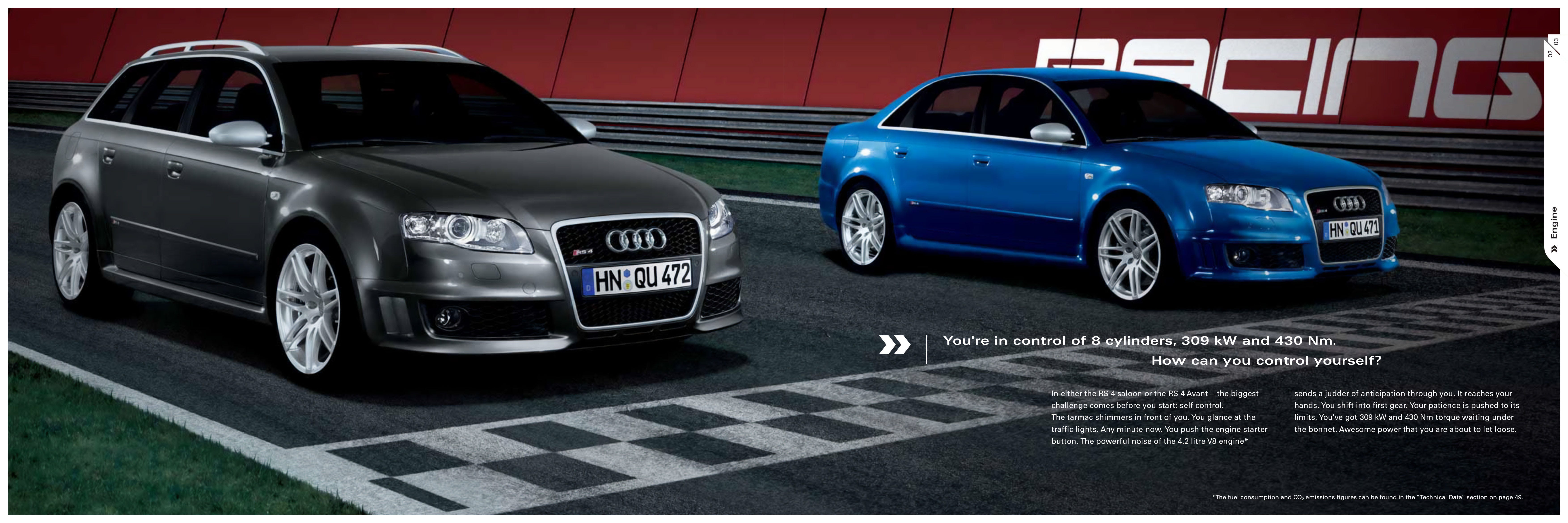
There are cars that redefine a segment, and then there are cars that redefine a manufacturer. The 2006 Audi RS 4 is the latter. For over a decade, the RS badge had meant turbocharged torque and quattro grip: a blunt instrument for overtaking on wet autobahns. But the B7 RS 4 represented something different: a philosophical pivot from turbocharged grunt to a high-revving, naturally aspirated scream. This was an 8,250rpm redline in an executive saloon, engineered for daily use rather than racing duty.
The impossible thing? Audi took a high-revving, naturally aspirated V8 philosophy (where an 8,250rpm redline requires meticulous engineering and constant attention) and fitted it into an executive saloon, or estate, that could collect the children from school. This was not a GT-R or an M3. This was a 420bhp V8 hidden inside a body so visually restrained that only the aluminium door mirrors and quad exhausts gave the game away. The brochure understood this tension perfectly. It didn’t sell a car. It sold a track day.
Paddock-Noir: The Art of the Night Session
The 2006 RS 4 brochure is not a sales document. It is a technical dossier disguised as a professional track outing. Fifty-two pages of dark, moody photography lit like a late-night DTM garage session, where mechanics speak in whispers and telemetry data scrolls across laptop screens. The typography is modern, clean sans-serif punctuated by red “start/stop” iconography and tracking lines that guide the eye like pit lane markers.
The palette is restrained to the point of severity: deep blacks, charcoal greys, and only two bursts of colour: the Sprint Blue car and the red of the racetrack. This is Paddock-Noir: the clinical, high-stakes atmosphere of a professional racing environment where every component is calibrated, every system is monitored, and nothing is left to chance.
Paddock-Noir is designed to make you feel like an interloper. You are not the customer; you are the privileged observer granted access to a world where lap times are measured in hundredths and brake temperatures are discussed with the seriousness of blood pressure readings.
The Course Map: Six Sectors of Dominance

Page 1 opens with a revelation: a 3D rendering of a racetrack labeled simply “The Audi RS 4 on the racetrack.” The circuit is divided into six technical challenges, each corresponding to a vehicle system: Engine, Brakes, quattro, Safety, Dynamic Ride Control, and Design. This is not metaphor; this is methodology. The brochure treats the car as a racing program broken into subsystems, each optimised for a specific corner of performance.
This layout is a masterclass in framing. By structuring the entire document as a track session, Audi transformed technical specifications into racing strategy. You don’t read about the engine; you drive down the start-finish straight (The Engine Sector), where revs and response are the only metrics that matter.
The Start-Finish Straight: The High-Rev Manifesto
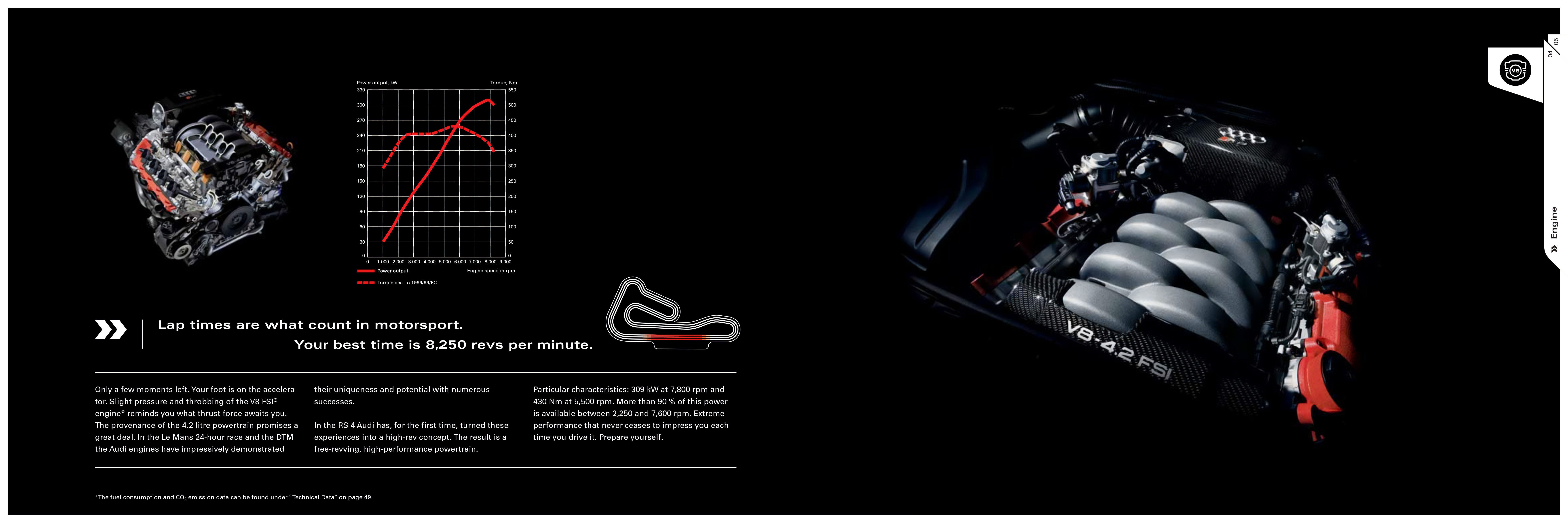
Page 4 introduces the 4.2-litre V8 FSI with the kind of reverence usually reserved for religious texts. A cutaway drawing of the engine dominates the spread, accompanied by power and torque curves that peak at 7,800rpm: a figure so alien to mid-2000s executive cars that it required explanation.
“In the RS 4 Audi has, for the first time, turned these experiences into a high-rev concept.”
Note the language: high-rev concept. Not just a high-revving engine, but a concept (a philosophy). The brochure is selling 8,250rpm not as a number but as a spiritual best-time, a devotion to the upper reaches of the tachometer where lesser engines wheeze and rattle. The FSI direct injection system is presented as “instantaneous” response, a word borrowed from fighter-jet throttle inputs. This was Audi applying lessons learned from FSI technology in motorsport to create a production V8 that thrived at the top of its rev range, and the brochure knew that such ambition required a new vocabulary.
Ninety percent of the engine’s 317lb ft torque arrives at just 2,250rpm, but the brochure barely acknowledges this. Low-end grunt is pedestrian. What matters is the 420bhp plateau that stretches from 7,800rpm to the redline, a power band so wide and sustained that it feels less like an internal combustion engine and more like an electric motor’s instantaneous delivery. This is the first clue that Audi was not building a traditional performance car; it was building a racing car with number plates.
Turn One: The 18-Inch Brake Study
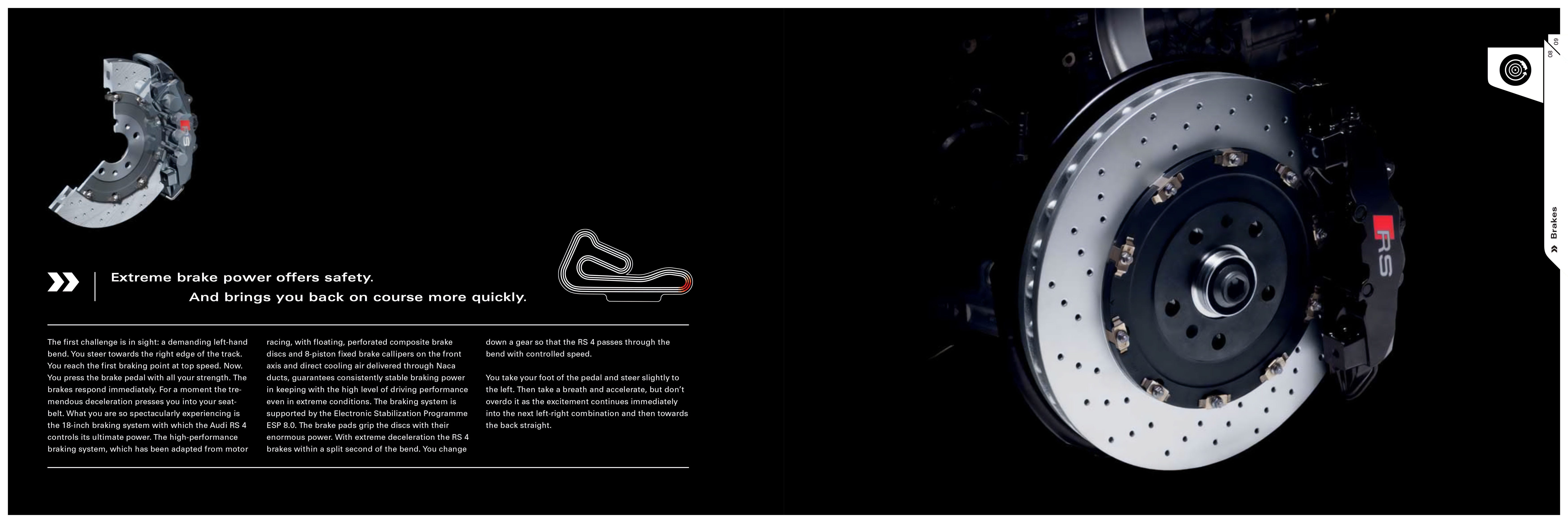
Page 8 is a technical meditation on thermal management. Macro photography captures the perforated composite brake discs (18 inches at the front, drilled and ventilated) under lighting that makes them look like industrial sculpture. The accompanying text does not simply describe brakes; it describes a system.
“8-piston fixed brake callipers on the front axle and direct cooling air delivered through Naca ducts... guarantees consistently stable braking power.”
Naca ducts. This is aeronautical terminology: National Advisory Committee for Aeronautics, the precursor to NASA. Audi is telling you that the RS 4’s brake cooling system uses aviation-grade aerodynamics to manage the thermal load of repeated 150-to-30 mph decelerations. The brochure doesn’t say “the brakes are good.” It says “we borrowed technology from aircraft design to ensure these brakes do not fade after the fifteenth consecutive full-threshold stop.”
This is Paddock-Noir at its most effective: the brochure assumes you understand why this matters. If you don’t, you’re probably looking at the wrong car.
Turn Two: The Quattro Equilibrium
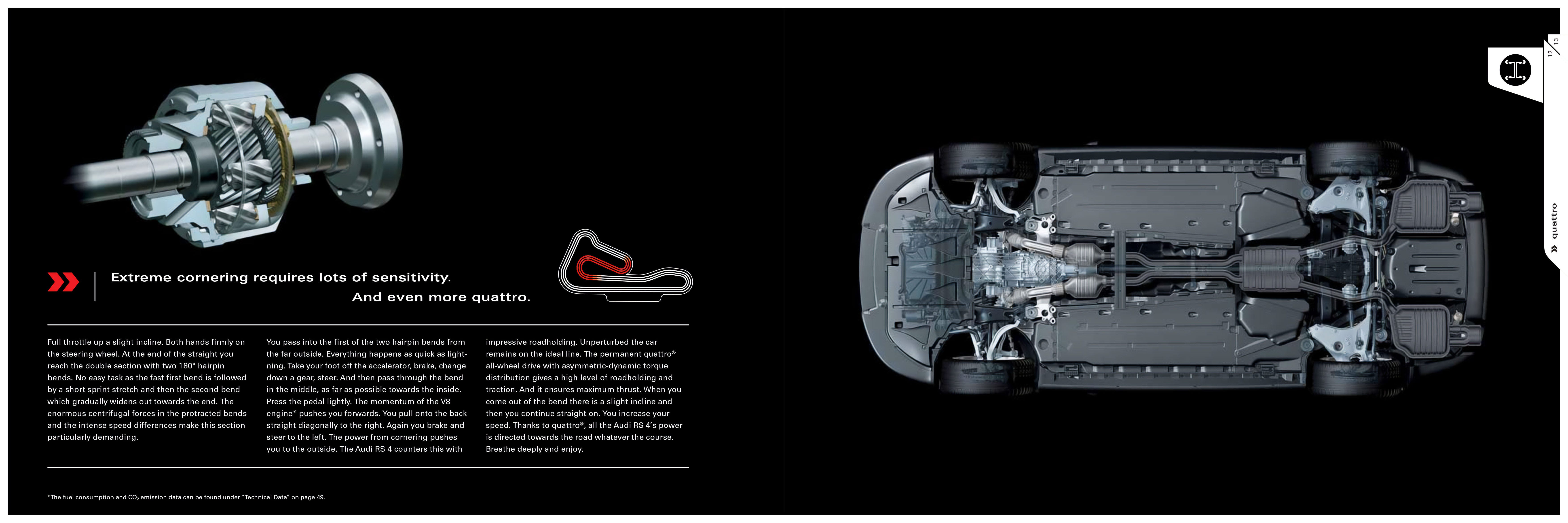
Page 12 shifts focus from longitudinal forces to lateral physics. An underbody technical study exposes the quattro driveline in cross-section, revealing the asymmetric-dynamic torque distribution that underpins the RS 4’s “unflappable” character. The illustration is rendered with surgical precision: centre differential, propshafts, crown gears, all labelled like anatomical structures.
“The permanent quattro all-wheel drive with asymmetric-dynamic torque distribution gives a high level of roadholding and traction.”
Asymmetric-dynamic. Two words that transform all-wheel drive from a traction aid into a philosophy. The system defaults to a 40:60 front-to-rear torque split, deliberately rear-biased to encourage rotation, rather than the nose-led understeer that plagued earlier RS models. The Torsen centre differential can shift torque in a 4:1 ratio, meaning up to 80 percent can flow to either axle depending on grip levels. This is not stability for stability’s sake; this is asymmetry engineered to find the ideal line through a corner.
The brochure is selling physics as product. The “high level of roadholding” isn’t just marketing speak, it’s a promise that the car will remain planted when lesser machines would be skating toward the armco. The quattro system is framed as the mechanical foundation that allows the driver to exploit the full 420bhp without drama, without hesitation, without fear. It is the confidence that transforms an ambitious corner entry into a clean exit.
Turn Three: The Hydraulic Hand

Page 18 introduces Dynamic Ride Control (DRC), Audi’s hydraulic suspension system that cross-links diagonal corners of the chassis to eliminate body roll. A chassis X-ray diagram explains the system with the clarity of a medical textbook: diagonal oil channels, pressure-sensitive valves, continuous real-time adjustment.
“The result is roll-free handling.”
Roll-free. Not reduced roll, not minimal roll, but roll-free. This is the language of absolutes, the kind of claim that only makes sense if you’ve watched an RS 4 carve through a fast chicane at Hockenheim with the body attitude of a kart. The brochure positions the DRC system as an active, intelligent participant in finding the ideal line, a mechanical co-driver that anticipates weight transfer and compensates before the driver even feels the nose push wide.
The problem, of course, is that hydraulic brilliance in 2006 becomes hydraulic liability in 2026. But the brochure doesn’t care about 2026. It cares about Turn Three.
Turn Four: The Cockpit Command
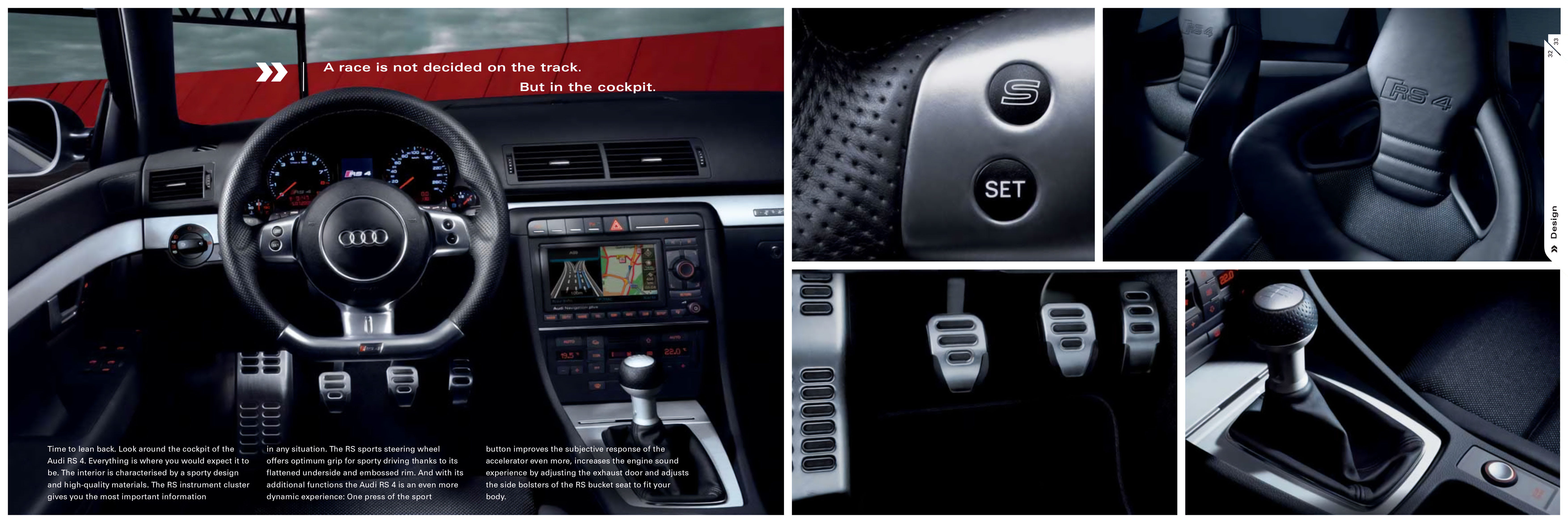
Page 32 shifts from chassis dynamics to driver interface. The images are simple: RS bucket seats with integrated headrests, a flat-bottom steering wheel wrapped in perforated leather, and a single button marked “S” on the centre console. The copy is equally economical.
“A race is not decided on the track. But in the cockpit.”
This line deserves attention. It positions the driver not as a passenger in a fast car but as the decision-maker in a precision instrument. The “S” button (Sport mode) is not a throttle map gimmick. It sharpens engine response, firms the DRC damping, and adjusts the seat bolster pneumatics to increase lateral support. The brochure frames this as a subjective enhancer, a tool for dialling in the car’s personality to match the driver’s commitment level.
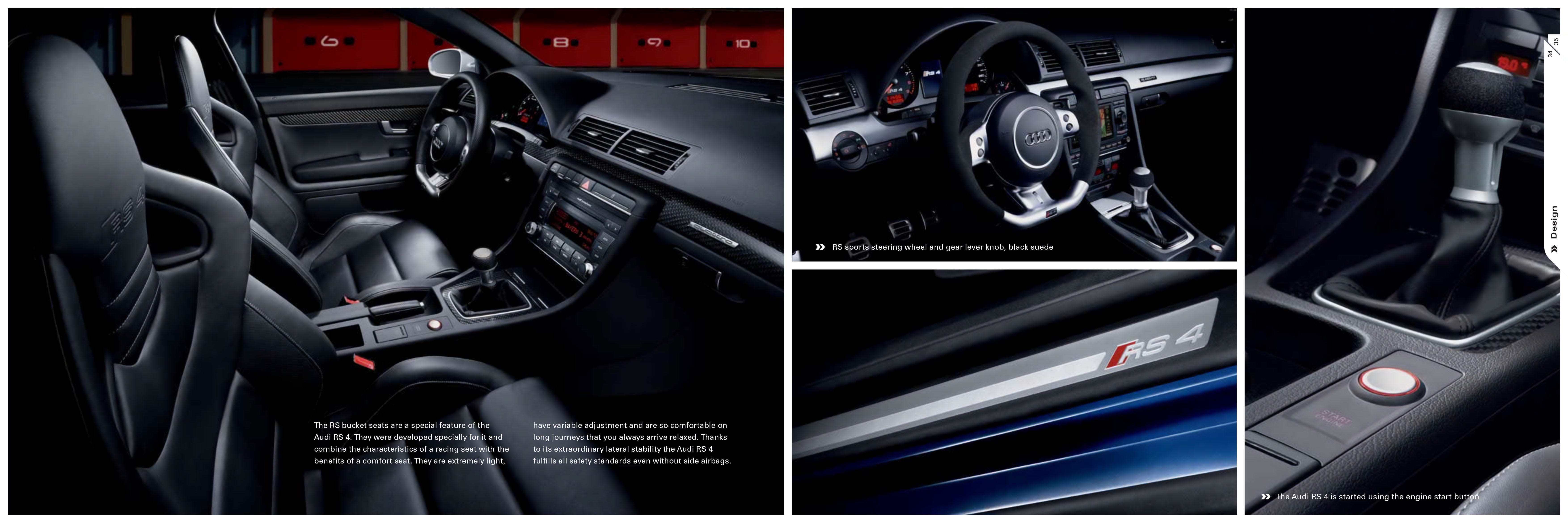
The seats themselves are described with the precision of orthopaedic equipment: pneumatic lumbar support, extendable thigh cushions, electric side bolster adjustment. This is not luxury; this is fitting. The RS 4 cockpit is designed to hold you in place through sustained lateral g-forces, and the brochure treats this as non-negotiable.
Turn Five: The Ceramic Option
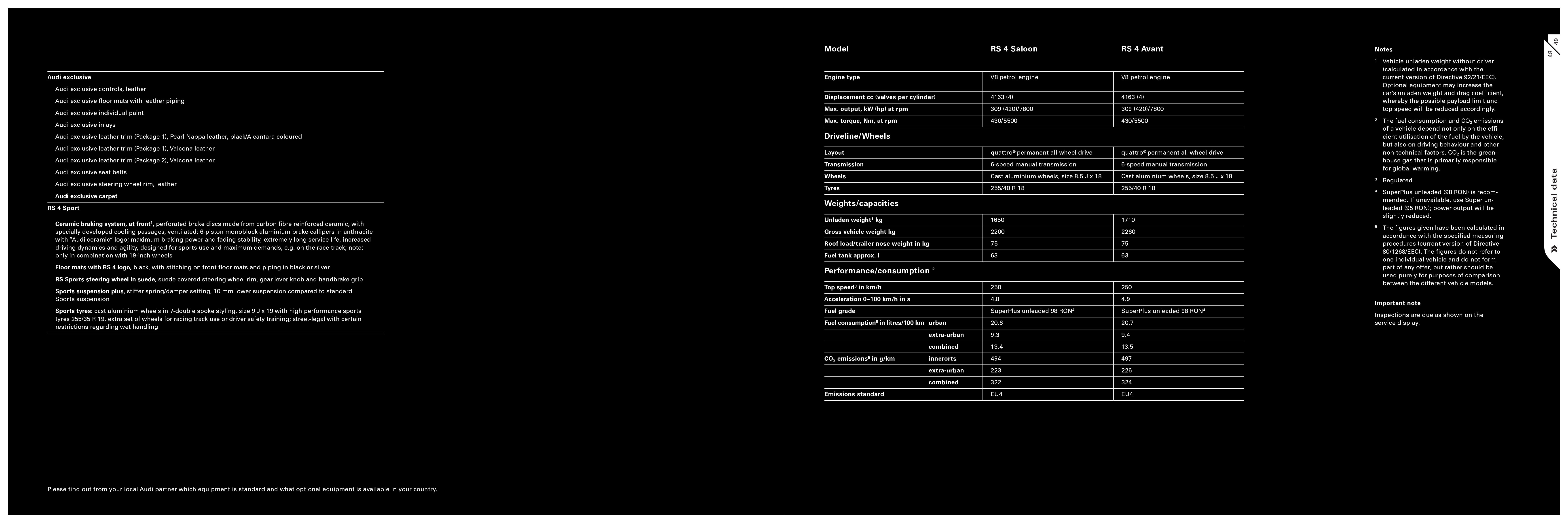
Page 48 introduces the RS 4’s ultimate track-day equipment: optional carbon-ceramic brake discs. The copy is brief but loaded.
“6-piston monoblock aluminium brake callipers in anthracite with ‘Audi ceramic’ logo... designed for sports use and maximum demands.”
Maximum demands. This is the only place in the brochure where Audi openly acknowledges that the standard 18-inch steel discs might not be enough. Ceramic brakes are presented as the bridge between street-legal car and racing training tool, the component that separates weekend track tourists from serious lap-time chasers. The brochure doesn’t specify cost or weight savings; it simply states that these exist for those who need them. If you have to ask why, you don’t need them.
The Rearview Mirror
The Sensitive Specialist: When Precision Becomes Fragility
The B7 RS 4 was a commercial success. It proved Audi could compete on handling dynamics, not just straight-line traction. But its engineering was high-strung in ways the brochure politely declined to mention. The Dynamic Ride Control system (so brilliantly “roll-free” on Page 18) became a common failure point as hydraulic lines corroded under road salt and neglect. Today, some owners have abandoned the system entirely, converting to traditional coilover setups that lack the DRC’s brilliance, but also lack its fragility.
The FSI direct injection system, celebrated for its “instantaneous” throttle response, introduced carbon buildup on intake valves: a problem Audi’s engineers didn’t fully anticipate. Maintaining all 420 horses requires periodic walnut-blasting or manual cleaning, a ritual that becomes expensive if ignored. The high-rev concept demanded high-maintenance commitment.
This was not a car that aged gracefully through benign neglect. The RS 4 required attention, expertise, and a willingness to pay specialist labour rates. It was a sensitive specialist masquerading as a daily driver.

The Ownership Tax: Keeping the Heart Alive
Parts availability has become the second tax. The 8-piston Brembo-derived callipers and unique RS body panels command a premium in the 2026 secondhand market. Replacement DRC hydraulic lines, when available, cost four figures. The carbon-ceramic brake option (so tantalisingly presented on page 27) now costs more to replace than many used RS 4s are worth.
Depreciation has been kind in recent years, as the B7 RS 4’s status as the analogue peak has driven collector interest. But the steep maintenance curve means that cheap examples are often neglected examples, and neglected examples are money pits. The brochure’s Paddock-Noir fantasy assumed access to a professional workshop. In 2026, that workshop books months in advance and charges accordingly.
The Manual Farewell: When Three Pedals Mattered
Here is what the brochure couldn’t know: the B7 RS 4 would be the only RS 4 generation to feature a naturally aspirated V8 paired with a six-speed manual transmission. The B8 generation (2012-2015) carried the same 4.2-litre naturally aspirated V8 forward, uprated to 450bhp and still screaming to 8,250rpm, but paired it with a seven-speed dual-clutch transmission. The manual was gone. The B9 generation that followed brought forced induction, a twin-turbo 2.9-litre V6, and the complete elimination of the high-rev naturally aspirated concept. It was faster, more capable, and utterly soulless by comparison.
The 4.2 V8’s heart lived on in the first-generation R8 supercar, where it finally received the chassis and badge it deserved. But for many collectors, the B7 RS 4 remains the ultimate sleeper: a track-bred racing engine hidden inside a subtle executive saloon or estate that could carry four adults and their luggage to the Nürbring for a weekend without drama.
The “high-rev concept” proved to be a peak moment: a brief window where motorsport engineering hadn’t yet been filtered through emissions regulations, turbocharger efficiency mandates, and corporate safety metrics. The naturally aspirated V8 survived one more generation in the B8 RS 4, but the manual transmission did not. The brochure’s six-sector racetrack was not a metaphor. It was a snapshot of a philosophy that would be gradually regulated and automated out of existence.
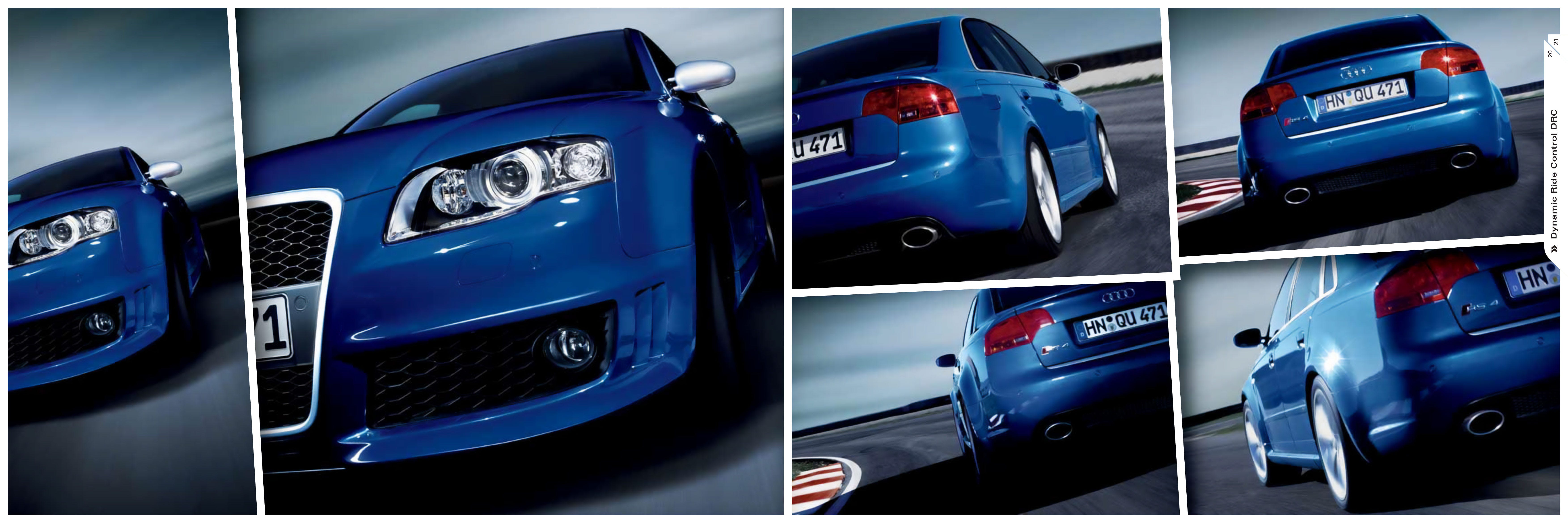
Somewhere, on a damp track day, a Sprint Blue B7 RS 4 Saloon is screaming towards 8,250rpm with the DRC system still functioning, the engine still pulling cleanly, and the driver realising they are piloting the last manual, naturally aspirated RS 4 that will ever be built.
The brochure declared: “In the RS 4 Audi has, for the first time, turned these experiences into a high-rev concept.”
It didn’t say “for the last time.”
But it should have.