The Master of Understatement: BMW’s Last Hand-Built M5
When BMW took great care to make an M5 that nobody would notice

The cover of the 1992 BMW E34 M5 brochure is a cropped, angled shot of the car’s front corner, framed so tightly you can barely read the badge. No performance claims. No engine statistics. Just four words at the top, discreetly announcing: THE NEW BMW M5.
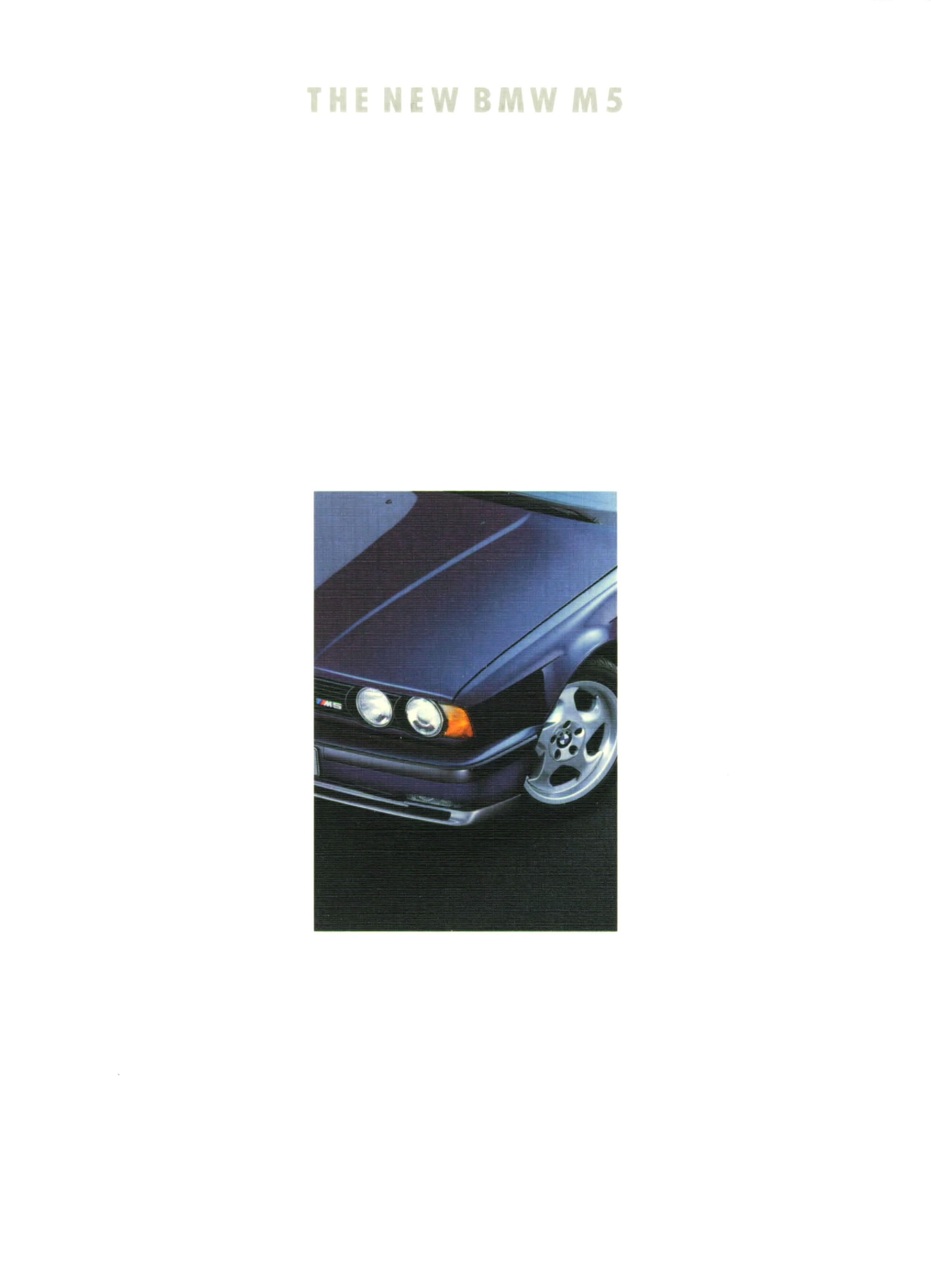
Going into 1992, BMW Motorsport GmbH had been regularly winning major performance saloon awards and this is how they chose to announce the car that replaced their winner. Quietly, and without apparent concern for whether you noticed.
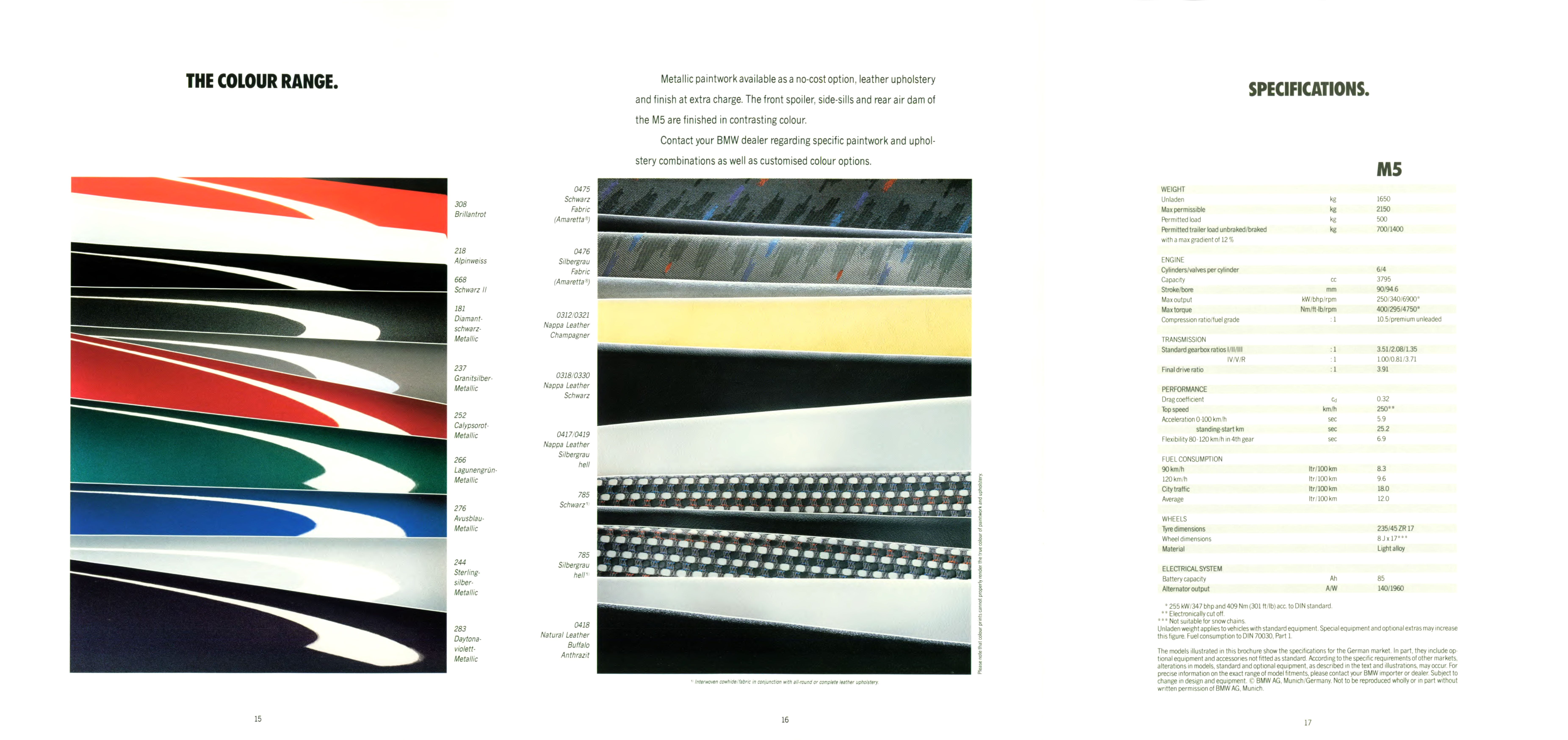
The aesthetic of the brochure is that of an engineering report that has been given a photographer. Dyno charts appear with hatching marks as if lifted from a technical journal. The cutaway of the all-metal catalytic converter sits beside an engine block photograph lit with the cold evenness of a forensic exhibit. The prose is structured not around desire but around a task list: “Task 1. Task 2. Task 3. Task 4.” Because BMW Motorsport’s engineers are not selling you a car. They are presenting their findings.
Physically, the brochure is dense in the way that competent engineering is dense: every element load-bearing, nothing decorative. The typography is a workhorse sans-serif in the headers, dropping to tight, justified body text for the technical passages. The colour palette is established entirely by the cars photographed: deep Avusblau and Daytonaviolett against grey asphalt and pale skies, with the tricolour M stripe providing the only ornamental colour in the entire document. There is no lifestyle photography, no aspirational settings. The car is shown at speed on the Nürburgring, in a workshop where a gloved hand checks the sheet metal, and on a gravel apron against mountains that look geological rather than scenic. The backgrounds are chosen not to sell a feeling but to confirm a fact: this thing operates in extreme environments, and it is comfortable there.
Making the Best Even Better
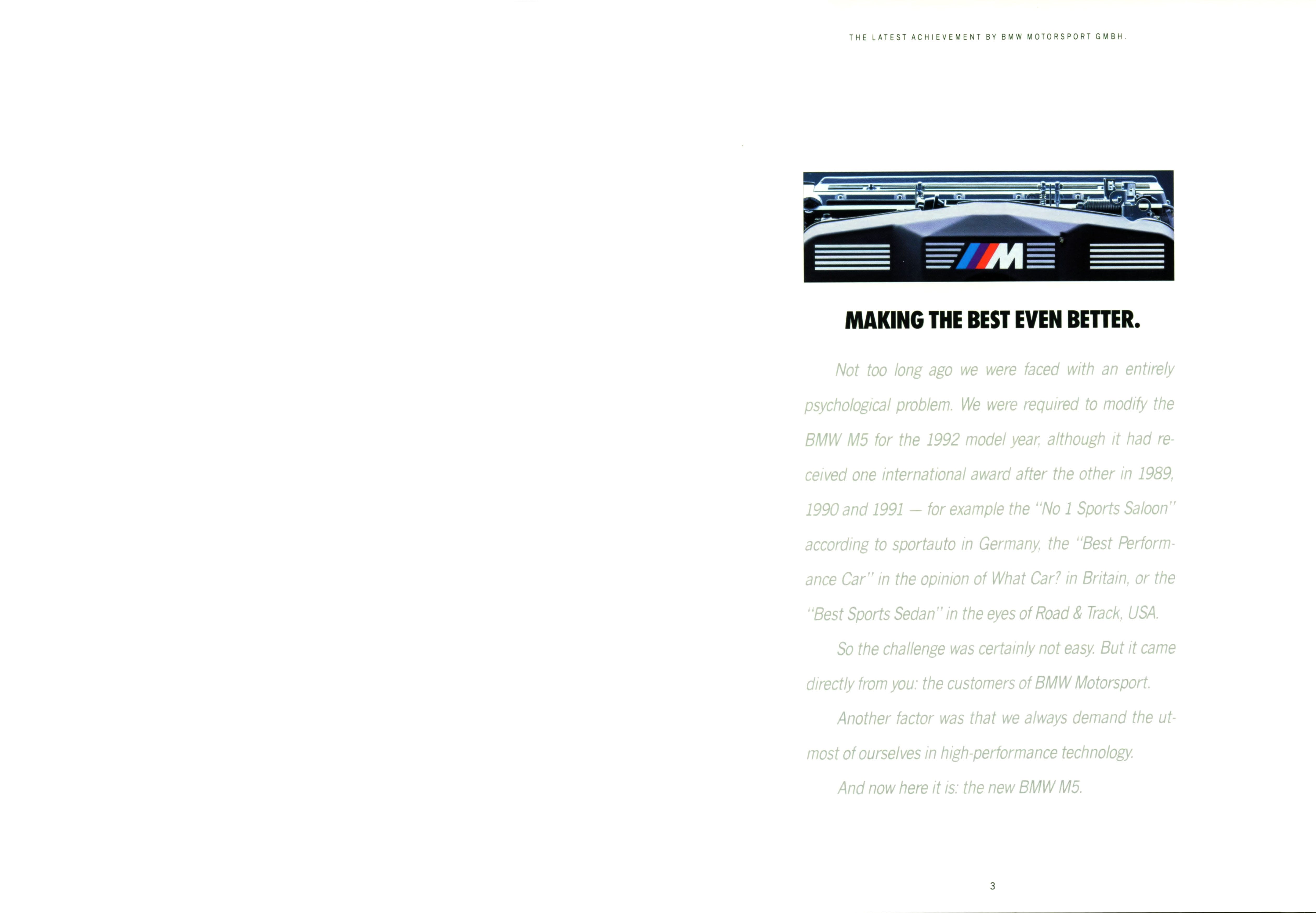
The brochure opens with an admission that reads, on first encounter, like false modesty, and on second reading, like something close to arrogance. BMW Motorsport GmbH, it acknowledges, faced “an entirely psychological problem”. The 1991 M5 had swept international awards: Germany, Britain, America. The car had won everything available to it. The “challenge was certainly not easy”.
What follows is the pivot. The challenge, they note, came “directly from you: the customers of BMW Motorsport”. This is a deft piece of corporate judo. Coming from a lesser manufacturer, this would be marketing language, the pretence that customer feedback drives engineering decisions.
Here it reads differently. BMW Motorsport’s customers in 1992 were not civilians. They were people who had chosen, over the 500E and the Lotus Carlton, a hand-built saloon with an engine derived from a mid-engined racing car. They were, in the specific and demanding sense, enthusiasts. Asking them what the car should do next was, in fact, a reasonable engineering brief.
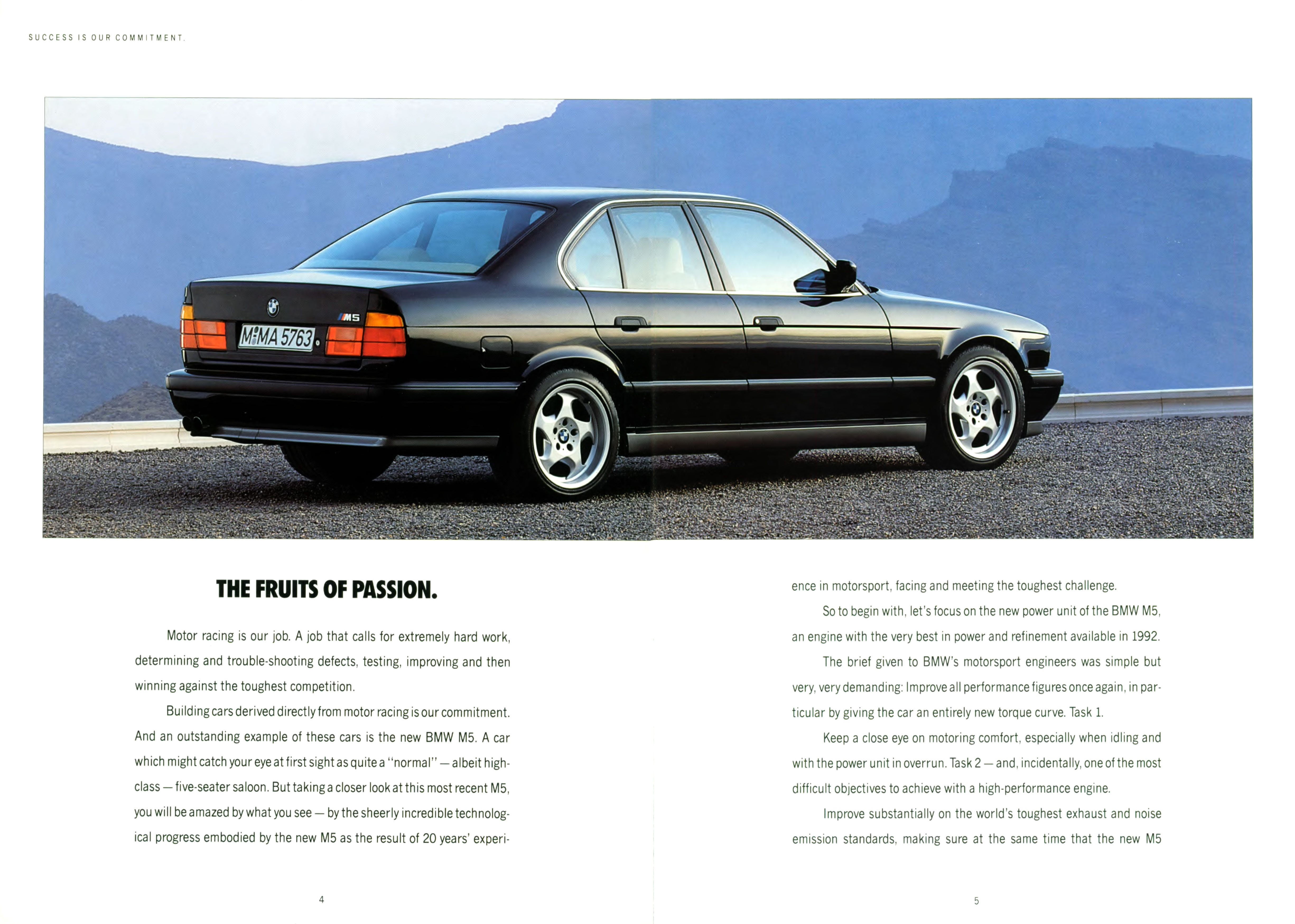
Pages four and five establish the central paradox that the rest of the brochure works to resolve. The M5, it states plainly, “might catch your eye at first sight as quite a ‘normal’ albeit high-class five-seater saloon”. But closer examination reveals “sheerly incredible technological progress embodied by the new M5 as the result of 20 years’ experience in motorsport”.
The brochure is telling you, directly, that the car is a sleeper. It is wearing a disguise. The 518i on the school run does not know that its neighbour is hiding 340bhp and M1 supercar DNA.
The engineers’ brief is then laid out in sequence, numbered like a project specification, which is exactly what it is. Improve the torque curve. Maintain comfort at idle and on overrun (described, with admirable understatement, as “one of the most difficult objectives to achieve with a high-performance engine”). Meet the world’s toughest emissions standards. Retain the turbine smoothness. Four tasks. They will return to tick each one off.
M Power in Its Latest Form
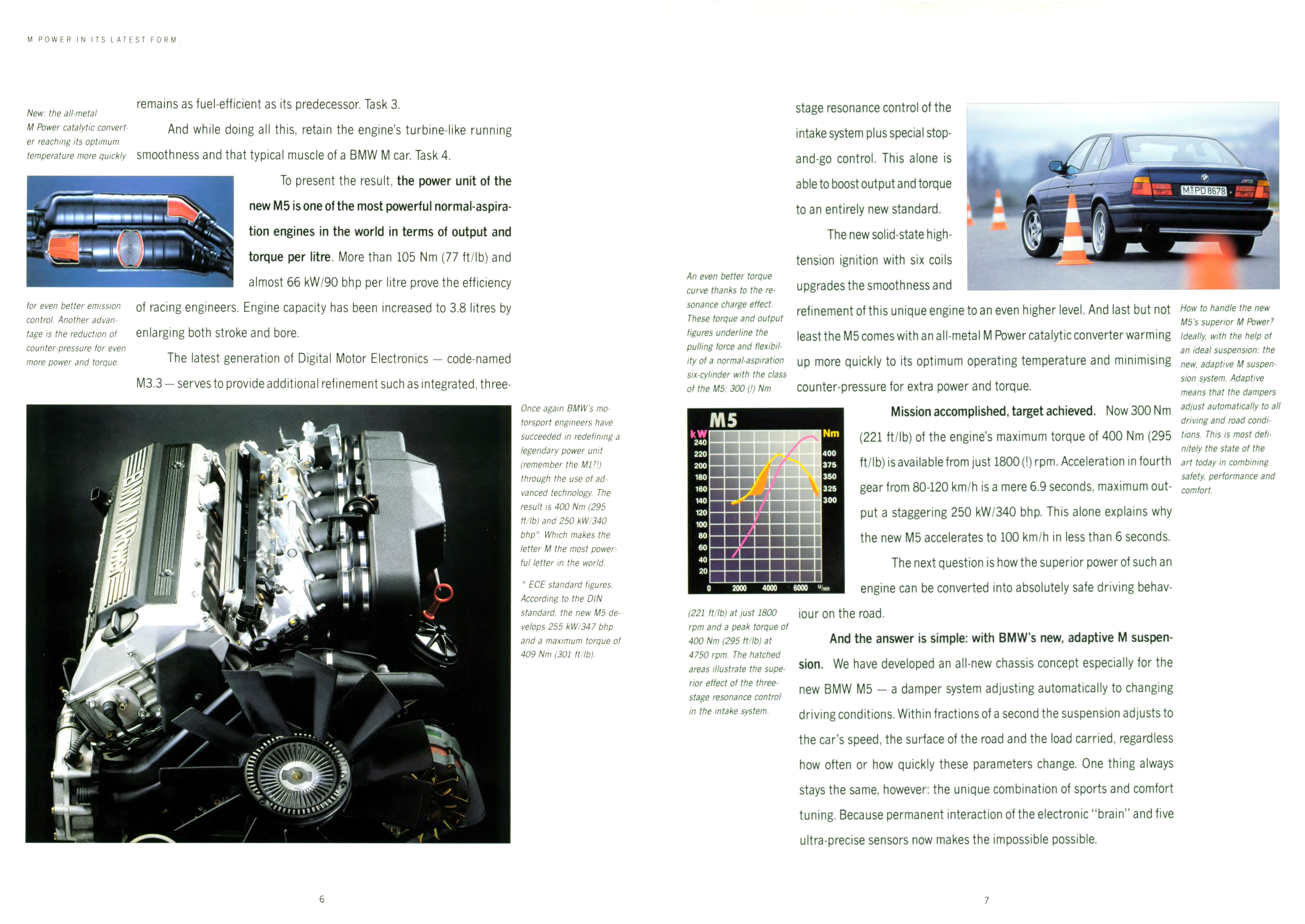
The S38B38 engine fills the lower half of the page in a photograph lit with the devotion usually reserved for Old Masters. Above it, the new all-metal M Power catalytic converter sits in a smaller inset, rendered in cross-section, its monolithic arrangement annotated with marginal text that explains it reaches operating temperature faster than its ceramic predecessor while reducing counter-pressure for additional power and torque.
The claim that follows is stated with the matter-of-fact tone of someone reading a measurement off a gauge: the new M5’s power unit is “one of the most powerful normal-aspiration engines in the world in terms of output and torque per litre”. The supporting numbers are provided immediately. More than 105Nm (77lb ft) and almost 66kW (90bhp) per litre. Capacity increased to 3.8 litres by enlarging both stroke and bore simultaneously, a solution requiring the block to be essentially re-engineered from its 3.5-litre predecessor. The Digital Motor Electronics system, designated M3.3, receives a brief paragraph noting its integrated three-stage resonance control and special stop-and-go function.
And then the note in the main image’s caption that turns the page from a technical specification into a cultural statement. BMW’s motorsport engineers have, it reads, “succeeded in redefining a legendary power unit (remember the M1?!) through the use of advanced technology. The result is 400 Nm (295lb ft) and 250 kW/340 bhp. Which makes the letter M the most powerful letter in the world.”
The parenthetical exclamation mark after “remember the M1” is, in context, doing significant work. It is the only moment of overt sentiment in the entire document. The M1 was BMW’s mid-engined supercar of 1978, designed as a racing homologation special that became, unexpectedly, the car that established the M brand’s identity. The S38 engine in the 1992 M5 is the direct descendant of that car’s M88 unit. The brochure knows this. It is making sure you know it too. The lineage is the argument.
The Resonance Charge Effect
Page seven is anchored by a dyno graph, the kW and Nm curves plotted against rpm on a grid with hatched areas shaded to illustrate the efficiency gain from the three-stage resonance control in the intake system. This is a graph from an engineering report. It has been reproduced, without apology or softening, in a consumer sales brochure.
The text around it explains the operating principle with the kind of clarity that reveals genuine understanding rather than communications management. The three-stage resonance control of the intake system, combined with special stop-and-go control, is able, it states, to boost output and torque “to an entirely new standard”. The solid-state high-tension ignition with six individual coils upgrades refinement further. The all-metal catalytic converter minimises counter-pressure for additional power.
“Mission accomplished, target achieved.”
The prose shifts from technical explanation to something approaching triumph. The four tasks from the brief have been completed. And the number that matters, the number that explains why this engine was considered extraordinary even against contemporary V8s producing their torque through cubic inches rather than engineering, arrives without fanfare: 300Nm available from 1,800rpm. The peak figure of 400Nm arrives at 4,750rpm. The hatched areas on the dyno chart show the spread. This is not a peaky, high-revving race unit with a narrow power band. This is a six-cylinder that can pull hard from walking pace and continue pulling to nearly 7,000rpm. The argument against the Mercedes 500E’s V8 is made entirely in engineering terms. The M5 doesn’t need more cylinders. It has better physics.
The brochure then pivots, cleanly, to the question of chassis. “The next question is how the superior power of such an engine can be converted into absolutely safe driving behaviour on the road.”
The Nürburgring Effect
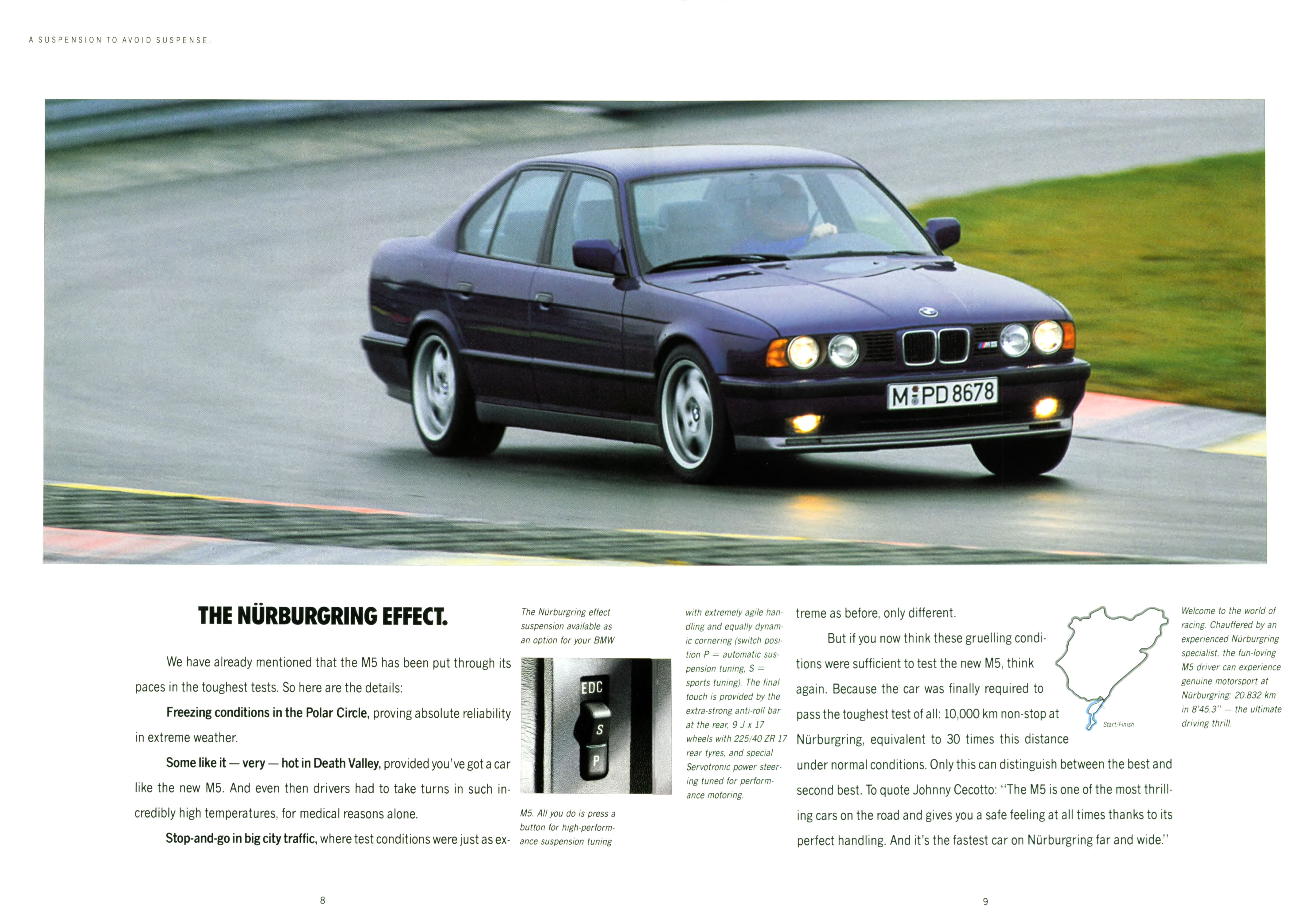
Pages eight and nine operate as the brochure’s proof of durability. The prose takes the reader through the development testing programme in the tone of a scientific report: arctic temperatures at the Polar Circle for extreme cold testing; Death Valley for extreme heat (drivers taking turns “for medical reasons alone” in the cockpit temperatures, which is the kind of detail that communicates engineering seriousness more effectively than any statistics); stop-and-go testing in major city traffic. But all of these, the text notes, were precursors to what it calls “the toughest test of all.”
10,000 kilometres, non-stop, on the Nürburgring Nordschleife. The brochure states it plainly. The figure is then contextualised: this is equivalent to thirty times the same distance under normal road conditions. The Nordschleife’s surfaces, gradients, compressions and camber changes are the equivalent of sustained punishment that road use cannot replicate. The M5 completed it.
A small circuit map appears beside the text, the Nordschleife’s 20.832-kilometre outline reproduced as a thin line. It functions as a kind of certification mark. The brochure does not dwell on this. It states the test, states the result, and moves on.
The brochure also introduces the adaptive M suspension. The Electronic Damper Control system adjusts within fractions of a second to speed, road surface and load. Three modes, mapped to a small rocker switch photographed in the margin: P for automatic, S for sport. The sidebar note is precise about what adaptive suspension means: “the dampers adjust automatically to all driving and road conditions. This is most definitely the state of the art in combining safety, performance and comfort.” State of the art. In 1992, this was a reasonable claim.
A quote from BMW touring car driver Johnny Cecotto arrives in the final paragraph of page nine, and it is the only testimonial in the entire document. Cecotto calls the M5 “one of the most thrilling cars on the road” and confirms it gives “a safe feeling at all times thanks to its perfect handling”. He adds that it is “the fastest car on Nürburgring far and wide”. This is not a celebrity endorsement. The brochure is using a professional’s assessment as additional data.
The Human Element
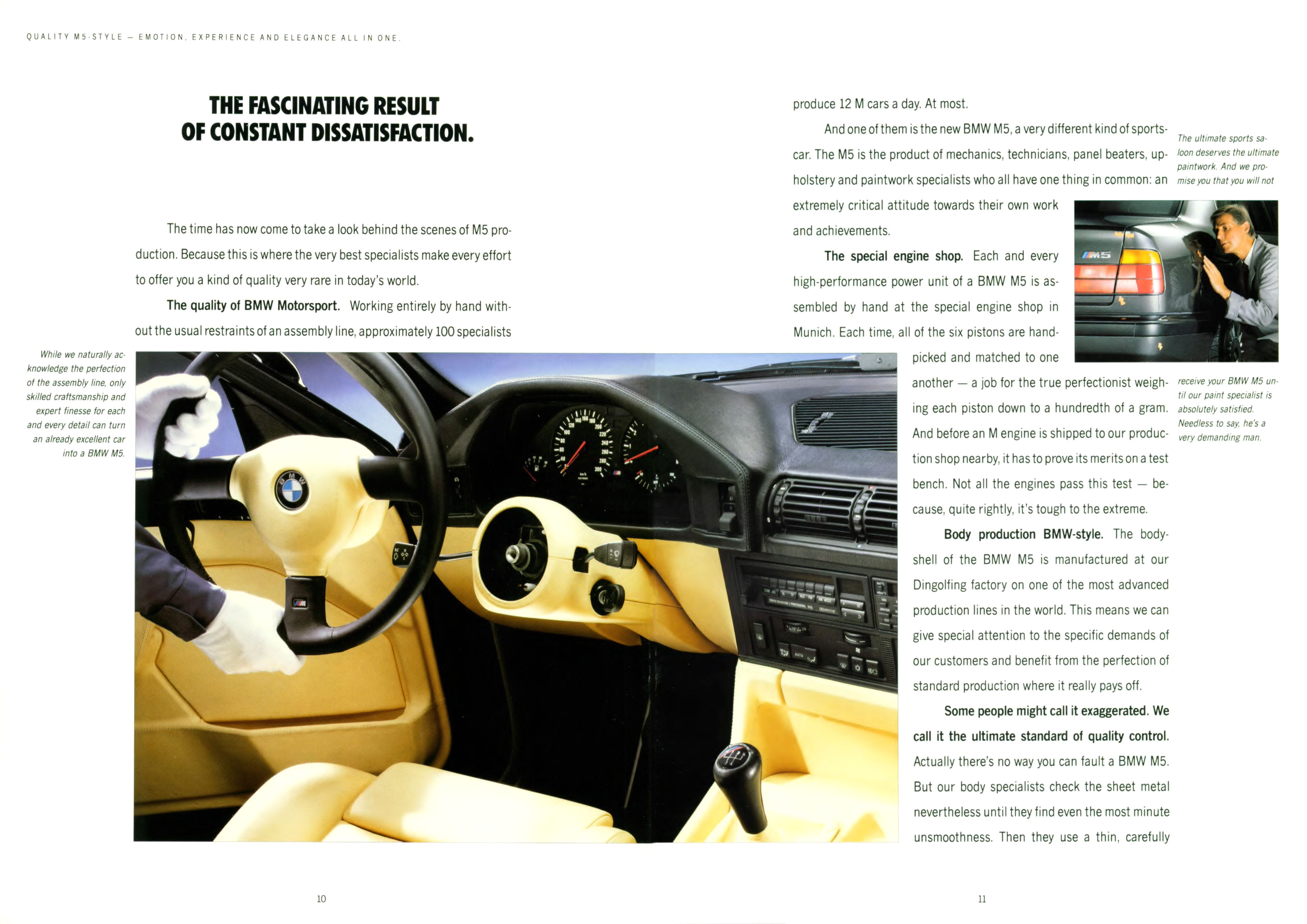
If pages six and seven are the brochure’s technical peak, pages ten and eleven are its emotional one, though the emotion is expressed through the language of craft rather than sentiment.
“The quality of BMW Motorsport. Working entirely by hand without the usual restraints of an assembly line, approximately 100 specialists produce 12 M cars a day. At most.”
The last two words. “At most.” This is the brochure’s single most arresting piece of prose, and it arrives without any typographic emphasis. Twelve cars per day. At most. The qualification implies that the output fluctuates because quality control, not production scheduling, determines the actual number. Some days fewer than twelve cars will pass.
The headline for these pages is “The Fascinating Result of Constant Dissatisfaction”. BMW Motorsport, the brochure tells you, is never satisfied with the work it has already done. This is why the car exists in the form it does.
The engine assembly process receives a detailed paragraph. Each power unit is built by hand in the special engine shop in Munich. Every one of the six pistons is hand-selected and matched, “a job for the true perfectionist weighing each piston down to a hundredth of a gram”. The engine is then tested on a dynamometer before it leaves the engine shop. Not all engines pass. That is the point.
Body production at Dingolfing is outlined, followed by the quality control process where specialists search for the most minute surface imperfections in the sheet metal and remove them with a thin steel rod. “Some people might call it exaggerated. We call it the ultimate standard of quality control.”
Page twelve adds the definitive flourish: every completed M5 undergoes a 25-kilometre test drive by a finish and quality control engineer. “The engine, transmission, suspension, seats, cockpit — everything is checked for perfect function. And the final result has got to be absolute satisfaction.”
Whatever condition the car might be in today, it was absolutely satisfying when it left Munich.
The Rearview Mirror
The Problem: Invisible at 250 km/h
The brochure celebrates the car’s resemblance to a standard high-class saloon. In 1992, this was a virtue marketed directly to the buyer who understood what lay beneath the standard bodywork. By the mid-1990s, it was a commercial liability. The E39 M5 that followed in 1998 was faster, smoother, cheaper to produce, and powered by a V8. It was hardly a showboat by later M standards, but it looked the part in a way the E34 never quite did. The market moved. The E34 M5 slid into a peculiar obscurity, remembered by specialists and forgotten by the broader collector community for the better part of two decades.
That the brochure, in retrospect, was entirely correct, that subtlety was the whole point, did not save the car’s market position in the short term. Truth in advertising is no defence against the market’s preference for the obvious.
The Tax: Known Quantities
For a 35-year-old hand-built performance car, the E34 M5’s ownership costs are, by any reasonable measure, manageable, provided the car has been maintained by people who understand what it is. The EDC dampers are the most commonly cited expense, and they are genuine specialist work when they require attention, but they are also a known quantity with a small community of specialists who have rebuilt enough of them to have the process down. The S38’s shim-and-bucket valve adjustment is labour-intensive rather than catastrophically expensive, and the cooling system, while genuinely intolerant of neglect, rewards owners who simply keep up with it. These are not surprises. They are the predictable costs of a complex, high-revving engine that was never designed for indifferent servicing.
The real tax is not financial. It is attentional. The E34 M5 rewards owners who treat it as the engineering thoroughbred it always was. Those who do report very little drama. Those who don’t are reading the wrong brochure.
The Success: The Last Letter
The E34 M5 is the last hand-built M5. This fact was not in the 1992 brochure because no one knew it yet. The E39 that followed would be faster and more refined and built to the standard production tolerances of a Dingolfing assembly line. It would be an outstanding car. It would not be hand-built.
The S38B38 is the final expression of an engine lineage that traces directly to the M1 supercar, the car that established BMW Motorsport GmbH’s identity and credibility. That lineage dies with the E34. What follows, in the E39 and beyond, is equally impressive engineering by different means. It is not the same argument.
The brochure, seen now, is a document produced at a precise moment of closure that neither the manufacturer nor its customers fully recognised. BMW Motorsport was closing an era and opening another. The 100 specialists building 12 cars a day were doing so for the last time in that form. The engine shop in Munich was producing its final iteration of an engine that had been evolving since the late 1970s.
In 2026, the remaining hand-built E34 M5s represent a specific and unrepeatable category: cars manufactured with racing-derived methodology in an era before cost-efficiency governed every industrial decision. The back cover declared that M was the world's most powerful letter. The collector market has now arrived at the same conclusion. It just took thirty years to recognise the car that was there.
The Fine Print