
The Track Athlete: BMW’s Eight-Minute Obsession
How BMW sold less, for more, without selling anything

By the second page of the 2003 BMW M3 CSL brochure, you already realise that you are not actually being sold anything. A silver coupe, studio-lit against blackness, in front of wire mesh that suggests a racing paddock rather than a showroom. The headline reads: “The M3 CSL driver talks about significantly increased lateral dynamic performance. The passenger keeps quiet.”
Not “the passenger enjoys”. Not “the passenger notices”. Keeps quiet. Because the passenger, the brochure implies, has been temporarily deprived of speech by lateral G-force. This is the document’s central act: not a sales pitch, but a clinical assessment of what the car does to the person sitting in the passenger seat.
The BMW M3 CSL is, by any conventional measure, an absurdity. The Bavarian manufacturer in 2003, competing in the premium segment, whose central proposition was the systematic removal of equipment (the stereo, the air conditioning, the sound deadening, the proper boot floor), replacing it with structural carbon fibre, glass-fibre/paper composite trays, and the promise of a Nürburgring lap in under eight minutes. You were paying a significant premium for less. The brochure’s genius is in making that premium feel like the only rational choice.
Monochrome Forensics
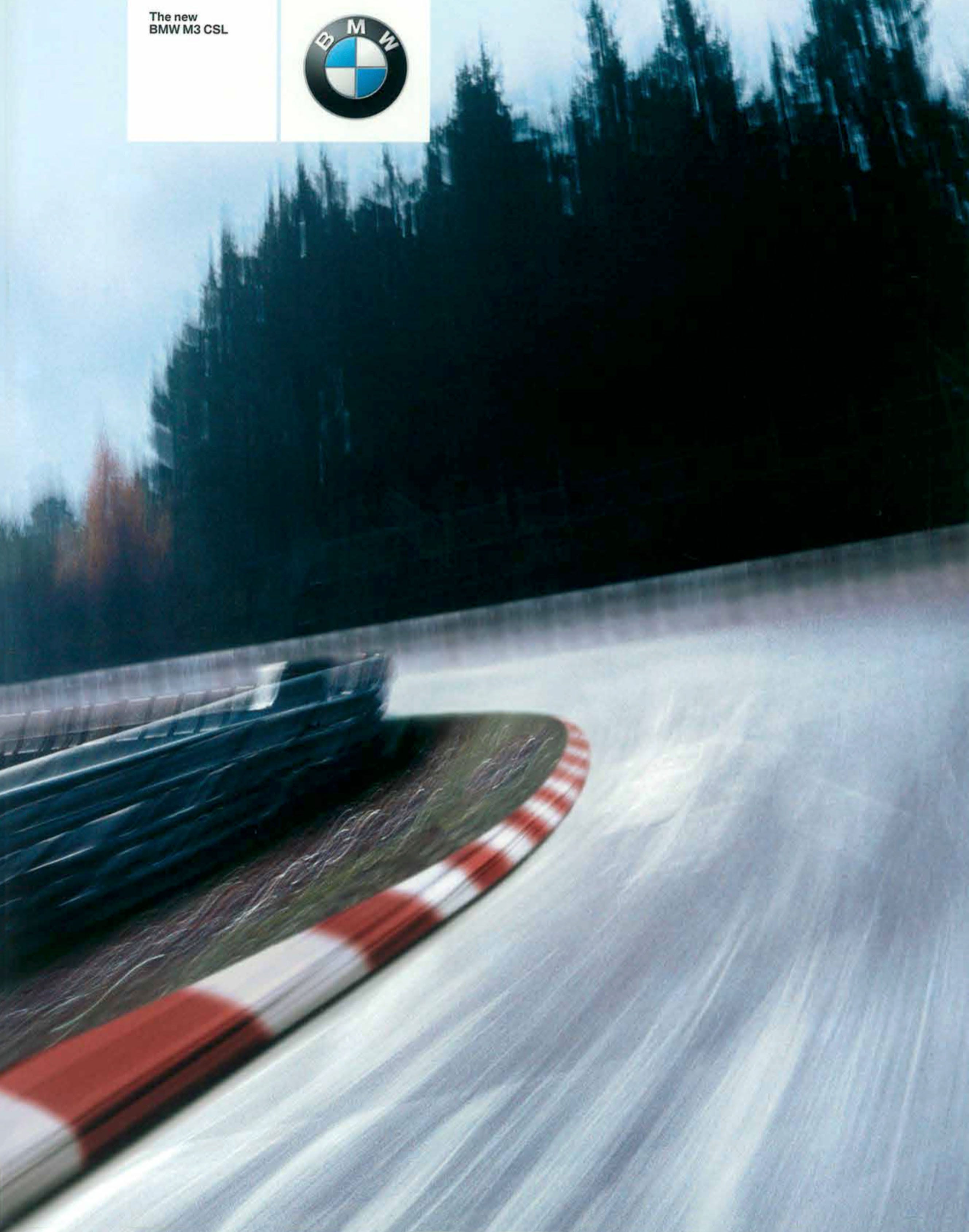
The brochure is a systematic documentation of a machine in the way that forensic photography documents evidence: without editorialising, with precise attention to texture and surface, and with the understanding that the subject matters too much to be glamorised. There is no aspirational lifestyle here. No driver grinning through a mountain hairpin with one hand raised theatrically off the wheel. No café terraces, no sun-drenched coastlines, no passenger laughing at nothing in particular. There are textures: the weave of carbon-fibre reinforced plastic (CFP), the grain of Alcantara, the geometric precision of machined aluminium engine castings. The car is not presented as a product. It is presented as an instrument, and the brochure is the instrument’s operating manual.
The colour palette is essentially a binary choice: black, and the precise silver-grey of the car itself. The BMW M tricolour logo appears once, quietly. The red tail lights bleed from two photographs. Everything else is grayscale. The typography is clean, sans-serif, lowercase where it wants to unsettle you. White space is weaponised; claims are isolated on vast black fields like specimens pinned for examination.
In 2003, this was arresting. Today, it reads as a document that knew exactly what it was doing.
The Green Hell Metric
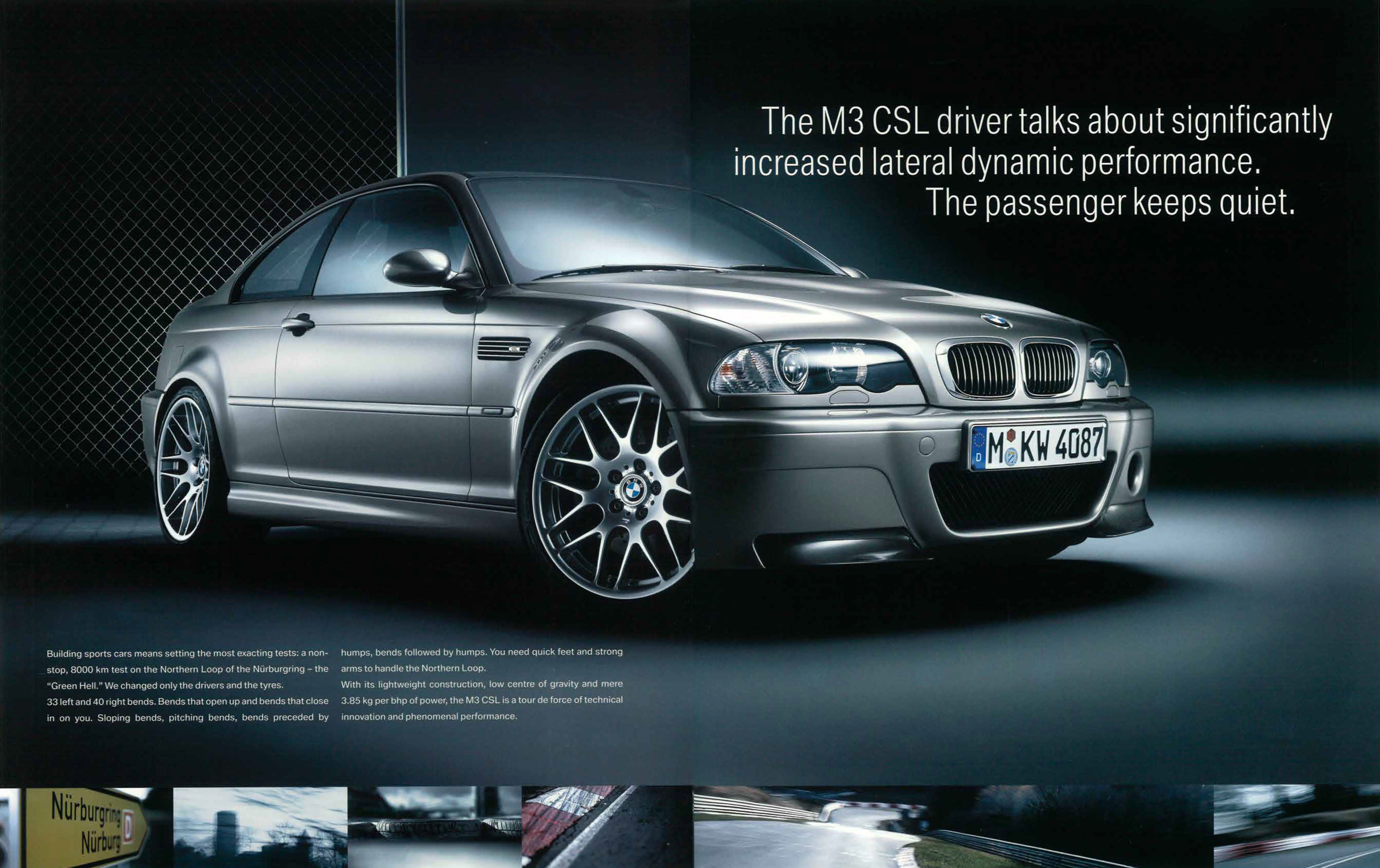
The brochure’s first act of argument is also its most economical. A full-spread image of the CSL in studio silver against near-total darkness. The copy below states that building sports cars means setting the most exacting tests, and that the most exacting test is a non-stop 8,000km endurance run on the Northern Loop of the Nürburgring.
“We changed only the drivers and the tyres.”
This is the sentence that establishes everything. Drivers are consumables. Tyres are consumables. The mechanical hardware is the constant. The implication is that the car has already done the qualifying; the brochure is merely posting the results. BMW is not asking you to imagine yourself driving this machine; it is informing you that the machine has already been validated at the highest level, and your job is to do it justice.
The bottom strip of the page runs a sequence of images: the Nürburgring sign, a grey town, a wet track photographed at speed. No crowds, no spectacle. The Northern Loop in winter, empty and demanding. The CSL’s natural environment looks like a place you would not choose to visit for pleasure.
The Material Manifesto
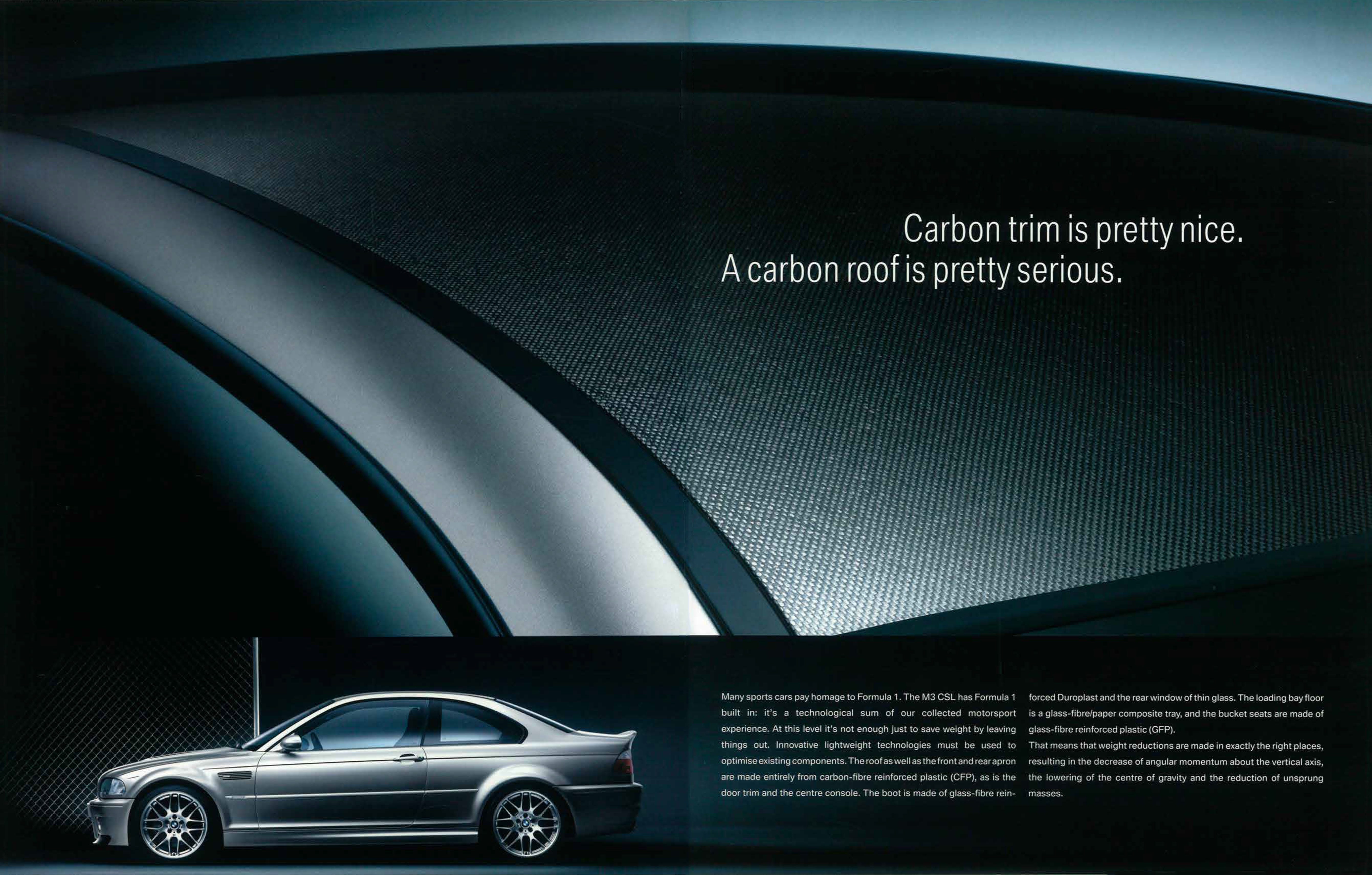
The third spread is given over to carbon fibre. Close-up, the texture fills the frame: the complex, angular weave of CFP rendered at a scale that makes each individual strand visible. It is, objectively, beautiful. The brochure knows this and places a single headline over it:
“Carbon trim is pretty nice. A carbon roof is pretty serious.”
The rhetorical move here is the graduated dismissal. Carbon trim, the implication runs, is what the other cars offer. The cars your colleagues drive. The CSL has transcended trim and arrived at architecture. The roof structure, the front apron, the rear apron, the door trim, the centre console, the boot construction: all CFP or its glass-fibre companion GFP, which here includes a glass-fibre/paper composite tray for the loading bay floor.
The brochure does not flinch from the word “paper”. It leans into it. The paper composite is presented not as a cost-cutting measure but as an innovative lightweight technology requirement. It is a masterpiece of reframing, and it works precisely because the rest of the material catalogue is so evidently serious: the paper floor and the carbon roof were decided by the same people, for the same reason. The paper is present because it is the right material for the task, and the task is reducing unsprung mass and lowering the centre of gravity.
“At this level it’s not enough just to save weight by leaving things out.”
At this level. The three-word qualifier does everything. It acknowledges what was left out (the air conditioning, the stereo, the conventional boot floor) and recontextualises those deletions as the primitive approach. The CSL has moved beyond subtraction and into material science. You are not buying a stripped car; you are buying a car that has been rebuilt from first principles using better answers.
The weight saved is not trivial. Against the standard E46 M3’s kerb weight of approximately 1,570kg, the CSL arrives at 1,460kg. That is 110 kilograms, the weight of a well-built adult human being, removed from the equation through the combined application of carbon fibre, thin glass, and the paper boot floor.
The physics are, naturally, improved.
The S54 Heart
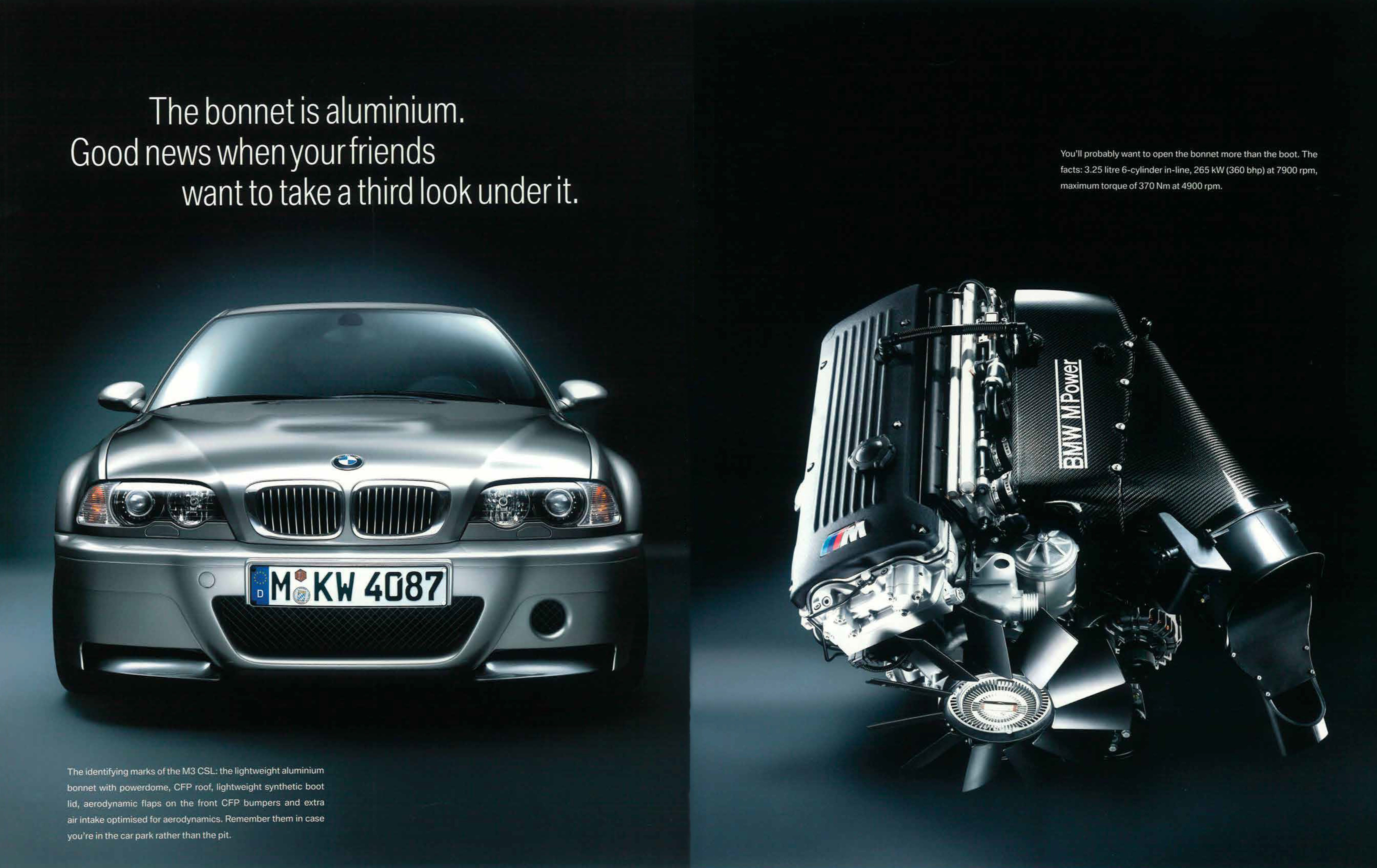
Pages six and seven split across a front-view photograph of the car and a studio portrait of the engine. The engine occupies the right half of the spread with the compositional confidence of a sculpture. The S54 inline-six, 3,246cc (styled in the brochure’s marketing as “3.25 litre”; the decimal branding doing significant work), sits against a dark gradient with its carbon-fibre intake plenum displayed as the primary visual element.
The headline announces that the bonnet is aluminium, and that this is good news when your friends want to take a third look under it. This is the brochure’s single moment of wit, and it is perfectly pitched: the engine is so unambiguously excellent that the aluminium bonnet’s lightweight properties are secondary to the fact that the bonnet exists as a frame for the engine’s display. You will not open the boot to retrieve your luggage. You will open the bonnet to show people what 360bhp at 7,900rpm in naturally aspirated inline-six configuration actually looks like.
“You’ll probably want to open the bonnet more than the boot.”
The brochure offers this not as a joke but as a practical observation. The engine is the artefact; the car is the delivery system.
The Cockpit Document
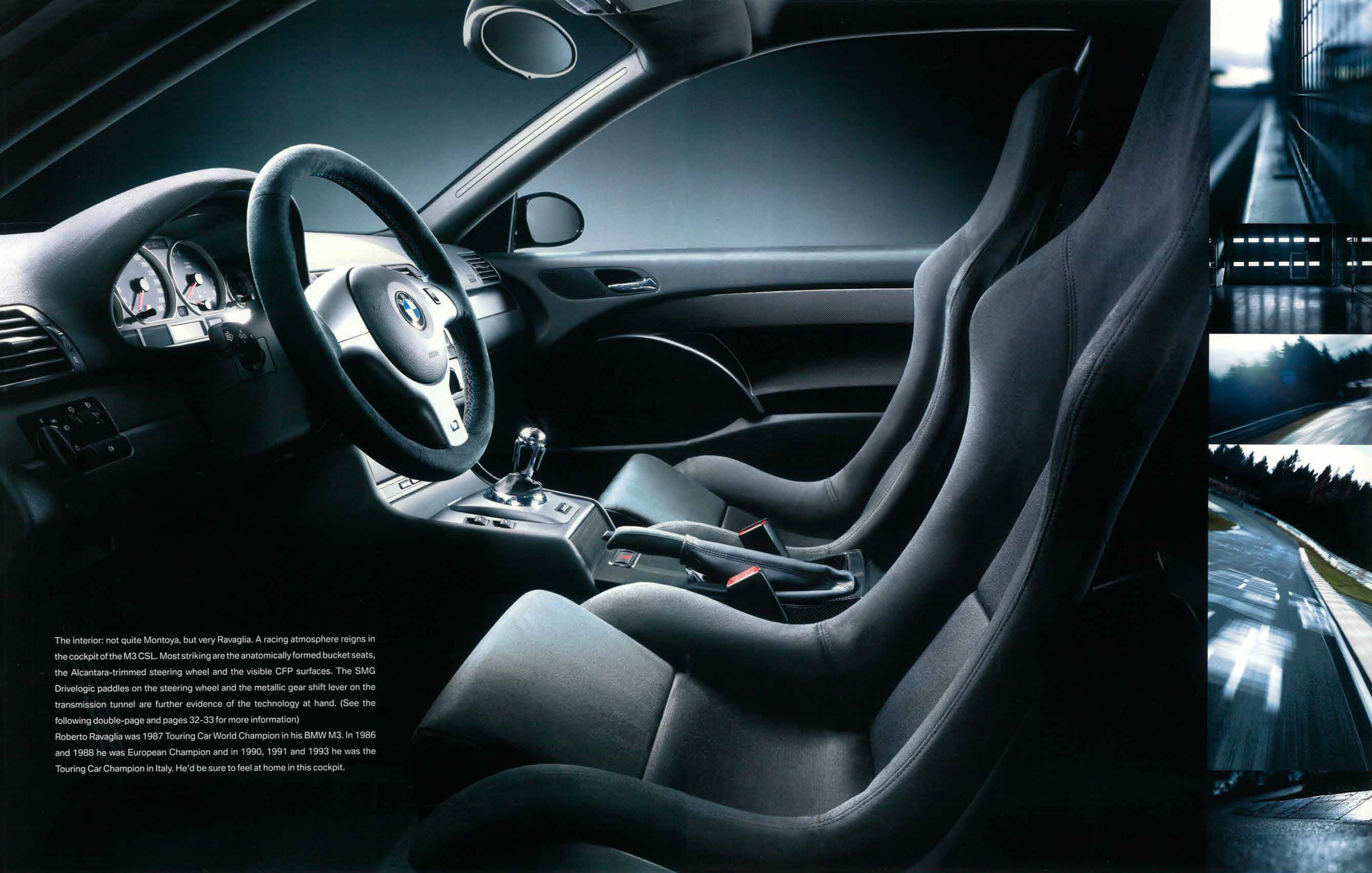
Interior pages are often where automotive brochures overclaim. Pages eight and nine are not an interior photograph. They are an evidence photograph.
The anatomically-formed bucket seats are shot in a profile view that emphasises their racing-specification containment. The Alcantara-trimmed steering wheel, the visible CFP surfaces of the dashboard, the metallic gear selector on the transmission tunnel: each item is present in the photograph as a specific technical decision, not a styling choice. The brochure identifies Roberto Ravaglia, 1987 Touring Car World Champion, as the reference point for cockpit ambience.
“Not quite Montoya, but very Ravaglia.”
Montoya was racing a Williams-BMW in Formula 1 at that time; the brochure is telling you the CSL's cockpit stops one rung short of that. Ravaglia won touring car championships in BMW M3s. That is the rung it occupies, and that is not a modest claim.
There is no infotainment screen, because there is no infotainment. The space where a radio would be has been rationalised away. The brochure does not mention the missing radio. It simply does not discuss what is not there. This is a sophisticated editorial choice: the brochure documents what is present, not what was removed. You will notice the absence when you sit in the car. The brochure will not help you grieve.
The SMG Mandate
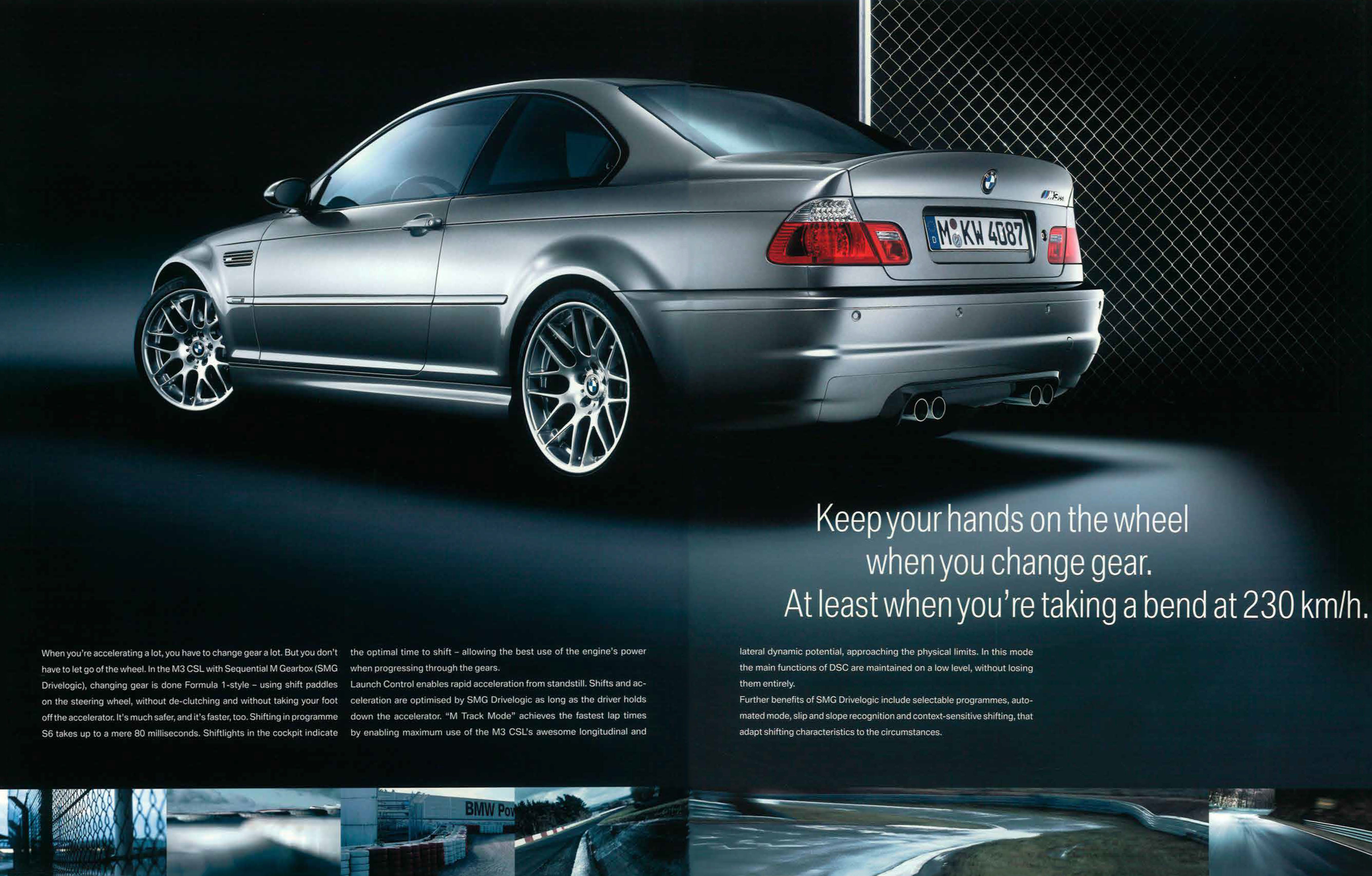
The Sequential M Gearbox spread is the brochure’s most technically dense, and its most philosophically charged. The headline:
Keep your hands on the wheel when you change gear. At least when you’re taking a bend at 230 km/h.
The SMG II is presented throughout as a Formula 1 technology that happens to be street-legal: shift paddles on the steering wheel, de-clutching handled automatically, gear changes executed without lifting from the throttle. The 80-millisecond shift time in programme S6 is stated as a fact with the flatness of a safety announcement. Eighty milliseconds is faster than the human nervous system can consciously initiate a clutch movement. The brochure quantifies, without editorialising, the degree to which the machine has surpassed the operator.
“Shifting in programme S6 takes up to a mere 80 milliseconds.”
"Up to a mere." The qualifier is a masterpiece of compression. "Up to" sets 80ms as the ceiling; "mere" renders that ceiling negligible. The combination of Launch Control, automated clutch management, and M Track Mode (which reduces DSC intervention to enable maximum lateral dynamic exploitation) is presented as the only rational engineering response to the challenge of a sub-8-minute Nürburgring lap.
The Nürburgring Report
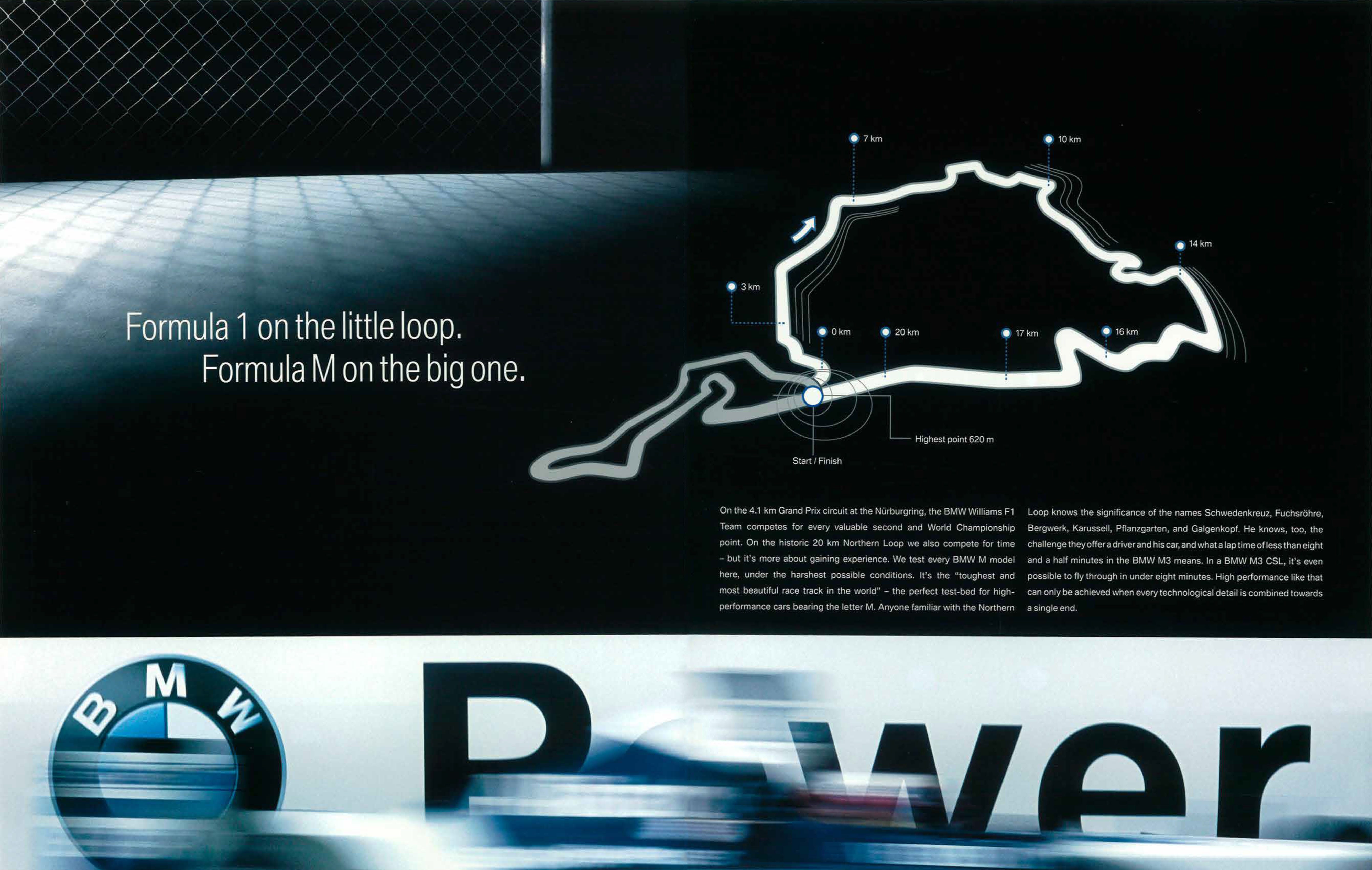
The Northern Loop map spread is the brochure’s closing argument, and it arrives with the precision of a legal submission. The 20-kilometre circuit rendered in glowing white on black, distance markers at 3km, 7km, 10km, 14km, 16km, 17km and the start/finish at 0/20km. The highest point, 620 metres above sea level, is noted. The named sections (Schwedenkreuz, Fuchsröhre, Bergwerk, Karussell, Pflanzgarten, Galgenkopf) are presented as facts that a serious reader will already know and a less serious reader should learn.
“In a BMW M3 CSL, it’s even possible to fly through in under eight minutes.”
Even possible. The careful modesty of the claim matters enormously. BMW is not guaranteeing eight minutes; it is guaranteeing that the car is capable of it, in the hands of the right driver, under the right conditions. The brochure’s own body copy has established, on page two, that the test was conducted with professional drivers and fresh tyres. The conditions are specified; the result is documented; the claim is defensible. This is not marketing. This is engineering evidence presented in a marketing format.
In 2026, with production electric SUVs posting seven-minute Nordschleife times and the lap record having moved into territory the CSL’s era would have considered science fiction, the sub-8-minute claim reads differently: not as a boast, but as something genuinely hard-won. The CSL did it with 360bhp, 1,460kg, and a paper boot floor. That deserves a different kind of respect than the lap times that followed.
The Rearview Mirror
One Optimisation Too Far
The SMG II gearbox is the CSL’s original sin, though sin implies moral failure and what actually occurred was a philosophical miscalculation. In 2003, the automated sequential manual was the fastest-shifting device legally available for a production road car; the 80ms shift time was not marketing copy but a technical reality. Formula 1 used paddle-shift systems. The CSL was bringing that technology to a road car without compromise.
The compromise arrived on the morning commute.
At low speeds and low temperatures, in urban traffic, in car parks, in the ordinary conditions of a car that costs considerably more than the standard M3, the SMG II’s character shifted from precision instrument to mechanical antagonist. Clutch engagement under 2,000rpm in automatic mode produced head-nodding jerkiness. Cold hydraulic fluid made the situation worse. The brochure’s instruction to keep your hands on the wheel at 230km/h was excellent advice; the brochure did not cover what to do when pulling out of a supermarket car park at 8km/h.
The refusal to offer a six-speed manual transmission was, in retrospect, the decision that most clearly revealed the CSL’s institutional blind spot. BMW M GmbH built a car of exceptional dynamic integrity and then made a gearbox choice that alienated the purist constituency it was ostensibly built for. The Porsche 911 GT3 of the same era offered a six-speed manual and was considered, by the market that mattered, to have made the correct choice. The CSL was faster around the Nürburgring. The GT3 was more satisfying to drive to the Nürburgring. Both of these things can be true simultaneously, and the CSL’s commercial limitation was in not grasping that the target audience was the kind of person who would choose satisfaction over lap time when given the option.
The Tax: The When, Not If
Twenty-three years after production, the CSL ownership proposition requires a specific kind of clarity before proceeding.
The SMG II hydraulic pump is the first item on any pre-purchase checklist and the item that will dominate any conversation with a BMW specialist. These pumps fail; the question is when rather than whether. Rebuilding or replacing the pump is a known cost of ownership; budgeting for it before purchase is a sign of preparation, not pessimism.
The E46 subframe cracking issue, present across the standard M3 range, is amplified in the CSL by the combination of stiffer suspension settings and the Cup 2-specification tyres that the car’s dynamics depend upon. Unmodified subframes in higher-mileage examples require inspection; professional repair or reinforcement is available but represents a meaningful cost. Skipping this inspection is the main mistake made by buyers without specialist knowledge.
The bespoke carbon-fibre bodywork, specifically the front apron and rear diffuser, presents the most significant insurance and maintenance risk. These components cannot be sourced from the general BMW parts supply; they are CSL-specific items with CSL-specific pricing. A medium-speed parking incident involving the front apron is a bill that will concentrate the mind considerably. The brochure’s pride in the CFP construction is entirely justified from an engineering standpoint; the practical consequence is that this pride carries a premium at the body shop.
The Vindication: The S54’s Immortality
None of the above has prevented the BMW M3 CSL from achieving what is possibly the most dramatic retrospective revaluation of any E46-generation vehicle. It is, without qualification, the most collectible variant of its generation. Values have moved accordingly.
The vindication is deserved, and it operates on two levels. The first is physical: the S54 engine in CSL specification, with its carbon-fibre intake plenum and revised throttle body mapping, produces an induction sound at full throttle that multiple generations of motoring journalists have reached for superlatives to describe and ultimately settled for recording instead. It is, by broad consensus, among the finest sounds produced by a naturally aspirated road car engine in the years before forced induction became the industry’s universal answer. The plenum amplifies and sculpts the engine’s breathing into something that rewards the ear as specifically as the chassis rewards the wrists. The decision to treat comfort as irrelevant and the lap time as the only valid measure, has aged from a liability into a virtue.
The second level of vindication is historical. The CSL was produced in approximately 1,400 units, which makes it simultaneously rare enough to be collectible and common enough that the ownership community is coherent, specialist-supported, and internationally connected. It appeared at the end of the period in which BMW M GmbH produced naturally aspirated, analogue performance cars as its primary product. What came after was technically more capable in measurable ways and less demanding to own in everyday terms. The CSL, however, was more interesting and the used market, which is rarely wrong about these things, has agreed.
The sub-8-minute Nürburgring lap stands. The paper boot floor stands. The 80ms shift time stands. In 2026, surrounded by electric performance cars that generate torque without drama and lap times without apparent effort, the CSL’s combination of obsessive lightness and mechanical character reads not as an extreme but as a high-water mark. The cars that followed were objectively faster and more liveable.
BMW changed only the drivers and the tyres.
The CSL made its case by refusing to negotiate. Everything that followed was a negotiation.
The Fine Print
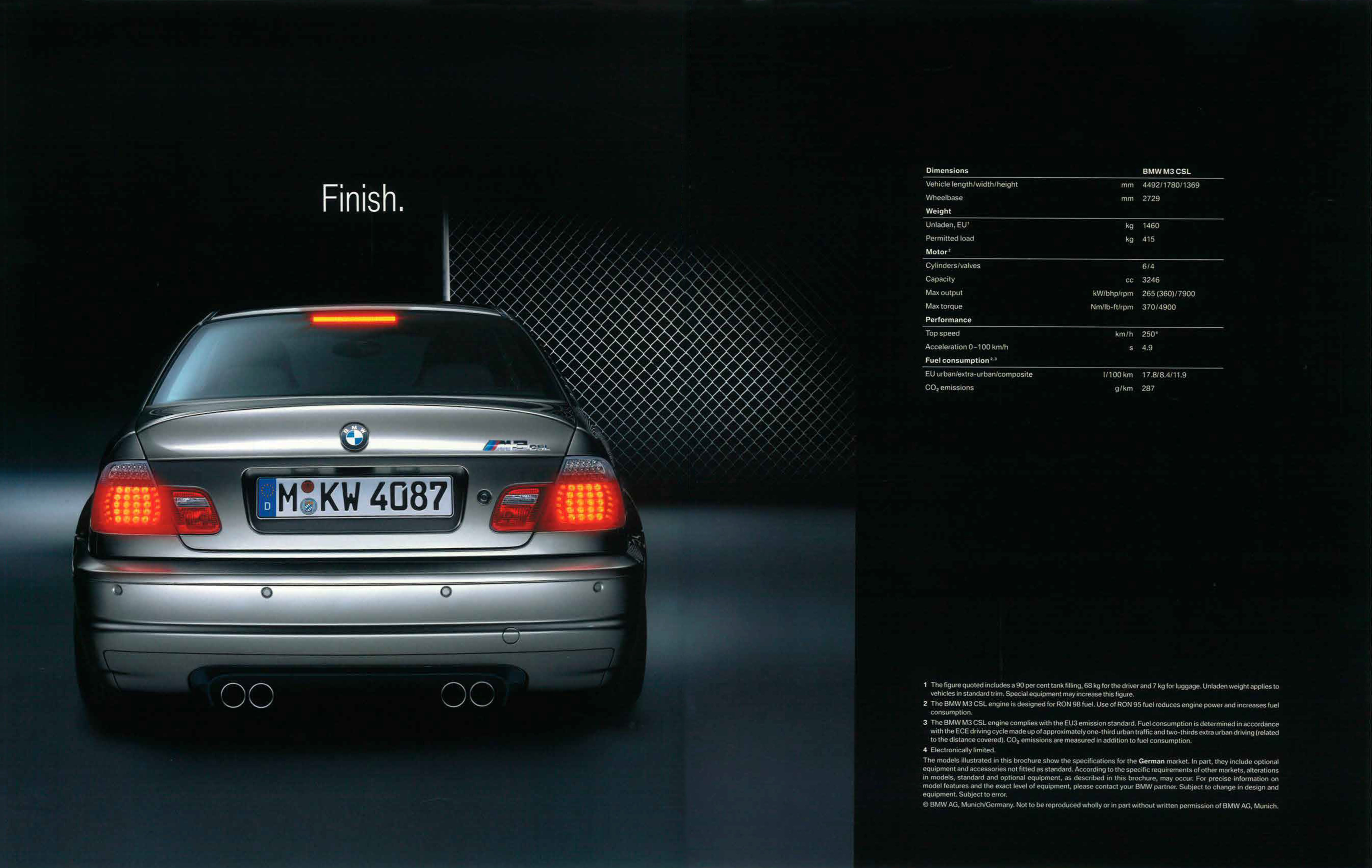
Very good article. I really enjoyed reading it.
The CSL was the only E46 that did not feel like a Honda Civic or something haha.
I think it was one of their greatest special series M cars. The market would reflect that, this things are worth crazy money!