
The Inconvenient Masterpiece: The Cadillac CT5-V Blackwing
The finest thing Cadillac ever built with a combustion engine. By the time anyone noticed, they’d already moved on.

There is a sentence on the Cadillac website that functions less as marketing copy and more as a monument inscription. It sits beneath the model selector for the CT5-V Blackwing, rendered in the same heavy-weight sans-serif that the brochure applies to everything from torque figures to package pricing, and it reads with the quiet confidence of someone who knows they’ve already won:
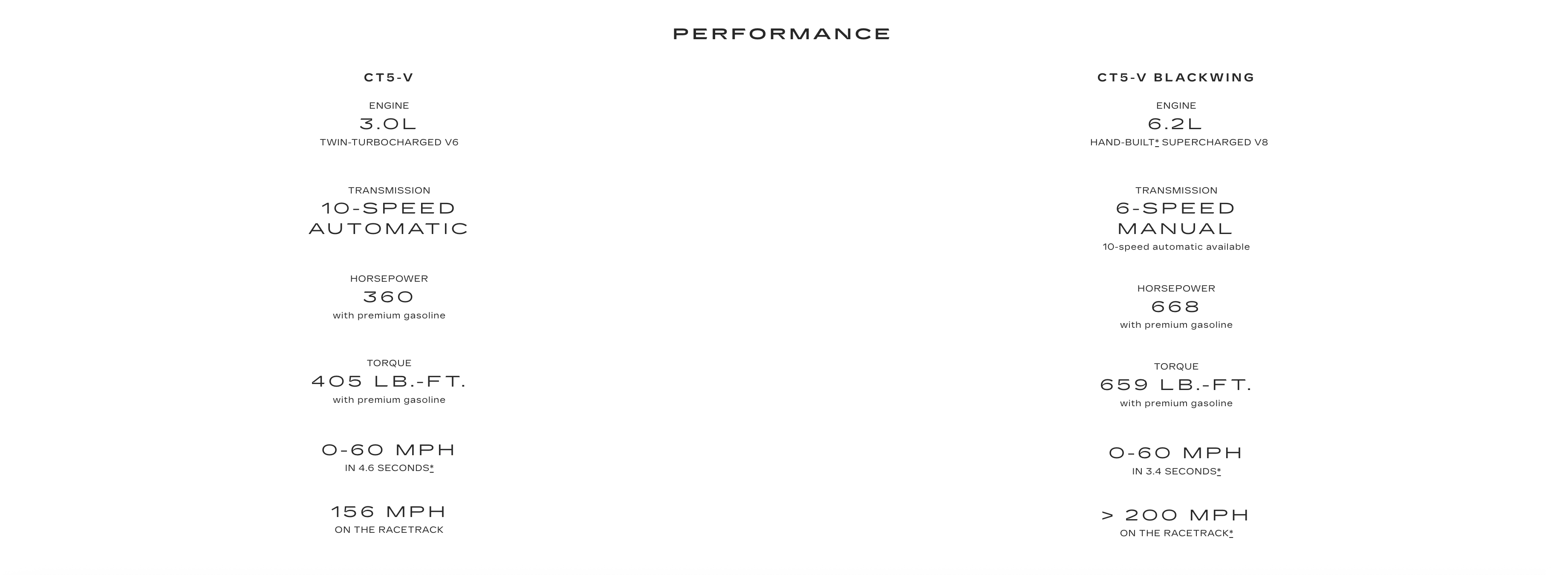
“668 HP AND 659 LB.-FT. OF TORQUE”
No exclamation mark. No italics. Not a suggestion. A statement of fact, delivered with the same emotional register you’d use to announce the boiling point of water. What makes this remarkable isn’t the number (though the number is remarkable) but the composure. The Cadillac website of 2026 is selling its last, loudest internal combustion act with all the showmanship of a Swiss patent filing. The drama, it seems to have decided, lives in the machine. The document merely witnesses it.
This is the central paradox of the CT5-V Blackwing’s digital brochure, and it’s a more interesting paradox than the car itself has ever received credit for. The Blackwing is an act of chronological defiance: a 668bhp, six-speed manual super-saloon launched at the exact moment the rest of the industry committed to electrons and silence. Cadillac chose to present this defiance not with a clenched fist, but with a clipboard. The brochure doesn’t argue for the Blackwing. It presents evidence. It leaves the argument to you.
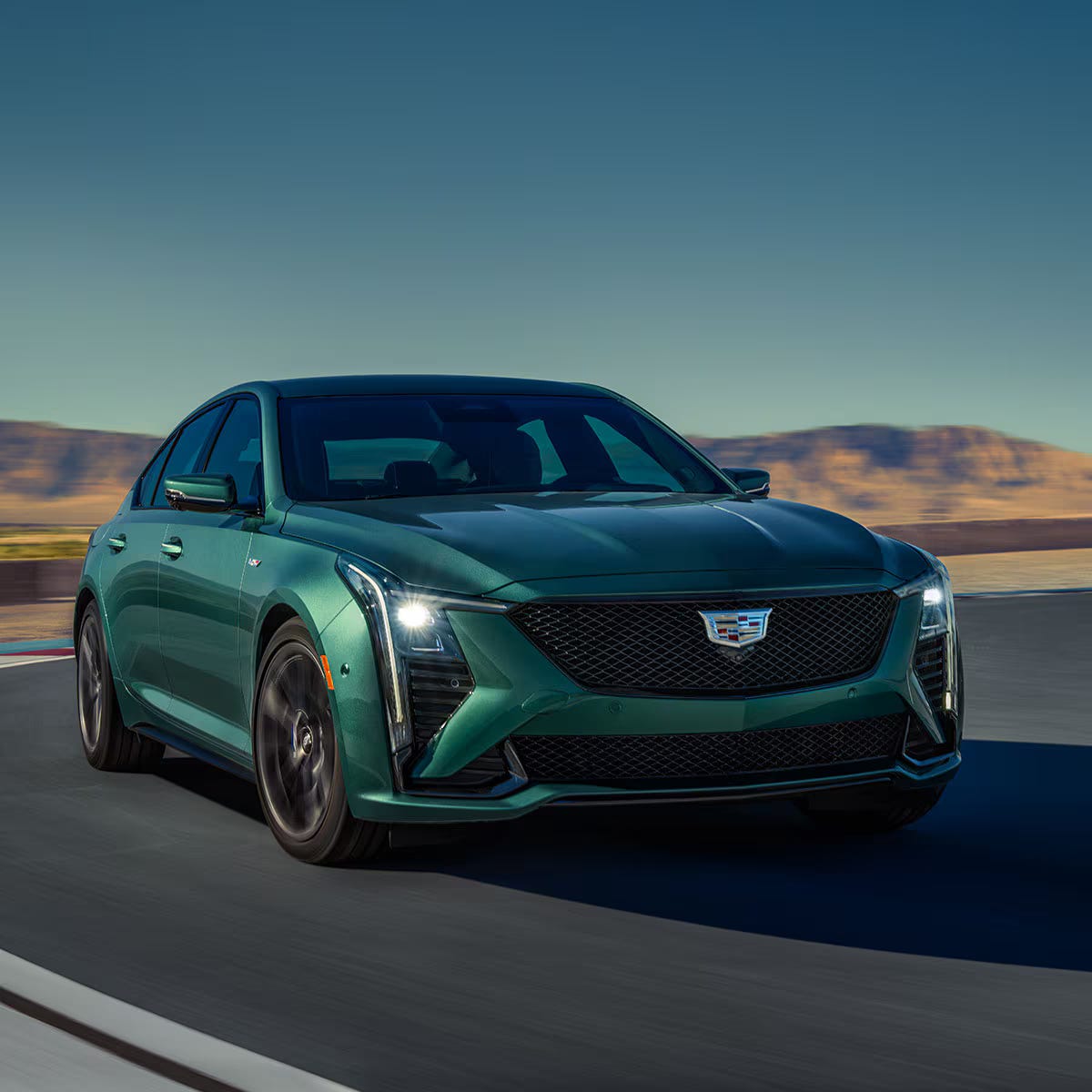
Bowling Green Noir
Let us establish, first, what kind of document this is, because the Cadillac digital brochure for the CT5-V Blackwing is a specific and considered artefact, not merely a product listing with photographs attached.
The visual vocabulary might best be described as Bowling Green Noir: a term that earns its invented status by capturing something genuinely distinctive about this brochure’s aesthetic choices. Bowling Green, Kentucky, is where the LT4 supercharged V8 is hand-assembled; “Noir” because the entire photographic palette operates in a kind of compressed chiaroscuro, isolating specific mechanical details against darkness, as if the rest of the car is classified information. The Blackwing’s own storytelling section describes the car with the language of predators and obsessives: it speaks of “the track: your signature obsession,” of “lower your foot gently and the horses impatiently roar,” of “wings appear, bearing creature comforts fit for an alpha beast.” This is not the measured prose of a luxury brochure. This is closer to a manifesto written by someone who has just set a personal lap record and hasn’t yet come down.
The typography is heavy and architectural, closer to a circuit blueprint than a showroom poster. The colour palette is predominantly monochrome, broken only by the specific application of Torch Red, appearing precisely where it matters most: the brake callipers, the seat belts, the V-Series badging. Cadillac’s Art & Science design language, which in prior decades leaned toward jewellery (the faceted surfaces, the knife-edge light signatures) has here been redirected toward something more purposeful. This brochure does not frame the Blackwing as a possession. It frames it as a relationship. You don’t buy this car; you enter into a training regime with it.
The brochure operates in sections that correspond to the digital experience: Performance, Technology, Interior, Exterior, Safety. The structure is modular rather than narrative, suggesting not a story moving from opening hook to emotional resolution, but a technical document for someone who already knows what they want and needs to understand exactly why this particular instrument will deliver it. Accordingly, the analysis that follows mirrors that architecture: less a journey through spreads, more a guided tour of the evidence.
The Hand That Builds the Engine
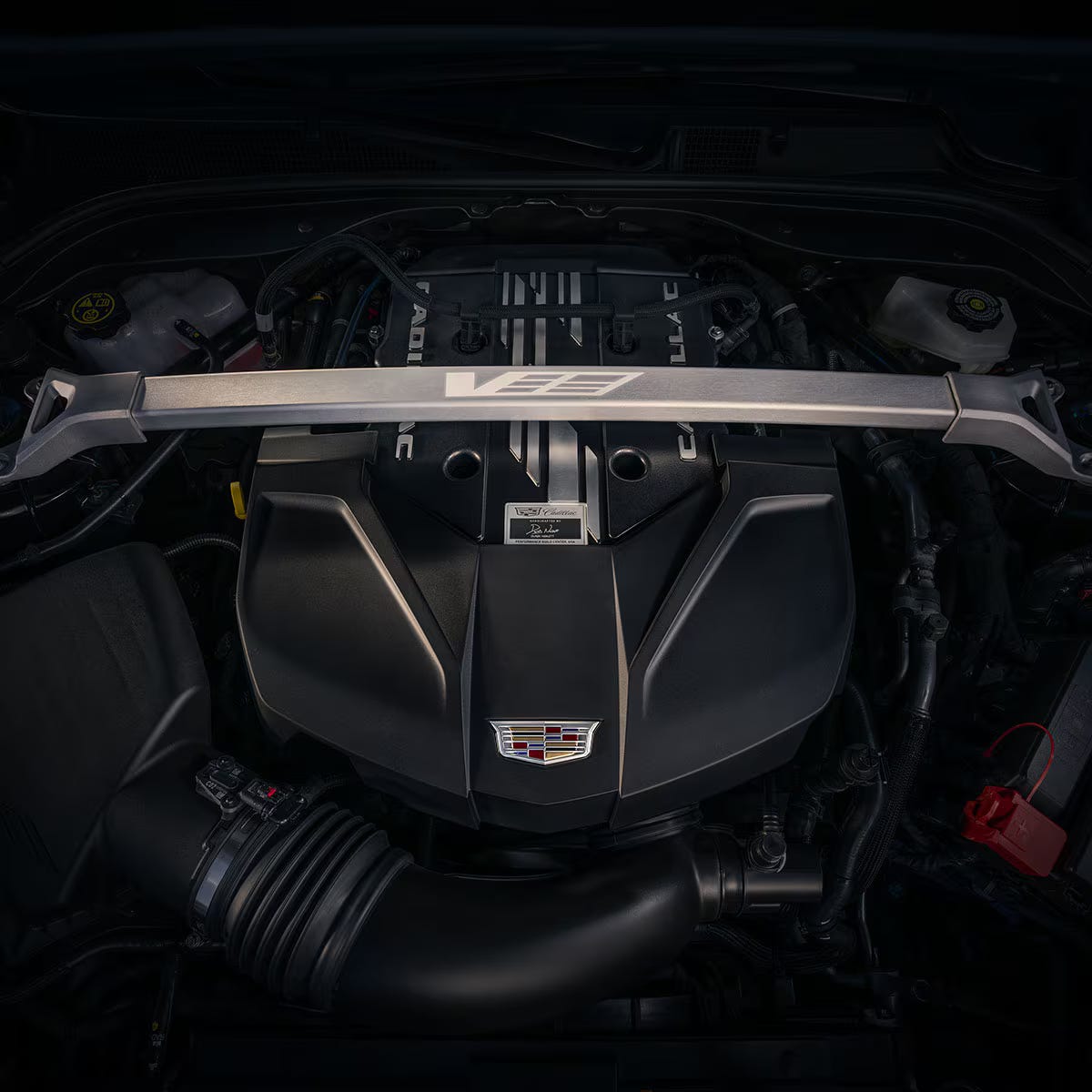
The first and most significant act of the Cadillac brochure is what it chooses to make human.
In an era when performance car marketing has retreated almost entirely into the language of software (systems, modes, algorithms, artificial intelligences) the Blackwing brochure’s decision to foreground the hand of the Bowling Green technician is striking and deliberate. The LT4 engine is presented not as a manufactured object but as a crafted one, with the Build Centre functioning as the brochure’s implicit workshop floor. The supercharged 6.2-litre V8 is positioned in the same conceptual territory as Swiss horology: something made by people who possess skills that cannot be automated, who can feel the tolerances.
The brochure quotation, “Hand-built 6.2L Supercharged V8... because machines can’t feel the tolerances”, captures its most audacious move. The LT4 is a pushrod V8, a configuration that European performance car marketing has spent four decades dismissing as architecturally primitive. Overhead camshafts are more sophisticated, goes the received wisdom; more moving parts in the right places means better breathing, better rev behaviour, better everything. Cadillac’s response is to sidestep the sophistication argument entirely and land on an older and more compelling claim: authenticity. The man who assembled your engine left his fingerprints on the tolerances. The cam profile was approved by a human being who has built thousands of engines and knows, by feel alone, when something is right.
This is not a technical argument. It is a philosophical one. And the brochure makes it quietly, without fanfare, which is what makes it land.
Three Pedals
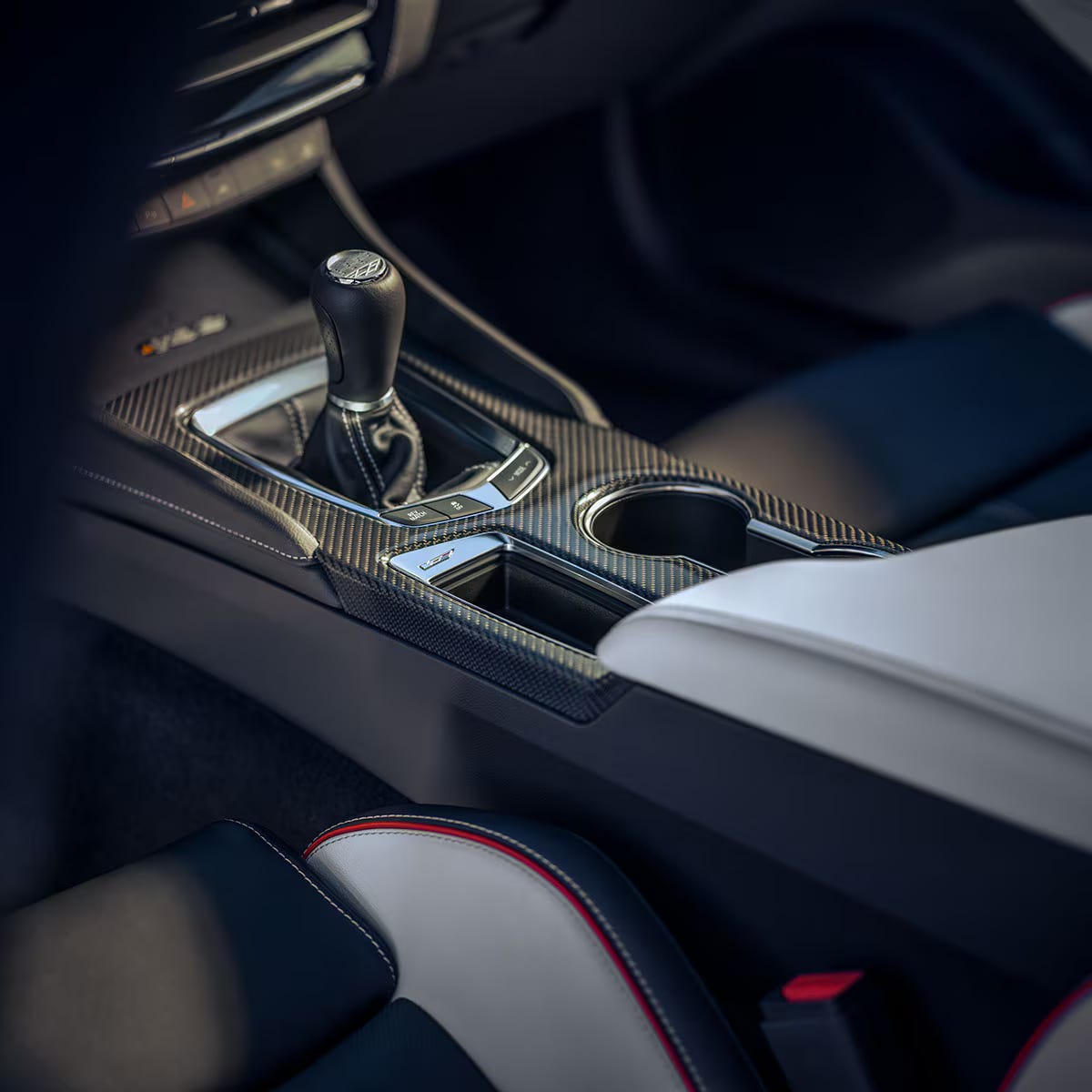
Somewhere on the model selector page, between the price callout of $98,900 and the specification of the 19” forged aluminium wheels with Polished Dark Android finish, lies what may be the most loaded three-word phrase in contemporary American automotive marketing: “6-speed manual transmission.”
Listed first, as the default. Before the 10-speed automatic even gets a mention.
The 2026 Cadillac brochure (in what amounts to a quiet act of commercial bravado) presents a six-speed manual gearbox as the standard equipment on its flagship performance saloon. The automatic is optional. This is, at time of writing, an arrangement available nowhere else on the market in this segment. The BMW M5 is automatic. The Mercedes-AMG E63 S, which was discontinued shortly after the Blackwing’s introduction, was automatic. The Alfa Romeo Giulia Quadrifoglio, its most characterful European rival, is automatic. The Cadillac CT5-V Blackwing is the only car in its price category that defaults to a clutch pedal, a gear lever, and the quiet presumption that the person paying $98,900 for a 668bhp super-saloon would rather do the work themselves.
The brochure’s gallery image of the gear shifter is worth extended attention. It is a focused close-up of the 3D-printed knob, isolating it against the dark interior with the kind of deliberate framing usually reserved for product photography: the object as argument, the shift knob as proof of intent. There is no context, no driver’s hand, no dashboard visible. Just the knob, which is all the brochure feels it needs to show. This, the image implies, is what distinguishes a driver’s car from a passenger’s car. The No-Lift Shift function, the software layer that allows the throttle to remain pinned during upshifts to keep the supercharger spooled, goes unmentioned on the overview page. It is a detail for enthusiasts who will discover it themselves, or have already Googled it. The brochure knows its audience.
The Horizon Display Paradox
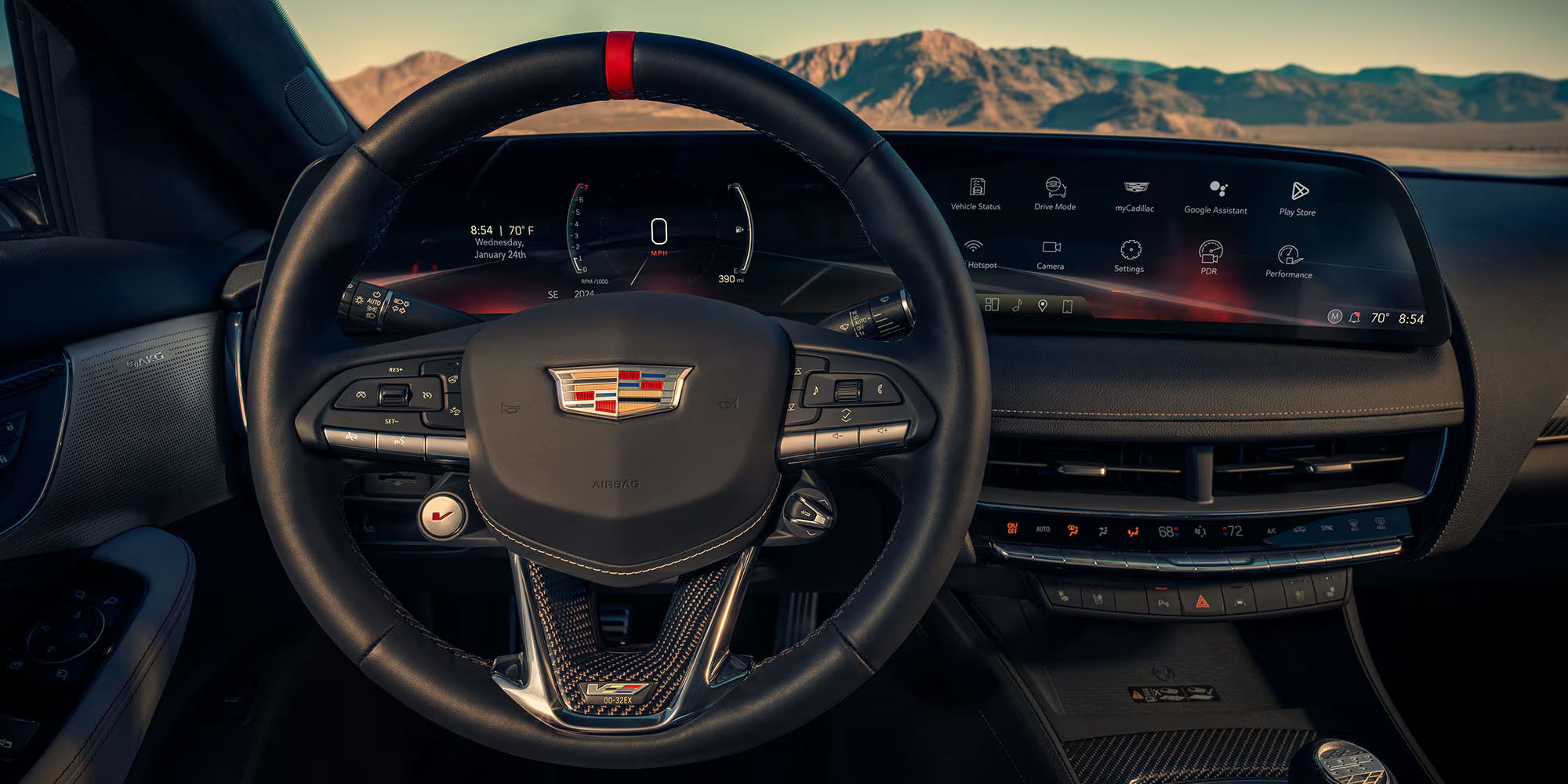
The 33” Horizon Display section of the brochure presents the Blackwing’s most interesting internal tension.
Here is a car sold on the primacy of the analogue interface: three pedals, a hand-built pushrod V8, a shift knob milled with the car’s VIN serialisation. It also features a thirty-three-inch curved display surface, Google built-in compatibility, an Enhanced Performance Data Recorder, and the optional availability of Super Cruise hands-free driver assistance technology. The brochure presents none of these as contradictions. They coexist within the Cadillac frame as naturally as the heated massaging front seats coexist with the launch control and line lock.
This is, in its own way, more sophisticated than anything the brochure’s language achieves. The Blackwing refuses the false choice between analogue purity and digital sophistication. It is a car in which you can record your lap data in granular detail on a 33-inch screen, while rowing through six gears yourself, with the supercharger audible above the AKG 16-speaker studio audio system. The Performance App, accessible through the Horizon Display, allows the driver to configure the car’s systems with a granularity that approaches motorsport data engineering. Magnetic Ride Control 4.0, reading the road surface one thousand times per second, adjusts damping in real time as the Performance Steering Wheel’s V Button allows mode-switching without lifting from the rim.
The brochure describes this interior not as a cockpit (the word preferred by most performance car manufacturers) but as something more evocative: “Slide in and say hello to the greatest version of yourself.” This is a sentence that has no business working as hard as it does. The greatest version of yourself does not, typically, materialise at the wheel of a four-door saloon. But there is something about the specificity of the Blackwing’s specification (VIN-serialised steering wheel, track-oriented data logging, six-speed manual, 668bhp) that makes the claim feel less like marketing rhetoric and more like an engineering brief.
The Exterior as Argument

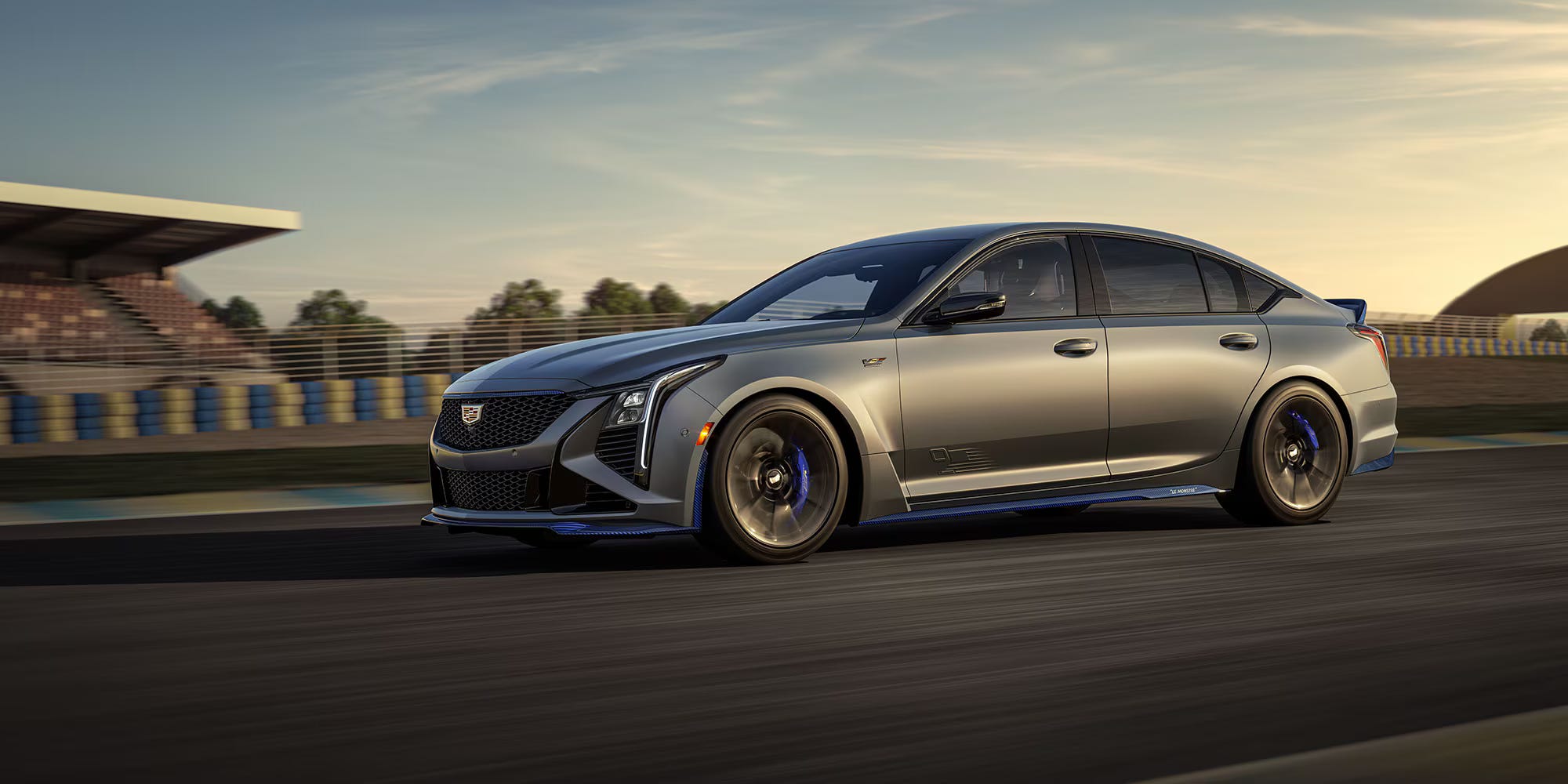
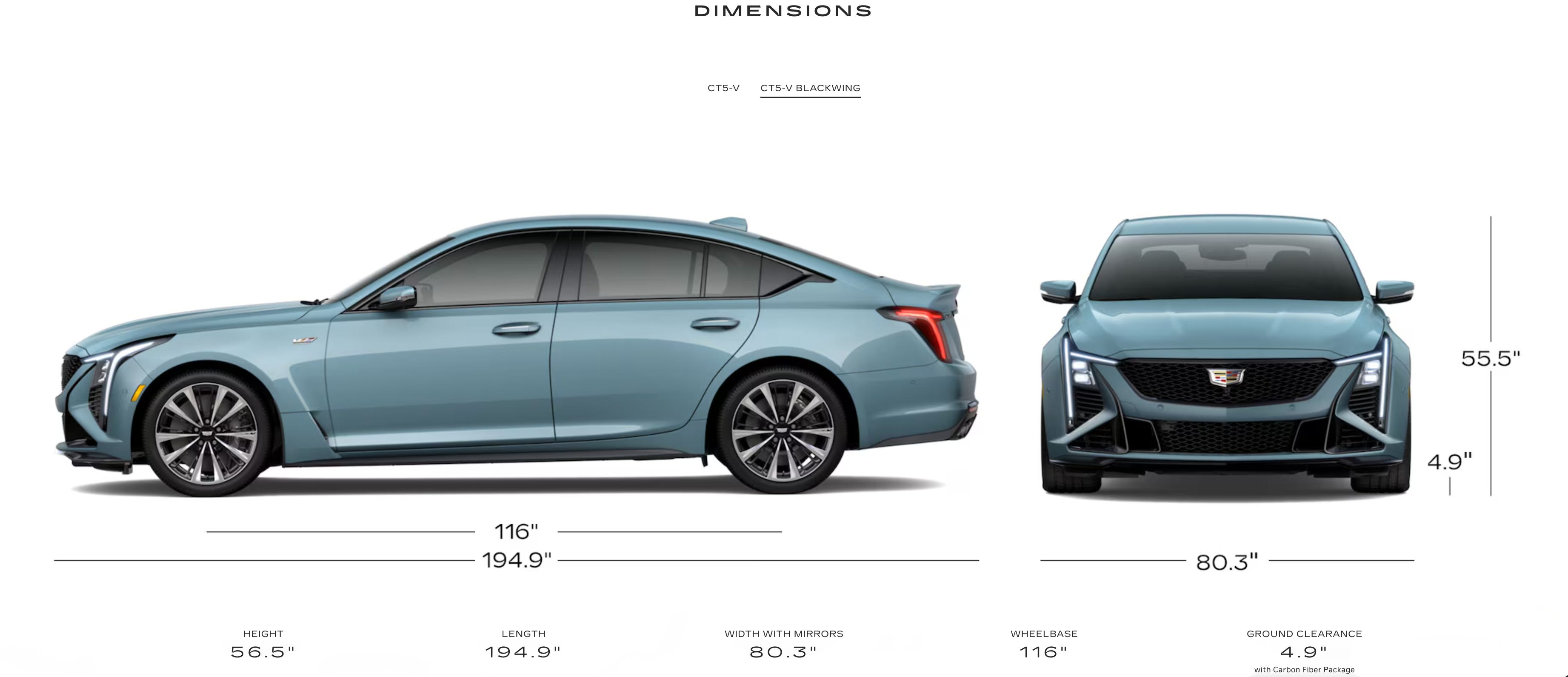
The revised front apron and the vertical lighting signature constitute the Blackwing’s primary visual argument, and the brochure presents them as self-evidently serious.
The distinction between CT5-V and CT5-V Blackwing exterior treatment is not cosmetic; it is categorical. The standard CT5-V receives what the brochure calls a “powerful grille and front fascia with black mouldings.” The Blackwing receives an “aggressive performance front end” with the kind of aerodynamic architecture that suggests the car has been designed around a specific cornering load rather than a specific design brief. The carbon fibre exterior packages, available in multiple configurations, extend this philosophy to the splitter, the side sills, the bonnet vents, and the boot lid spoiler. The quad trapezoid exhaust tips are finished in dark rather than bright chrome, a distinction that communicates serious intent without requiring explanation.
What the brochure does not say is that the carbon fibre front splitter is essentially a consumable in anything other than idealised road conditions. At speed, in anger, over the kind of urban topography that constitutes the Blackwing’s daily habitat for most of its owners, the splitter is a $5,000 interaction waiting to happen with a steep driveway or a poorly-sited sleeping policeman. The brochure presents the exterior carbon fibre as aspiration. Reality will present it as maintenance. This is the tax. More on that below.
The Deep Ocean Package, presented as “extremely limited”, extends the exterior palette to include Deep Ocean Tintcoat with blue brake callipers, black mirror caps, and a Jet Black interior with Carbon Fiber accents. This is the Blackwing as collectible artefact: a time-limited expression of a colour that acknowledges the car is moving toward historical significance faster than its owners might like to admit.
The Rearview Mirror
The Problem: The Badge That Almost Won
The CT5-V Blackwing’s one genuine commercial liability was never mechanical. It was typological. The CT5 chassis spent several years establishing itself in the marketplace as a near-luxury executive saloon, closer in perception to a Buick LaCrosse than to a BMW M5. Cadillac dealers had positioned the CT5 as sensible transportation for the professional classes, and when the Blackwing variant arrived with 668bhp, a track-tuned suspension, and a six-speed manual, the badge’s existing baggage created cognitive friction that no brochure could entirely dissolve. The car was better than its platform’s reputation. Proving that required the passage of time, and the goodwill of Car and Driver, which rewarded the Blackwing with five consecutive 10Best awards: a credibility accumulation that the brochure now wears as a ticker-tape banner across the top of the page.
It is worth noting, too, that the Blackwing’s production volumes were always modest by design. “Limited availability,” reads the 2026 page with characteristic understatement. This was never a car intended to move metal. It was intended to move perception.
The Tax: Carbon and Salt
In 2026, the Blackwing’s maintenance profile has clarified into two specific liabilities that the brochure’s language renders invisible.
The first is the Magnetic Ride Control 4.0 sensor array. The system, genuinely brilliant in operation and filtering road information at frequencies that analogue suspension geometry cannot match, is sensitive to road salt in the manner of precision electronics placed in close proximity to a road surface. Owners in northern states and Canada have discovered that the sensors require replacement with a frequency that the original warranty period conveniently masked. The brochure presents MRC 4.0 as pure capability. This is accurate. It simply omits the maintenance footnote.
The second is the carbon fibre front splitter. Listed as an available package and positioned in the gallery as an aggressive aesthetic enhancement, the splitter is a precisely engineered aerodynamic device designed to function in the context of smooth, controlled road surfaces. It is not engineered for the potholed approaches of North American urban centres, steep car park ramps, or the surface deterioration that follows a severe winter. A single incident (common, unremarkable, barely noticed) can render it unserviceable. The replacement cost sits in territory that causes financial pain even to people who spent $98,900 on a car.
The Precision Package, which includes the most aggressive exterior carbon fibre configuration, represents the most beautiful way to acquire a $5,000 consumable.

The Success: The Greatest American Saloon
Here is what the brochure’s composed, data-dense language is actually saying, if you know how to read it.
The Car and Driver 10Best award (five consecutive years) is not a marketing claim. It is a peer verdict, rendered by people who are constitutionally suspicious of American performance cars and who spent the preceding two decades handing those awards to Munich and Stuttgart with metronomic regularity. The Blackwing did not merely enter that competition. It altered it. By 2026, the European manufacturers that once defined the super-saloon segment have largely vacated it: the BMW M5 is now a plug-in hybrid; the Mercedes-AMG E63 S was retired and replaced by a six-cylinder hybrid wearing a smaller number on the boot; Alfa Romeo continues to sell the Giulia Quadrifoglio with admirable stubbornness but in volumes that would embarrass a coachbuilder.
The Blackwing stands alone. Not by attrition (Cadillac did not win by watching the competition leave) but by genuine engineering merit. The Alpha platform, long underestimated and under-resourced, turned out to be one of the great chassis architectures of the combustion era. Magnetic Ride Control 4.0 is, by any objective measure, better than the adaptive damping systems in the cars it competes against. The LT4’s 659 lb ft of torque, delivered through a manual gearbox that the rest of the market abandoned as archaic, produces a driving experience that no software calibration has yet replicated.
The brochure knows all of this. It simply doesn’t say it in those words. Instead, it says: “668 HP AND 659 LB.-FT. OF TORQUE.”
And leaves the rest to you.
The Fine Print
A good modern car. I am a big GM critic but props to them for still making something excessive and fun.
I do see these around but it is mostly older guys haha