
Fiat 500: The Anatomy of an Accessory
When Fiat Stopped Selling Cars and Started Selling Happiness

There exists, somewhere in the archives of Fiat’s Centro Stile, a spreadsheet containing 549,936 permutations. Not torque curves or chassis geometry (though those were sorted years earlier) but combinations of paint, upholstery, badges, and accessories. This is the mathematics of desire, the cold calculus of Italian joie de vivre reduced to cells and formulae. It represents the most audacious repositioning in modern automotive history: Fiat transforming from a purveyor of budget white goods into a curator of lifestyle accessories. The 2009 500 wasn’t just a car. It was the car you wear.
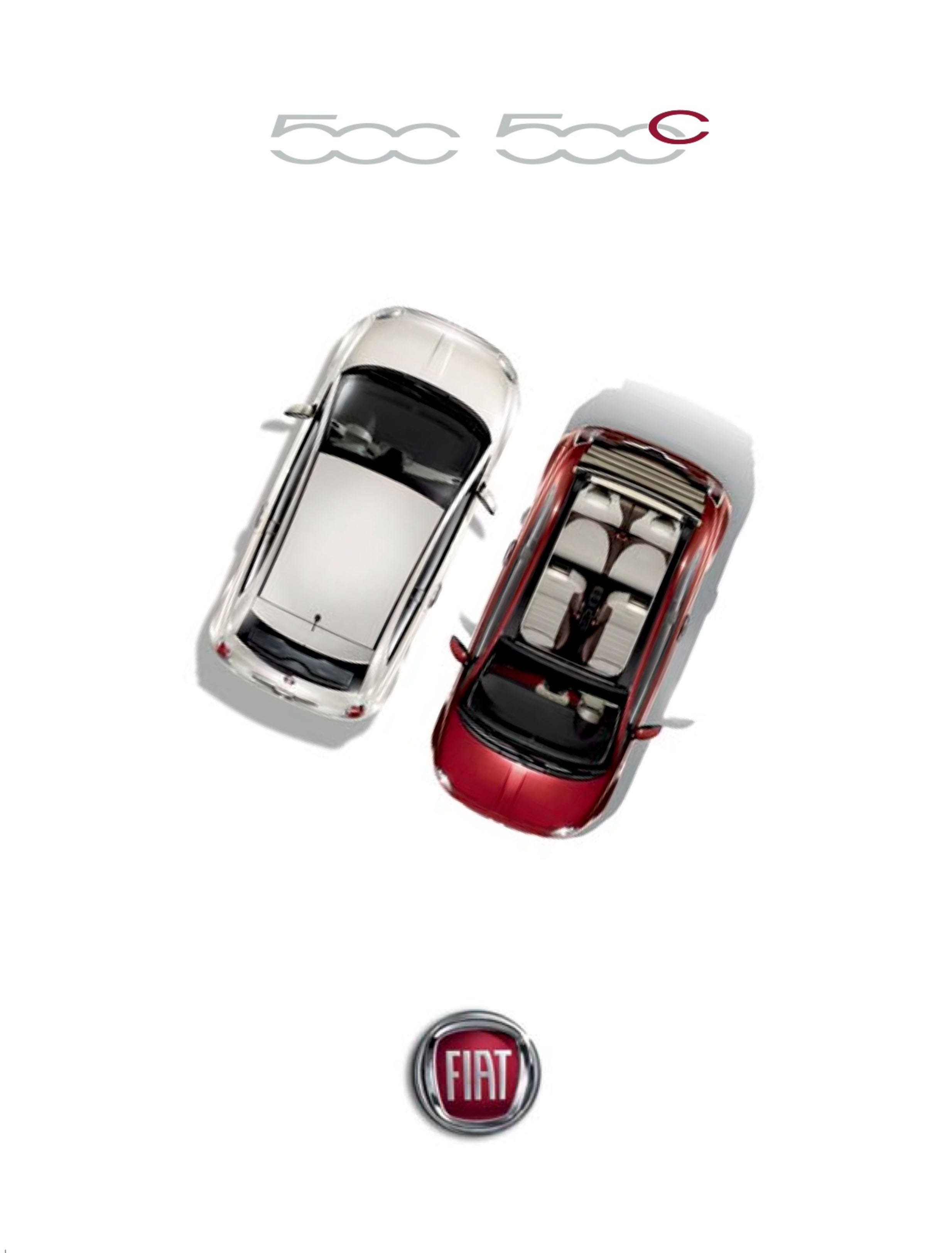
Let us take a guided tour through the launch brochure, a document that reads less like technical specification and more like a manifesto for an entirely new species of urban transport.
The Manifesto – ‘Be Happy’
The brochure opens not with a specification sheet but with a command: Be Happy. This is revolutionary. Where German manufacturers spoke of Vorsprung durch Technik and the Japanese preached reliability, Fiat was selling emotion as a standard feature. The copy speaks of “a joyful car that puts you in a good mood,” positioning the 500 not as transport but as therapy. This was 2009, remember; the depths of economic gloom, Lehman Brothers barely cold in the ground, and here was Fiat prescribing Italian sunshine as an antidote to British drizzle.
It was audacious. It was manipulative. It was brilliant. Because buried beneath the lifestyle semiotics was a genuine product insight: in an era where cars had become commodified, when any car would get you to Sainsbury’s just as effectively as any other, the differentiator wasn’t capability but character. And character, as the Italians have always understood, is an emotional proposition.
The Sardine Tin – Engineering Pragmatism as Poetry
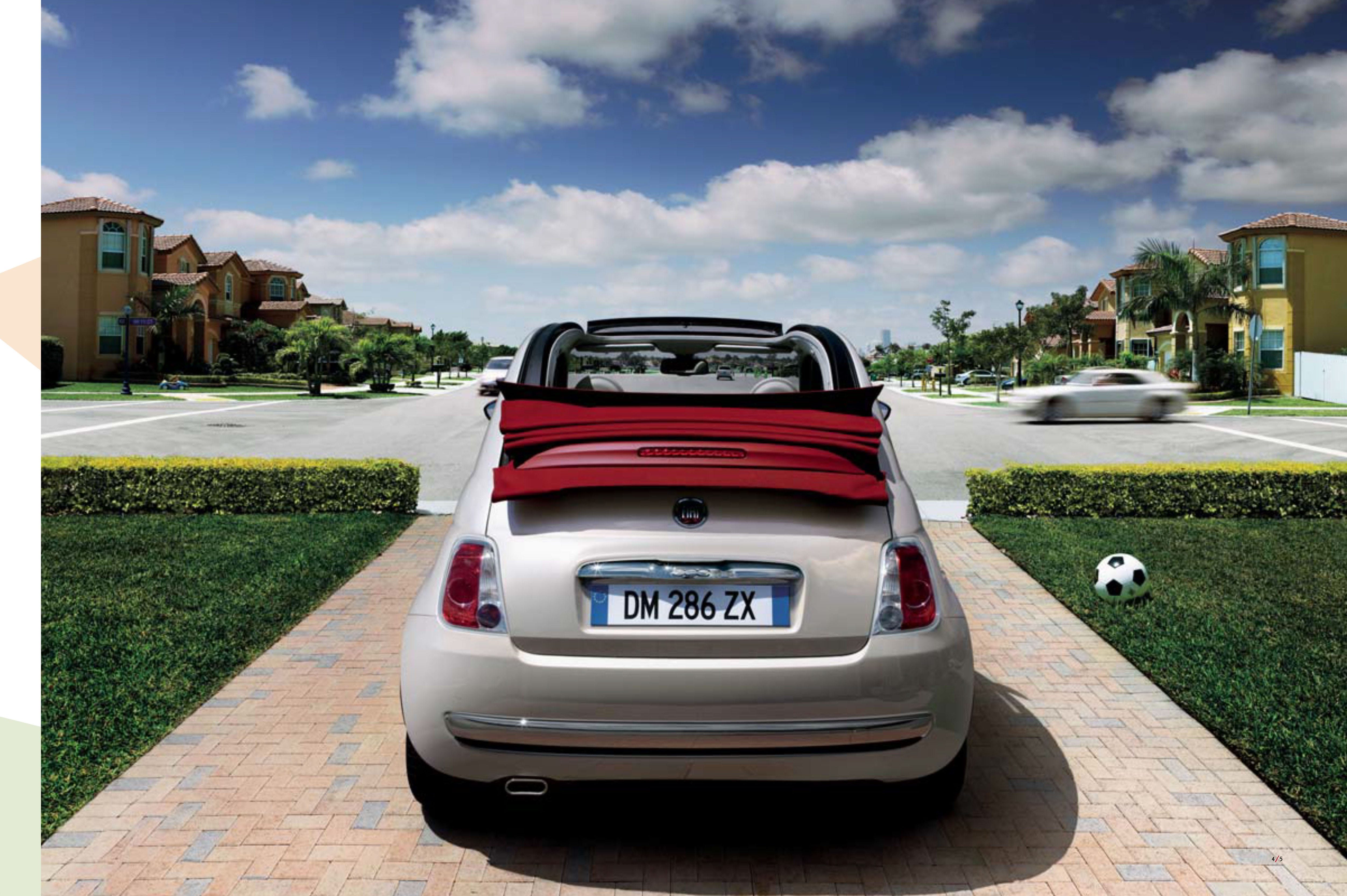
The 500C deserves particular scrutiny. Fiat’s marketing copy describes it as having a “special sardine-tin folding system,” which is either the most honest product description in automotive history or a masterclass in turning limitation into virtue. Unlike a proper cabriolet, which would require structural reinforcement, chassis strengthening, and the inevitable loss of boot space, the 500C retained its roof pillars and simply folded back a large canvas panel.
Cynics called it a sunroof with delusions of grandeur. They were missing the point. What Fiat had engineered was the feeling of open-air motoring without the compromises. You got wind-in-hair theatre whilst maintaining luggage capacity and structural rigidity. This was fake authenticity done right: a simulation so convincing it became its own kind of real. The British market, with its three weeks of annual sunshine, lapped it up.
The Urban Sophisticate
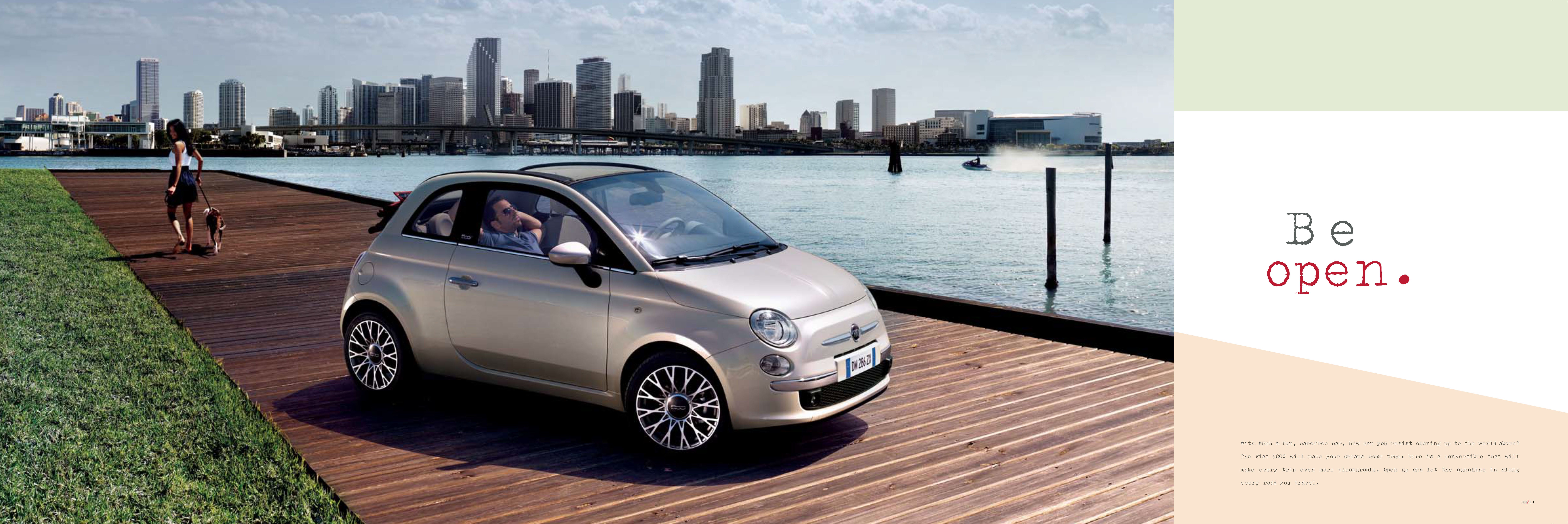
Every photograph in the brochure reinforces the same thesis: this car belongs in the city. Not tolerates it, not navigates it, but belongs there with the same natural authority as a Vespa or an Alfa Romeo. The 500 is framed against concrete and glass, steel and water, always sophisticated, never utilitarian.
Compare this to the Smart ForTwo’s positioning. The Smart was about solving the problem of urban congestion: it was traffic origami, spatial pragmatism wrapped in quirky styling. The 500 took the opposite approach: it created the desire to drive in the city. You wanted to be seen in the 500. You wanted to park it outside artisan coffee shops and independent bookshops. The Smart was a solution. The 500 was an aspiration.
This positioning was brilliant because it bypassed the traditional metrics. Who cares about A-road agility when you’re making a statement on Regent Street? Who worries about motorway refinement when your typical journey is a three-mile urban crawl punctuated by admiring glances?
Nocturnal Glamour – Technology as Theatre
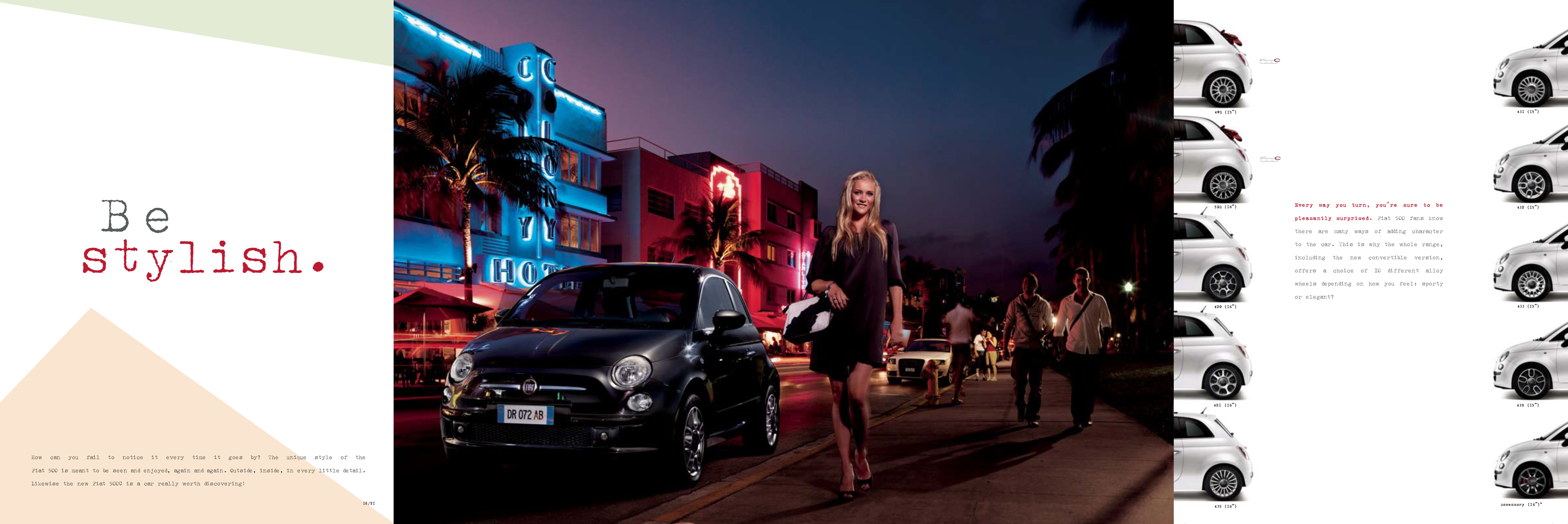
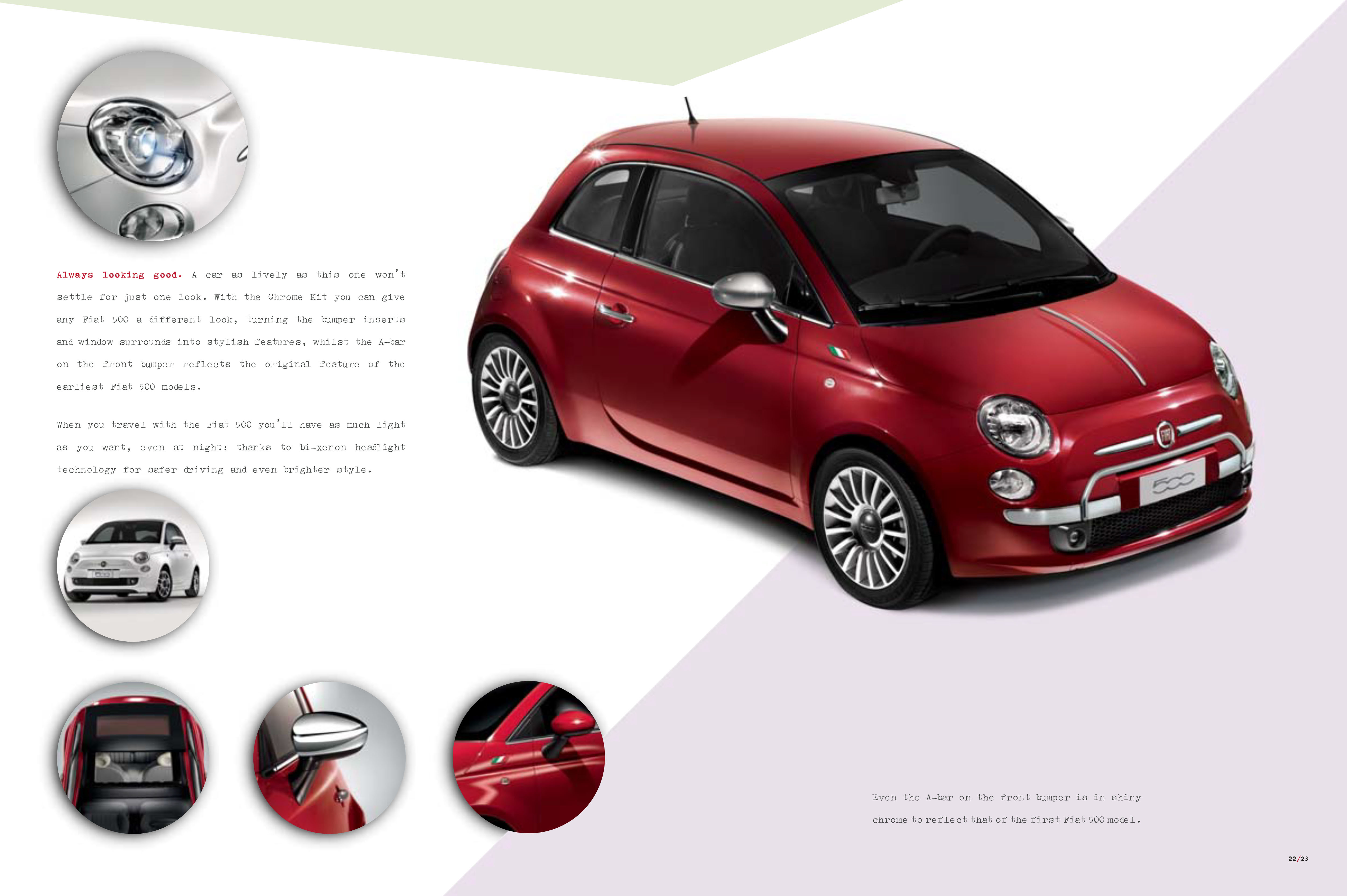
The night-time spread showcasing bi-xenon headlights is instructive. In any other brochure, this would be a safety feature: superior illumination, reduced night-driving fatigue, improved visibility in adverse conditions. Fiat’s copy? “Even brighter style.” The headlights aren’t primarily about seeing; they’re about being seen. This is technology recast as fashion, engineering subsumed into styling.
And yet, here’s where the braiding becomes essential, those bi-xenon units were genuinely excellent. Fiat hadn’t merely slapped a marketing veneer over substandard hardware. The 500 could back up its style credentials with substance. The lights were better, the Stop&Start system did reduce emissions, the Blue&Me telematic system worked. This wasn’t vapourware. It was the rare instance of marketing and engineering singing from the same hymn sheet.
The Cockpit – Trepiuno’s Legacy
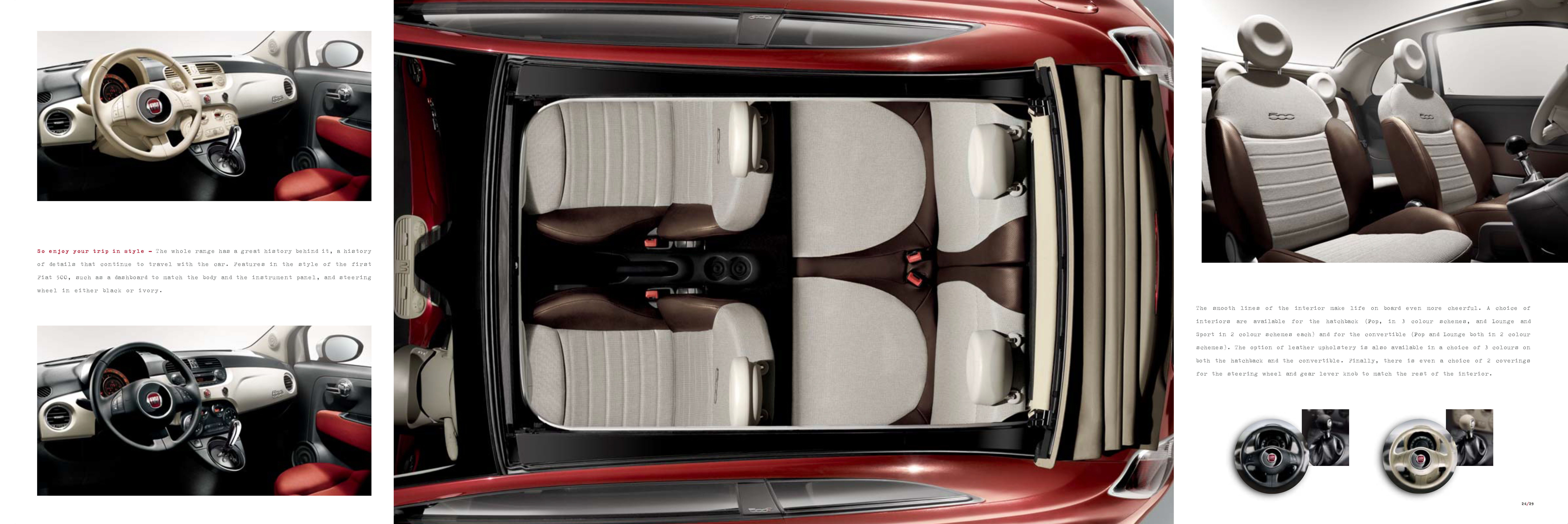
The interior was lifted wholesale from the 2004 Trepiuno concept car, and what a lineage that represented. Where the original 1957 Cinquecento had minimalism forced upon it by material scarcity, the modern version embraced it as aesthetic choice. Roberto Giolito’s design team obsessed over every surface, every switchgear, every bloody air vent.
You could colour-match the steering wheel and gear lever to your interior scheme. You could specify leather in three colours. The dashboard featured body-colour inserts. This level of customisation was unprecedented in the segment; hell, it was unprecedented at any price point below the German prestige brands. Fiat had democratised personalisation.
But here’s the critical question: was this customer service or clever manipulation? By offering 549,936 combinations, Fiat had essentially guaranteed that every buyer would feel their 500 was unique, even though they were rolling off the same production line in Tychy, Poland, by the thousand. This was mass customisation deployed as a psychological weapon. You weren’t buying a commodity; you were assembling an identity.
Global Citizenship via Sticker
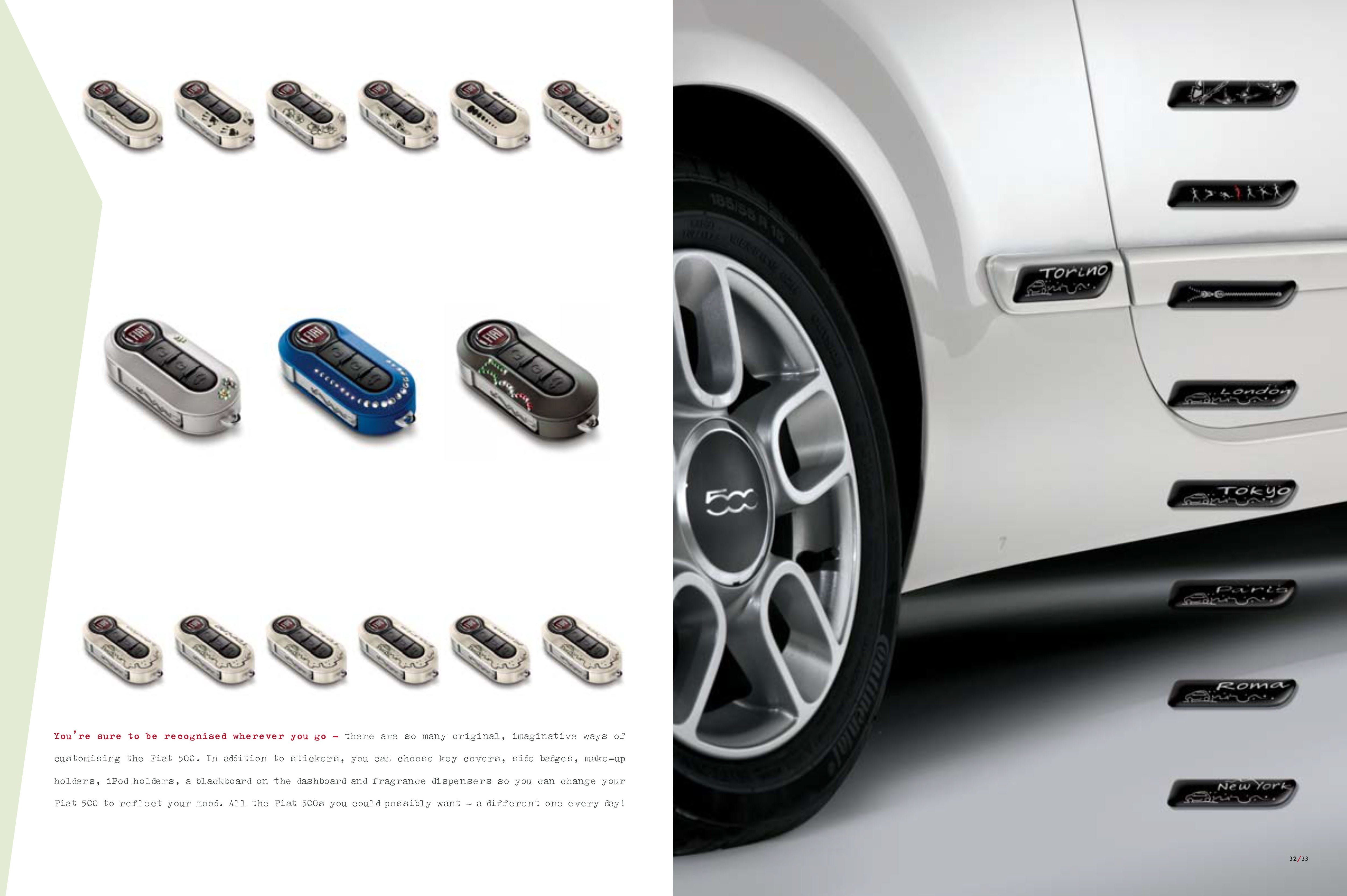
The city badge programme was either genius or absurdity, depending on your tolerance for lifestyle marketing. For a nominal fee, you could specify Tokyo, Paris, London, Roma, Torino, or New York side badges, proclaiming your cosmopolitan credentials through adhesive vinyl.
The cynic notes that these badges were pure profit margin: tooling costs near zero, perceived value substantial. The romantic argues that in an increasingly globalised world, these badges let owners telegraph their aspirations, their travels, their tribe. A Tokyo badge on the streets of Manchester was a statement: I am worldly. I am cultured. I do not merely commute; I curate my existence.
Both interpretations are correct. That’s the trick. Fiat had created a product that worked simultaneously as genuine self-expression and manufactured aspiration. The fact that people bought the badges, in volume, suggests the strategy worked.
The Digital Dashboard – Blue&Me & Microsoft’s Gamble
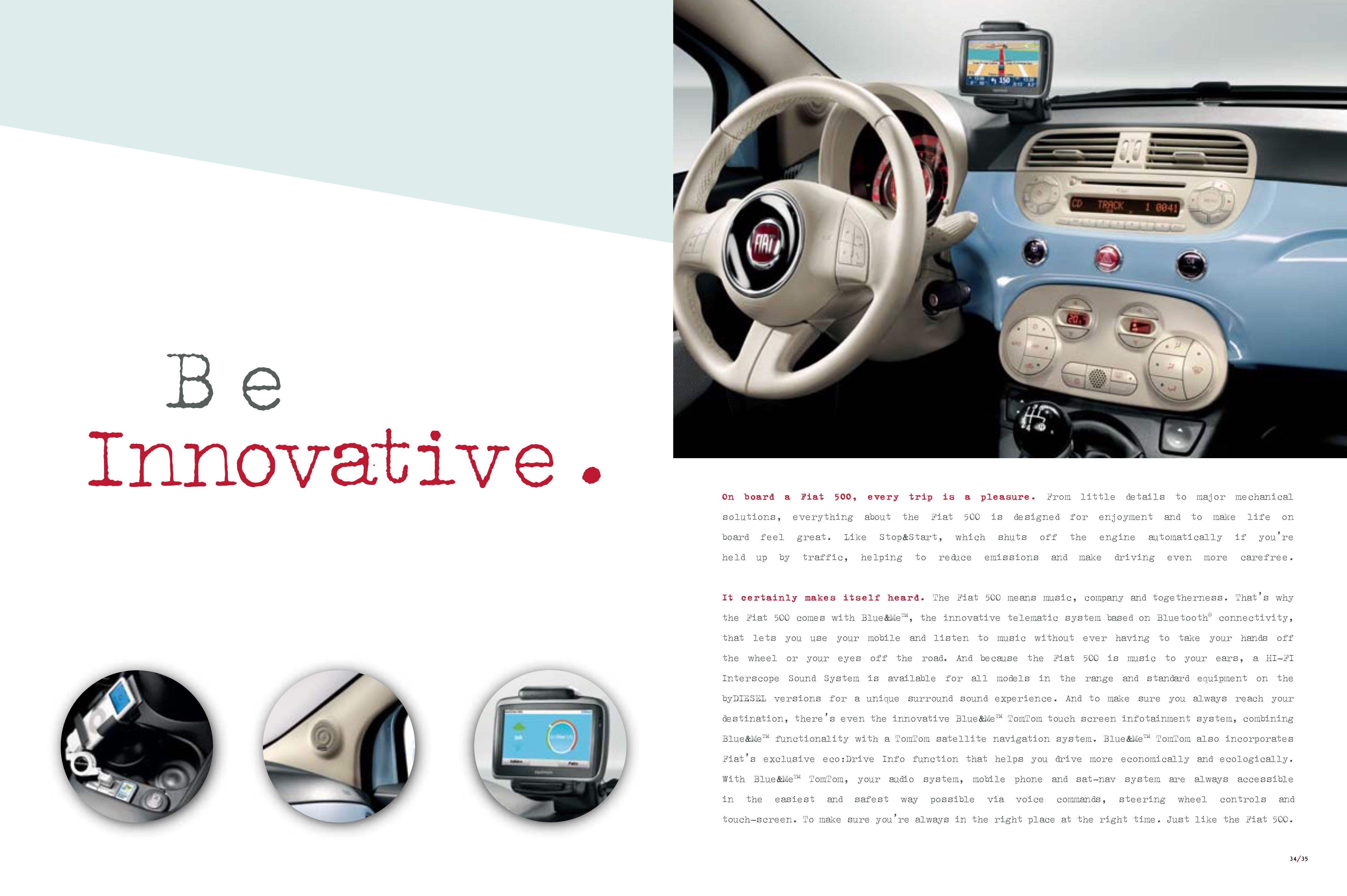
Blue&Me deserves its own case study. In 2009, before Apple CarPlay and Android Auto had colonised every dashboard, Fiat partnered with Microsoft to create a telematic system that genuinely worked. You could stream music via Bluetooth, make hands-free calls and, most impressively, analyse your driving style through the eco:Drive feature, which uploaded data via USB stick for analysis.
This was gamification before the term entered common usage. Fiat had turned fuel economy into a competitive sport, letting drivers compare their efficiency scores and improve their technique. It was brilliant psychology: instead of lecturing people about emissions, they made the game the message.
The Microsoft partnership is fascinating in retrospect. This was Redmond’s desperate attempt to gain automotive relevance before they lost the smartphone war to Apple and Google. Blue&Me was actually good: intuitive, reliable, properly integrated. But Microsoft’s automotive ambitions died anyway, killed by the iPhone and the subsequent platform wars. The 500 caught them at their zenith.
The Mechanical Heart – TwinAir’s Audacity
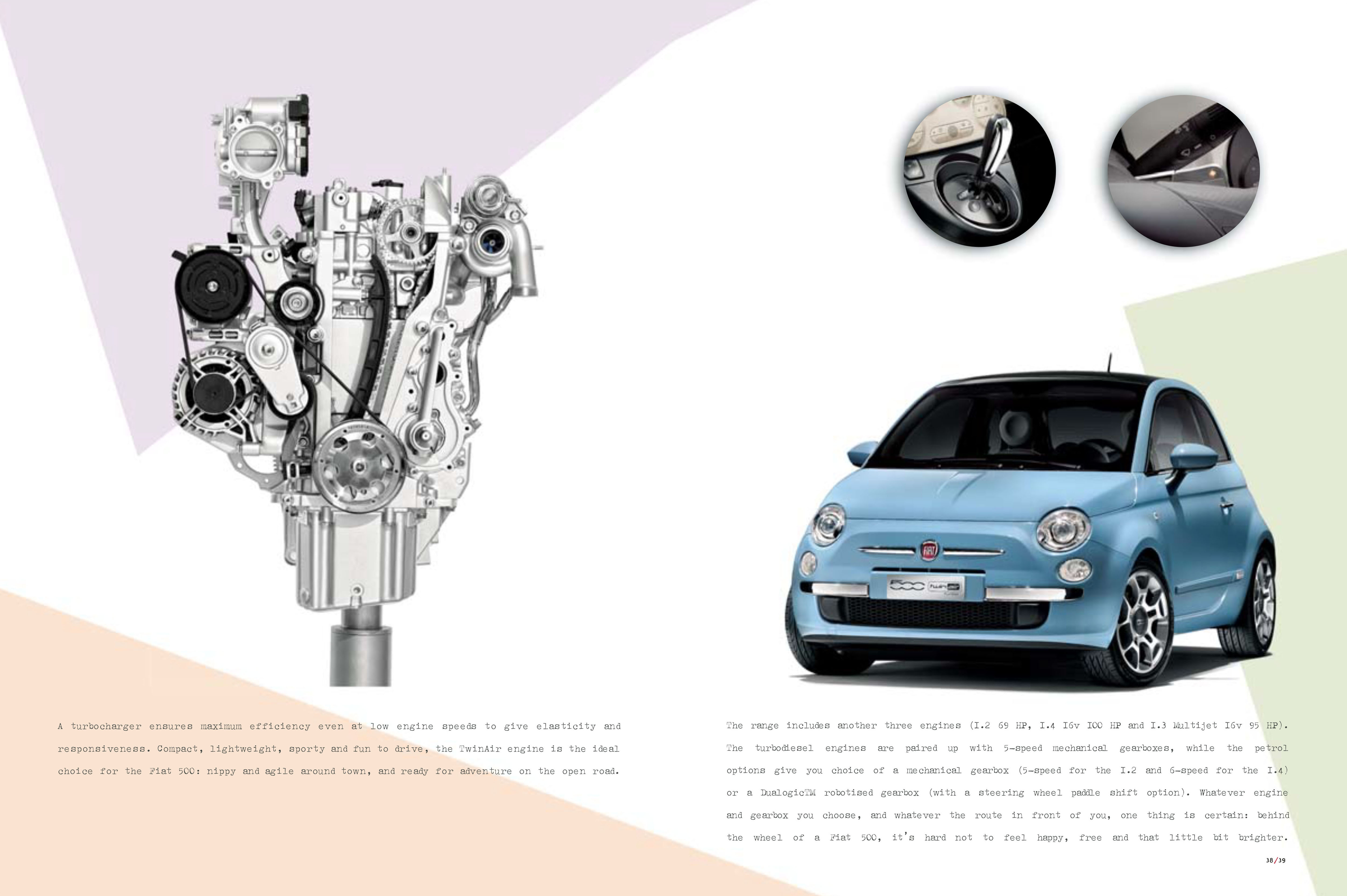
Here’s where the marketing men had to step aside and let the engineers take the stage. The 0.9-litre TwinAir turbocharged twin-cylinder was bonkers, a technical proposition so outlandish that it shouldn’t have worked. An 875cc two-pot in 2009? When even motorcycles were running inline-fours? This was either visionary downsizing or commercial suicide.
It turned out to be the former. Through electronic airflow control and high-pressure turbocharging, Fiat’s engineers coaxed 85 horsepower from two cylinders, delivering proper torque from basement revs whilst returning fuel economy that embarrassed much larger engines. The TwinAir sounded like an agricultural implement, a threshing machine with delusions of grandeur, but it had character. That distinctive thrum became its signature, proof that Italian engineers still understood the value of mechanical personality in an increasingly homogenised market.
The TwinAir won International Engine of the Year in 2011, vindication for a design that looked like madness on paper. It proved that downsizing needn’t mean dull, that efficiency could coexist with enthusiasm. The Germans were building 1.4-litre turbocharged fours; Fiat halved the cylinder count and won the argument.
American Dreams – Interstate 95 & Manifest Destiny
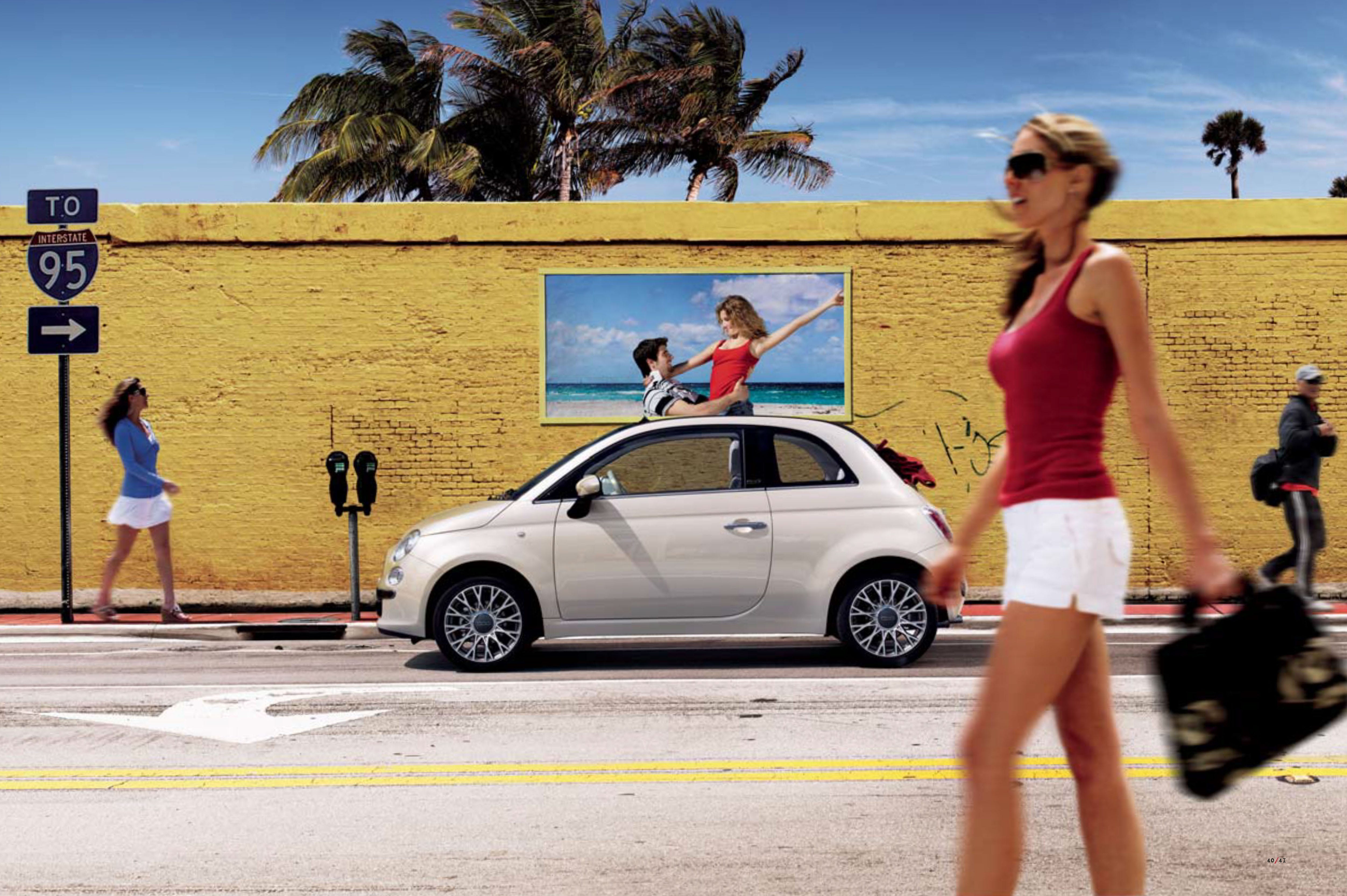
The Interstate 95 spread is fascinating when viewed through the lens of 2026. Here was Fiat, positioning the 500 for American conquest with the confidence of a company that hadn’t yet learned that Americans view small cars with the same suspicion they reserve for metric measurements and socialised healthcare.
The U.S. launch happened. The 500 found an audience, albeit a niche one concentrated in coastal cities where European sensibilities held sway. But it never achieved the cultural penetration it managed in Europe. Americans wanted the idea of La Dolce Vita, the romantic notion of Italian style and café society, but when it came time to actually write a cheque, they defaulted to crossovers and pickup trucks. The market Fiat was chasing simply didn’t exist at American scale.
This doesn’t diminish the 500’s European success, but it serves as a reminder that cultural context matters. What played as sophisticated urbanism in London or Paris read as impractical compromise in Houston or Phoenix. The 500 needed density, foot traffic, café culture. It needed cities in the European sense: compact, walkable, human-scaled. American suburban sprawl was its natural enemy.
Fashion Fusion – The Diesel Collaboration
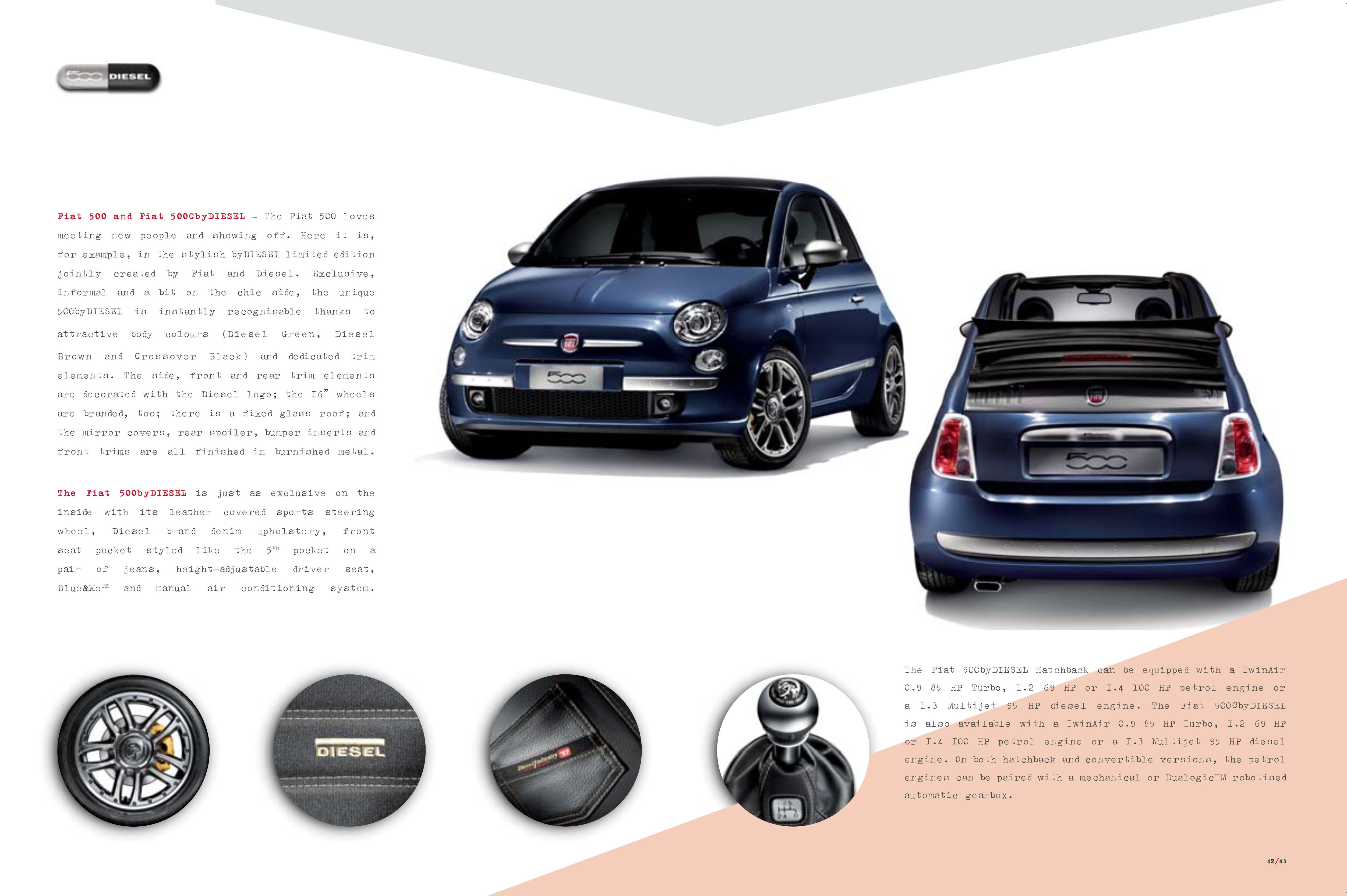
The 500byDIESEL edition represents the logical endpoint of Fiat’s lifestyle positioning. Denim upholstery. Burnished metal finishes. Seat pockets styled after five-pocket jeans. Diesel branding scattered throughout. This should have been catastrophic; automotive/fashion collaborations usually produce nothing but cringe.
But it worked. Why? Because Fiat had already established the 500 as a fashion object. The Diesel collaboration wasn’t a departure; it was an escalation. This was a car designed to be worn and Diesel, with their expertise in wearable identity, understood the brief perfectly. The denim seats weren’t mere trim; they were a statement. This car’s owner doesn’t just drive; they curate.
The fact that these limited editions retain value today, that they’re genuinely collectible, suggests Fiat and Diesel achieved something remarkable. They created an object that transcended its transport function, becoming instead a cultural artefact. How many cars can claim that?
The Rearview Mirror: 2026 Perspective
Seventeen years downstream from the UK launch, what has the 500 taught us?
First, it proved that retro-modernism could sustain a product line indefinitely, if executed with sufficient conviction. The VW New Beetle aged badly, its literal-mindedness and American optimism curdling into ironic nostalgia. The BMW MINI became bloated, losing the plot entirely by the third generation. The 500 stayed true to its silhouette whilst evolving its substance. When Fiat transitioned to the electric 500e in 2020, it felt inevitable rather than jarring. The fashion appeal remained constant; only the powertrain changed.
Second, it demonstrated that personalisation could be monetised at scale without alienating customers. Those 549,936 combinations weren’t merely marketing hyperbole, they were genuine choice. And choice, as every economist knows, creates perceived value. By letting customers assemble their own identity, Fiat transformed a commodity transaction into a creative act. You weren’t buying transport; you were authoring yourself.
Third, it proved that engineering and marketing needn’t be adversaries. The TwinAir was simultaneously a technical tour de force and a character generator. The Blue&Me system was both functional telematic integration and lifestyle enabler. Fiat understood that in the modern market, these dimensions must braid together. You can’t fake substance with style alone, and substance without style won’t sell.
Most importantly, the 500 proved that emotion is a legitimate engineering goal. Whilst rivals optimised for 0-60 times and Nürburgring lap records, Fiat optimised for happiness. That opening spread, ”Be Happy”, wasn’t marketing fluff. It was the product brief. Every design decision, every specification choice, every customisation option served that singular purpose: to make the owner feel good about themselves and their choice.
Did it work? The numbers suggest yes. The 500 has sold over 2 million units globally. It’s won countless design awards. It’s appeared in fashion magazines as often as automotive publications. Most tellingly, it’s retained value better than almost any rival in its segment. People want these cars. Even used examples command respect.
The 2009 Fiat 500 wasn’t the best car in its class by any objective measure. The Ford Fiesta drove better. The Toyota Yaris was more reliable. The Volkswagen Polo was more refined. But none of them made you feel the way the 500 did. None of them let you telegraph identity through 549,936 combinations. None of them came with city badges and fragrance dispensers and the option to match your gear lever to your dashboard.
They were cars. The 500 was an accessory. And in the end, that made all the difference.