
The Knuckle Duster: Ford’s 300bhp Gamble on Front-Wheel Drive
The Rally Car Hiding in a Family Hatchback

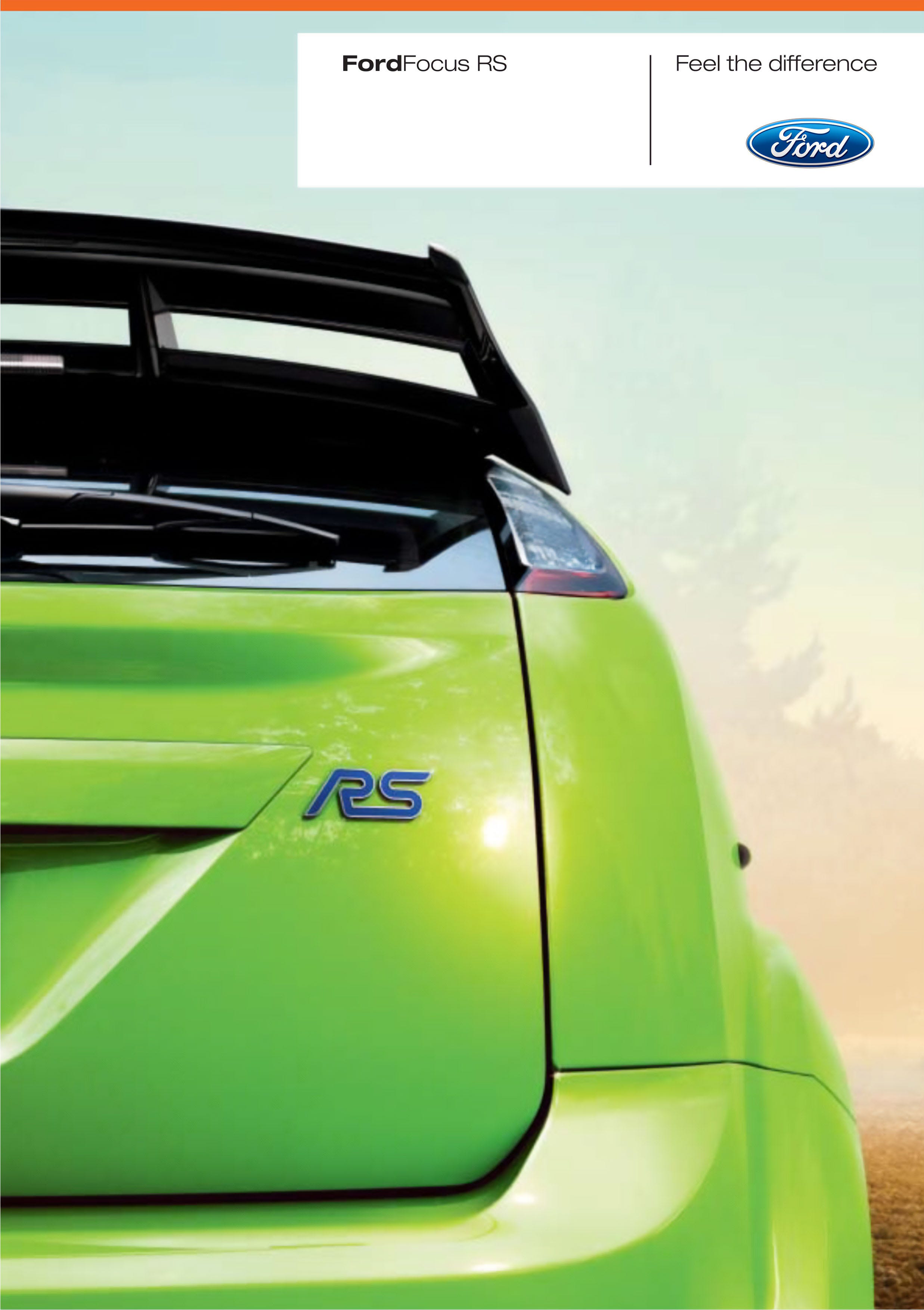
The question the 2008 Ford Focus RS brochure asks its reader is not whether they want the car. It is whether they can handle it.
The December 2008 UK brochure is not a subtle document. Six pages. Five-cylinder grunt. One colour so aggressively green it reads less as a paint option than as a declaration of intent. Page three states the challenge plainly: “A 300 BHP high-performance engine. Aggressive RS styling. And a short fuse. Can you handle it?” In automotive brochure history, asking the customer whether they are actually qualified to buy the product is either extraordinary arrogance or extraordinary honesty. In the Focus RS’s case, it is both.
Neon-Industrial Hyper-Realism and the Brochure as Workshop Manual
The aesthetic identity of this brochure has no precedent in the Ford catalogue. Macro photography of mechanical components treated as gallery sculpture, lit with the clinical precision of a surgeon’s lamp and set against atmospheric industrial shadow. A MacPherson strut knuckle assembly, photographed in close detail, sits in pools of deep shadow as if it were a Henry Moore. A ventilated brake disc, occupying a sixth of a page, has the presence of something much larger. A stack of coil springs curls into the frame with the sensuous tension of a nautilus shell.
The brochure’s designers understood that the Focus RS’s engineering was its most distinctive feature, and they photographed it accordingly. The car itself, draped in Ultimate Green, appears in full-body shots that are almost secondary to the component portraits. You are being invited to see the mechanics before the machine, to understand the argument before the vehicle makes it. It is, for Ford, an unusually confident intellectual position.
The colour palette does the rest. Ultimate Green, a shade that is somewhere between acid and vegetable and entirely too loud for a company that also sells the Mondeo, fills the right-hand pages while technical copy occupies the left. The typography is spare, modern, and sans-serif; the brochure never shouts its words because the photography is already shouting. There is no gold leaf here, no lifestyle photography of people laughing beside their cars. The brochure contains, to my count, precisely zero human beings. It is a document about machinery in the way that a watch catalogue is a document about movement: the assumption is that you are already sufficiently interested.
The RevoKnuckle
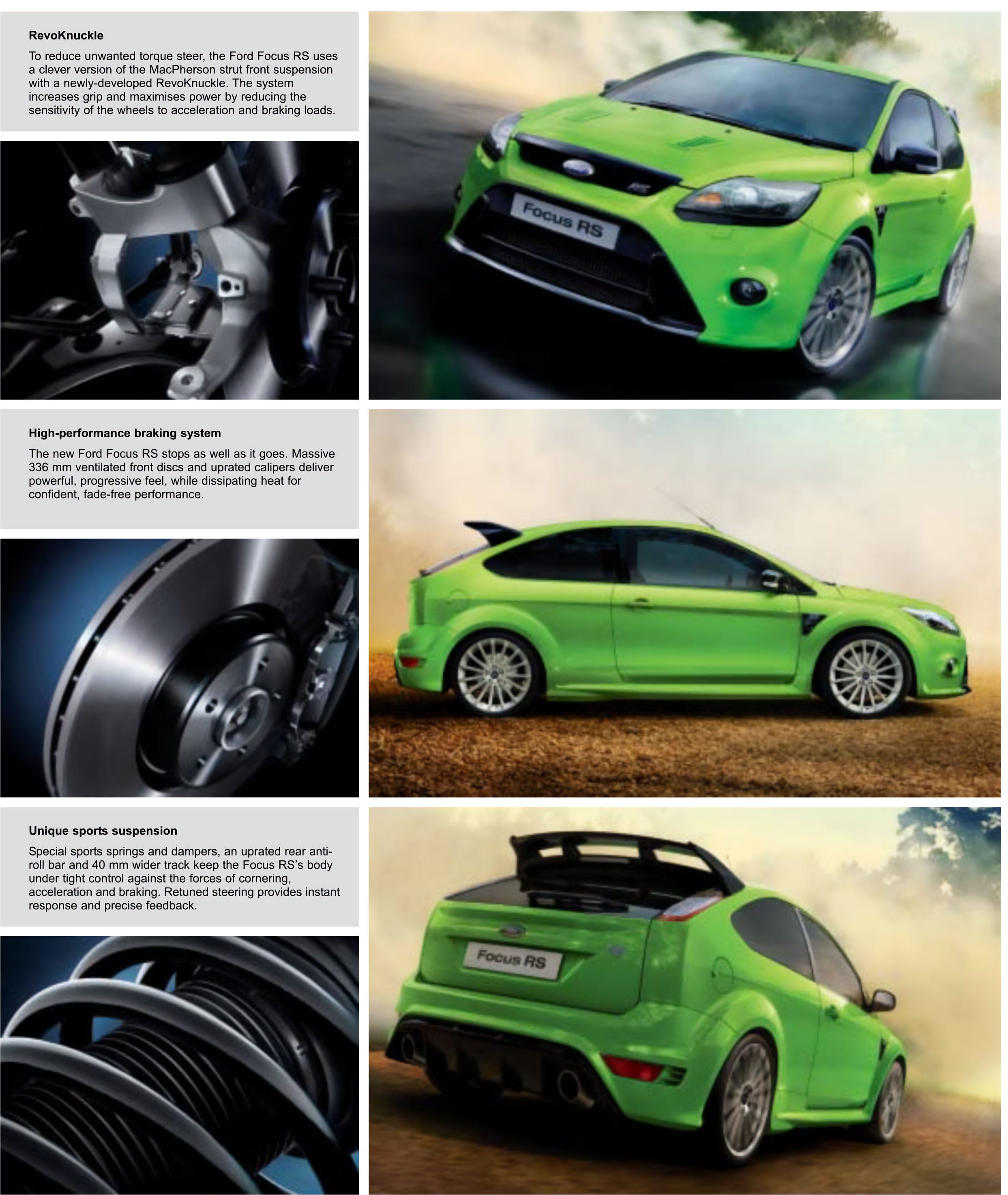
Page two opens with a heading that no previous Ford brochure had required: “RevoKnuckle”. It sounds like a fighting move, which is probably the point. The brochure’s explanation is technically precise and strategically placed: Ford’s engineers developed a modified MacPherson strut front suspension in which the outer swivel bearing was relocated to decouple steering inputs from suspension loads. The result, in the brochure’s words, was a system that “increases grip and maximises power by reducing the sensitivity of the wheels to acceleration and braking loads”.
What the brochure is managing here, with admirable directness, is a confession dressed as a feature. Torque steer, the tendency of a high-powered front-wheel-drive car to wrench the steering wheel sideways under hard acceleration, is the engineering problem that the entire performance industry had concluded made putting 300bhp through the front wheels impossible.
The brochure acknowledges this, names the problem, and then introduces the solution:
“To reduce unwanted torque steer, the Ford Focus RS uses a clever version of the MacPherson strut front suspension with a newly-developed RevoKnuckle.”
The word “unwanted” is doing unusual work; it implies that some torque steer is perhaps acceptable, even characterful, which the RS badge has historically agreed with.
The macro photograph beside this copy shows the knuckle assembly in profile: machined aluminium, articulated joints, and the geometry of something designed by people who disagreed with physics, and had the mathematics to prove it. It is, for a suspension component, a genuinely beautiful image.
The Anchor
The braking section deploys a photograph of a ventilated front disc, occupying a sixth of the page, though photographed with enough clinical intimacy that it feels larger. The disc is 336 mm across. The callipers are uprated. The brochure makes the argument efficiently: the Focus RS “stops as well as it goes”.
On page four, the brochure will ask whether you can handle the car. The braking section, arriving earlier, is a quieter form of the same challenge: a reassurance that carries real weight precisely because the machine it is reassuring you about has just been described as one that could surpass you.
“Powerful, progressive feel, while dissipating heat for confident, fade-free performance” is the language of a car that expects to be driven hard repeatedly, not just quickly once. Progressive feel matters; it implies a pedal that tells you what is happening rather than simply happening to you. For a car sold on the premise of mechanical purity and driver engagement, a braking system that communicates is as important as one that decelerates. The brochure understands this in a way that many performance car brochures do not.
The Heart
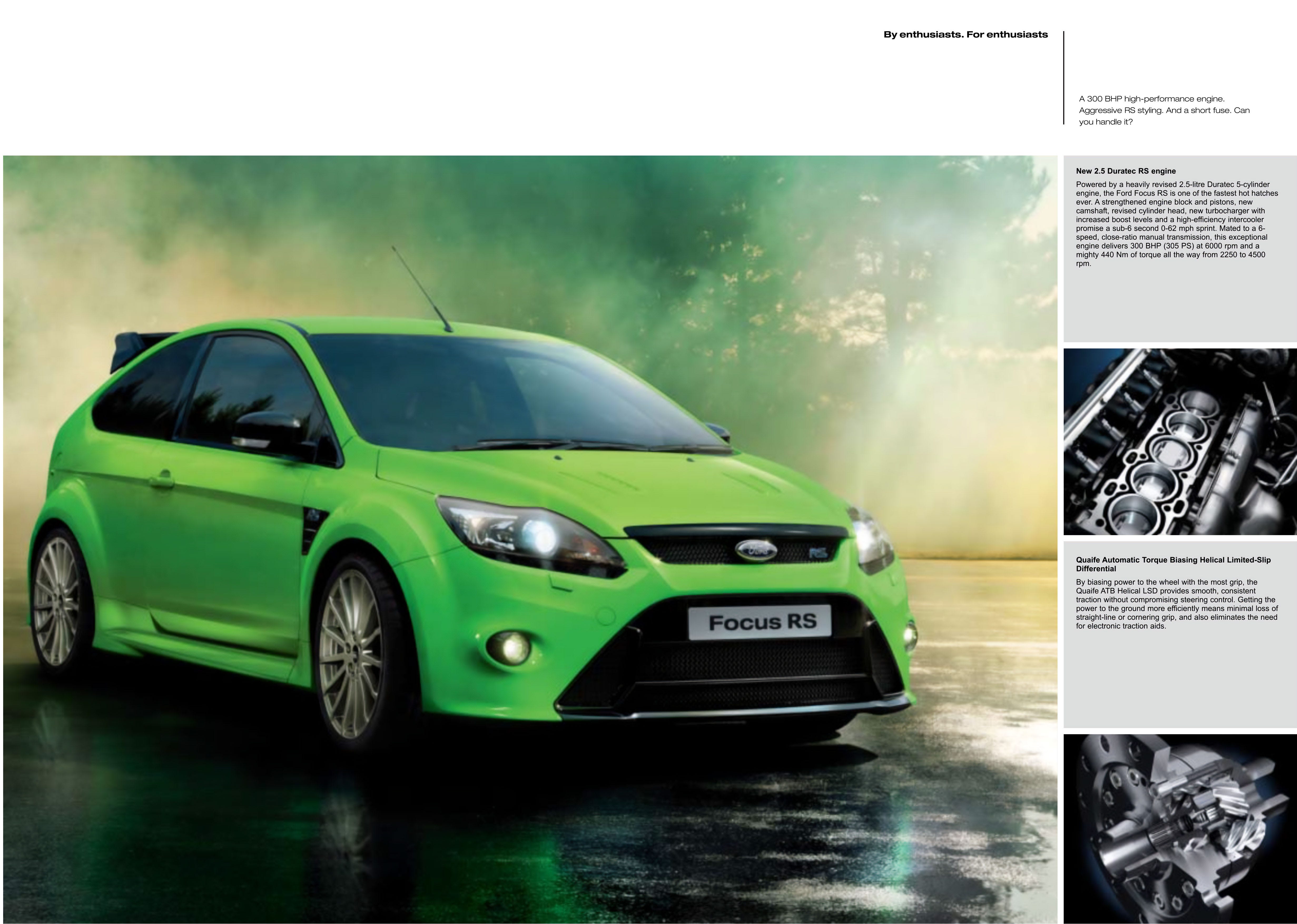
Pages three and four are where the brochure sharpens to its point. The hero spread is a full-width shot of the Focus RS in Ultimate Green against a mist-softened expanse of wet tarmac, the background dissolving into indistinct trees and humid air. It could be a B-road at night, or a test track at dusk; the point is that the surface beneath the car is real and the weather is hostile and the car looks entirely at home in both. On the right, a small block of text introduces the five-cylinder Duratec RS engine with the confidence of a man who knows he is holding the strongest card at the table.
“Powered by a heavily revised 2.5-litre Duratec 5-cylinder engine, the Ford Focus RS is one of the fastest hot hatches ever.” The sentence earns its claim: 300bhp (305PS) at 6,000rpm; 440Nm of torque from 2,250 to 4,500rpm; 0-62mph in under six seconds.
The engine’s origins are worth noting. The Duratec in the Focus RS was not shared with the Focus ST beneath it in the range; it was a substantially different unit, with a strengthened block, uprated pistons, new camshaft profiles, a revised cylinder head, an enlarged turbocharger with increased boost pressure, and an intercooler redesigned for greater efficiency. The brochure catalogues these changes with the thoroughness of a committee report, though significantly more interesting to read, because each modification is a direct response to the question: how do you extract 300bhp from a 2.5-litre five-cylinder engine that must survive repeated enthusiast use and still start first-time on cold January mornings?
The five-cylinder configuration deserves its moment here. Five cylinders produce a firing interval that is fundamentally irregular in a way that four- and six-cylinder engines are not, and the acoustic result is a warble, a mechanical cadence that is immediately recognisable and impossible to fully describe in print. Ford’s engineers knew this. The brochure does not specifically mention it, but the RS community has, exhaustively, in the years since. It is perhaps the most sonically interesting engine note in any mainstream hot hatch of its era, and the brochure’s decision not to mention it suggests either editorial restraint or the recognition that you cannot describe the sound of a five-cylinder Duratec on boost in technical prose without sounding either unhinged or inadequate.
The Traction Logic
Below the engine section, the brochure turns to the Quaife Automatic Torque Biasing Helical Limited-Slip Differential, described with a specificity that signals this is not a badge-engineered afterthought. The Quaife ATB is professional motorsport equipment. In 2008 it was being fitted to rally cars and racing saloons as a means of managing power delivery without the lag and unpredictability of electronic intervention. Ford installed it as standard. The brochure doesn’t frame this as racing technology transferred to the road, but that is the implicit argument of every sentence in this section.
The Quaife ATB LSD “biases power to the wheel with the most grip” while providing “smooth, consistent traction without compromising steering control”. The key sentence follows: “Getting the power to the ground more efficiently means minimal loss of straight-line or cornering grip, and also eliminates the need for electronic traction aids.”
The same logic applies to the RevoKnuckle. The geometry that separates steering forces from suspension loads under hard acceleration is a solution developed in the context of competition, where torque steer at the wheel is not an inconvenience but a liability. Ford’s engineers had been working on rally cars to solve this problem for decades. The brochure presents the RevoKnuckle as a new invention; it is, more precisely, an application of lessons the sport learned the hard way, made available to anyone who could write a cheque and answer “yes” to the question on page four.
Eliminates the need. In 2008, electronic traction control was becoming standard equipment on performance cars in the way that airbags had become standard a decade earlier. To position its absence not as an economy measure but as a positive outcome of mechanical excellence was a significant rhetorical gamble. The Quaife partnership was Ford’s argument that the Focus RS had solved the power-to-tarmac problem mechanically, without the intermediary of software. For a buyer who wanted to feel the physics rather than have the physics managed for them, this was the correct argument to make.
The Heritage Claim
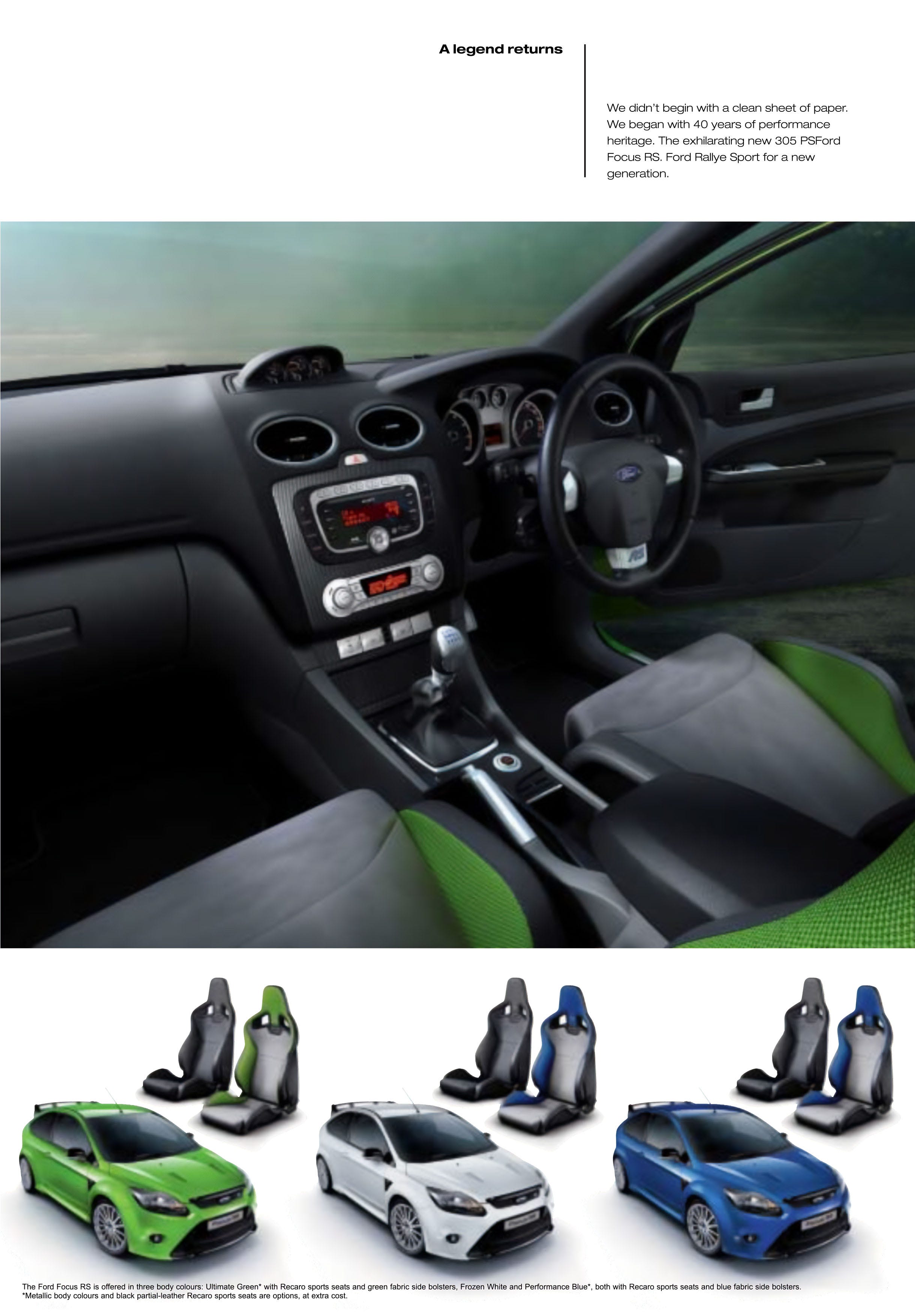
Page five arrives with a heading that shifts tone entirely: “A legend returns”. The copy beneath is the brochure’s most overtly sentimental passage: “We didn’t begin with a clean sheet of paper. We began with 40 years of performance heritage. The exhilarating new 305 PS Ford Focus RS. Ford Rallye Sport for a new generation.”
The RS badge at Ford is genuinely old money. It traces its lineage to the Escort RS1600 of the early 1970s, through the RS2000, the Sierra RS Cosworth with its whale-tail absurdity, and the original Focus RS of 2002. The heritage claim is not aspirational; it is historical. The brochure knows this and invokes it with appropriate directness. The Focus RS is not pretending to a performance lineage that doesn’t exist; it is completing one.
The page also shows the three available body colours in miniature: Ultimate Green with green fabric Recaro bolsters, Frozen White with blue fabric Recaro bolsters, and Performance Blue with blue fabric Recaro bolsters. The colour combinations suggest a brochure written for people who will remember what their car looked like parked outside a venue twenty years from now. Ultimate Green is not a colour you choose if you want your car to be forgotten.
The Rearview Mirror: A Weapon Licensed for the Road
The Problem: The Tyranny of the Drivetrain
The RevoKnuckle worked. The Quaife differential worked. The Focus RS Mk2 achieved what Ford set out to prove: that 300bhp could be channelled through the front wheels of a family hatchback without producing a car that was simply too violent to enjoy. But the market, in the years that followed, moved anyway. When the Mk3 Focus RS arrived in 2016, it used all-wheel drive. The industry had concluded that beyond 300bhp, the front-wheel-drive argument became too costly in engineering terms to sustain, and too compromising in real-world terms to sell. The Mk2 is remembered as the final proof-of-concept rather than a blueprint; a demonstration of the possible that commercial reality eventually superseded.
The Tax: Liners and Bolsters
The 2.5-litre five-cylinder engine that makes the Focus RS so sonically and dynamically distinctive has one well-documented failure mode: cracked cylinder liners, typically resulting from sustained hard use in engines that have been modified beyond factory specification, or in units that have been driven aggressively without the coolant system being properly maintained. The block, strengthened for the RS application, is robust in standard form; it is what owners subsequently ask of it that creates the vulnerability. The lesson is the one that applies to all high-output turbocharged engines from this era: they reward careful stewardship and punish the opposite proportionally.
The Recaro seats deserve mention. The bolsters, upholstered in Ultimate Green or Performance Blue fabric, are both the car’s most distinctive interior feature and its most common wear item. Lateral support adequate for track use is not compatible with long-term fabric durability in daily service; the outer edges of the bolsters show wear on even relatively low-mileage examples. Re-trimming in the correct fabric is possible, expensive, and complicated by the specificity of the colour options.
The Success: The One That Got Away, and Stayed
The Focus RS Mk2 is, in 2026, a blue-chip modern classic. Its values have appreciated substantially beyond those of the Mk3 that succeeded it, despite the Mk3’s additional technological complexity and all-wheel-drive traction. This is a reversal that would have been difficult to predict at launch, and it tells you something important about what buyers value in retrospect.
What they value is the purity of the argument. The Mk2 RS did something improbable through mechanical elegance rather than electronic compensation. The five-cylinder warble at full boost, the steering weight through the RevoKnuckle geometry, the direct communication of the Quaife differential: these are qualities that software cannot replicate and that subsequent generations of performance cars, reaching for more power and more intervention by electronic systems, have made progressively rarer. The Mk2 Focus RS is worth more than the Mk3 not despite its limitations but because of them; it is the last car that made a virtue of necessity and convinced you, at full chat on a damp B-road, that necessity was actually the point.
The brochure, for its part, understood this from the first page. The question it asked of its reader was not “do you want this car?”. but “can you handle it?”. In 2026, that question reads not as arrogance but as foresight. The people who answered yes, and looked after what they bought, are sitting on something that gets more valuable every year.
The Fine Print
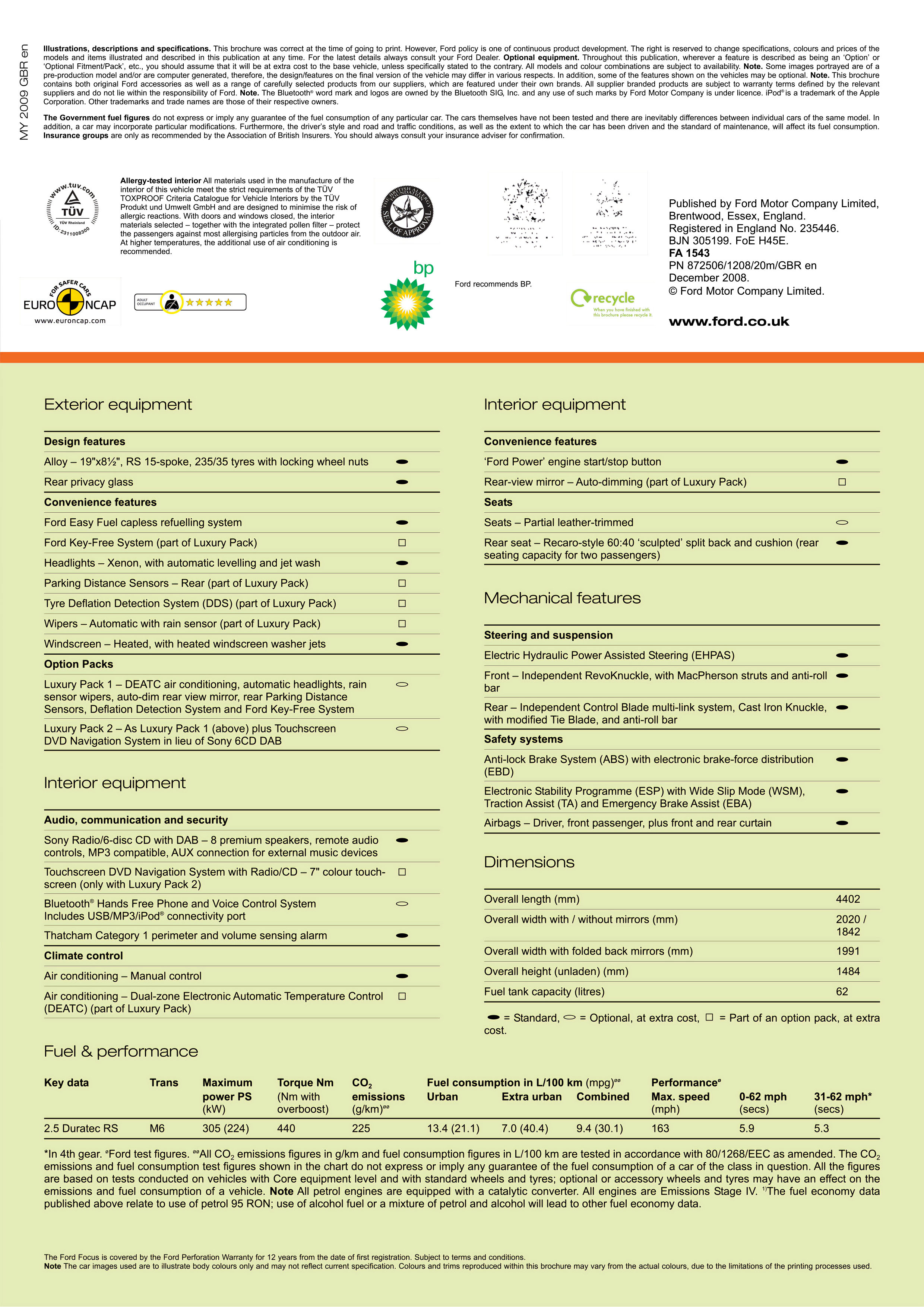
Notable anomalies: The rear seat, in Recaro style, is sculpted for two passengers only, giving the Focus RS an effective capacity of four. Ford listed this as a feature rather than a compromise, which is the correct way to read it.