Tochigi Technic: The 9,000rpm Birthday Card
Honda’s 50th anniversary gift in aluminium and VTEC

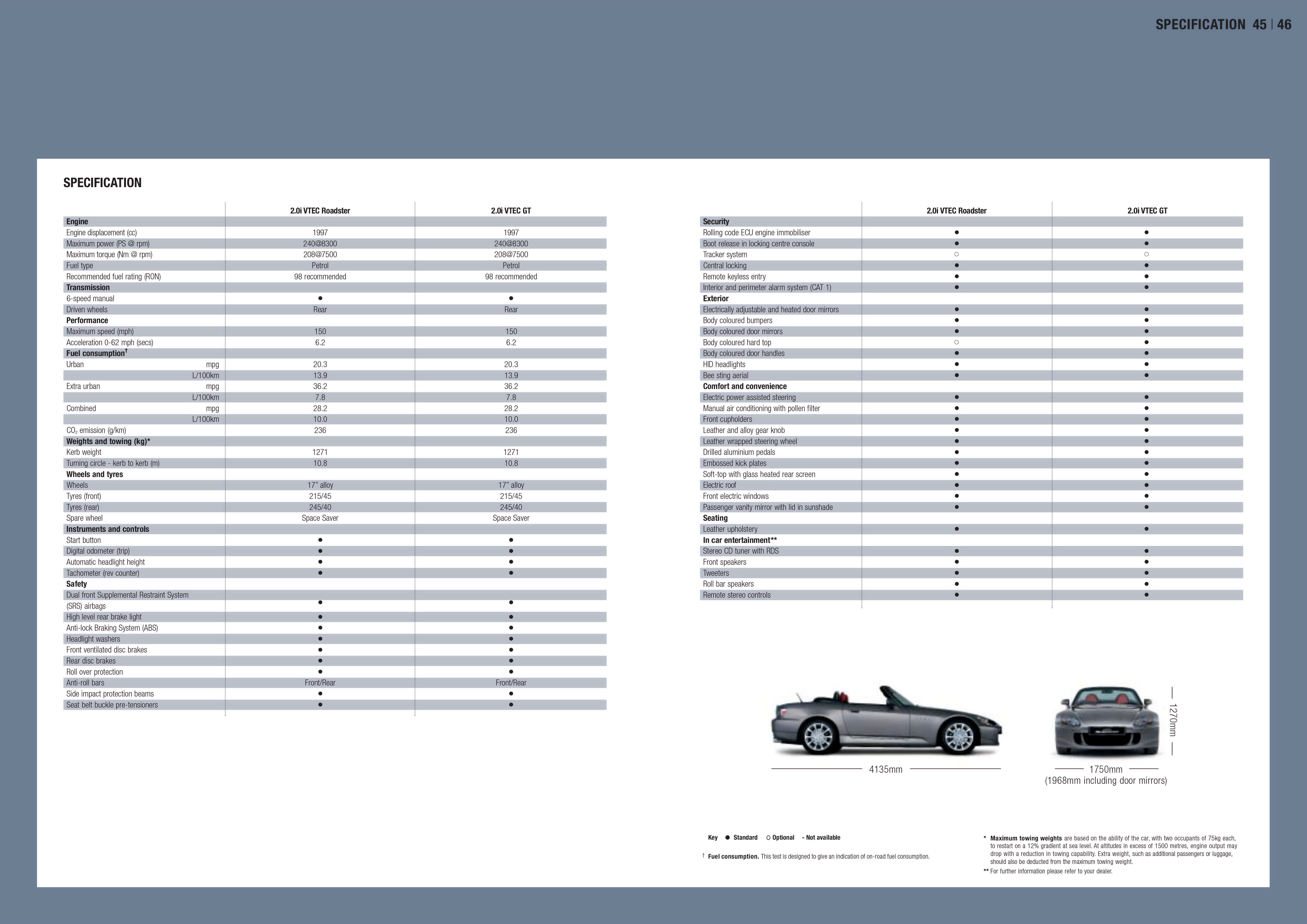
The Honda S2000 is a machine that greets you with an illuminated start button, a digital tachometer that sweeps to 9,000rpm, and an inline-four engine that produces 237bhp from two litres of displacement. That figure (118.7bhp per naturally aspirated litre) was not just class-leading in 2006; it was a world record for a production engine that did not involve forced induction or the kind of mechanical sorcery typically reserved for Formula One paddocks.
The S2000 was not built to compete. It was built to celebrate. Fifty years of Honda engineering, fifty years of motorsport victories, and fifty years of the philosophy that Soichiro Honda himself supposedly whispered to his engineers: “Build what you believe in, and the market will follow.”
The 2006 UK brochure does not present this car as a product; it presents it as a manifesto. A 64-page document that treats engineering precision as an art form and a birthday as an excuse to build something completely unreasonable.
The central paradox of the S2000 is this: it is a roadster designed to behave like a race car, sold to buyers who expected it to behave like a roadster. The brochure doesn’t flinch from this tension; it leans into it with the confidence of a company that has spent decades in motorsport at the highest level. Every page whispers the same promise: this is not a car for posing. This is a car for driving.
Tochigi Technic: The Aesthetic of Precision
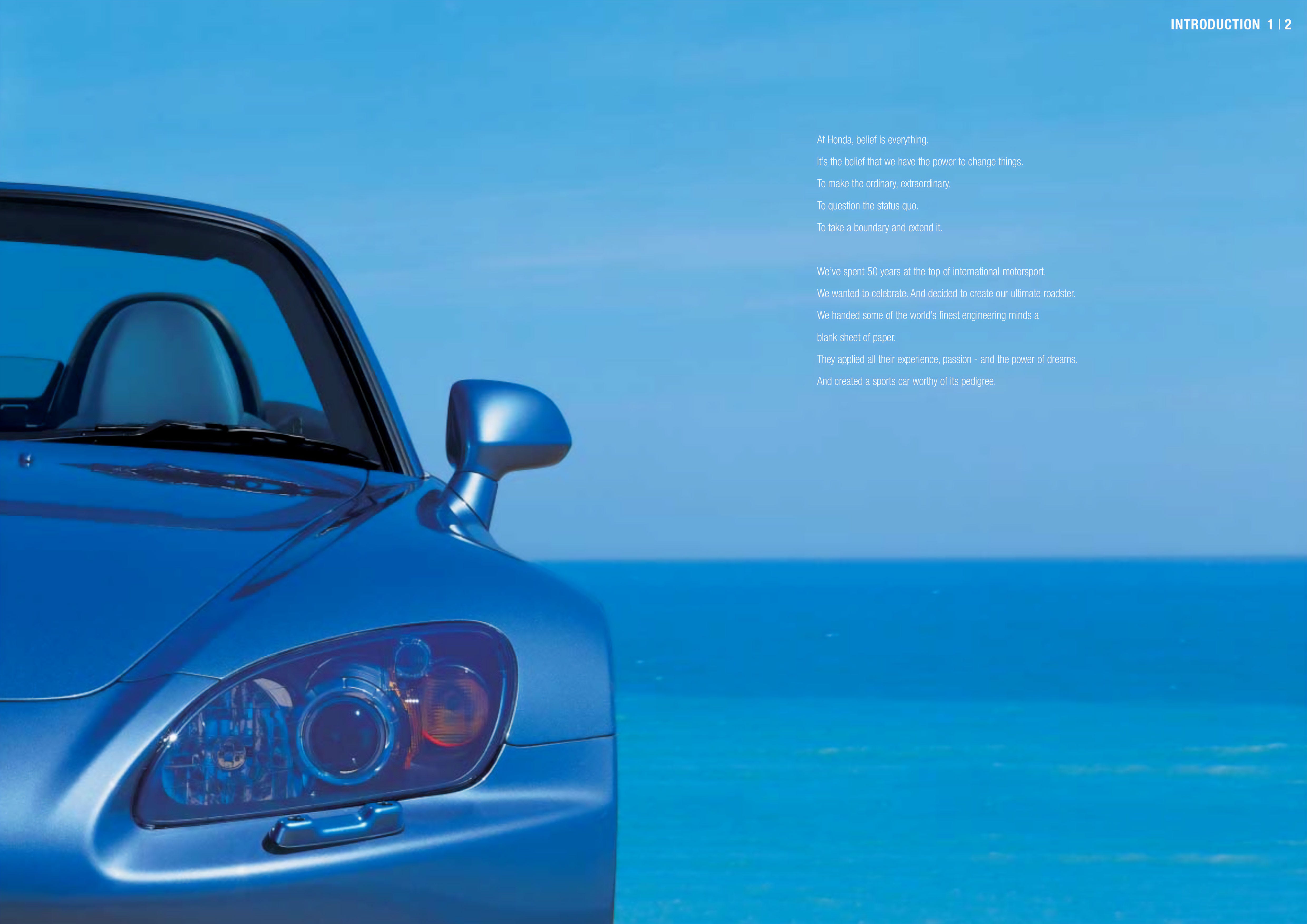
The brochure opens with a philosophy, the words arranged like a poem:
“At Honda, belief is everything... It’s the belief that we have the power to change things. To make the ordinary, extraordinary.”
This is not marketing copy; this is a mission statement. The typography is clean, modern, sans-serif. White text on a palette of blues. The photography that follows is split into two visual languages: Lifestyle-heavy outdoor shots of the car on mountain roads and coastal highways, and clinical macro studio details rendered like mechanical jewellery.
This is the visual language of a company that builds racing motorcycles and Formula One engines treating a roadster like a laboratory experiment. The brochure does not sell you a dream of convertible summers and romantic drives; it sells you the dream of being good enough to deserve 9,000rpm.
The Pedigree: A Lineage Written in ‘S’
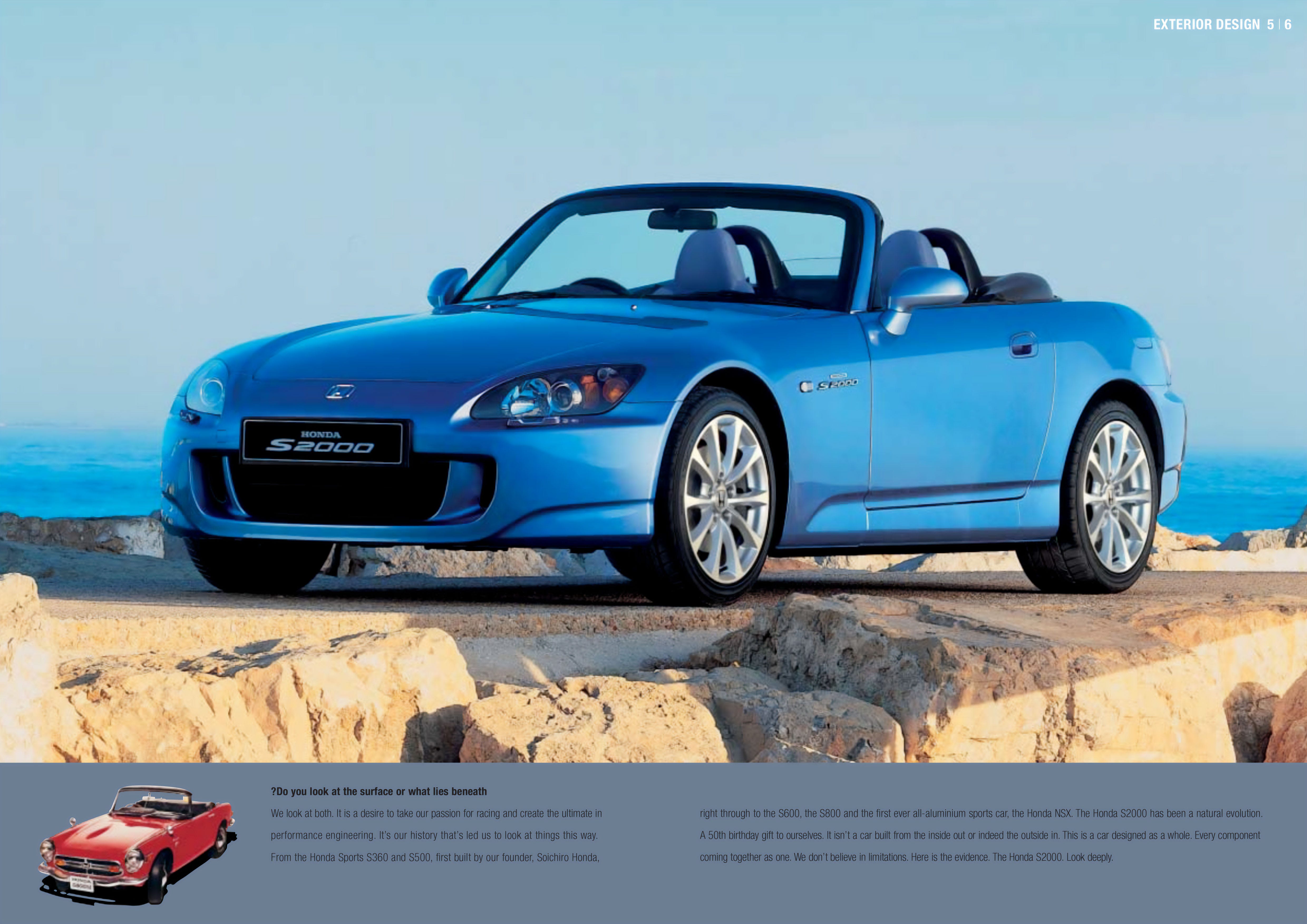
Page four is devoted entirely to history. The 2006 S2000 dominates the spread, while a colour photograph of the 1963 S500 (the first production car Honda ever built) sits in the bottom left corner. The visual connection is immediate: both are open-top roadsters, both have long bonnets and short rear decks, and both wear the letter 'S' as a badge of intent.
“The Honda S2000 has been a natural evolution. A 50th birthday gift to ourselves.”
This is the brochure at its most direct. The S2000 is not a response to the Porsche Boxster or the BMW Z4; it is a response to 1963. Honda is building this car because Honda has always built this kind of car. The implication is clear: other manufacturers chase markets; Honda chases its own ghost.
The S500 produced 44bhp from 531cc (a specific output of 82.9bhp per litre). The S2000 produces 237bhp from 1997cc (a specific output of 118.7bhp per litre). The mathematical arc is not coincidental, Honda has spent forty-three years learning how to extract power from displacement and the S2000 is the graduation thesis.
The Cockpit: A Fighter Jet for the Road
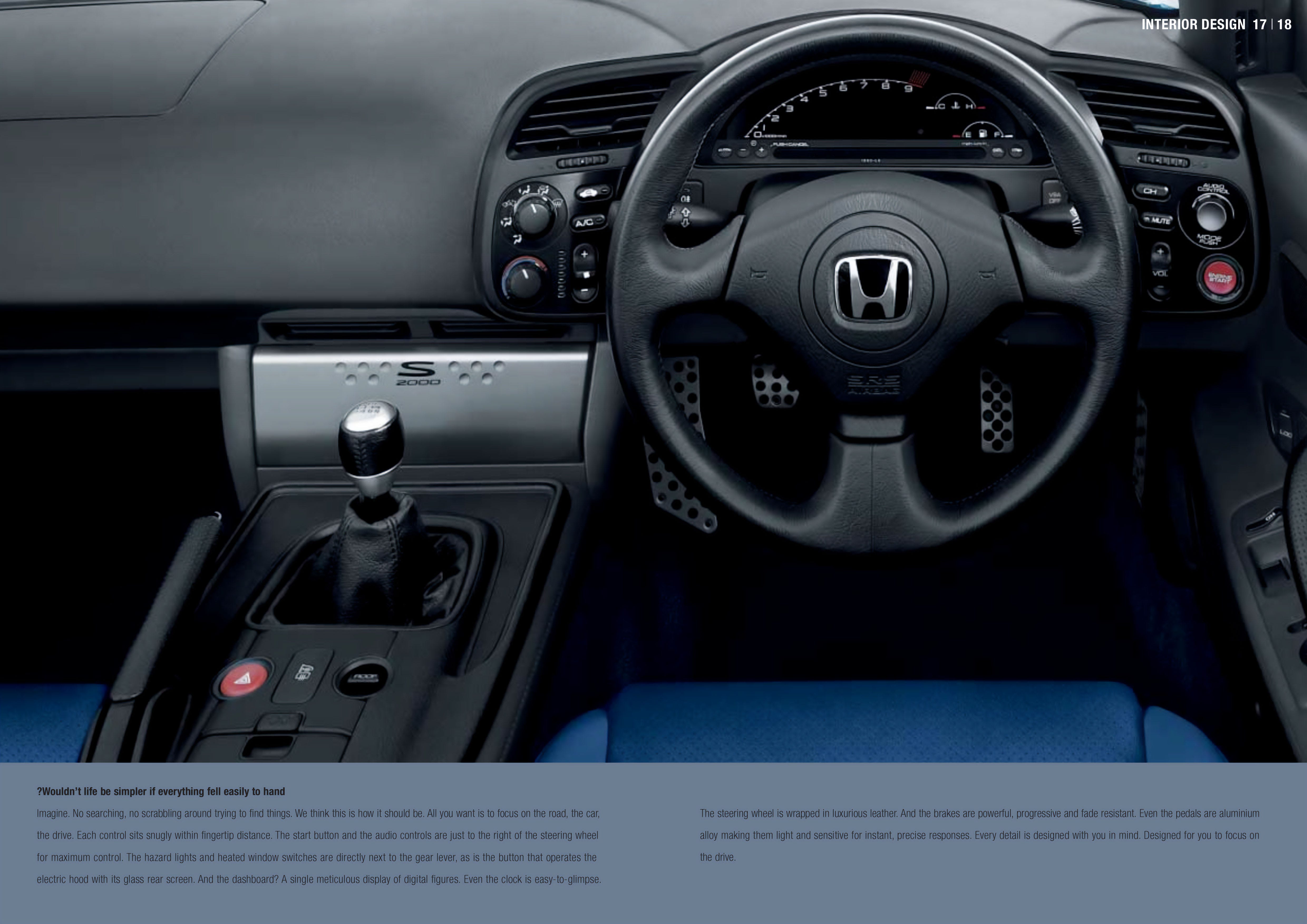
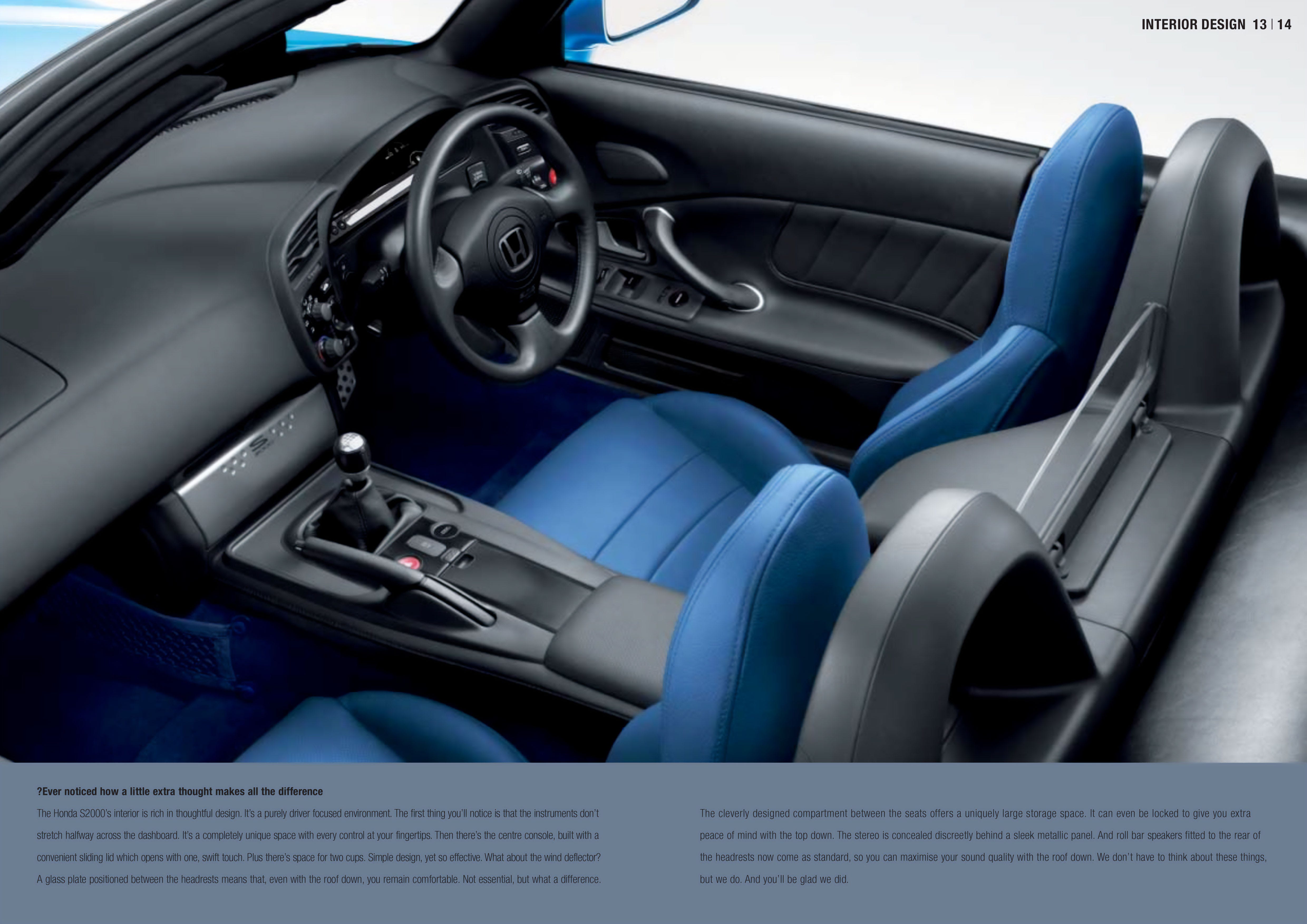
Page ten is a driver’s-eye-view photograph of the S2000’s interior, and it is glorious in its single-mindedness. The digital tachometer dominates the instrument cluster, a sweeping arc that runs from zero to 9,000rpm in white numerals, with a redline that begins at 8,300rpm and a rev limiter that cuts in at 9,000. The speedometer is smaller, almost an afterthought. The message is clear: this car does not care how fast you are going; it cares how fast you are revving.
“All you want is to focus on the road... Each control sits snugly within fingertip distance.”
The brochure calls this “meticulous ergonomics”, but what it really is, is the absence of distraction. There is no infotainment screen, no touch-sensitive climate controls, no ambient lighting. The S2000’s interior is a study in tactile minimalism: aluminium pedals, a leather-wrapped steering wheel, a six-speed gear lever with a spherical knob machined from solid metal. The start button glows red, a single piece of theatre in an otherwise utilitarian space.
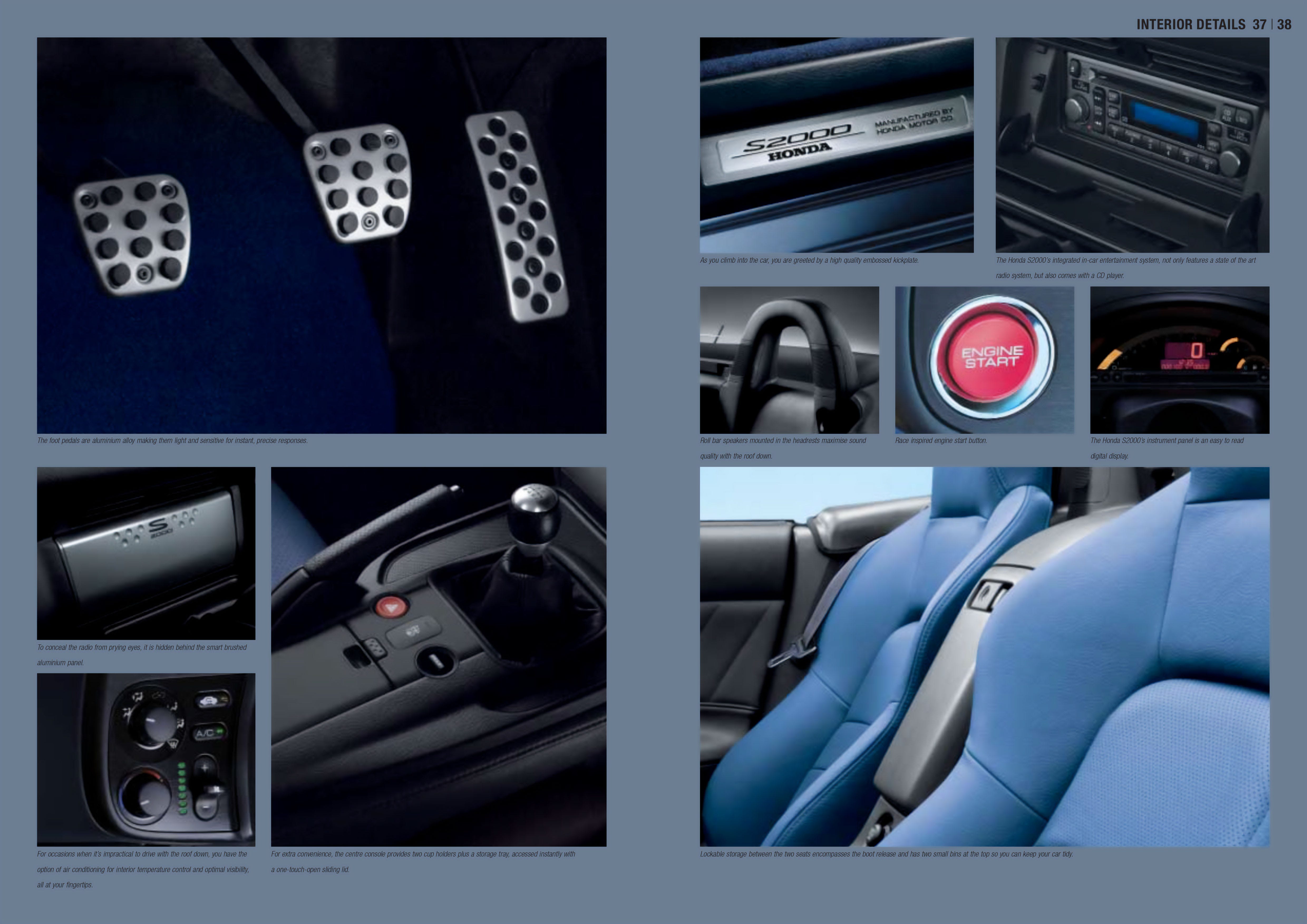
The brochure devotes two entire pages to a grid of close-up interior photographs: the pedals, the gear lever, the handbrake, the air vents. Each component is presented in isolation, like a museum exhibit. The copy on Page twenty-five reads:
“True driving pleasure lies in precise control.”
This is the philosophy at its purest. The brochure does not tell you the interior is beautiful; it shows you the engineering and trusts you to reach that conclusion yourself. The pedals are aluminium; weight-saving as a design language. The gear lever is not just short; it is positioned exactly 150mm from the steering wheel, the optimal distance for a six-foot-tall driver to shift without moving their elbow.
The Heart: 8,300rpm and the Religion of VTEC
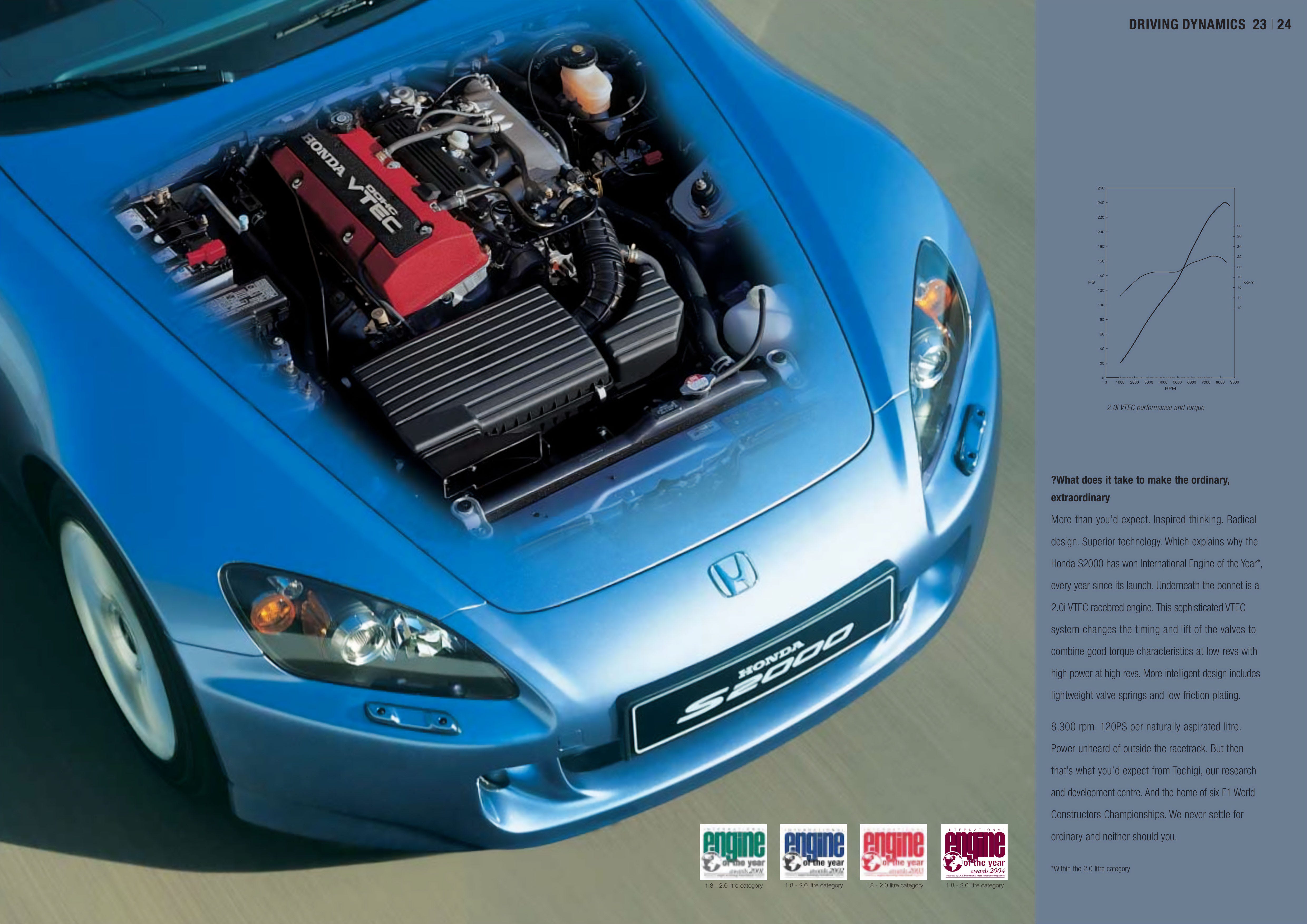
And then, Page twenty-three. A full-page photograph looking down on the bonnet of the S2000. The bonnet is rendered partially transparent, revealing the F20C engine nestled beneath. The photograph is lit with dramatic precision, the engine presented as a mechanical centrepiece.
“8,300rpm - 120bhp per naturally aspirated litre. Power unheard of outside the racetrack.”
This is the S2000’s ecclesiastical moment. The F20C is a 1997cc inline-four engine with VTEC (Variable Valve Timing and Lift Electronic Control), Honda’s proprietary system for switching between two sets of cam profiles. Below 6,000rpm, the engine uses mild cam profiles for torque and fuel efficiency. Above 6,000rpm, the VTEC system engages the aggressive cam profiles, and the engine transforms. The power curve does not climb gradually; it surges. The sound changes from a muted hum to a mechanical howl. The entire experience is visceral, almost violent.
The brochure does not explain VTEC in technical detail; it assumes you already know. The copy simply states that the system “changes timing... to combine good torque... with high power”, and leaves it at that. This is a brochure written for enthusiasts, not casual buyers. If you need convincing that 237bhp from two litres is extraordinary, this car is not for you.
The specific output of 118.7bhp per litre was, at the time, the highest of any naturally aspirated production engine. Ferrari’s 360 Modena produced 400bhp from 3.6 litres (111.1 bhp per litre). Porsche’s Boxster S produced 280bhp from 3.2 litres (87.5bhp per litre). The S2000’s F20C was not just competitive; it was untouchable.
The Crash Test Facility: When Existing Standards Fall Short, Build Your Own
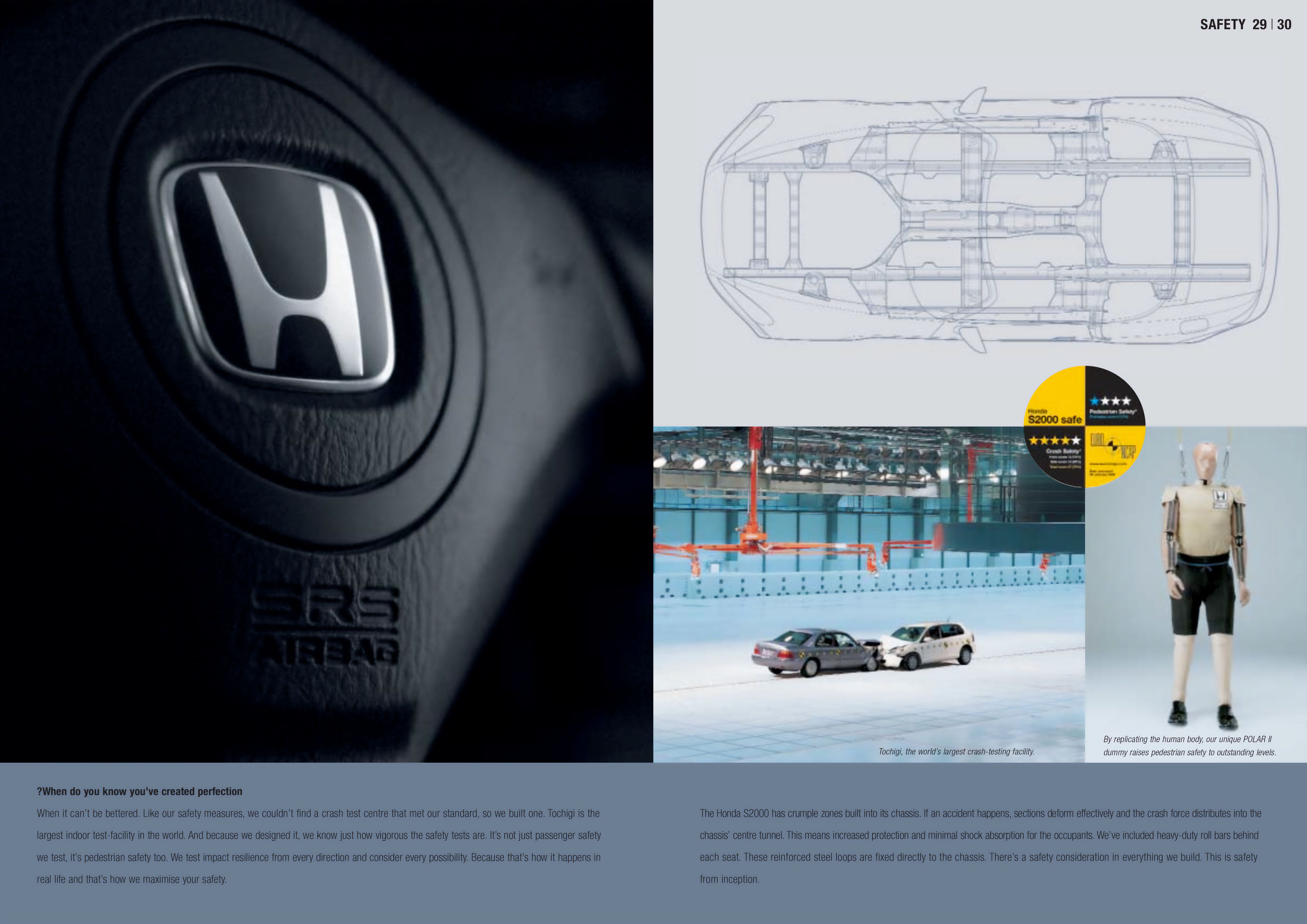
Page twenty-nine is perhaps the most Honda moment in the entire brochure. A photograph of a crash test facility (grey walls, fluorescent lighting, a crumpled S2000 mid-impact) is accompanied by the following copy:
“We couldn’t find a crash test centre that met our standard, so we built one.”
This is the mentality that built the S2000. Honda could not find a crash test facility that could test a lightweight aluminium roadster at high speeds, so Honda built its own. The Tochigi facility is not mentioned by name in the brochure, but the implication is clear: Honda does not outsource excellence.
The Rearview Mirror
The Problem: The “Torque Gap” Psychology
The S2000 disappointed, commercially, because it refused to compromise. At launch in 1999, and throughout its life, critics and buyers alike found the 153lb ft torque figure deeply unimpressive compared to turbocharged rivals. While Honda marketed the VTEC system as combining “good torque” with “high power”, the reality was that casual buyers could not adjust to a car that only came to life above 6,000rpm.
In an era where turbocharged engines delivered flat torque curves and effortless mid-range punch, the S2000 demanded skill. You had to learn to drive it, to keep the engine in the VTEC zone, to plan overtakes in advance. For driving enthusiasts, this was the entire point. For everyone else, it was a hassle.
The S2000 sold approximately 110,000 units over its eleven-year production run. The Mazda MX-5 of the same era sold over 800,000. The market spoke: it wanted a roadster, not a race car with a soft-top.
The Tax: The “Keep It Genuine” Premium
By 2026, the S2000 has moved from used bargain to collector’s item. Values have soared since 2015. Early cars (1999-2003 AP1 models with the 9,000rpm redline) now command significant premiums for clean examples. Late cars (2004-2009 AP2 models with the 8,300rpm redline and revised suspension) are similarly sought after. Limited-edition models like the UK-market Type GT command premiums of 30-50% over standard cars.
The F20C engine is famously bulletproof, but only if maintained obsessively. Valve clearances must be checked every 25,000 miles. The brochure’s recommendation of 98 RON fuel is not a suggestion; it is a requirement. Use 95 RON for extended periods, and the engine will develop carbon buildup on the valves, leading to poor VTEC engagement and, eventually, valve recession. Top-end rebuilds are costly.
The biggest tax, however, is not mechanical but scarcity. Honda no longer manufactures many S2000-specific parts. The digital dashboard cluster, if it fails, cannot be repaired; it must be replaced, and NOS (new old stock) units are increasingly expensive. The soft-top mechanism, if it seizes, requires a complete replacement at considerable cost. The S2000 is no longer a car you can run on a budget.
The Success: Analogue Purity
The S2000 was vindicated by history. In 2026, it is recognised as one of the last pure analogue sports cars: no turbochargers, no driver aids, no electronic steering. The technology developed for the F20C engine (the VTEC system, the individual throttle bodies, the lightweight reciprocating components) influenced every subsequent Honda Type-R model, from the Civic Type-R FK2 to the NSX revival.
The digital dashboard, once criticised as too clinical, is now a retro-futurist icon. The S2000’s commitment to driver engagement (no traction control, no stability control, no electronic nannies) has aged into a philosophy. Modern sports cars are faster, more comfortable, and more capable. But they are not more honest.
The S2000 is now a cultural artefact: the last sports car Honda built for driving enthusiasts before the market demanded hybrids and SUVs. It is the 9,000rpm birthday card that Honda wrote to itself, and twenty years later, we are still reading it.
Somewhere in Tochigi, in a research facility built to a standard the world couldn’t meet, the finest engineering minds were given a blank sheet of paper and told to celebrate fifty years of motorsport. They built a roadster that redlined at 9,000rpm, weighed 1,271 kilograms, and produced 118.7bhp per litre from a naturally aspirated engine. They built it because they believed they could, and because belief, at Honda, is everything.
The S2000 was never a commercial success. But it was never supposed to be. It was supposed to be a monument. And monuments, if built well enough, outlast the markets that rejected them.
The Fine Print