The Fuji Paradox: A V8 Built at a Racetrack, Sold as a Sanctuary
When the Lexus RC F answered a question nobody was asking

The third page of the 2015 Lexus RC F UK brochure carries a direct quotation from the car’s chief engineer. Not a brand statement. Not a designer’s sketch. Not a rendering of the car against an aspirational landscape. An engineer’s name, beneath an engineer’s words, in the commanding typographic voice the document reserves for its most important claims.
Every brochure makes a promise; most make it through imagery and adjectives, with the corporation as guarantor. This one makes it through a person. Yukihiko Yaguchi, RC F Chief Engineer, signs his name to the proposition before you have seen a single performance figure, and in doing so accepts a different kind of accountability. If the car disappoints, it is not the brand that has failed you. It is him.
The RC F arrived in British showrooms in 2015 carrying a proposition that was both entirely straightforward and quietly paradoxical. Five litres. Eight cylinders. No turbocharger. Four hundred and seventy-seven DIN horsepower, hand-built at the Tahara plant, developed by the same team that had constructed the LFA’s V10. Rear-wheel drive.
This was an engine conceived at Fuji Speedway (where the toughest corners of the track are encoded into the “F” marque logo itself) and placed inside a car that greeted you at the door handle, offered white-glove artisanal inspection at the factory, and invited you to upgrade to a seventeen-speaker Mark Levinson audio system. A V8 built at a racetrack, sold as a sanctuary.
That is the paradox the brochure must resolve. The RC F’s engine wants to rev to 7,100rpm and howl above 6,000. The car around it wants to cosset, to welcome, to perform what the brochure calls Omotenashi: the Japanese principle of hospitality so complete that the host anticipates every need before it is expressed. One half is a racing instrument. The other is a tea ceremony. The brochure’s argument, and Yaguchi’s by extension, is that this is not a contradiction but a synthesis. Not racetrack or open road. Both.
The Brochure as Digital Dojo
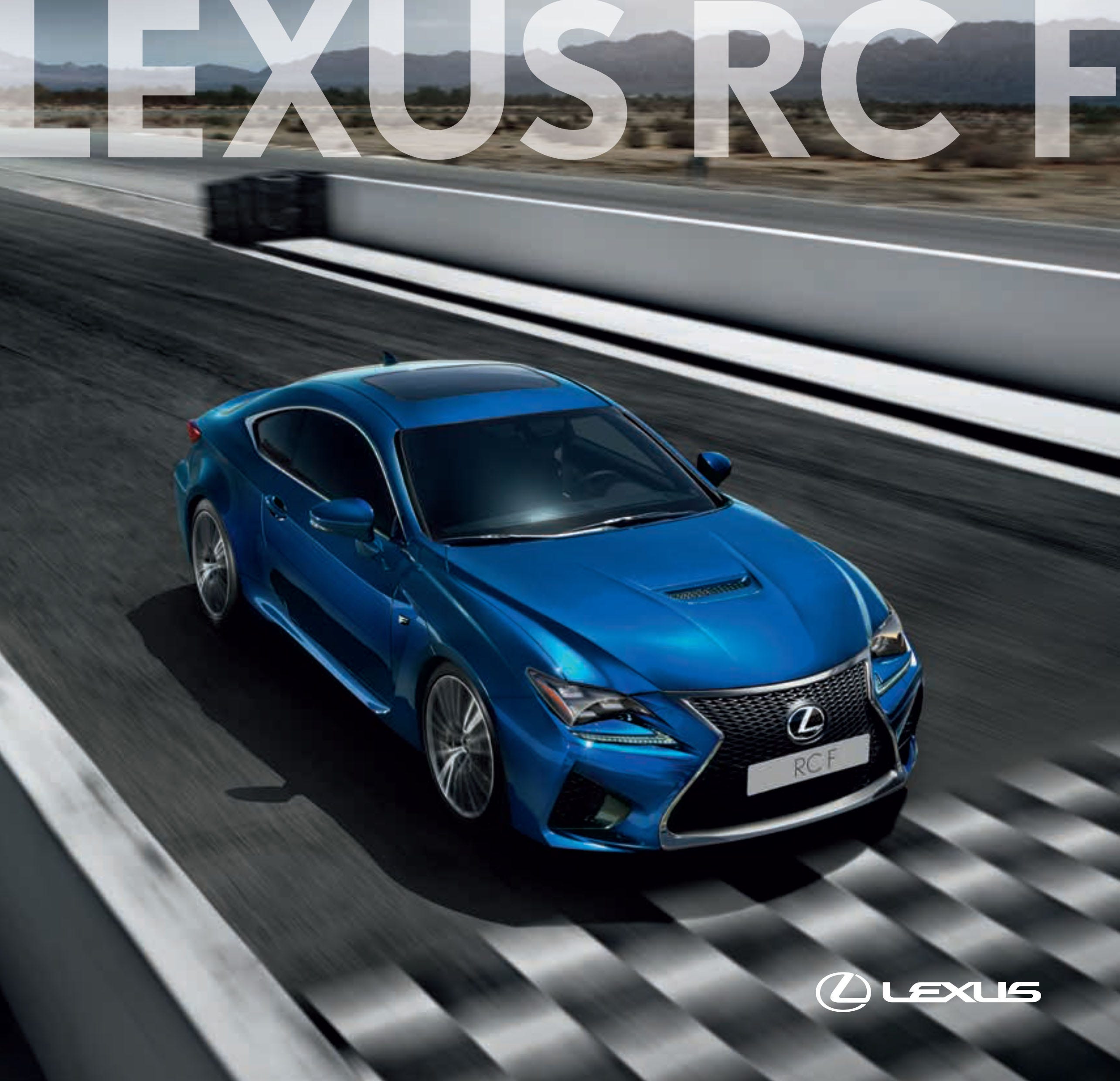
The RC F brochure does not open with theatre. The cover is almost austere: the car on a circuit, shot from above and ahead, the body a cool Azure Blue against grey tarmac and pale concrete barriers. The colour palette throughout is strategic: Velvet Black, Sonic Silver, and the signature Solar Flare orange that Lexus deployed as its kinetic punctuation mark in the mid-2010s. These are not warm colours. They are precision colours. They suggest the temperature of a test cell.
The brochure oscillates between two modes, the clinical and the sensory, and is most interesting at the points where those modes meet. On one page, a ghosted chassis diagram reads like an engineering drawing. On the next, a macro photograph of a carbon weave fills the spread with the kind of detail usually reserved for a materials science journal. White space is used not as a luxury signifier, but as the silence between data points. The document wants you to concentrate. The closest cultural analogue is a dojo in which high-speed telemetry and ancient craft are not in conflict but in conversation: above all, a serious place.
The Manifesto: An Engineer Speaks
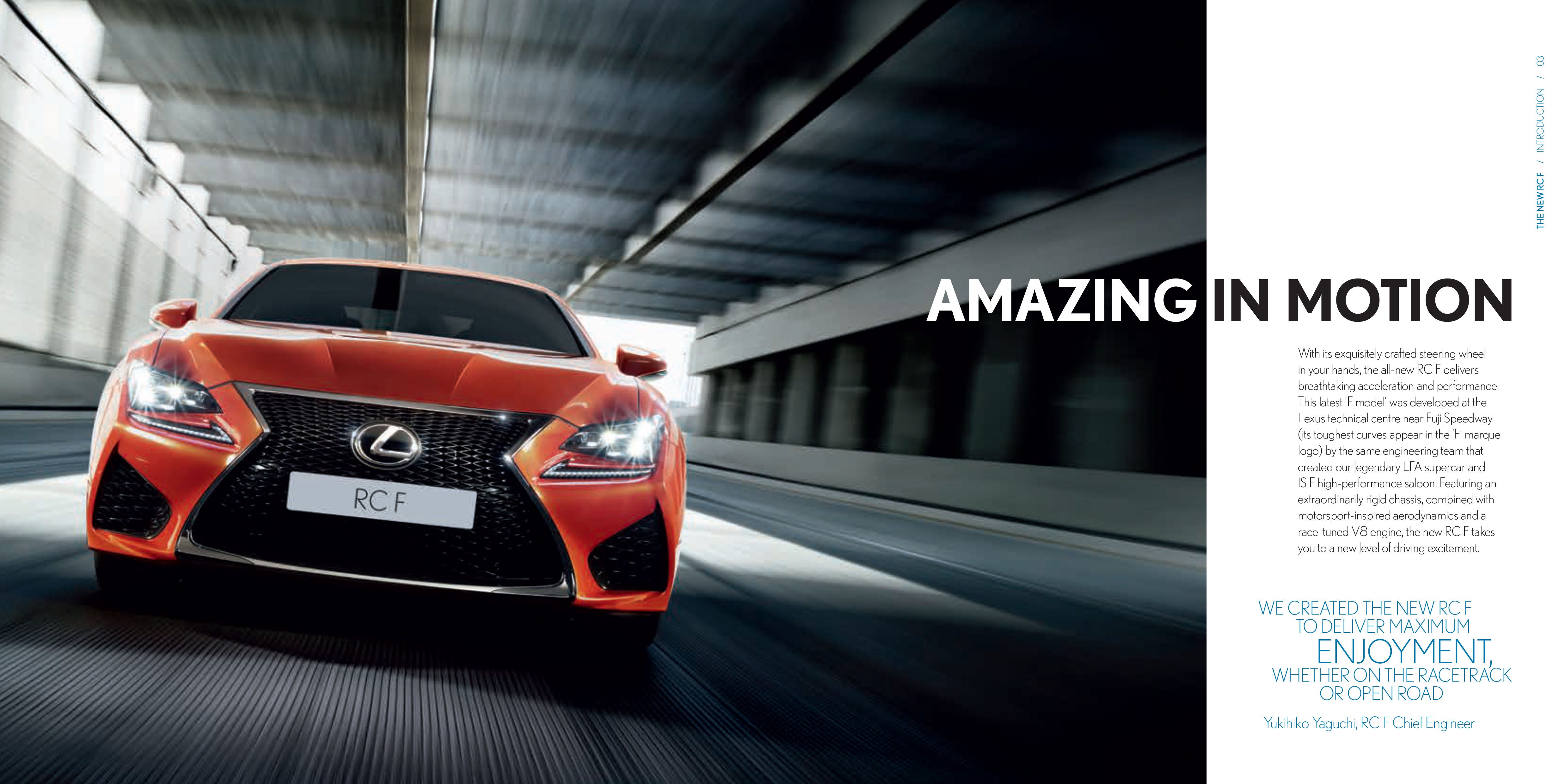
Most automotive brochures open with a brand statement, a design sketch, or a landscape photograph calculated to induce wanderlust. The RC F brochure opens with an attribution. The second spread foregrounds a direct quotation from Yukihiko Yaguchi, RC F Chief Engineer, printed in the commanding typographic register the document reserves for its most important declarations:
“We created the new RC F to deliver maximum enjoyment, whether on the racetrack or open road.”
The word to focus on is not “enjoyment” but “created”. Not “engineered to deliver”, not “designed with”, not the deferential passive construction that fills so much automotive copy. “We created.” It is a claim of authorship rather than manufacture, and it lands differently because it is signed. Yaguchi is not a brand avatar. He is the engineer who spent years at Fuji Speedway with the IS F and LFA teams, and the brochure plants his name in your memory before it shows you a single performance figure. Whatever follows, the implication runs, was made by a person with convictions, not a committee with targets.
The accompanying photography places the car in a tunnel, shot from the front, headlights on, the body colour a vivid Solar Flare orange that reads almost as an act of aggression against the surrounding grey concrete. The headline “AMAZING IN MOTION” is bold, and very large. It is the only moment in the document where the copy risks overstatement. Everything that follows is more careful.
The Powerhouse: On the Word ‘Relish’
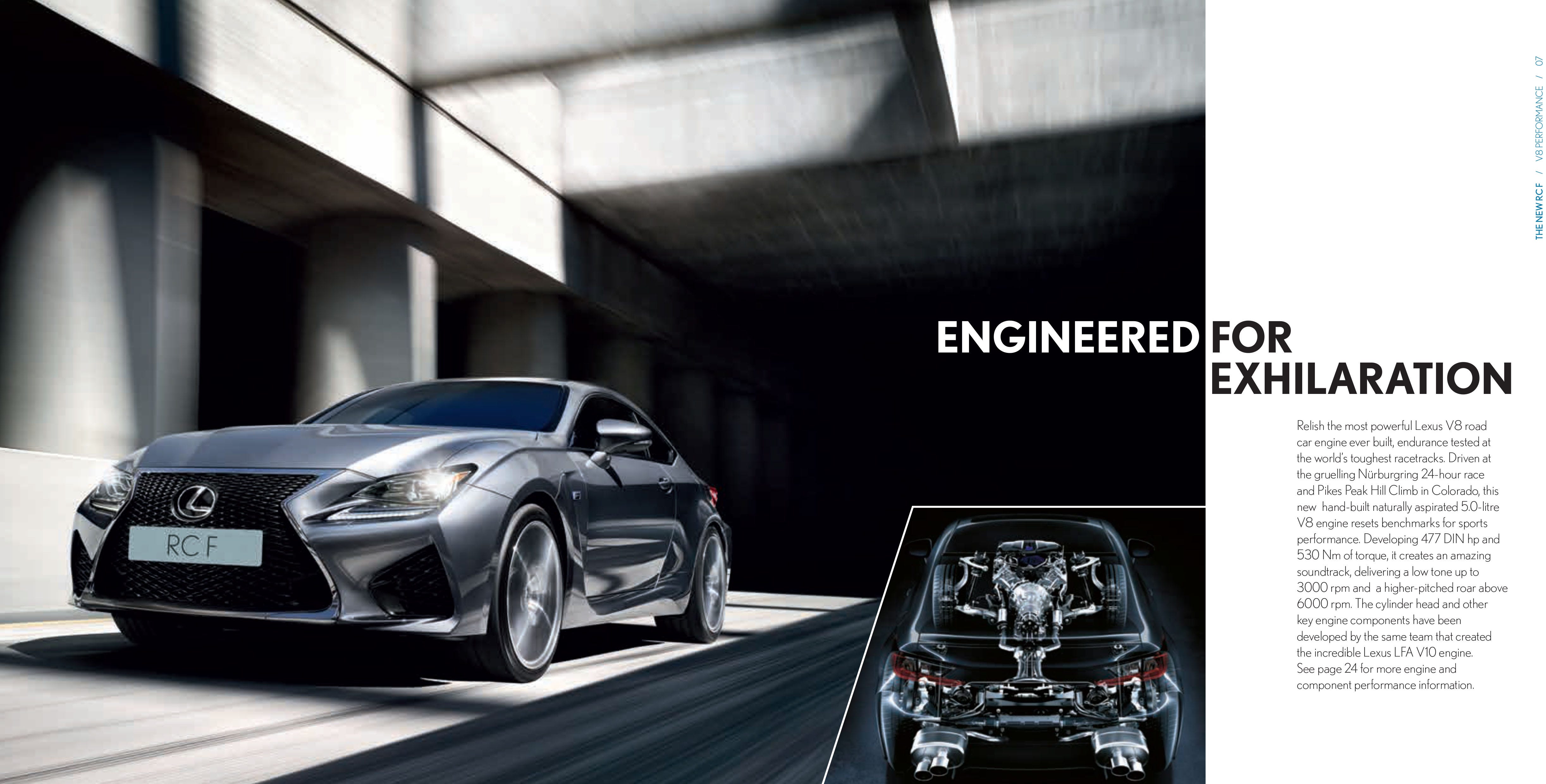
Page seven carries the headline “ENGINEERED FOR EXHILARATION”. The RC F is shot in Sonic Silver, travelling fast along a concrete-walled road, the image deliberately lit so that the bodywork reads as mass rather than colour. A small cutaway inset sits in the lower corner, showing the drivetrain from the rear, the engine barely visible, the chassis and running gear the real subject. It is an unusual choice for a page nominally about the powertrain: the brochure seems more interested in how the power reaches the road than in the source of it.
“Relish the most powerful Lexus V8 road car engine ever built.”
“Relish” is not a standard automotive verb. “Enjoy” is standard. “Experience” is standard. “Discover” is common in premium brochures that want to imply there is depth without specifying what the depth consists of. “Relish” implies appetite, anticipation, a willingness to be consumed by what you are consuming. It shifts the V8 from mechanical fact to sensory proposition. The copy goes on to describe a “deeply resonant tone up to 3000rpm” transforming into “a higher-pitched roar above 6000rpm”: a two-register soundtrack engineered as deliberately as the engine itself. No turbocharged rival offers “relishing”. The turbocharger is efficient. The naturally aspirated V8 is something you savour, and the brochure knows the difference.
The engineering context is also pointed. The cylinder head development team is identified as the same group responsible for the LFA’s V10, the most expensive engine Lexus had ever built, in the most expensive car Lexus had ever made. The V8 is presented not as a cheaper alternative to that ambition but as its direct continuation. The lineage is the argument.
Breathtaking Curves: The Chassis as Instrument
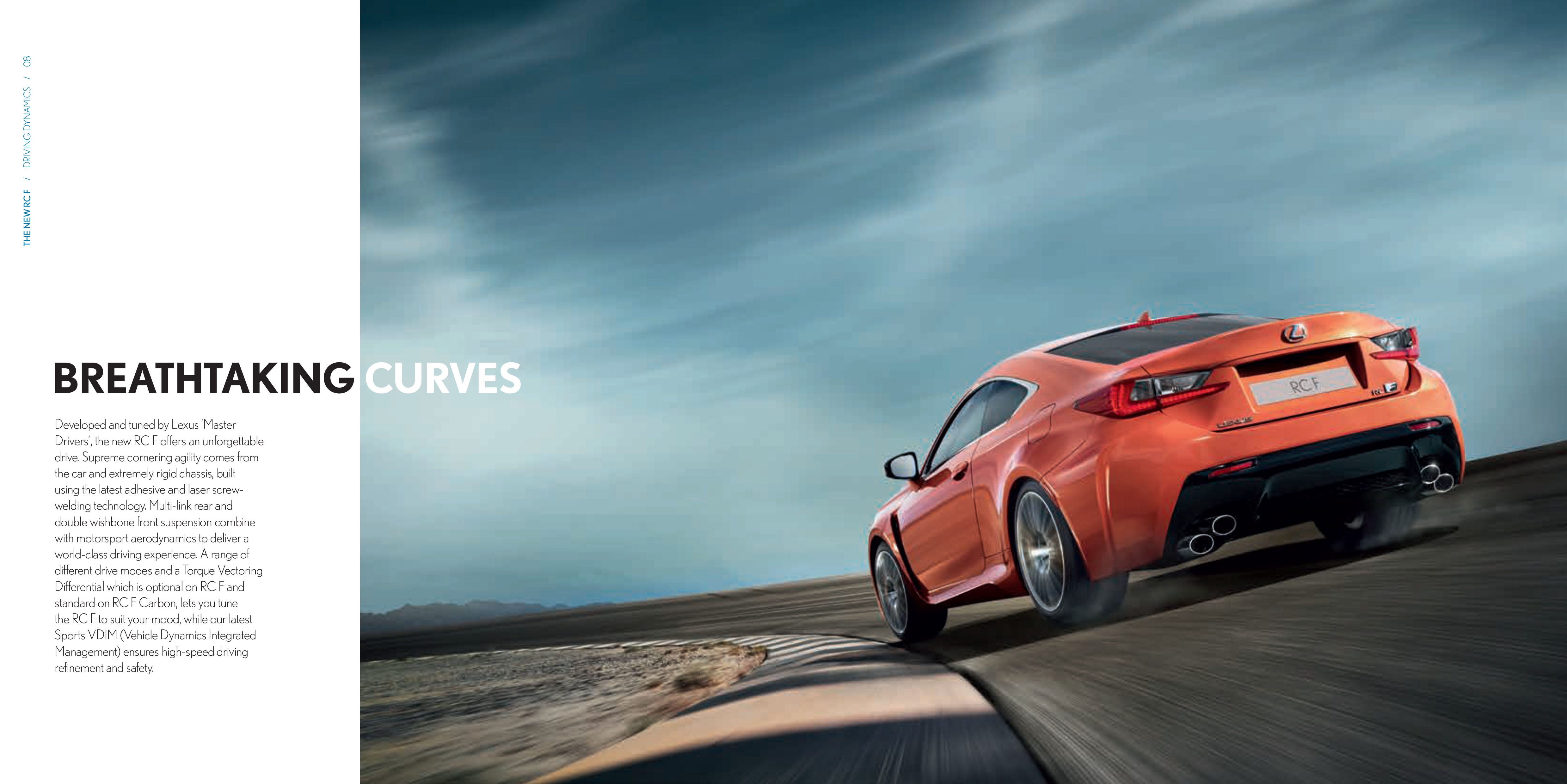
The driving dynamics spread carries the headline "BREATHTAKING CURVES", a phrase that could refer to the road, the bodywork, or the cornering arc, and is almost certainly intended to suggest all three simultaneously.
Before the copy reaches the chassis specifications, it pauses on a detail that repays attention: the RC F was "developed and tuned by Lexus 'Master Drivers'". Not engineers. Not a chassis team. Master Drivers, a designation that places a named class of human being at the centre of the car's dynamic character, in the same way that Takumi craftsmen are placed at the centre of its finish. The implication is consistent throughout the document: every significant attribute of the RC F has a person responsible for it, and that person has a title that confers seniority.
The copy then describes a chassis built using "the latest adhesive and laser screw-welding technology", which is technical language deployed with unusual precision for a consumer brochure. Lexus does not merely say the car is stiff; it explains the manufacturing methodology that makes it stiff.
“Supreme cornering agility comes from the car and extremely rigid chassis, built using the latest adhesive and laser screw-welding technology.”
This is the brochure operating in its clinical mode: the chassis is not described as “planted” or “confidence-inspiring” (the standard vocabulary of test-drive journalism). It is described as the product of specific industrial processes. Multi-link rear suspension, double wishbone front, Sports VDIM: each system is named rather than implied. The car is, the page suggests, a programmable instrument with a very wide dynamic envelope. The Torque Vectoring Differential makes its first appearance here too, with the important caveat that it is optional on the standard car but standard on the Carbon, a distinction the brochure flags with quiet significance.
The photography on this spread does something the previous pages have not: it shows the car from behind, in motion, with the exhaust outlets prominent. Four of them. The RC F’s rear end was designed to be looked at from a specific angle, and the brochure knows which one.
Passion for Performance: Aerodynamics as Posture
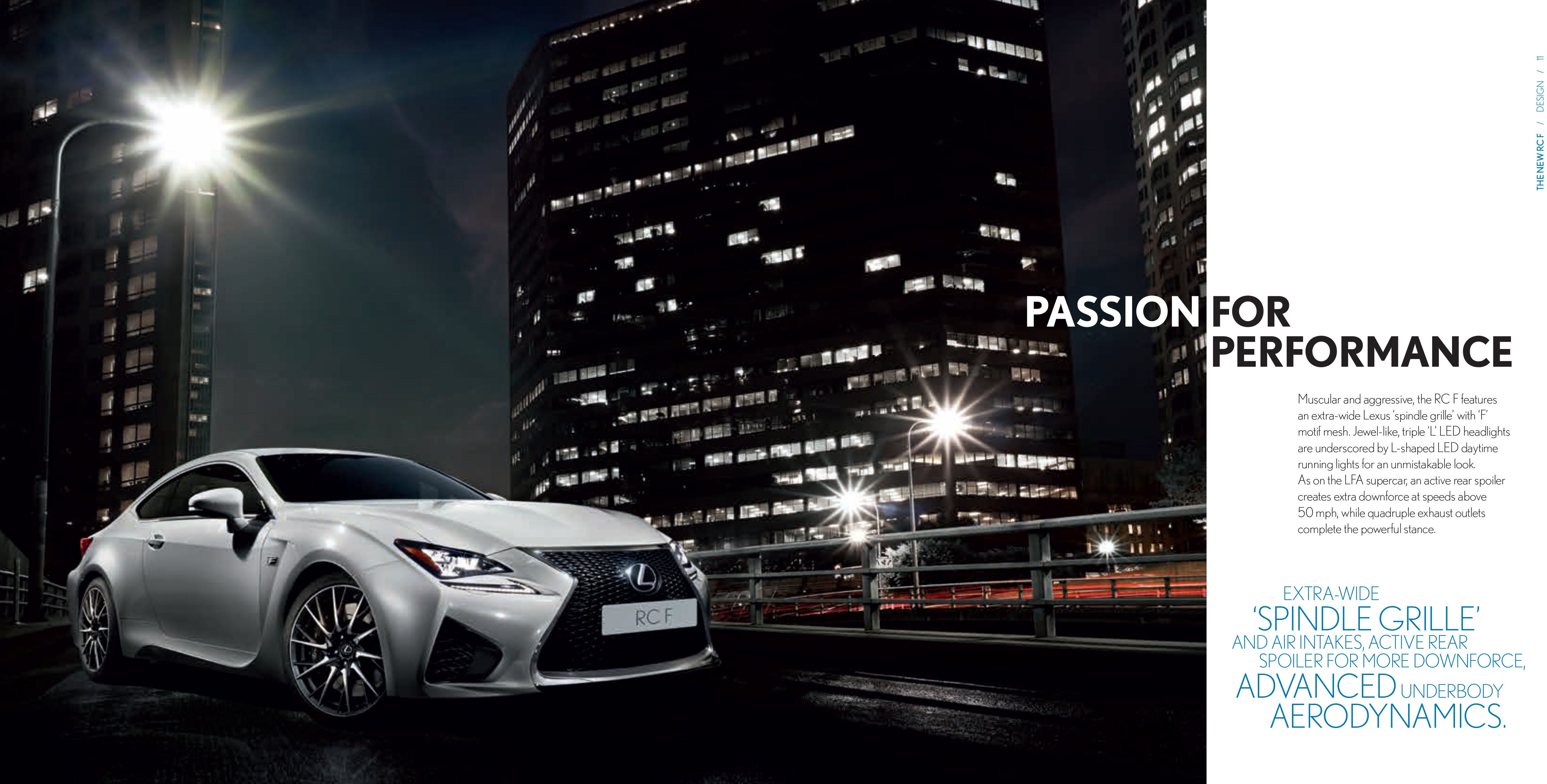
Shot in near-darkness against an urban backdrop of illuminated tower blocks, the RC F in Sonic Silver reads as a machine from another taxonomy entirely, as if the city is its natural habitat not because it belongs there but because nothing in the city can challenge it. The headline “PASSION FOR PERFORMANCE” is the kind of copy that ordinarily weakens under scrutiny. Here it does not, because what follows it is architectural rather than emotive.
“As on the LFA supercar, an active rear spoiler creates extra downforce at speeds above 50 mph, while quadruple exhaust outlets complete the powerful stance.”
Three elements of this sentence deserve attention. First, the LFA comparison is invoked again, not as marketing heritage but as functional precedent. The spoiler is not novel; it is inherited, which has a different weight. Second, the threshold of 50mph is stated precisely, making the aerodynamics feel like engineering fact rather than styling gesture. Third, "complete the powerful stance": the exhaust outlets are framed as aesthetic rather than acoustic, which is unusual given that the RC F's exhaust note is one of the car's defining attributes. To describe the outlets purely as visual elements is to leave the most compelling argument unspoken. The brochure, characteristically, trusts you to make the connection yourself.
The spindle grille (Lexus’s signature design element of the era, and one of the more polarising front-end treatments in the premium segment) is described here as “extra-wide” with an “’F’ motif mesh”. The brochure does not attempt to justify the spindle grille to sceptics. It describes it factually and moves on. Take it or leave it. This is also, in its way, a form of confidence.
Material Advantage: The Precision of 9.5 Kilos
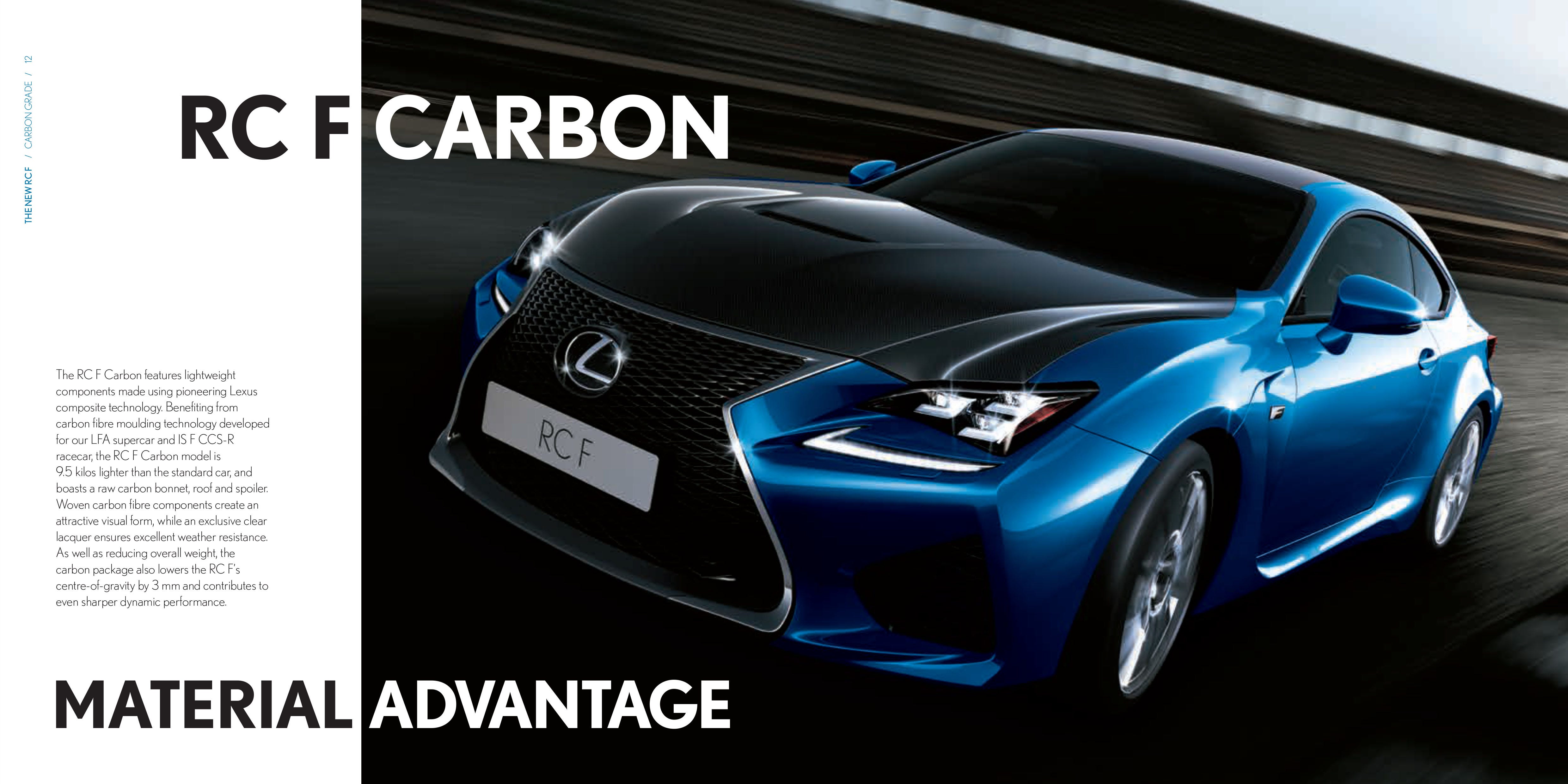
The RC F Carbon model is introduced not with superlatives but with measurements:
“RC F Carbon model is 9.5 kilos lighter than the standard car.”
Not “significantly lighter”. Not “meaningfully reduced”. Not “featuring extensive use of lightweight materials throughout”. Nine point five kilos. The specificity is the argument. Carbon roof, bonnet, and spoiler: the three highest-mounted panels on the car, the ones whose mass affects the centre of gravity most acutely. The brochure notes that the carbon package lowers the RC F’s centre of gravity by 3mm, which is a figure precise enough to sound like it came from a chassis dynamometer rather than a press release. This is not a diet; it is an intervention, measured in millimetres and kilograms.
The carbon fibre moulding technology, the brochure explains, was developed for the LFA supercar and the IS F CCS-R racing car. The material is not new to Lexus; it has been stress-tested at a level that no road car buyer will ever approach. The “exclusive clear lacquer” ensuring weather resistance is the document’s single concession to the practical ownership reality of exposed carbon, a detail that will acquire a certain retrospective irony for any Carbon owner who leaves the car outside during a British summer.
The photography on this page places the Carbon model in Azure Blue: the dark panel contrast of the raw carbon bonnet and roof against the metallic body colour is the spread’s argument made visual. Weight as precision. Carbon as craft.
Pole Position: The LFA’s Cognitive Architecture
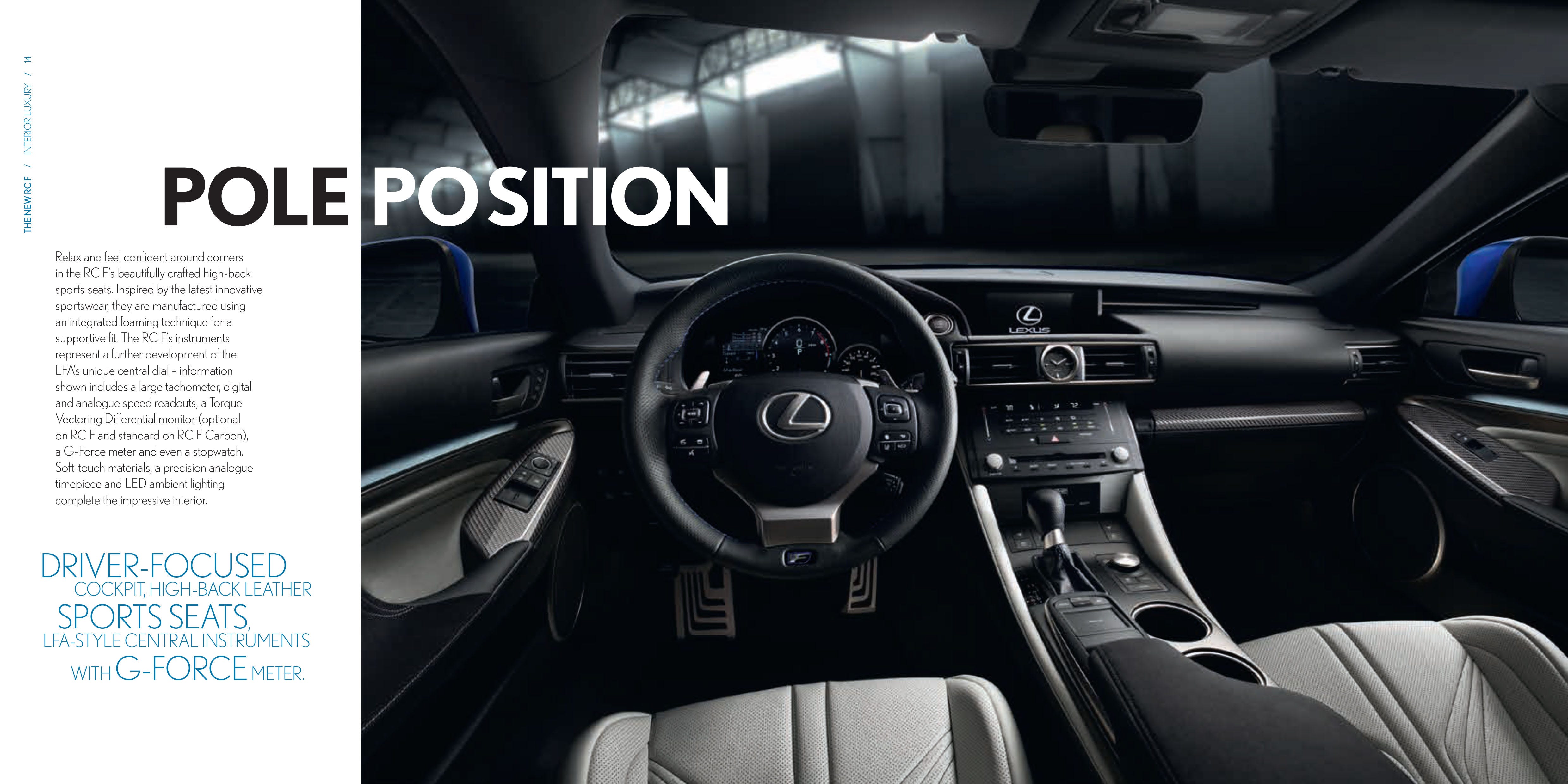
The interior spread carries the headline “POLE POSITION” and is dominated by a wide-angle photograph of the cockpit in grey upholstery. The driver’s seat is centred in the frame; the steering wheel and instrument cluster serve as the focus.
“The RC F’s instruments represent a further development of the LFA’s unique central dial. Information shown includes a large tachometer, digital and analogue speed readouts, a G-Force meter and even a stopwatch.”
The LFA is invoked here not as heritage, not as a proud moment in company history, but as lineage. A direct filament connecting a £340,000 supercar built in tiny numbers to this production machine sold through ordinary dealers. The tachometer, G-force meter, and stopwatch are not convenience features. They are the documentary evidence of that lineage; they tell you, every time you start the engine, which engineering philosophy was invoked before the car went into production.
The G-force meter in particular is worth dwelling on. It has no practical safety function. It does not help you brake earlier or corner faster. What it does is make the driving experience legible: it translates the physics of the car’s behaviour into a number you can read and remember. It is, in a sense, the brochure’s argument made physical. This is a car that rewards attention, that gives you data in exchange for commitment, that treats the driver as a participant in an experiment rather than a passenger in a product.
The analogue clock, mentioned almost parenthetically (”a precision analogue timepiece” completing the interior) is the single element the brochure most carefully does not over-explain. It simply is. In the context of the G-force meter and the LFA-derived dial, the clock is not an affectation. It is a counterweight: a reminder that this machine also exists in ordinary time.
The Takumi Room and the Drivetrain X-Ray: Ceremony and Telemetry
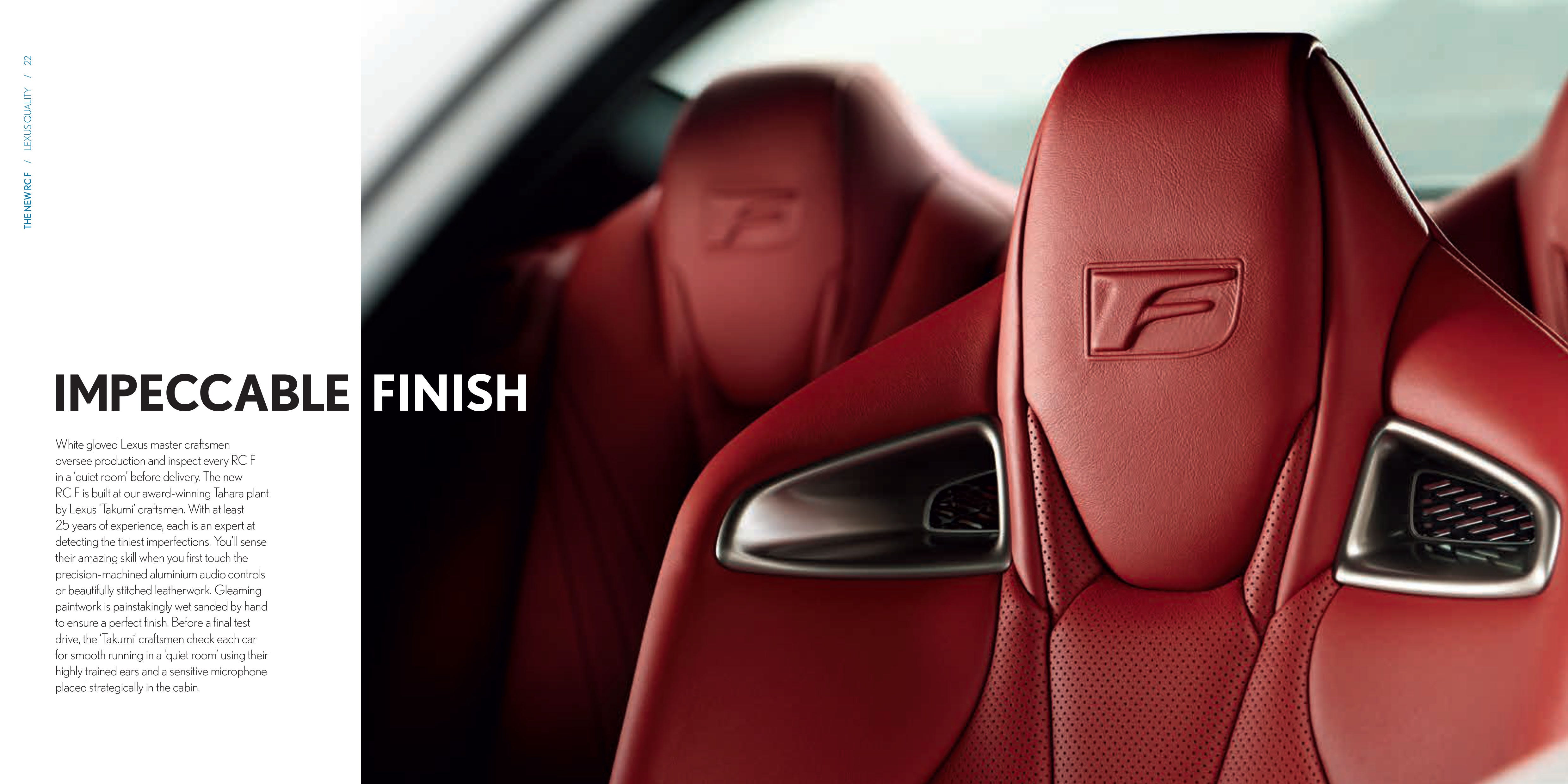
Pages twenty-two and twenty-three, together with the following spread form, the document’s most revealing pairing, and they reward being read together rather than separately. Page twenty-two is the Takumi spread: white-gloved craftsmen in the Tahara plant’s “quiet room”, attending to a car with the concentration of surgeons.
“White gloved Lexus master craftsmen oversee production and inspect every RC F in a ‘quiet room’ before delivery.”
Mass production, presented as artisanal ritual. The “quiet room” is real: an acoustic evaluation chamber in which sensitive microphones are placed in the cabin to detect mechanical imperfections inaudible to an untrained ear. But the brochure transforms it into something approaching ceremony. Takumi craftsmen with at least twenty-five years of experience are not described as quality control personnel; they are, in the document’s framing, the final instrument in the manufacturing process. The gleaming paintwork, the brochure notes, is “painstakingly wet sanded by hand to ensure a perfect finish.” In a car produced for a competitive mass market, this is an extraordinary claim to make, and an extraordinary process to maintain.
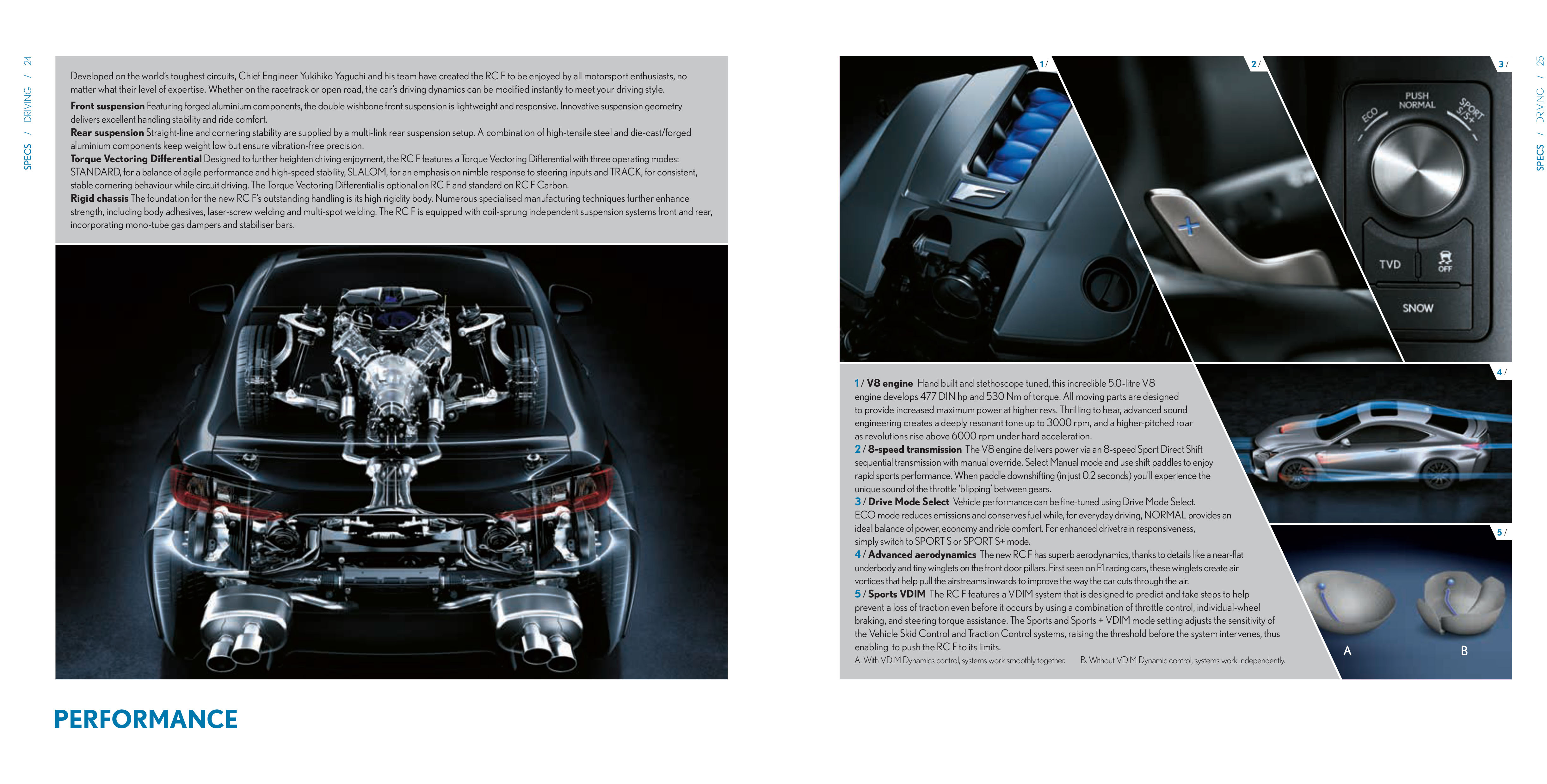
Turn the page and the tone shifts entirely. Page twenty-four is the drivetrain X-ray: a ghosted technical illustration of the chassis, suspension geometry, and drivetrain layout, presented with the cool detachment of an engineering drawing. Drive Mode Select (ECO, Normal, Sport S, Sport S+) is introduced on page twenty-five. Four modes. The car as a programmable instrument.
Ceremony and telemetry, occupying consecutive pages, neither in conflict with the other. The brochure places the white-gloved craftsman and the systems diagram one after another, as if they are not opposites but partners in the same project.
The Rearview Mirror
Weight as Identity
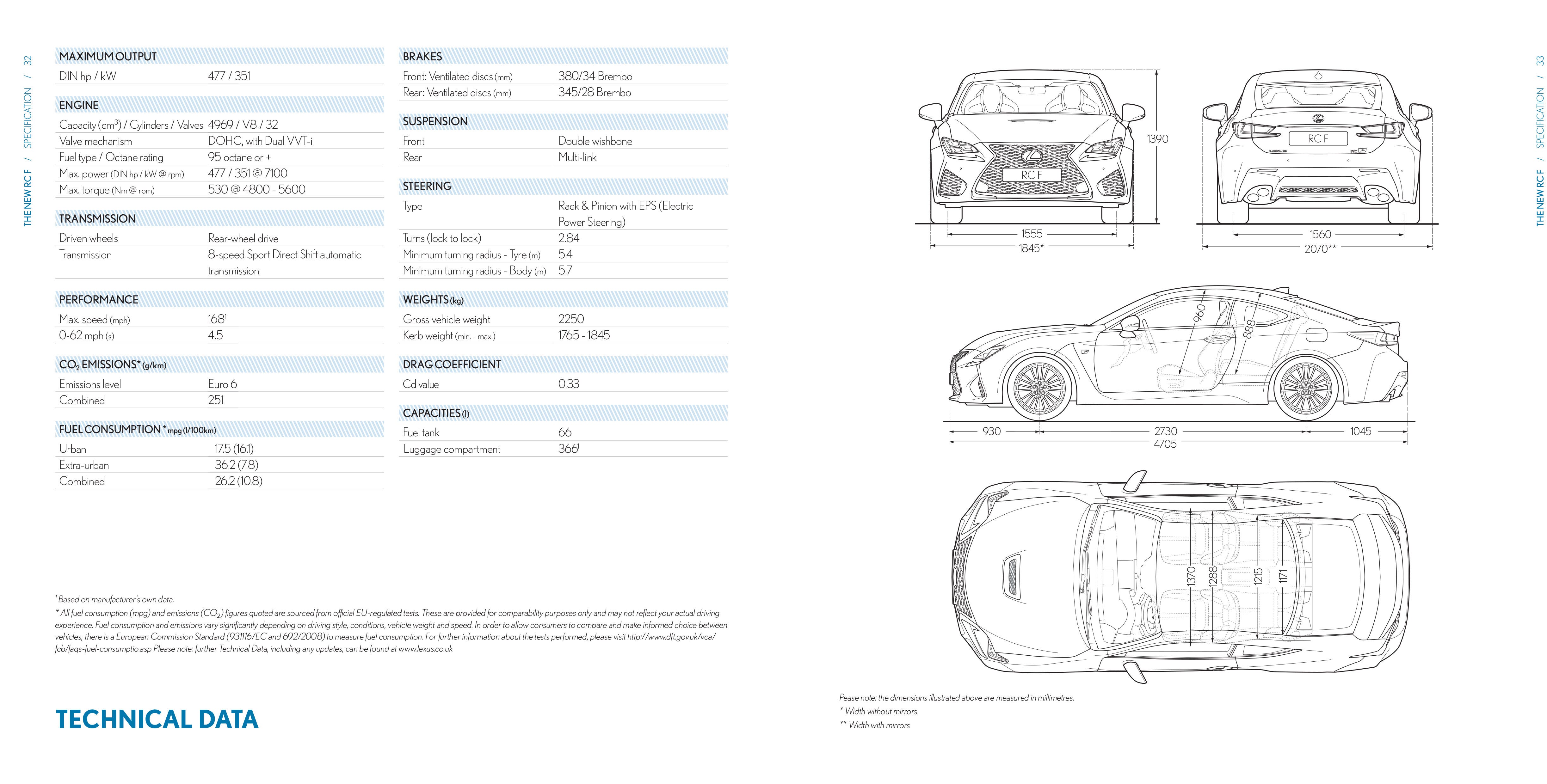
The RC F’s commercial challenge was never the engine. The 2UR-GSE 5.0-litre V8 was magnificent in 2015 and remains magnificent now. The problem was a figure that the brochure carefully avoids placing in the narrative: 1,845kg. In a segment where the BMW M4 was fighting to stay below 1,500kg and the Audi RS5 offered Quattro security as an implicit apology for its own substantial construction, the RC F’s weight was substantial in a way that the brochure’s careful vocabulary could not quite neutralise. “Extraordinarily rigid chassis” is not wrong. But it is doing heavy lifting.
Ergonomic Heresy
The infotainment system is where the paradox collapsed. The brochure had devoted a section to the LFA-derived instrument cluster (the G-force meter, the switchable dial, the stopwatch) and called it, with some justification, a piece of cognitive architecture: a system designed to make the car’s behaviour legible to the person driving it. On the facing console, sat the Remote Touch Interface. A trackpad. In a performance car. The brochure describes it as an “innovative new Touch Pad” that “lets front seat occupants interact intuitively with the central 7-inch multimedia display”, which is the kind of sentence that reads as marketing copy rather than engineering conviction, because it is.
Where the instrument cluster had been designed for a driver at speed, the Remote Touch Interface had been designed for a driver at a standstill, and it showed. Drivers found the trackpad frustrating in a way that a 477-horsepower engine could not entirely compensate for. Cognitive architecture on one side of the steering column; ergonomic heresy on the other.
The Tax: Brembo, Rubber, and Lacquer
Ownership of a 2015 RC F in 2026 is, in mechanical terms, an exercise in pleasant repetition with occasional expensive interruptions. The 2UR-GSE engine has proven essentially bulletproof; Lexus reliability statistics for this unit are among the best in the segment, and stories of high-mileage examples running without major intervention are not uncommon. The mechanicals, in other words, have vindicated the Takumi quiet room.
The consumables tell a different story. Nineteen-inch Michelin Pilot Sport rubber (the brochure’s preferred footwear, spec-sheet confirmed) is not inexpensive on a car that weighs what this one weighs. The Brembo callipers (380mm front, 345mm rear, both listed with the confidence of a racing specification) are excellent; their replacement cost is not. For RC F Carbon owners, there is an additional variable: the carbon roof requires UV-protective lacquer maintenance. Leave it unattended and the clear coat will eventually yellow in a way that the brochure’s pristine macro photography of “woven carbon fibre” did not anticipate.
None of this is exceptional by the standards of the class. The RC F simply requires the same informed ownership that any serious performance car demands.
The Success: The Voice That Lived On
In 2026, looking back at the RC F with the benefit of hindsight, the car resolves into something unexpected: a proof of concept. Not for the RC F itself, which sold in numbers that left Lexus cautious about the segment’s appetite, but for a philosophy. The argument that a naturally aspirated V8 could be built with supercar-grade engineering, dressed in Omotenashi hospitality, and sold to a driver who did not want to choose between Saturday circuit sessions and Monday morning commutes: that argument did not die with the RC F’s production run.
The 2UR-GSE engine, celebrated in the brochure with the understated vocabulary of sensory engineering, migrated to the LC 500. In that car, wearing a body that fully matched the mechanical ambition, it became the heart of a modern classic. The LC 500 was everything the RC F had been arguing for: grand touring dimensions, naturally aspirated theatre, Japanese craftsmanship elevated to something approaching art. The RC F was the dress rehearsal. The LC was the performance.
And the V8 itself (hand-built, stethoscope-tuned, capable of an eight-cylinder soundtrack that no turbocharged engine could replicate, regardless of the sophistication of its exhaust tuning) became, in the years after its introduction, a rarity. The automotive industry turned toward electrification, hybridisation, downsizing. The naturally aspirated V8 in a performance coupe became not just uncommon but, increasingly, unrepeatable. In 2026, the RC F is not merely a used car. It is a primary document: evidence that such a thing was made, and made well, and made without apology.
This shift in the industry has done something for the RC F’s reputation that its brochure could not. At launch, the car was assessed against what existed: the M4, the RS5, the prevailing assumption that lighter and more turbocharged was straightforwardly better. In 2026, it is assessed against what no longer exists. The criticisms that stuck in 2015 (the weight, the infotainment, the price) have not disappeared, but they have been recontextualised. What remains, and what has grown in standing, is the engine, the soundtrack, and the knowledge that the Takumi craftsmen were not lying. The car that was once considered the soulful but slightly compromised alternative is now considered one of the last examples of a thing done a certain way. The RC F has not changed. The market around it has, and the market has caught up.
Chief Engineer Yaguchi promised maximum enjoyment on the racetrack or open road. The brochure, read now with the knowledge of what came after it and what did not, suggests that the more interesting promise was the quieter one: not maximum enjoyment, but simple, durable integrity.
The promise made, not in bold typography, but in a quiet room at the Tahara plant, by craftsmen in white gloves, listening for sounds that were never supposed to be there. A decade on, the cars that were inspected in that room are still being driven hard, and still found to be without fault. The promise, it turns out, was kept.
The Fine Print