The Thoroughbred Limousine: Maserati's Elegant Balancing Act
The Ferrari in a Dinner Jacket

In 2003, if you wanted a large luxury saloon, the Germans had the answer. The Mercedes S-Class was technically impeccable. The BMW 7 Series was the driver’s choice. Both were supremely competent, thoroughly engineered, and about as emotionally involving as a business-class seat.
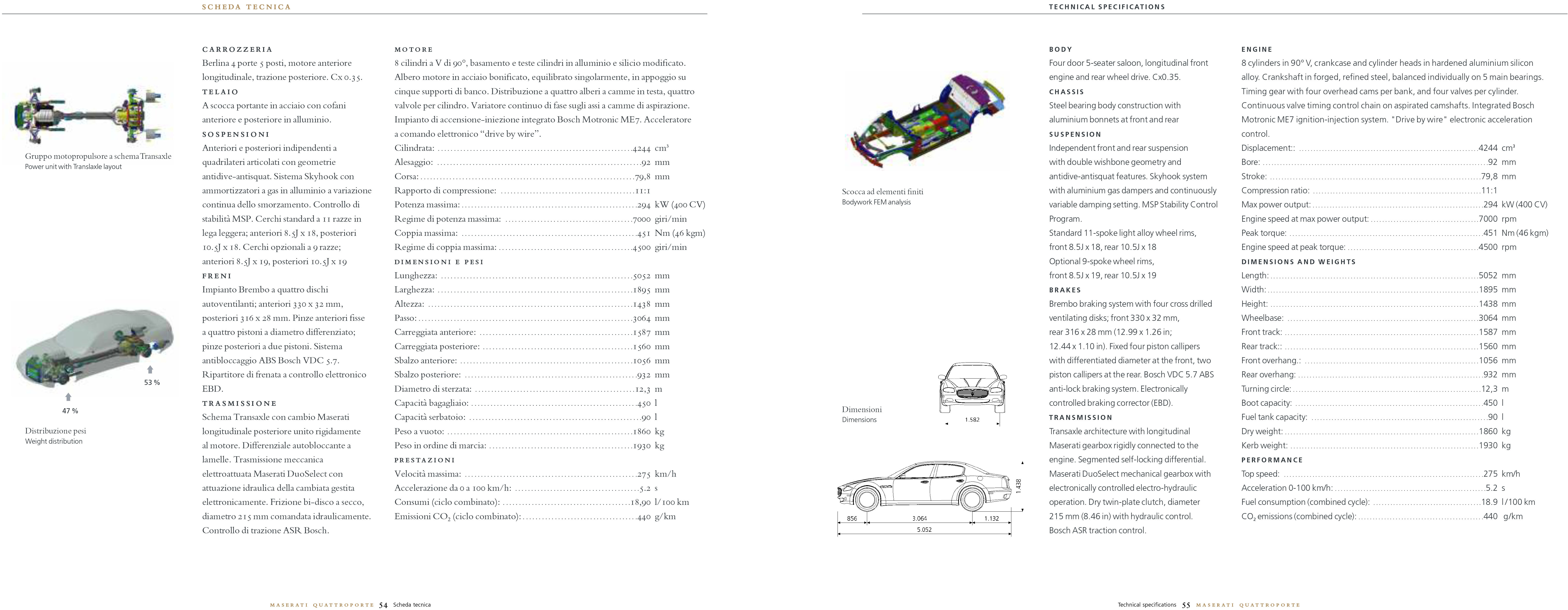
Then Maserati arrived with something that had no business existing: a five-metre limousine with a Ferrari-derived V8 mounted behind the front axle, a gearbox bolted to the rear differential, and a weight distribution of 47 per cent front, 53 per cent rear. Numbers that a mid-engined sports car would be proud of. In a car you could be chauffeur-driven in.
This had never been done before. Not in a flagship saloon. Not anywhere close to this size and weight. The engineering alone should have been the story. Instead, Maserati opened its 2003 global launch brochure, titled “Contemporary Italian Art,” with a picture of a Stradivarius violin.
Couture-Tech and the Art of the Comparison
The brochure’s first act is to establish a frame of reference that has nothing whatsoever to do with cars.
Page two opens with a cascade of Italian cultural artefacts: a Roberto Capucci haute couture gown, a Macchi flying boat, a Stradivarius violin, a Riva Aquarama, a Ferragamo shoe, a Poltrona Frau armchair. These are arranged in a horizontal strip across the centre of the spread, each oval-cropped. The typography is bilingual throughout: first Italian, then English.
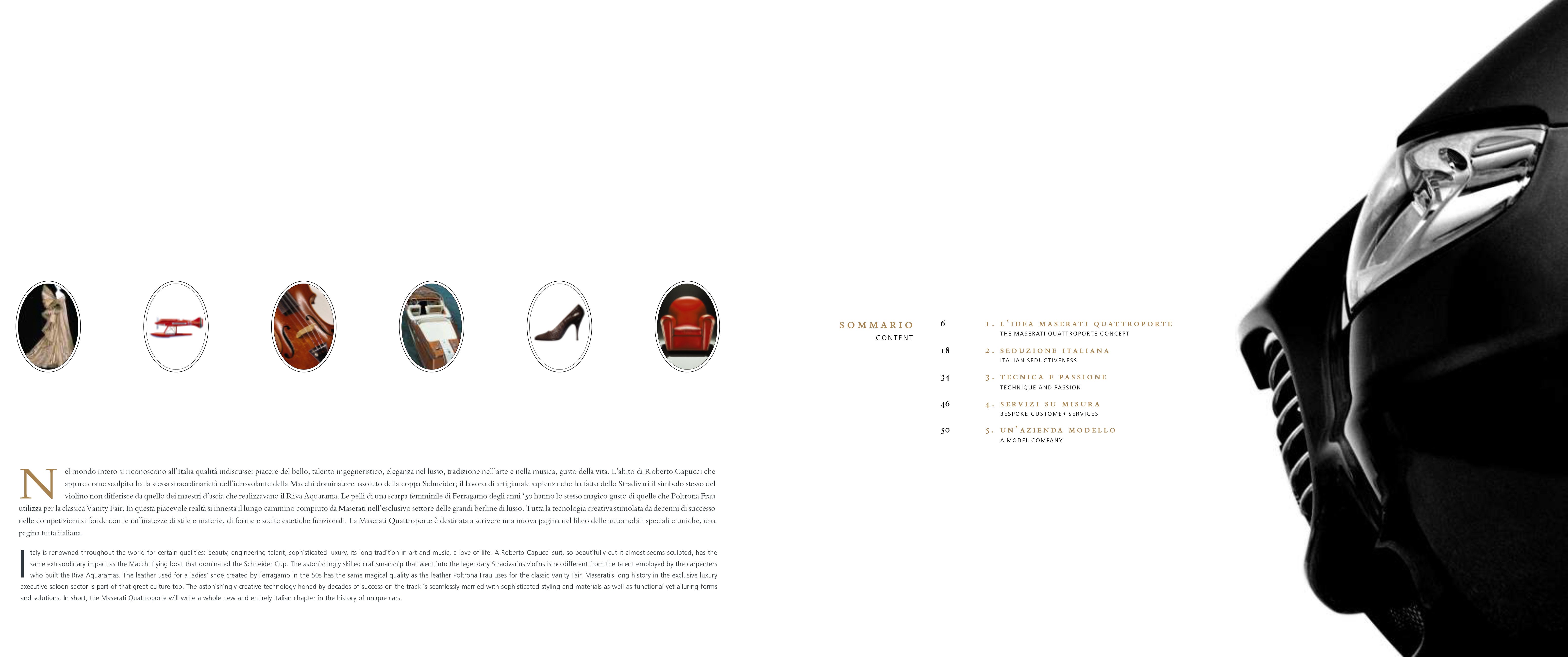
“Italy is renowned throughout the world for certain qualities: beauty, engineering talent, sophisticated luxury, its long tradition in art and music, a love of life.”
The brochure is making a specific argument: that the leather in a Ferragamo shoe and the leather in a Quattroporte cabin are expressions of the same tradition, the same hands, the same standards. That the “astonishingly skilled craftsmanship” of a Stradivarius is “no different from the talent employed by the carpenters who built the Riva Aquaramas”. And that “Maserati’s long history in the exclusive luxury executive saloon sector is part of that great culture too”. The word “too” is doing considerable work in that sentence, but the car earns it.
This is the fusion of Italian sartorial craft with genuine engineering audacity. Ferrari blood in the engine, Ferragamo standards in the cabin. The brochure asks you to feel the weight of Italian craftsmanship before it shows you a chassis diagram, which is a confident sequence when the engineering is this good.
The Concept: A Sports Car disguised as a Limousine
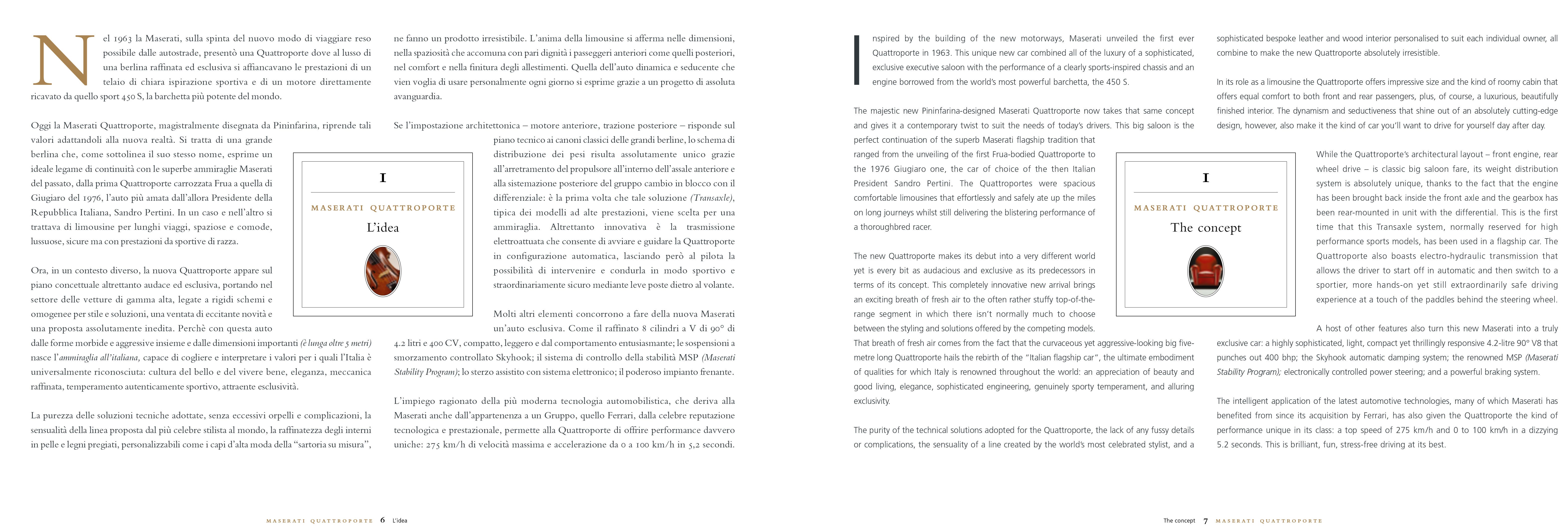
The brochure takes direct aim at the segment it is entering. It acknowledges that its competitors offer nothing to choose between in terms of “styling and solutions”, calls the top-of-range sector “often rather stuffy”, and positions the Quattroporte as a breath of fresh air. It does not name the S-Class or the 7 Series, but it does not need to. Every buyer who walked into a Maserati showroom in 2003 had just gotten out of one.
The counter-proposal is the transaxle, and the brochure presents it with justified pride:
“While the Quattroporte’s architectural layout — front engine, rear wheel drive — is classic big saloon fare, its weight distribution system is absolutely unique, thanks to the fact that the engine has been brought back inside the front axle and the gearbox has been rear-mounted in unit with the differential. This is the first time that this Transaxle system, normally reserved for high performance sports models, has been used in a flagship car.”
Think about what this actually means in practice. The V8 sits so far back in the engine bay that it is effectively a mid-engine layout. The gearbox, rather than sitting directly behind it in the conventional manner, is at the opposite end of the car, bolted to the differential. Between them runs a torque tube the length of the cabin floor. The result is a weight distribution (47 per cent front, 53 per cent rear) that transforms how a nearly two-tonne car behaves when you ask it to change direction. The rear squats and grips rather than pushing wide. You steer it like something half its size. This is not a small achievement. In the segment it was entering, it was unheard of.
Across a two-page spread, the car is photographed in a studio, silver, the long bonnet establishing the “cab-back stance”. Even in a static photograph it looks coiled. The high waistline, the muscular C-post, the roofline that tapers rather than slumping: this is not a car that looks like it is waiting for a chauffeur.
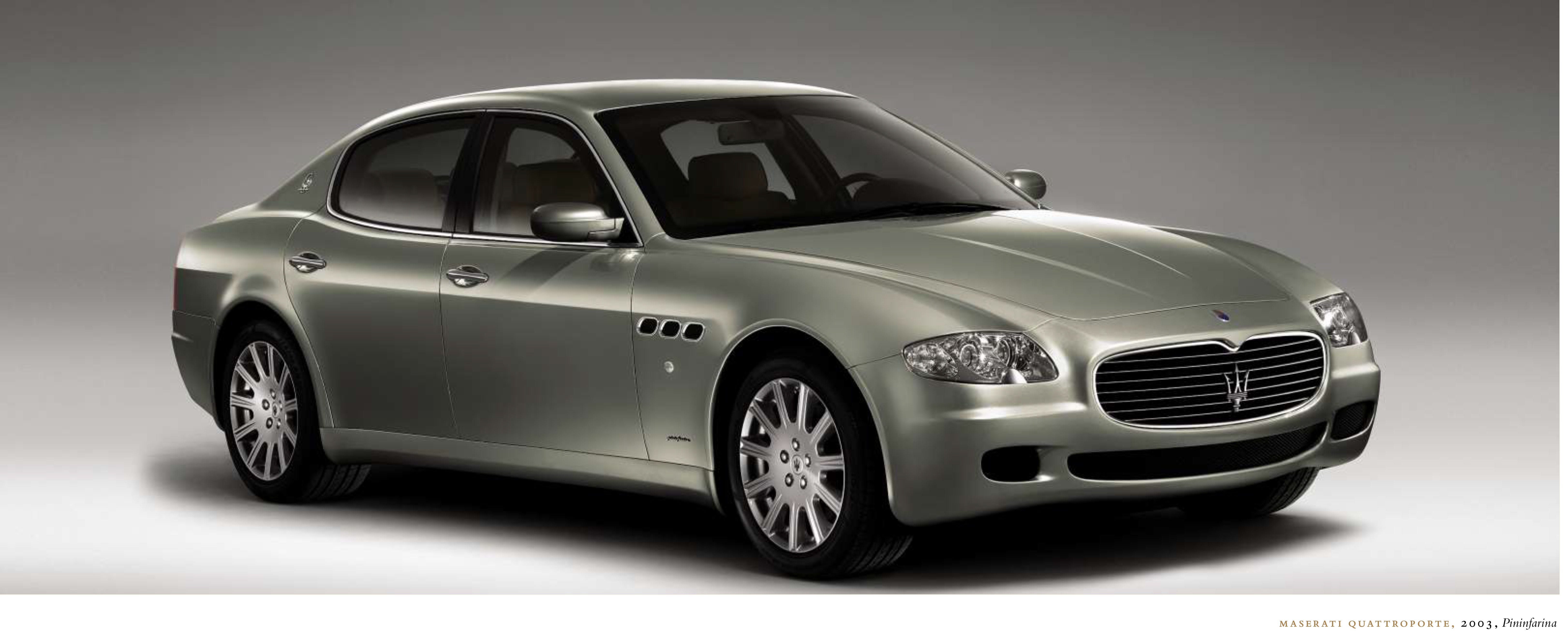
What the brochure moves through quickly is the electro-hydraulic DuoSelect gearbox that makes all this possible: the paddles, the automatic mode, the Manual and Sport and Low Grip settings. It is mentioned efficiently, as if city traffic is not a scenario worth dwelling upon. We will return to that.
Italian Seductiveness: The Body as Athlete
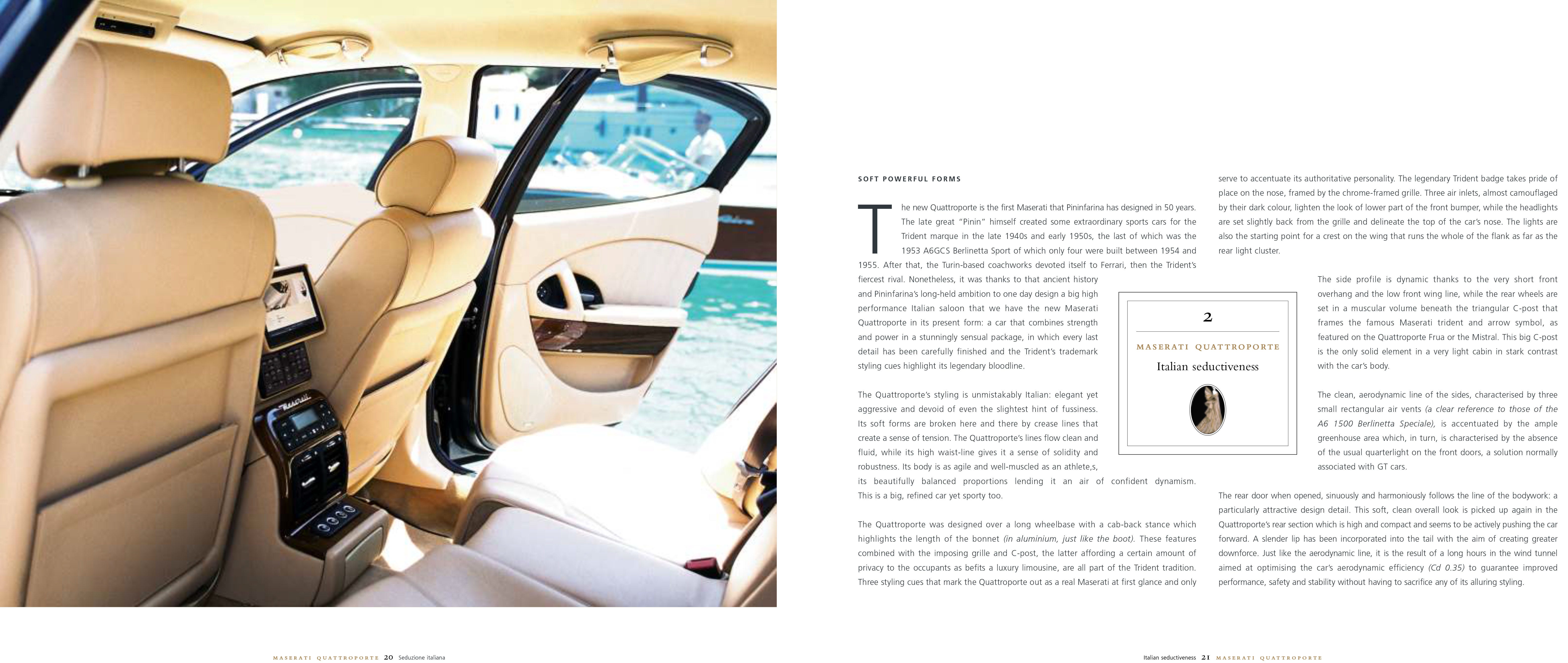
Section two, “Seduzione Italiana / Italian Seductiveness”, is where the brochure earns its subtitle. This is Pininfarina returning to the Trident after fifty years away. The result, designed by Ken Okuyama, is one of the most beautiful large saloons ever made.
The brochure’s description of the exterior is unusually precise. The Quattroporte is not merely called elegant; it is called a body “as agile and well-muscled as an athlete’s”, its surfaces “soft forms broken here and there by crease lines that create a sense of tension”. The high waistline provides “solidity and robustness”. The rear door, when opened, “sinuously and harmoniously follows the line of the bodywork”. That last detail matters: very few brochures describe the geometry of an open door, because very few cars get it right. The Quattroporte does, and the brochure noticed.
What strikes you looking at the car in 2026 is how none of this has dated. The long bonnet, the muscular haunches, the triangular C-post with its oval Trident badge, the twin oval exhausts: every proportion is exactly right.
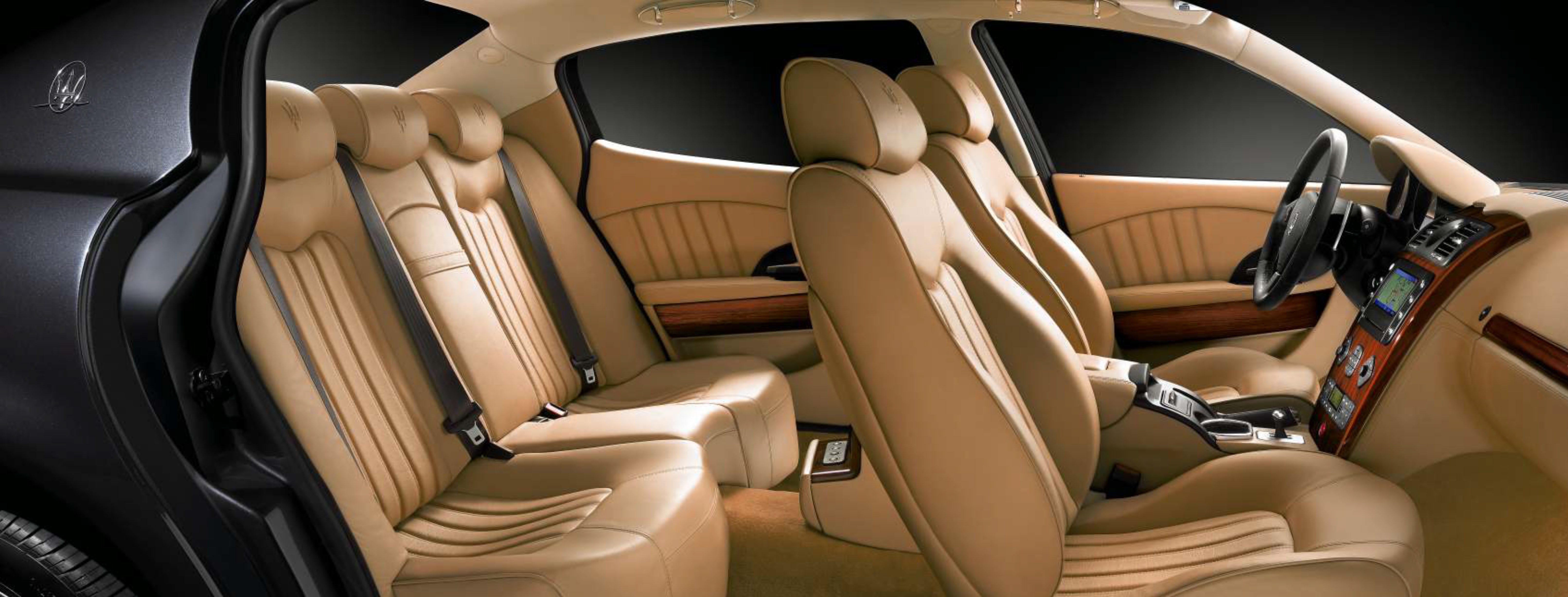
Inside, the personalisation programme the brochure describes is genuinely staggering in its scope. This was not a car you configured from a fixed options list; it was a car you specified the way you might commission a suit. The brochure calls it exactly that:
“The result is an atmosphere of luxurious good taste that is further highlighted by the legendary Maserati personalisation programme. In fact, clients have such a freehand in choosing the various materials for their car that the Quattroporte can only be described as the ultimate expression of the Italian concept of bespoke automotive tailoring.”
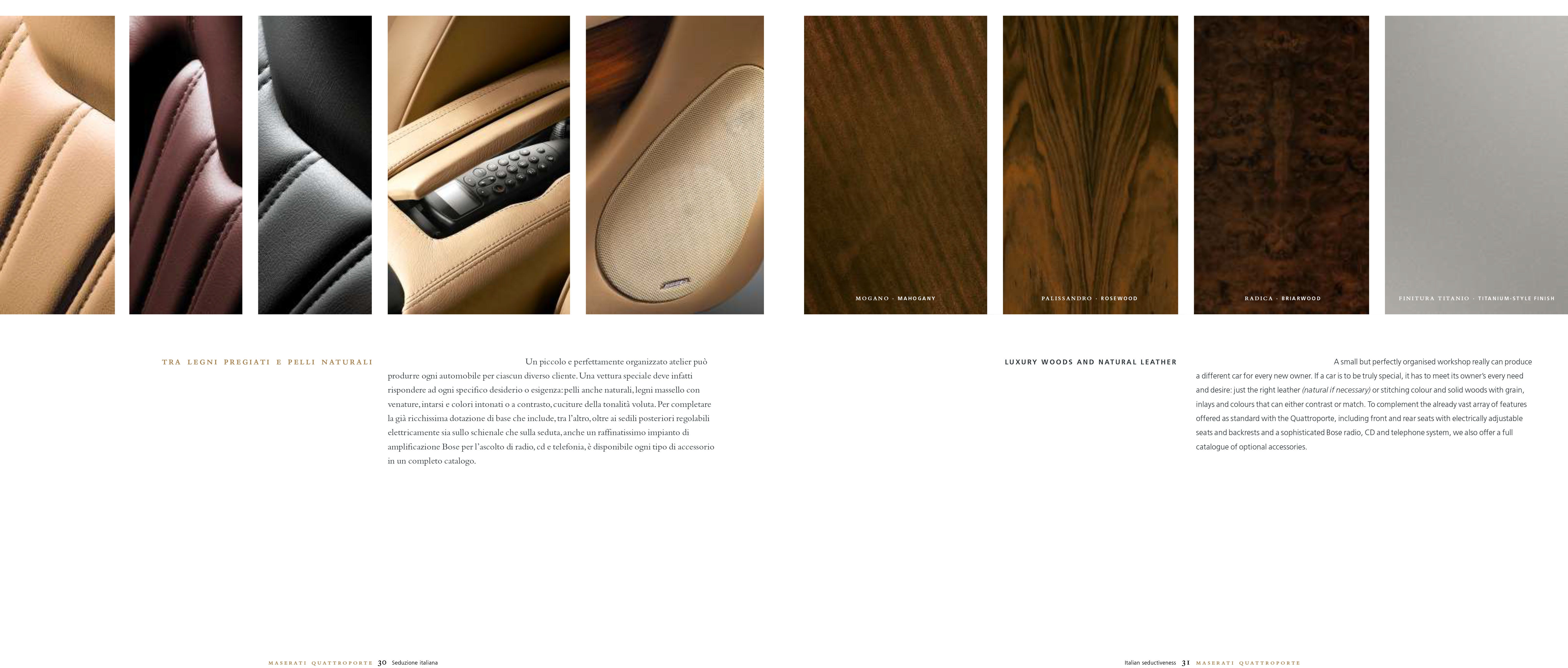
Millions of combinations. Fifteen exterior colours. Ten leather shades. Thirteen stitching colours. Dashboard in ten tints. Three woods: rosewood, mahogany, briarwood. The rosewood described as “offering the richest, clearest finish”, its grain “vertical on the central console, horizontal on the door panels”, the result “reminiscent of the kind of splendid craftsmanship normally found aboard luxury boats”, Every piece is hand-selected. Every piece is real. In the era of plastic wood-effect trim and printed leather grain, Maserati was hand-laying solid timber veneers cut and matched by craftsmen in Modena.
The V8 engine, which exists and is impressive, does not appear until page thirty-four. The brochure’s sequencing is deliberate: earn the desire before you explain the means.
Technique and Passion: The Racing Heart in Evening Dress
When the engineering section finally arrives, the brochure places it where it belongs: in the context of Maserati’s racing history. The 47/53 weight distribution returns, described as “previously virtually unthinkable in a big front-engined saloon.” It is not a boast. It is a statement of fact.
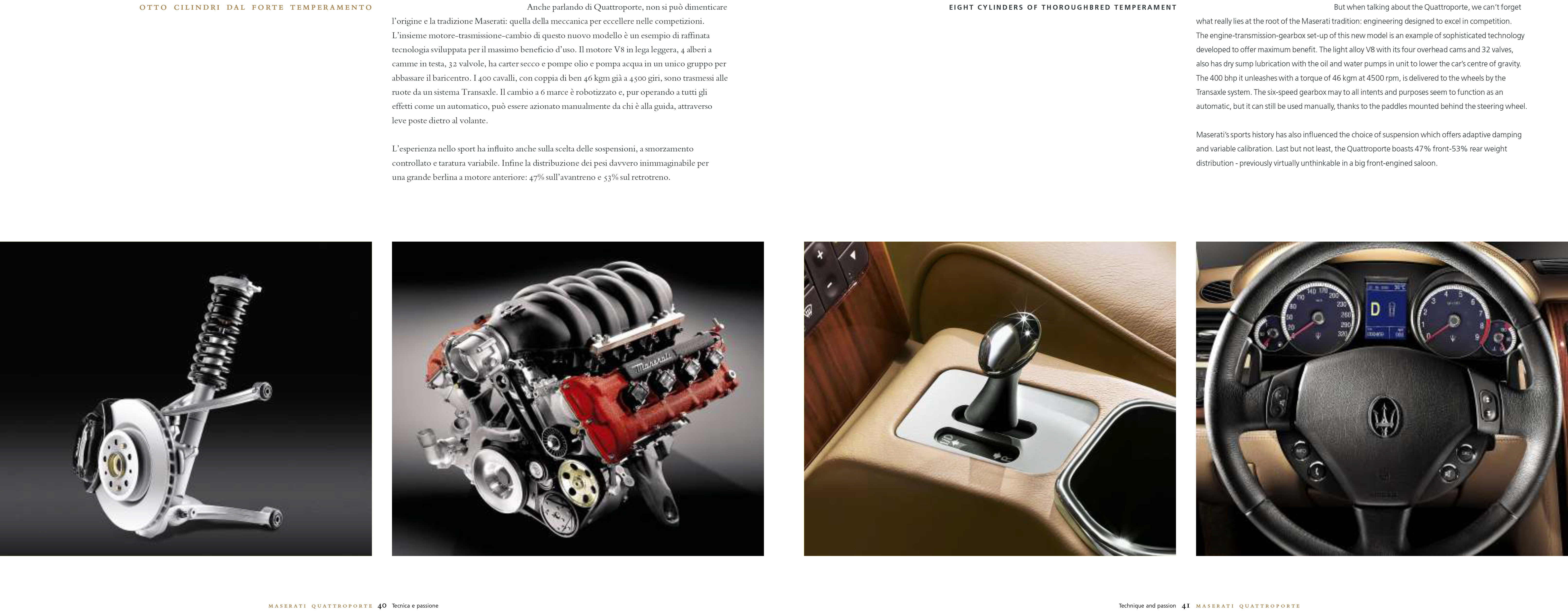
The engine photograph on page forty tells you everything. There it sits against a black background, the red cam covers drawing the eye, the Trident embossed on the intake plenum: a 4.2-litre 90-degree V8, dry-sump, four overhead camshafts, 32 valves, variable intake cam timing, 400bhp at 7,000rpm. This is the Ferrari F136 in all but name, built at Maranello and delivered to Modena. In 2003, it was one of the finest naturally aspirated V8s in production anywhere in the world. The brochure notes that it weighs just 183kg and describes it as “a veritable jewel”. For once, the copywriter was not stretching the truth.
The chassis engineering matches it. Torsional rigidity of 3,200kgm/degree and flexural rigidity of 1,300kg/mm are cited, numbers unusual in a luxury brochure and included here because the engineers were evidently proud of their achievement. The double-wishbone suspension front and rear, with forged aluminium arms and anti-dive geometry, was developed specifically for this platform. The Skyhook adaptive damping system, which the brochure describes as “a staggering 10 times faster than conventional systems currently available”, works in two modes: Normal and Sport. At speed on a good road, with the Sport button pressed and the paddles in hand, this was a genuinely exciting machine. The 275km/h top speed was not a theoretical figure.
The Rearview Mirror
The Problem: The Transmission Ate the Promise
The brochure describes the DuoSelect gearbox with careful enthusiasm: “smooth, rapid gear changing combined with top class responsiveness”. It mentions, almost parenthetically, that “there’s no need for the driver’s foot to be on the brake in traffic jams”. This reassurance, buried in a paragraph about the system’s advantages, turned out to be the most important sentence in the document.
The DuoSelect’s fundamental tension was that it behaved magnificently at eight-tenths and above, which is precisely what a saloon with a 47/53 weight split and 400bhp deserves. In brisk, committed driving, the paddle changes were quick, the logic was sound, and the whole thing made a compelling argument for the transaxle philosophy. At traffic lights, at car parks, at school runs: the clutch consumed itself with a determination that mechanics found educational and owners found expensive. Replacement costs run well into four-figures. The brochure, to its credit, never claimed this was a conventional automatic. It called it “electro-hydraulic” throughout. Buyers who did not appreciate the difference paid the price.
The Tax: What Comes Due in 2026
The ownership reality of a 2003 to 2006 Quattroporte in 2026 is one of alternating magnificence and administrative suffering. The suffering arrives in several forms.
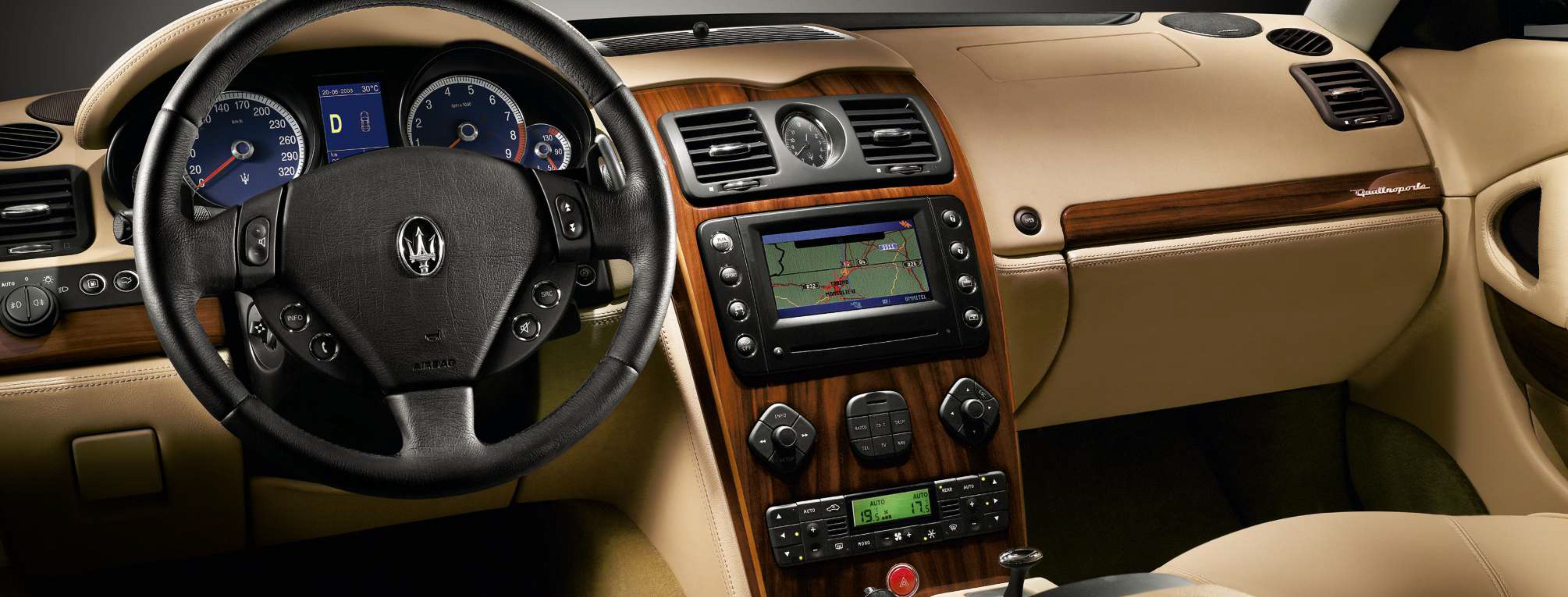
The “soft-touch” interior plastics, that luxurious, tactile surface that distinguished the cabin from the German competition in the showroom, eventually acquiesce to entropy and begin to liquefy. The substance produced is black, sticky, and absolute. Every affected button becomes both a switch and a reproach. This is the brochure’s most significant omission, not for dishonesty but for understandable ignorance: nobody knew in 2003 that the decade-forward version of “tactile quality” would be structural failure.
The camshaft variators on early 4.2-litre engines develop a habit of announcing their unhappiness on cold starts with a sound that the brochure’s lyrical prose about Stradivarius violins could not have anticipated. The noise is more Massey Ferguson than Stradivari. Replacement is specialist work. Parts are not unobtainable, but they are not inexpensive, and the knowledge required to fit them correctly is concentrated in a small number of workshops.
The clutch, already discussed. Battery drain from the complex electronics during storage. The Skyhook damper units, which the brochure celebrates for their speed relative to conventional systems, require specialist attention when they fail. Service intervals are short. The three-year unlimited mileage warranty that the brochure promises as a standard feature has, in 2026, long since expired on every example in existence.
But the Quattroporte ages with a particular poignancy because the promises of the brochure were so vividly made. When the wood veneer remains perfect and the leather is supple and the engine fires cleanly and pulls to its 7,000rpm ceiling, the car is everything the 62-page document said it would be.
The Success: The Bloodline It Established
Here is what the 2003 brochure could not have known it was launching: the platform beneath the Quattroporte was not just a luxury saloon chassis. It was the DNA of what would become the GranTurismo, a car that remained in production for over a decade, that found critical and commercial success the Quattroporte could only gesture toward, and that is, in the opinion of most who drove both, the more naturally resolved expression of the engineering philosophy.
The transaxle layout, the Ferrari-derived V8, the suspension architecture, the fundamental idea that a Maserati should have the weight distribution of a sports car wearing the suit of a limousine: all of it migrated into the GranTurismo and found a second life in a body perhaps better suited to pure expression. But the Quattroporte got there first, and did it in five metres of saloon with four doors and room for a chauffeur.
The Ken Okuyama design has also aged better than almost any contemporary. The W220 S-Class is unmistakably of its era. The E65 7 Series remains controversial. The Quattroporte of 2003 looks, in 2026, like a car that was designed with deliberate resistance to the calendar. It was always the most elegant thing in its class, and the brochure’s insistence on comparing it to Renaissance violin making now reads not as marketing delusion but as a statement of architectural intent.
The brochure ended with a single, confident declaration: “And it is these qualities that continue to make the difference between a choice made with passion and commitment, and a coldly functional one.”
It was right. The coldly functional choice depreciated predictably and was replaced on a logical schedule. The passionately irrational choice either costs you a clutch or becomes, in certain lights, at certain speeds, the most beautiful thing in the garage.
This is what “Contemporary Italian Art” looks like as a commercial proposition. It is not without its casualties. But it is not without its vindication either.
The Fine Print