The Welded Paradox: Mazda Adds a Roof and Still Calls It a Roadster
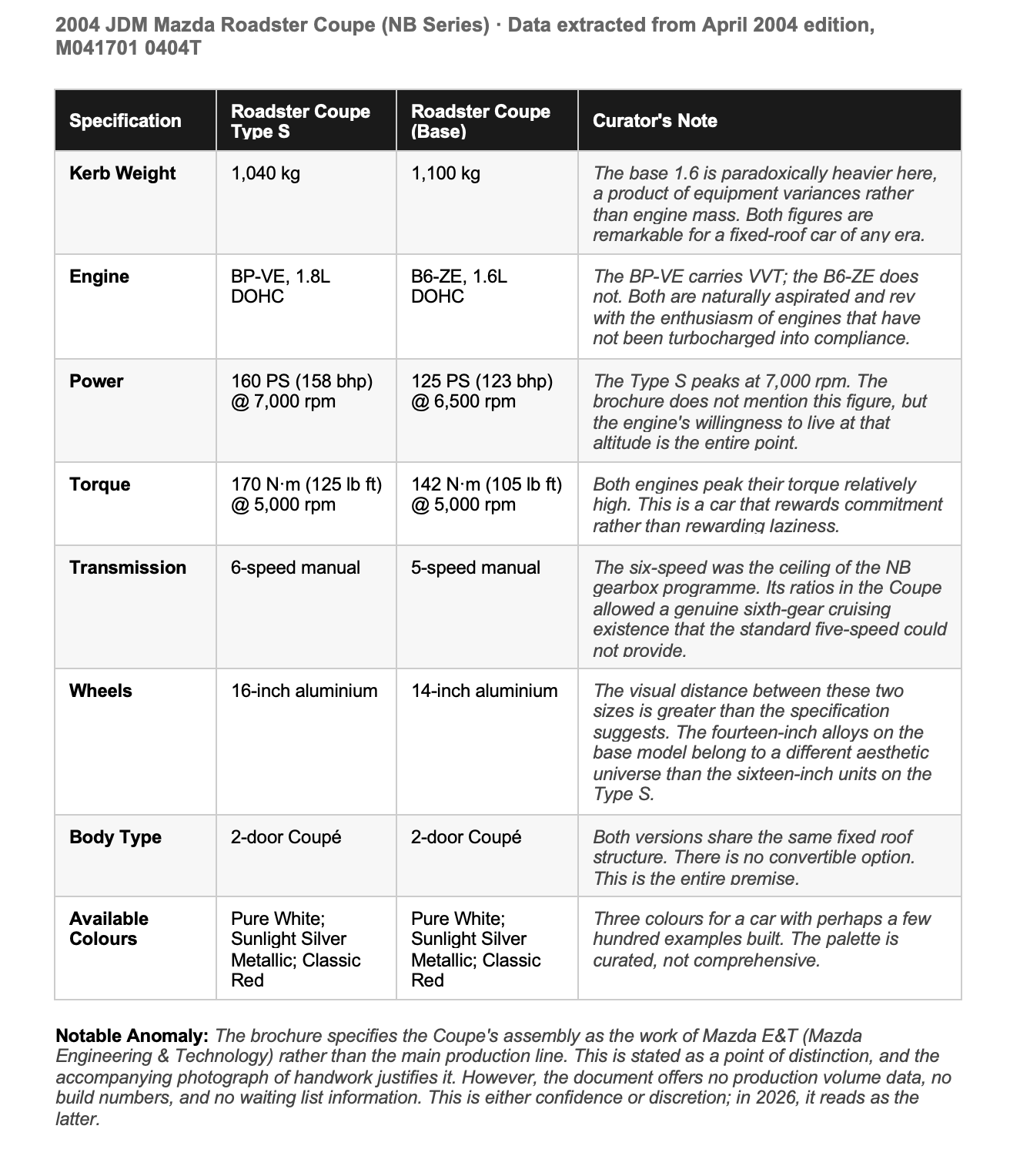
2004 JDM Mazda Roadster Coupe (NB Series)

Mazda had spent fifteen years making the world’s most popular argument for open-air motoring, the MX-5. And then, in 2004, a small team within Engineering & Technology took one and welded the roof shut.
They called it the Roadster Coupe. A roadster, with a fixed roof. Mazda printed the contradiction in bold sans-serif on every piece of literature, apparently daring you to notice. The brochure for this car, a single double-sided sheet of heavyweight coated gloss in the format that Japanese manufacturers reserve for things they consider simultaneously precious and slightly too unusual to explain at length, is the document this piece examines. It is a masterclass in the art of reframing.
Jinba-Ittai Formalism
The standard NB Roadster brochure behaves as you would expect. Coastal roads. Saturated sunshine. A couple in their late thirties discovering that freedom comes in a two-seat soft-top for a very reasonable sum.
The Roadster Coupe brochure goes somewhere else entirely. Mazda’s native philosophy of rider and horse as one, jinba-ittai, stripped of its recreational warmth until only the structural skeleton remains. The Sunlight Silver Coupe sits against a field of pure black. No road. No context. No aspirational lifestyle prop of any kind. Two cars exist in an absence, and that absence is doing all the work.
What you are looking at, it immediately explains, is something rare.
The Silhouette Reveal
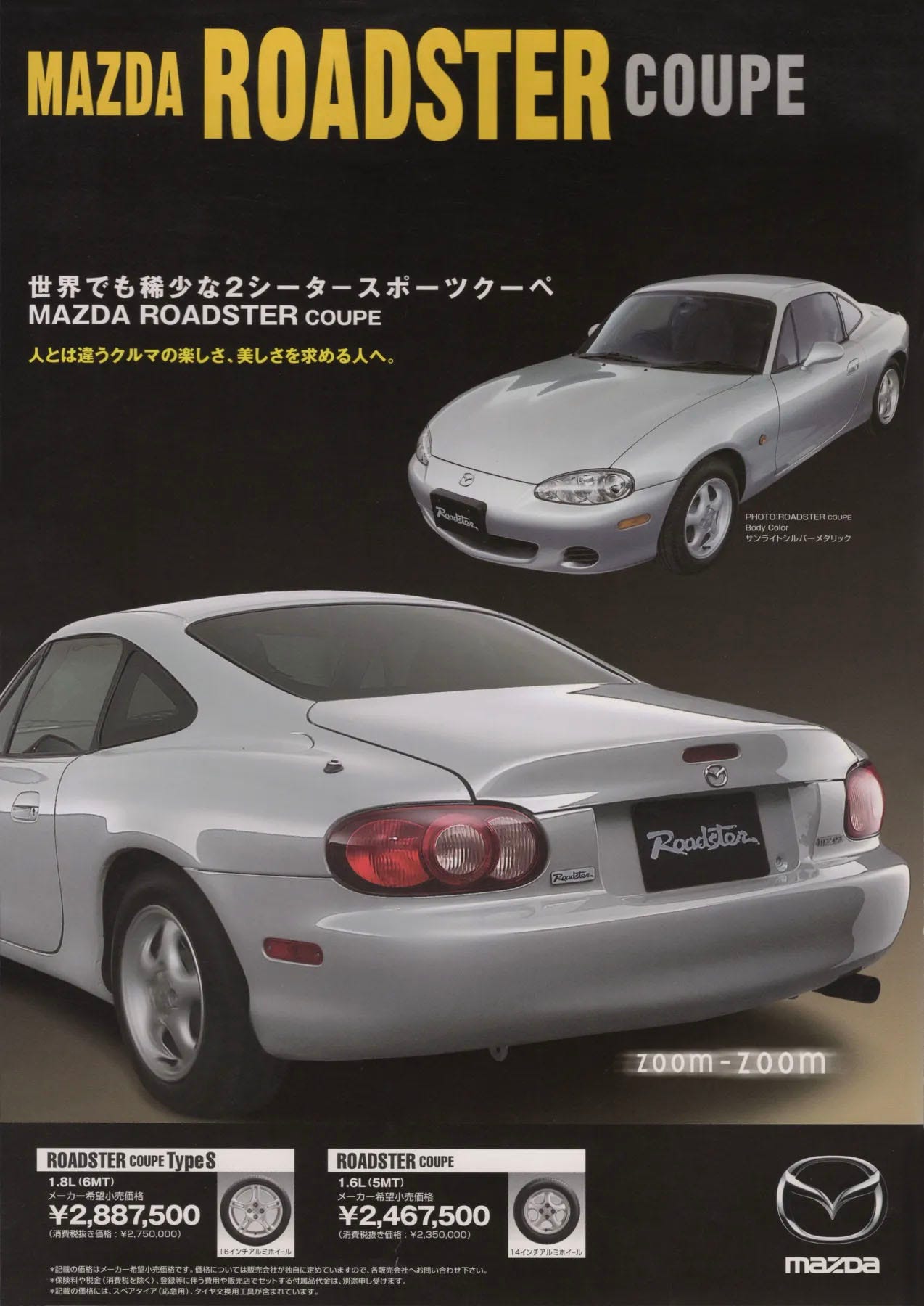
The language of the front page opens a specific territory and stakes its claim without hesitation: 世界でも稀少な2シータースポーツクーペ (”A 2-seater sports coupe rare even in the world.”)
This is not a boast about the Roadster lineage, or the MX-5’s Guinness World Record as the best-selling two-seat sports car in history. It is a deliberate reclassification. Mazda is not selling you a Roadster with its hood up. It is selling you membership in an endangered species: the small-displacement, rear-wheel-drive, fixed-roof two-seat sports coupé. By 2004, this was not an exaggeration. The Toyota MR-S existed, but strictly as a targa. The Honda S2000 was magnificent but architecturally committed to open air. The Lotus Exige offered the configuration but at a price point and with a level of mechanical drama that placed it outside civilian life. The Roadster Coupe was, in the context of the JDM market and a sub-three-million-yen (approximately $28,000 at the time) price ceiling, genuinely without equivalent.
Beneath this headline, in smaller yellow type: 人とは違うクルマの楽しさ、美しさを求める人へ。 Which translates as: “For those who seek a different kind of driving pleasure and beauty from other cars.”
Not joy. Not fun. Pleasure and beauty. The vocabulary is more demanding. It implies that the person being addressed has already considered and discarded the conventional answer. It implies connoisseurship. It implies, without quite saying it, that driving a standard Roadster is what other people do.
The two cars, front three-quarter view above and rear three-quarter below, are shot with the lighting of a jewellery catalogue. The rear view, which consumes the majority of the lower panel, is the more striking image. The Coupe’s roofline sweeps from the A-pillar in a single unbroken arc to the truncated tail, where a modest spoiler lip punctuates the fastback. From this angle, the bodywork over the rear haunches swells with a quiet confidence. It is not the NB Roadster. Something structural and intentional has happened to it, and the photographer knows to linger.
“zoom-zoom” sits in the bottom right, white on the shadowed gradient. Its presence is worth noting. Mazda’s brand tagline, introduced in 2000, was designed to communicate something light and instinctive about driving: the onomatopoeia of a child playing with a toy car. In the context of this brochure’s carefully constructed atmosphere of exclusivity, it creates a single note of tonal dissonance: the artisan workshop has a corporate logo above the door.
At the bottom, two price boxes. The Roadster Coupe, 1.6-litre, five-speed: ¥2,467,500 (~$22,800). The Roadster Coupe Type S, 1.8-litre, six-speed: ¥2,887,500 (~$26,700). The images of the wheels beside the price boxes tell the story as efficiently as any specification table: fourteen-inch alloys for the base, sixteen-inch for the Type S. Visually, the gap between those two sizes reads as the gap between a car and a serious proposition.
The Hand-Made Narrative
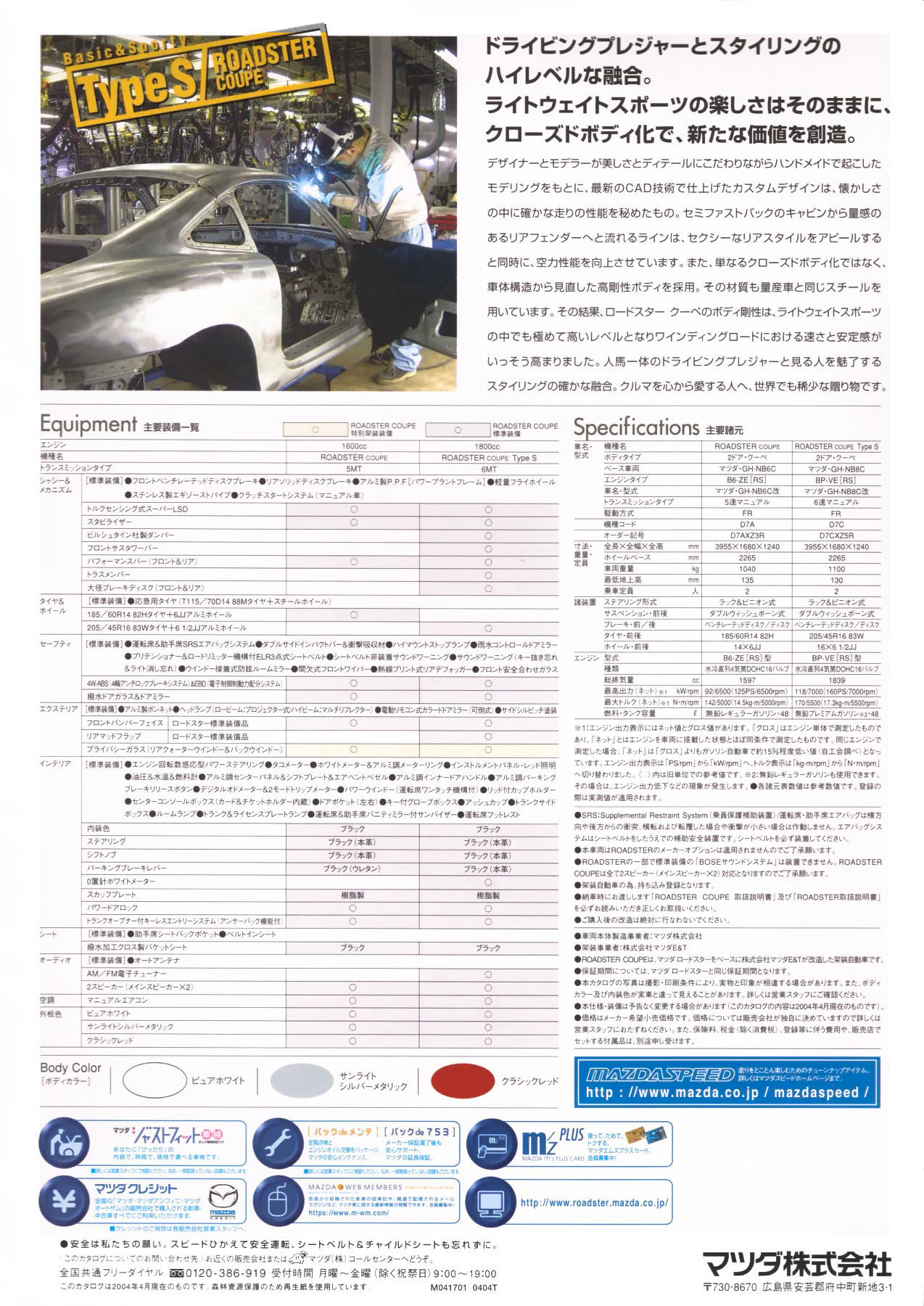
Flip the page and the emotional tone shifts. The upper-left panel shows a worker bent over a welding station, the bright arc-light of a weld in progress, the production floor visible behind him. It is an unusual image for a car brochure. Hands that make things. Fire and human judgment.
The headline to the right of the photograph in the main body column reads, in full: ドライビングプレジャーとスタイリングのハイレベルな融合。 “A high-level fusion of driving pleasure and styling.” This is the brochure’s governing thesis. Not a compromise. Not a trade-off. A fusion, the word carrying a sense of two things achieving something neither could accomplish alone.
The supporting copy earns the vocabulary. The relevant passage translates as: “Based on modelling created by hand by designers and modellers who were obsessed with beauty and detail, the custom design finished with the latest CAD technology conceals solid driving performance within a sense of nostalgia.”
Several things are happening in that sentence simultaneously. First, the “hand-made” origin is placed before the technology, not after. The sequence matters: it begins with human obsession and arrives at CAD, not the reverse. The implication is that the digital tools were servants of the artisanal vision, not its source. Second, the word translated here as “obsessed” (kodawari) carries specific cultural weight in Japanese manufacturing contexts. It does not mean merely “concerned” or “attentive”. It implies a craftsperson’s refusal to accept the merely adequate. It is the vocabulary of the master artisan, applied to automotive body engineering.
The copy continues, describing the semi-fastback cabin flowing into the rear wing (sekushii-na ria sutairu, a “sexy rear style”) and noting that it simultaneously improves aerodynamic performance. Then: “Furthermore, it is not merely a closed body; a high-rigidity body was adopted by reviewing the body structure from scratch.”
“From scratch.” This is doing considerable lifting. The Coupe shares its floor, engine bay, suspension, and front-end structure with the standard NB Roadster. What changed from scratch was the passenger cell above the waistline, the fixed roof structure, the rear quarters, and the door apertures. The brochure is technically accurate and selectively generous at the same time. What changed was significant. What it omits is that the standard Roadster platform was already one of the most torsionally effective structures in the class.
What the roof added, the brochure is careful to quantify without stating directly: the Coupe’s body rigidity was, by its own admission, “at an extremely high level among lightweight sports cars”. The rigidity increase over a convertible body is inherent to the architecture; closing a box structure is a basic exercise in structural mechanics. But the brochure correctly identifies that this was not merely a cosmetic exercise. The Coupe drove differently from the Roadster: more planted, quieter, with a different relationship between road input and driver perception. Whether this was better was a question of what you believed a Roadster should be. The brochure quietly suggests that the Coupe had moved beyond the question entirely.
The Rearview Mirror
The Problem: Too Rare to Function
The brochure’s claim that this was “rare even in the world” was not marketing hyperbole. It was a logistical statement of fact that the brochure’s authors perhaps did not intend as a warning.
Approximately 179 examples of the Type S were produced. Total Coupe production across both variants reached a few hundred units. For context: in the same period, the standard NB Roadster was selling in volumes that made it a fixture on Japanese used-car lots. The Coupe, by contrast, was produced in numbers that would embarrass a coachbuilder.
This created an immediate paradox for the buyer. You could purchase a car that the brochure correctly described as extraordinarily rare. You could not, in any practical sense, service, insure, or maintain it without confronting that rarity at every turn. The rear quarter panels are not shared with the standard Roadster. The fixed roof structure is unique. In 2026, a damaged Coupe rear haunch presents a restoration problem that no catalogue-parts supplier can resolve.
The weight question is worth addressing, though it is a thinner argument than the purists suggest. The 1,040 kilogram Type S weighs roughly the same as a decently equipped NB Roadster. What changed was not the mass but the character: the car was quieter, stiffer, more focused. Some found that it had lost something irreplaceable. Others found that it had become something different and arguably better. The brochure, wisely, never attempts to convince the open-air faithful. It addresses itself exclusively to those who have already decided.
The Tax: The Body Panel Problem
The bodywork above the waist is the Coupe’s single greatest liability in 2026. Every pressing that differs from the standard car, the fixed B-pillar, the sail panel, the rear haunch, the roof skin, exists in a supply chain that effectively closed when production ended. Specialist restorers in Japan have documented cases where sourcing a single rear quarter panel requires either a parts donor (itself a collector’s item) or bespoke fabrication at costs that substantially exceed the car’s market value at any point before approximately 2020.
The good news is that the mechanical and structural components beneath the waistline, the suspension geometry, the powertrain, the front subframe, are shared with one of the most thoroughly supported sports cars in the world. The Roadster’s global ownership community has spent thirty years ensuring that BP-VE engine components, NB-spec dampers, and gearbox internals remain available. Buy a Roadster Coupe and you inherit that support structure from the firewall forward. From the A-pillar upward, you are on your own.
The Success: The Ancestor in the Room
The Roadster Coupe can now been seen as the proof-of-concept that eventually became the ND-generation MX-5 RF, the Retractable Fastback introduced in 2016. The question it was designed to answer, “is there a market for a fastback-roofline MX-5?”, was answered definitively, if quietly, by the hundred-odd Japanese enthusiasts who paid a significant premium for one in 2004.
The irony, though is that the RF, for all its success, is an engineering compromise: the folding mechanism demands a thicker C-pillar and truncates the roofline to accommodate the works. The NB Coupe’s fixed roof is a single unbroken arc with nothing behind it but steel and intent. It is cleaner precisely because it never had to move. The ancestor is, by any honest aesthetic measure, the purer object.
In 2026, the market has noticed. These are no longer used Mazdas. A few hundred hand-finished examples, with a direct historical line to one of the company’s most successful modern variants, have crossed into blue-chip JDM collector territory. The designers who were “obsessed with beauty and detail” were vindicated twice: once by history, and once by the market.
The Fine Print