
The Boardroom Brute: Making Speed Look Responsible
How AMG Sold a 525bhp Saloon with a Straight Face

Calculated confidence does not shout. It presents evidence. It arranges photographs. It sets copy in a restrained serif typeface and lets the reader draw the correct conclusions, which are, of course, the conclusions it wants them to draw.
The 2010 Mercedes-Benz E63 AMG International Edition brochure is twenty-two pages long. It contains no price. It mentions no rivals. It barely raises its voice. And yet from its opening spread to its final technical data block, it builds a case that is almost lawyerly in its construction: that 525bhp is not an indulgence. It is a professional necessity.
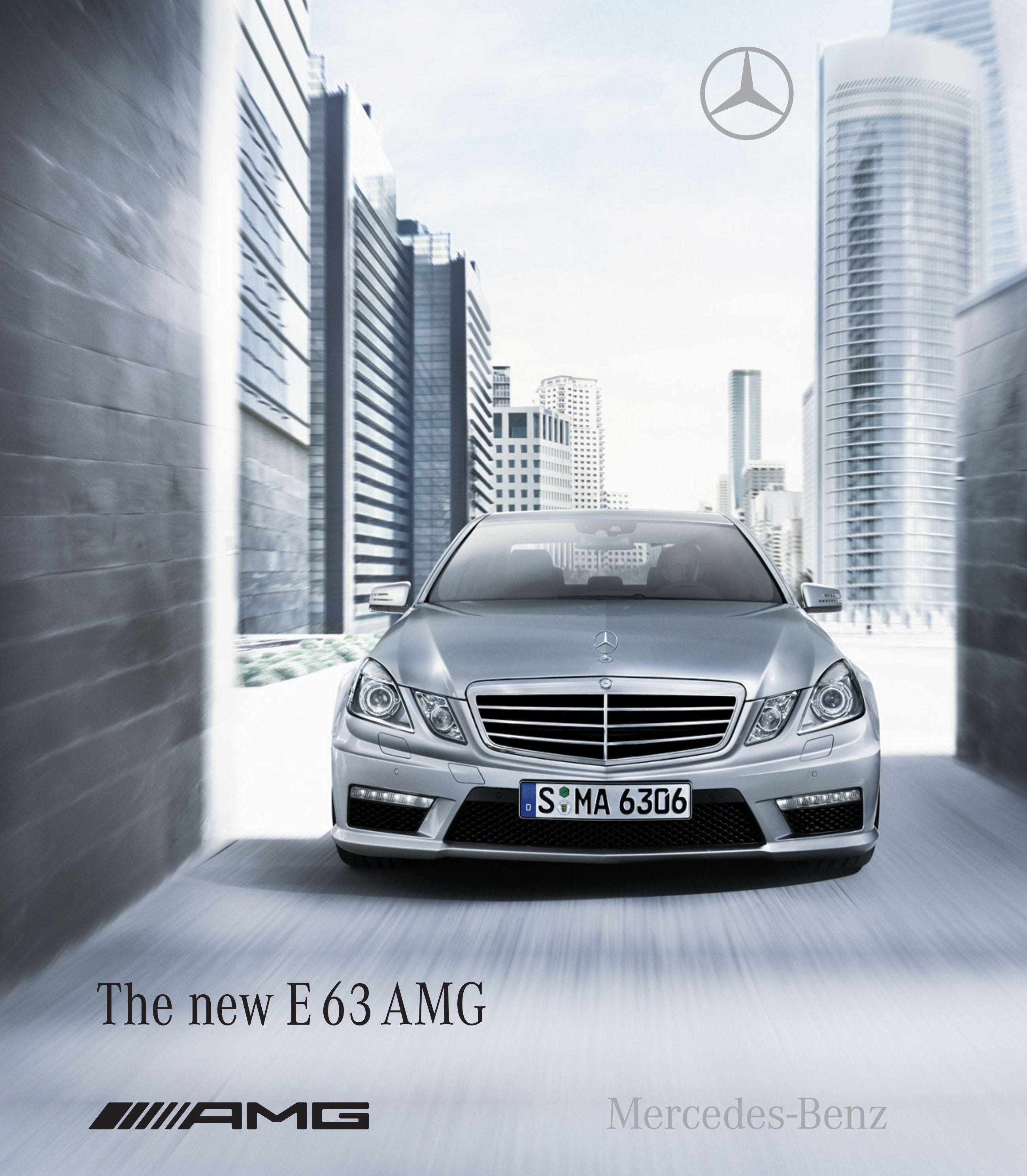
This is the paradox the brochure was assembled to resolve. The W212 E-Class was, in its standard configuration, a car for the senior executive: rational, composed, impeccably upholstered. AMG’s task was to take this reliable instrument of business travel and transform it into a saloon that could cover a motorway kilometre in under fifteen seconds, without making the buyer feel they had done something irresponsible. The solution, executed across twenty-two pages, was to reframe the entire enterprise. The E63 AMG was not a performance car with executive pretensions. It was an executive car with a moral obligation to perform.
The Aesthetic of Cold Advantage
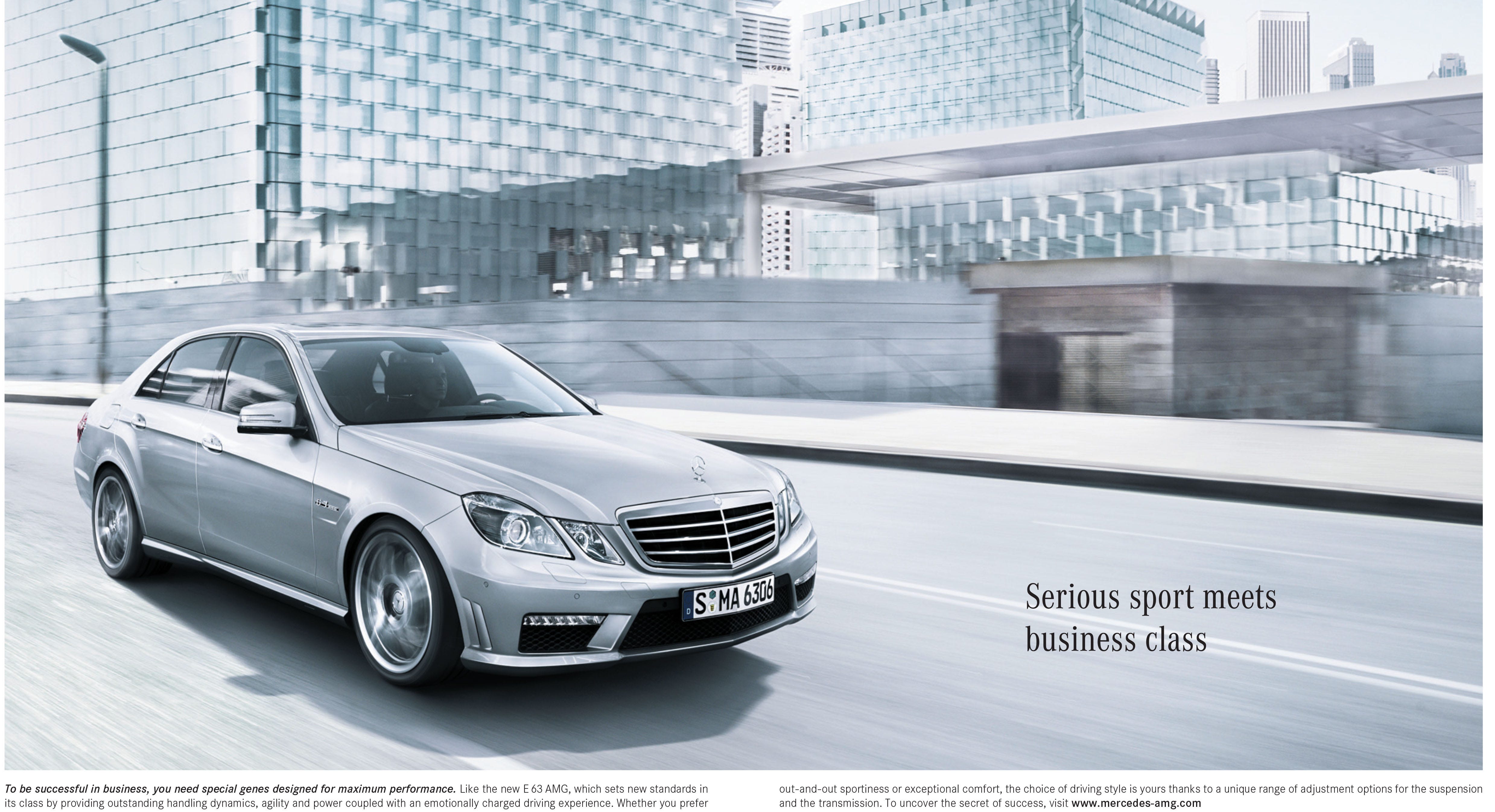
Open the brochure at page two and you are not standing in a showroom. You are in an anonymous modern cityscape, the light sharp and cold. The E63 moves through it at speed. The headline reads: “Serious sport meets business class.” Below, in the dense sans-serif body copy reserved for technical elaboration, the argument begins.
“To be successful in business, you need special genes designed for maximum performance.”
It is a remarkable sentence. It frames the AMG 6.2-litre V8 not as an engineering achievement but as a biological competitive advantage. The car, implicitly, is for people who already have the correct genes; purchasing it is simply a matter of consistency. The brochure never explains what happens to those without them. It doesn’t need to. The target reader has already assumed themselves to be in the correct category.
The copy that follows lists the car’s virtues in a telling sequence: “outstanding handling dynamics, agility and power coupled with an emotionally charged driving experience.” Emotion arrives last, almost apologetically, behind the harder virtues. This is the correct order of priorities for the intended reader.
The visual vocabulary that carries this argument throughout the brochure is cool-toned silver, clinical high-contrast lighting, and the kind of architectural backdrop that suggests glass, steel, and the relentless optimisation of space. Even when the car escapes the city, it feels less like leisure, and more like a site visit. The E63 AMG has no off-duty mode. It is always working.
The typography is deployed with precision. Headlines appear in an open-spaced serif that carries the appropriate weight of expensive calm. Body copy drops to a compact sans-serif, technical and businesslike, the visual equivalent of a well-formatted report. White space is used aggressively throughout. The car sits alone against pale backgrounds like a sculpture in a well-funded gallery, or a chief executive in a glass-walled boardroom: in plain view, deliberately isolated, certain of its own importance.
Efficiency as Strategy
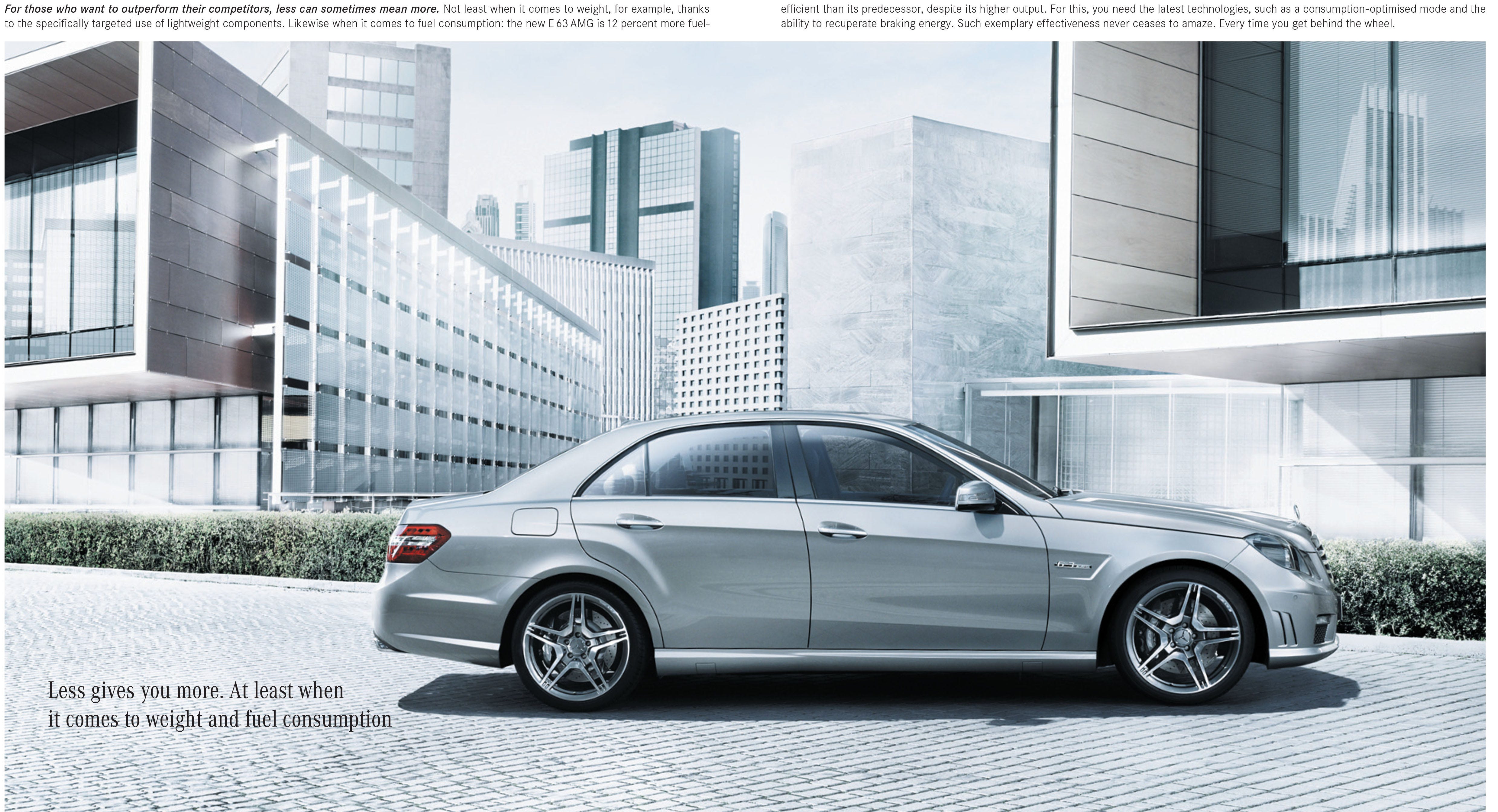
This is the brochure’s most carefully constructed page. The E63 is shown in profile, static, against another glass-and-steel facade. The headline declares: “Less gives you more. At least when it comes to weight and fuel consumption.”
The argument that follows is genuinely audacious. The new E63 is 12 per cent more fuel-efficient than its predecessor despite its higher output. This fact, which in any other context would be a footnote, is presented here as a competitive masterstroke, the automotive equivalent of outperforming the market benchmark. Efficiency, the brochure insists, is not compromise. It is outperformance by another metric. The word “competitors” appears in the body copy. The competitors are not named, but their implied inferiority is structural to the sentence.
What the page does not mention is the combined fuel consumption figure of 12.6 litres per 100 kilometres, or the CO2 emissions of 295 grams per kilometre. These numbers exist, they occupy a small block of regulatory text on page eighteen. But pages four and five is not the place for them.
The Aerospace Claim
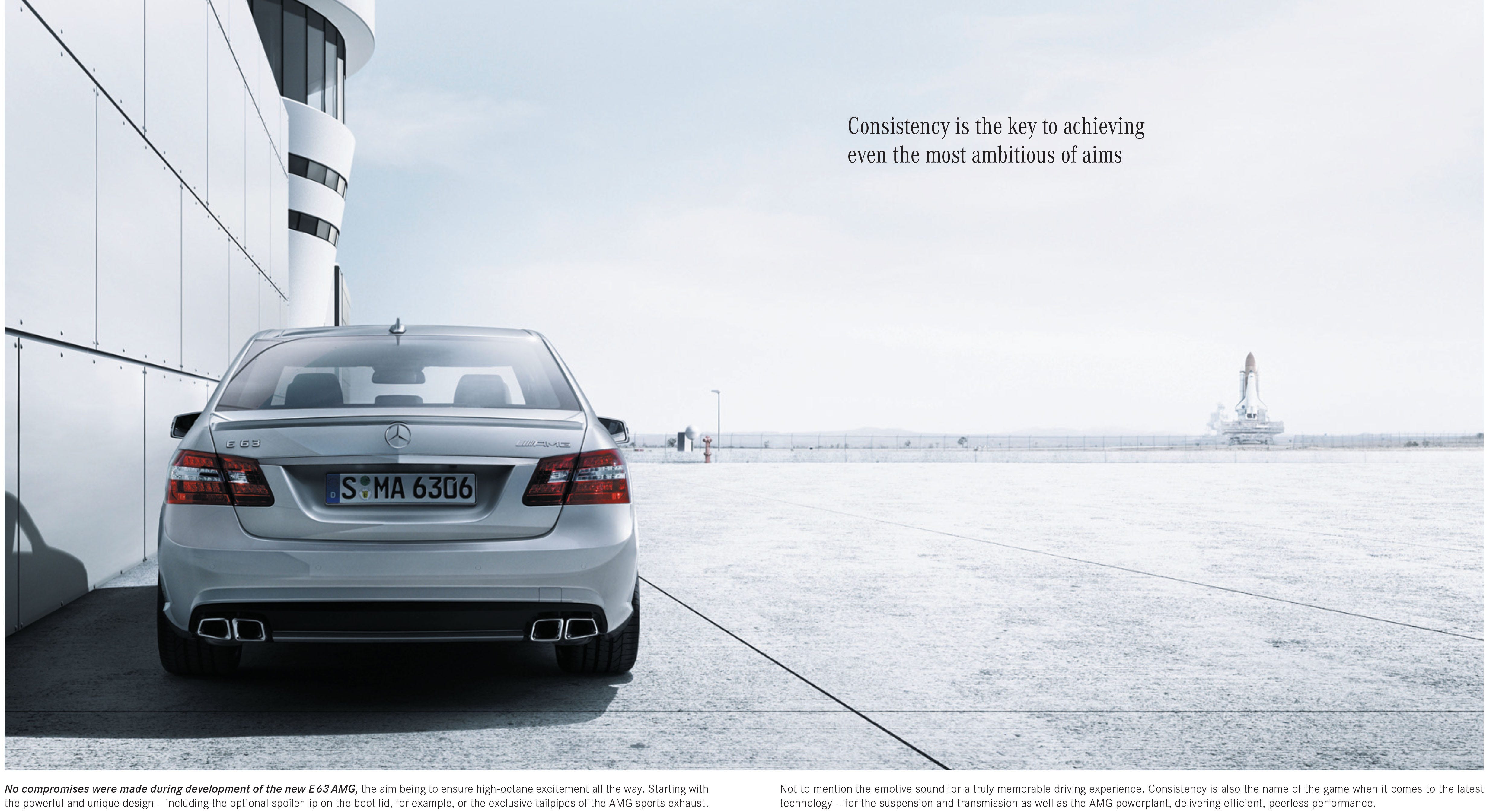
A rear shot of the E63, positioned on a launch facility apron. In the far right of the frame, rendered small but unmistakable, a space shuttle stands on its pad. The headline: “Consistency is the key to achieving even the most ambitious of aims.”
It is the brochure’s most operatic moment, and it earns it. The choice to park a performance saloon against a spacecraft is not accidental visual excess; it is the argument about ambition made visible. The body copy follows through by describing AMG’s engineering approach, which admits to no compromises, as the same quality of thinking that puts things into orbit. The fact that this comparison is logically absurd is almost beside the point. It lands.
The Command Centre
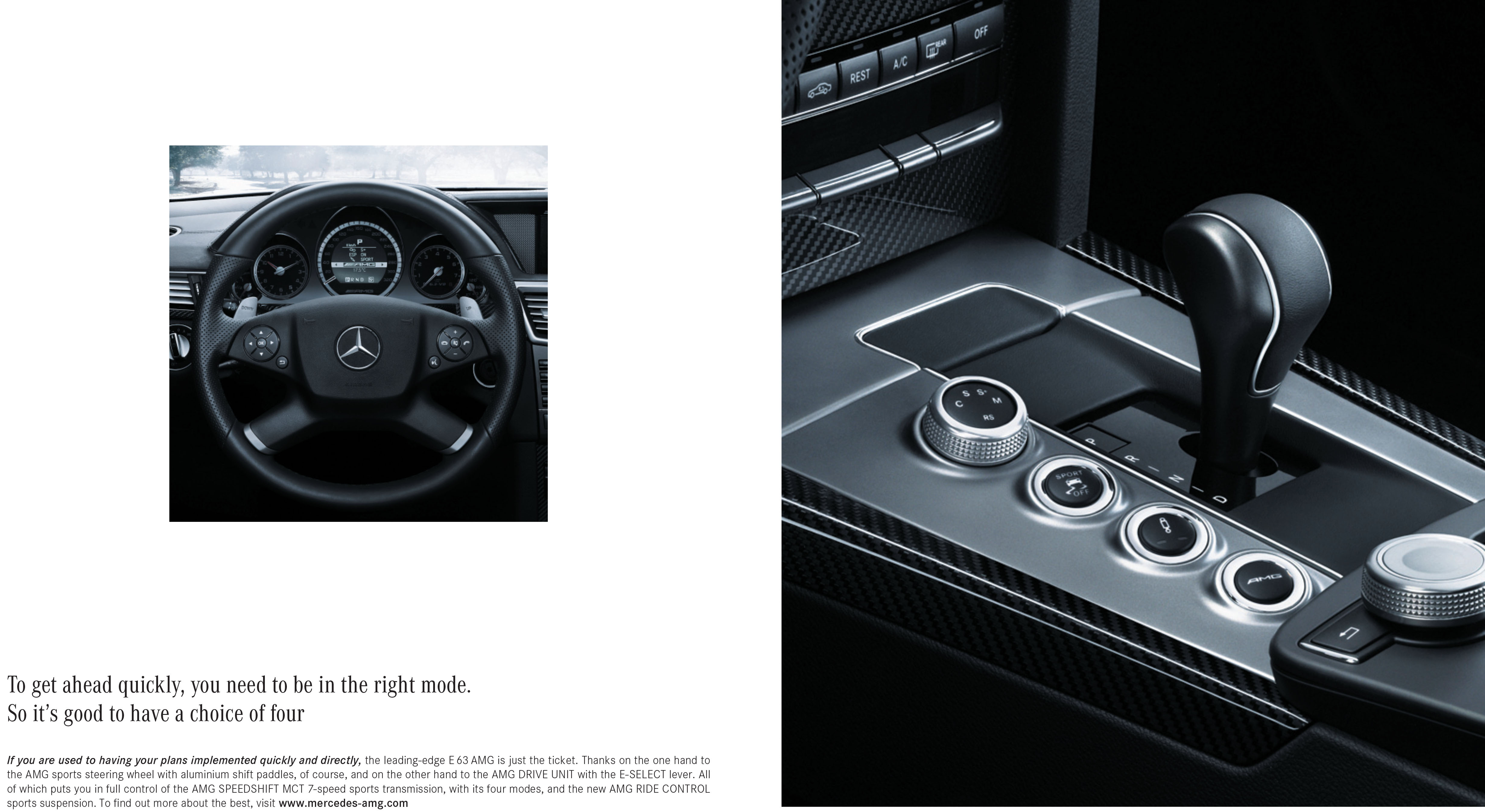
Two photographs: the AMG sports steering wheel with its aluminium shift paddles, and a close-up of the AMG DRIVE UNIT console, its dials and the E-SELECT lever arranged with the clinical deliberateness of avionics. The headline: “To get ahead quickly, you need to be in the right mode. So it’s good to have a choice of four.”
The four modes of the AMG SPEEDSHIFT MCT transmission are C (Controlled Efficiency), S (Sport), S+ (Sport Plus), and M (Manual). The brochure positions these not as driving options but as management tools: different operating modes for different professional contexts. The DRIVE UNIT console is photographed in controlled darkness, its machined aluminium dials picking out hard light against the carbon fibre surround. It is the visual equivalent of a boardroom presentation slide showing competitive advantages.
The Mechanical Soul
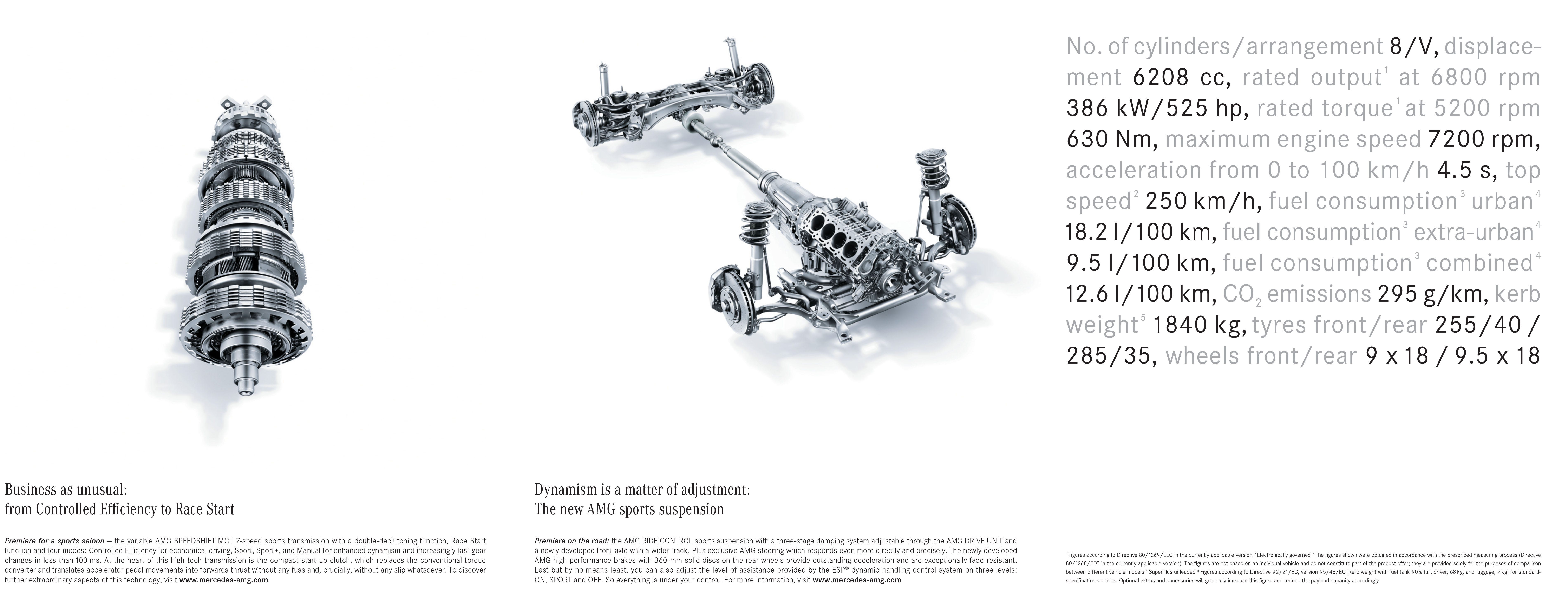
The technical climax, and the brochure’s most ambitious layout: three pages given over entirely to the mechanical argument. The internal workings of the MCT 7-speed transmission occupy the left page, dense and machined and entirely unexplained. The centre page presents the powertrain and suspension geometry in the same dissected clarity. The right page is given over entirely to the technical specifications. No lifestyle photography. No headline. Just numbers, at scale, as if the data itself is the closing argument.
“At the heart of this high-tech transmission is the compact start-up clutch, which replaces the conventional torque converter and translates accelerator pedal movements into forwards thrust without any fuss and, crucially, without any slip whatsoever.”
Without any slip whatsoever. It is the brochure’s most revealing piece of copy, and not because of what it claims about the hardware. It is revealing because of what AMG considers worth guaranteeing. In a world where the torque converter was the industry standard, the MCT’s promise of zero mechanical inefficiency is presented as a moral position. Slip is waste. Waste is incompetence. The E63 AMG, the copy implies, does not tolerate either.
The Rearview Mirror
The Problem: The Brilliant Anachronism
By the time the W212 E63 arrived in showrooms, the direction of travel was becoming visible to anyone paying close attention, though the destination had not yet been confirmed. BMW’s M5 still used a naturally aspirated V10; Audi’s RS6 remained, in that generation, a V10 car. The turbocharged future was something engineers and platform planners could see approaching, but it had not yet arrived with sufficient force to make the present feel like an ending. The naturally aspirated 6.2-litre V8 in the E63 was not obviously a last statement. It felt, in 2010, like a continuation of something healthy.
The “63” badge was a problem that the brochure chose not to acknowledge. In the showroom, it confused some buyers who checked the specification sheet and found 6,208cc. For AMG enthusiasts, the lineage was perfectly understood; the number honoured the original M100. For those arriving at the E63 from outside the tradition, it introduced a small but nagging doubt about whether AMG was being entirely straightforward. This was not a useful doubt for a car at this price point.
The MCT transmission, for all the brochure’s celebration of its zero-slip clutch mechanism, proved temperamental in the conditions the brochure preferred not to discuss: city traffic, slow-speed manoeuvring, the exact operating environment the “business class” positioning implied. In Race mode, extracting violence from a standing start, it was superb. Crawling between meetings in central London, it could be abrupt and unrefined in a way that reminded you this was, at its heart, a racing transmission wearing a suit.
The Tax: The M156’s Reckoning
The brochure, on page nineteen, mentions the M156’s “exemplary reliability and durability”. This remains, on balance, a fair claim, with an asterisk the size of a cylinder head. The M156 is susceptible to head bolt failures, a known issue that if unaddressed can lead to coolant ingestion and the kind of mechanical reckoning that no number of sequential gearchanges in under 100 milliseconds will solve. Updated head bolts and regular coolant maintenance form the liturgy of M156 ownership in 2026. It is not complicated, but it is non-negotiable.
The MCT unit, celebrated in such detail on page sixteen, has developed a reputation for expensive attention requirements. Fluid changes at shorter intervals than the official schedule, clutch pack replacement and a sensitivity to incorrect fluid specification have made specialist knowledge an entry requirement for ownership. The independent AMG specialist, not the main dealer, has become the practical choice: they understand what the brochure’s photograph doesn’t show you.
Parts availability remains manageable, for now. The M156 in various states of tune appeared across AMG’s portfolio for long enough that the supply chain is reasonably well stocked. The W212 chassis is robust. The electronics are dense but not pathological in the way that some contemporary rivals’ systems became. Today, a well-maintained E63 AMG is an achievable proposition; it simply requires more deliberate management than the brochure’s framing of inevitable, consequence-free performance might have suggested.
The Success: The Last Honest Scream
Here is what no one anticipated writing in 2010, but which has become, sixteen years later, an obvious truth: the W212 E63 AMG was the last naturally aspirated AMG E-Class, though few recognised it as such at the time. Its immediate predecessor, the W211 E55, had been supercharged. The W212 was a brief return to natural aspiration before the M157 closed the door permanently. It didn't just replace it. It redefined it, retrospectively, as a farewell.
The M156 at full chat sounds like nothing produced since. The naturally aspirated V8, climbing to its 7200rpm limit without the urgency-on-demand that a turbocharger provides but with a linearity and vocal character that turbocharging cannot replicate, has become the thing that W212 E63 owners describe first and statistics describe last. The brochure references “emotive sound” in a single phrase on page eleven. It is the most significant understatement in the document.
The W212 platform’s longevity proved remarkable. Built on a chassis that was regarded at the time as a quantum improvement over the W211 it replaced, the car has aged structurally well. The collector premium has arrived quietly and without the ceremony afforded to more obviously exotic machinery; private sales of clean examples have been climbing with the steadiness of someone who knows what they have and is in no hurry to demonstrate it.
The brochure’s approach was, ultimately, successful. It reframed excess as efficiency, displacement as strategy, and sound as executive advantage. In retrospect, it was also, without meaning to be, a farewell. The business case AMG made for the naturally aspirated V8 in 2010 was the last one it would make. The market moved on. The engine did not. And those twenty-two pages of cold, precise, high-contrast silver remain, filed somewhere between the commercial and the elegiac: a brochure that made its argument, sold its cars, and turned out to be commemorating something it had not yet realised it was losing.