
The Insulation Doctrine: Mercedes-Benz W123 Coupé and the Science of Not Feeling
The coupé that sold anxiety reduction as a luxury product

There is a sentence buried in the second spread of this brochure that contains the entire Mercedes-Benz philosophy of the 1970s. “It produces a car”, the copy reads, “which has all the attributes necessary for calm, composed, superior driving, because the driver is relaxed, insulated from effort and stress.” Not thrilled. Not exhilarated. Insulated.
This is not, as it might appear, a failure of ambition. It is the brief, stated plainly. And for a car of this type it is a perfectly coherent brief: the W123 Coupé was never a sporting machine in the manner of the BMW 633CSi or the Porsche 928. It was a more stylish, more individual expression of the saloon beneath it, bought by someone who wanted the same proven engineering, but in a more exclusive form.
What is interesting is not that Mercedes promised insulation from stress, but the language they chose to justify it: not opulence, not performance, but the cold clinical vocabulary of pulse rates and psychological factors. Rolls-Royce sold serenity through craftsmanship and heritage. Mercedes sold it through engineering psychology. The difference says everything about what each company believed its customers ultimately respected.
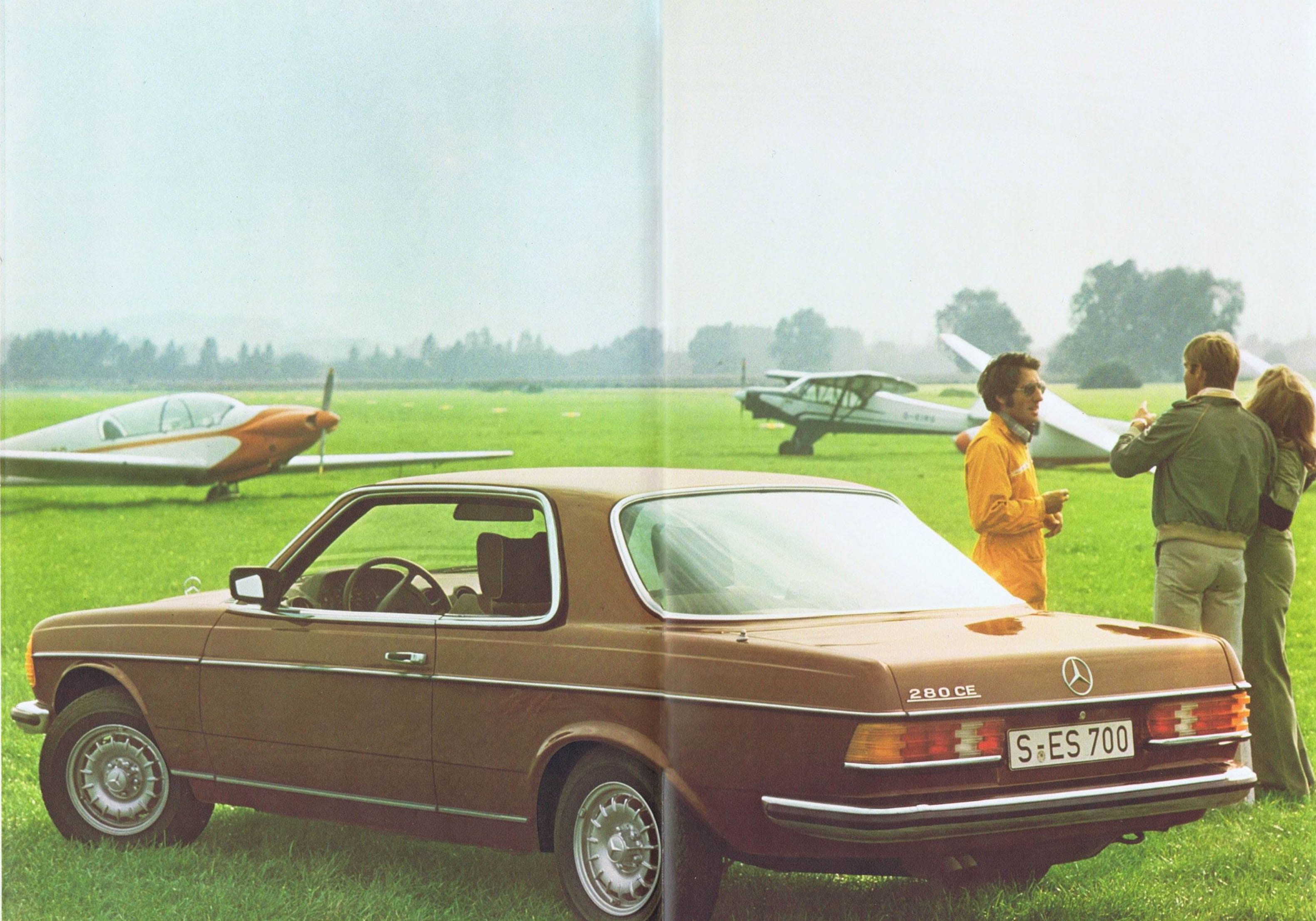
The W123 in its two-door form is photographed against blurred European motorways and manicured golf courses. It is obviously beautiful. The pillarless side profile, the chrome perimeter that floats the glass in mid-air, the sculpted rear haunches above those famous ribbed tail lamps, which the text dutifully informs us are ribbed not for elegance but to prevent road dirt from obscuring the lenses. Aesthetics determined by function. The brochure will not allow you to enjoy the styling for its own sake. Enjoyment, for Daimler-Benz in 1977, requires justification.
The central paradox of this document is that it sells an emotional purchase, a two-door coupé, a car of vanity and self-expression, through an argument constructed entirely from engineering psychology. The person who buys this car is seeking “a high degree of individuality”. And they will achieve it, the brochure implies, because the car has been calibrated so precisely to the known parameters of human stress response that the driver’s pulse will remain, throughout, admirably low.
The W123 Coupé: the only car in the world that you buy with your heart and justify with your cardiovascular data.
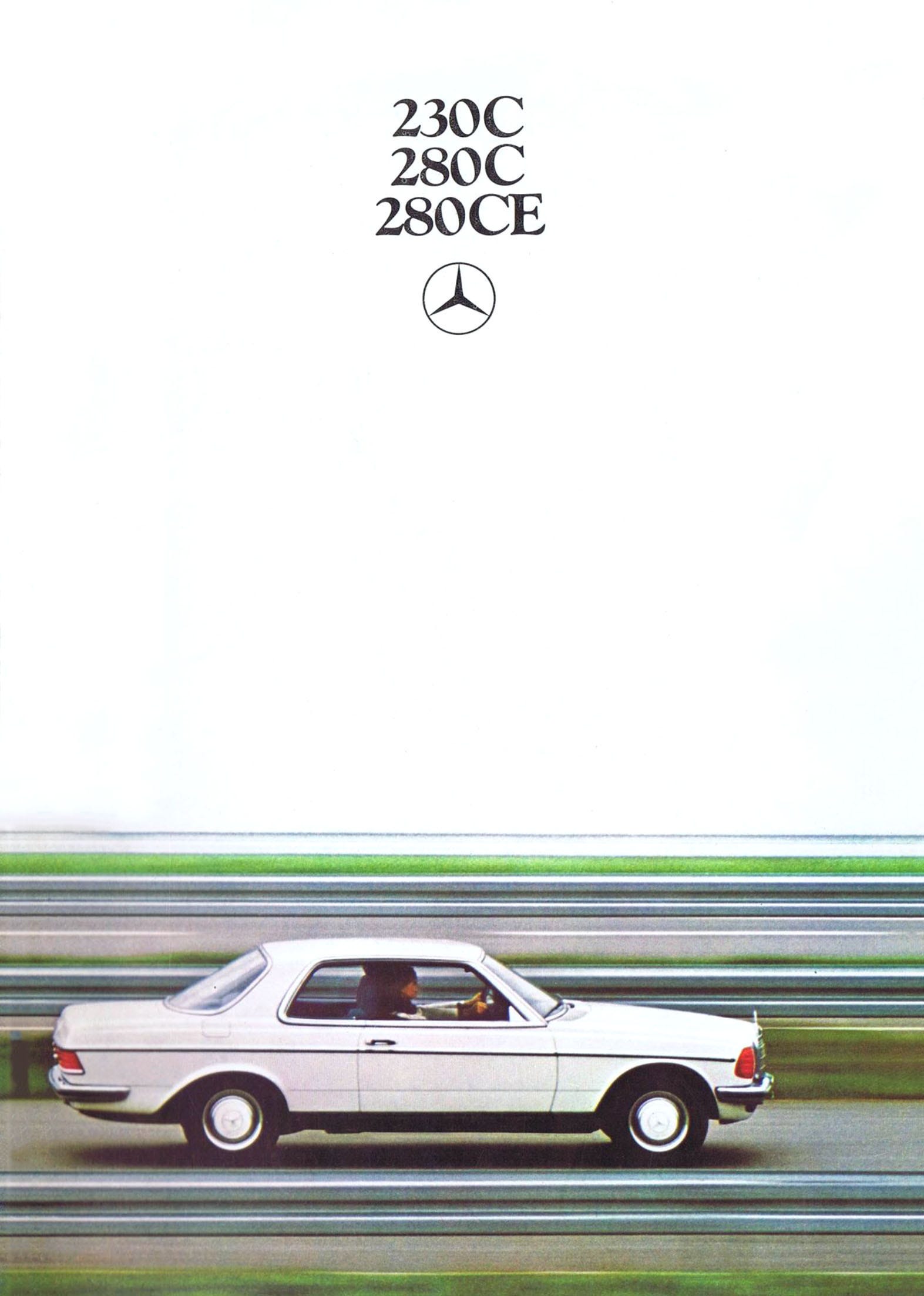
Clinical Teutonism: The Aesthetic of the Piece
The brochure is 36 pages, stapled, printed on heavyweight semi-gloss stock that sits somewhere between a medical journal and an upmarket department store catalogue. The typography is rigorous: clean sans-serif for headings, traditional serif for body copy, every block of text justified, every caption subordinate to its photograph. No element is decorative. Every element is there to serve the proposition.
The visual identity is built on a productive tension between two competing photographic styles. The first is chromatic and kinetic: the Mimosa Yellow 280C blurred against autobahn barriers, the 280CE caught in a panning shot as it sweeps through a motorway interchange, the interior spread with its warm Zebrano woodgrain glowing against the cognac velour seats. These images sell pleasure. The second style is monochrome and diagrammatic: a bare bodyshell being lowered into the factory’s protective dip, a schematic of the corrugated steering tube floating against white space, a technical cutaway of the double-wishbone front suspension geometry. These images sell certainty.
The brochure understands that these two styles are not in conflict. Together they make the argument: here is something beautiful, and here is why it is safe to want it.
The document is organised thematically, which is an unusual choice for its era and one that reveals the depth of Daimler-Benz’s confidence. It does not walk around the car. It does not take you from bonnet to boot, from engine bay to luggage compartment. It moves instead through a series of philosophical propositions: “The Elegance of Perfect Engineering.” “Safety, for More Enjoyable Driving.” “Aesthetics Determined by Function.” “Spaciousness, Not Just Space.” “As Individual as the Driver Himself.” “It is Not Only Its Shape that Gives a Lasting Impression.” Each heading is a small argument, set in bold serif at the top of its spread. The car is not described. It is proven.
The Concept

The brochure opens without an image. The right-hand page contains only text, flush right, in one column. The headline reads: “The Mercedes-Benz Coupé. The Elegance of Perfect Engineering.” The copy below it establishes the entire frame in 200 words. The car, it explains, is “visualised — and realised — by the use of the psychological, scientific and functional factors which influence motoring.” This sentence is the foundation. The product of those factors is not a fast car, or a beautiful car, or a comfortable car. It is a car for someone who “still wants a high degree of individuality” and “is not prepared to do without the perfection of a Mercedes-Benz”.
Note the construction: “not prepared to do without.” The desire is treated as settled. What remains is the mechanics of the transaction.
Technical Supremacy
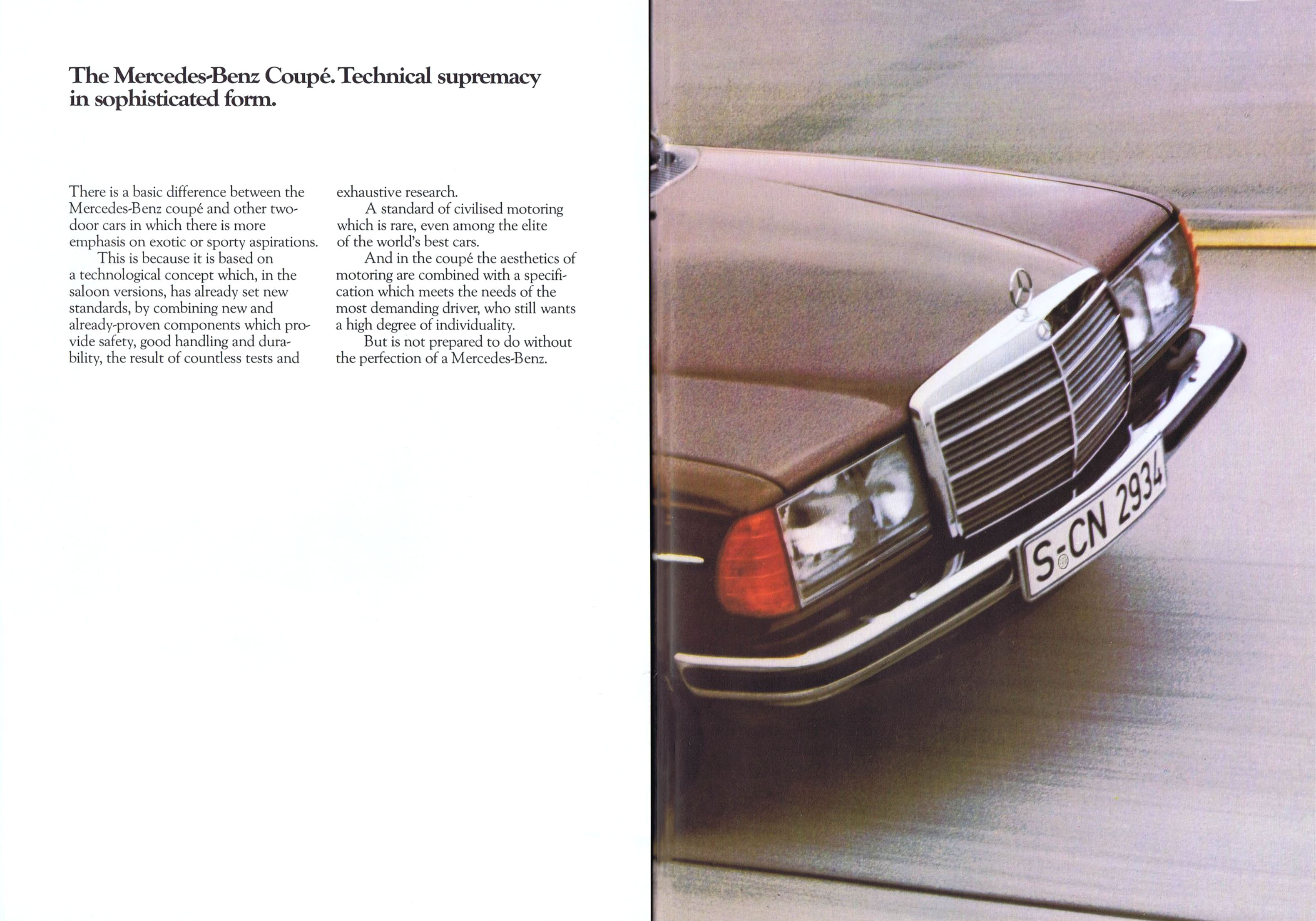
The first image is a tight three-quarter front shot of the 280C in what appears to be a deep metallic brown, the Stuttgart number plate legible. The headline: “The Mercedes-Benz Coupé. Technical supremacy in sophisticated form.” The copy dispatches the competition with admirable economy. “There is a basic difference between the Mercedes-Benz coupé and other two-door cars in which there is more emphasis on exotic or sporty aspirations.”
The BMW 633CSi, which was more driver-focused and genuinely rapid, is thus pre-categorised as a car for people who want to feel something. The Jaguar XJ Coupé, with its more traditional interpretation of British luxury, is implicitly positioned as merely comfortable rather than scientifically correct. The W123 Coupé alone, the argument runs, meets “the needs of the most demanding driver” without sacrificing the perfection of the engineering.
The demanding driver, one notes, is demanding in the sense of requiring rigour, not in the sense of wanting the car to respond to his demands. He demands quality. He does not demand excitement.
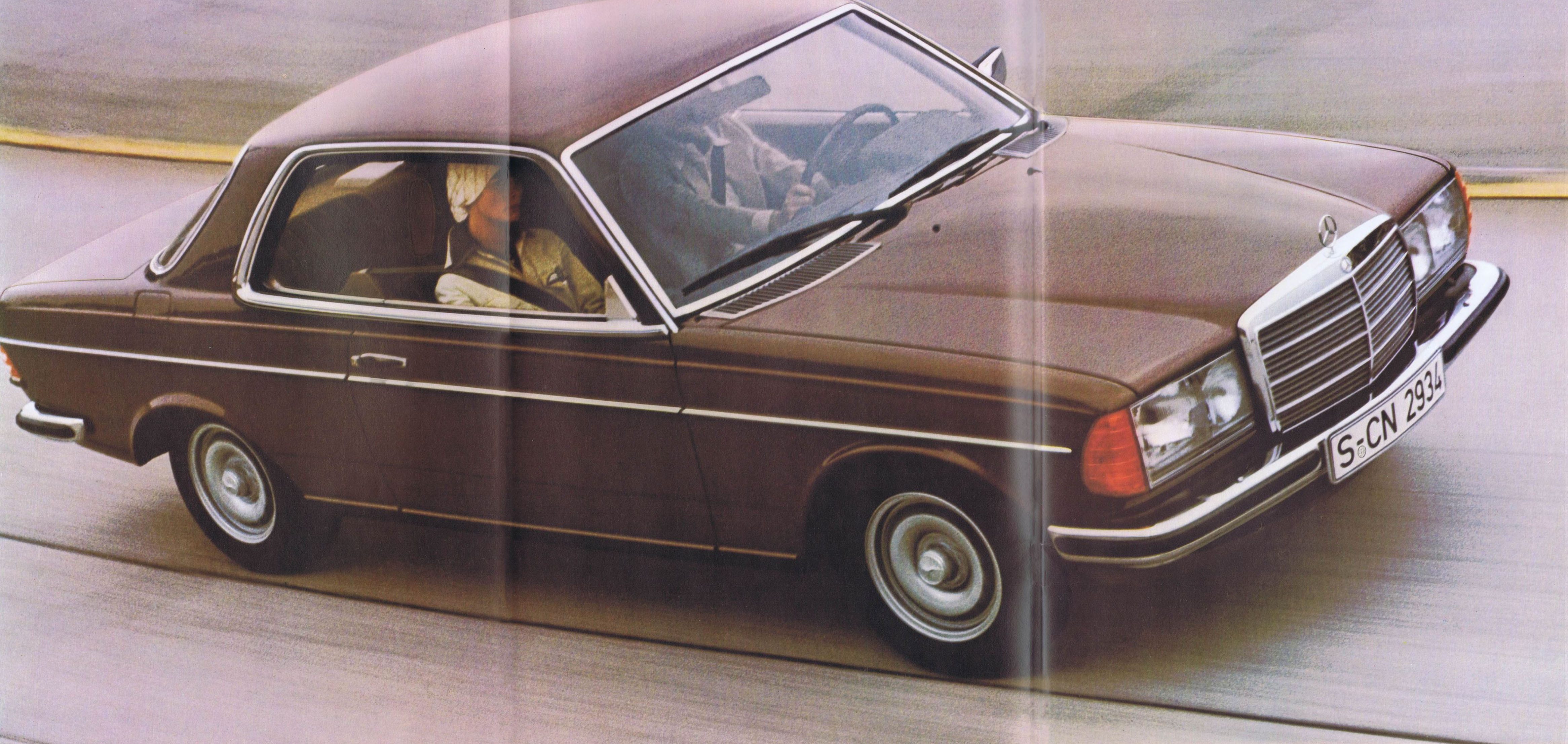
The left page opens out to reveal the whole car, moving at speed.
Safety, for More Enjoyable Driving
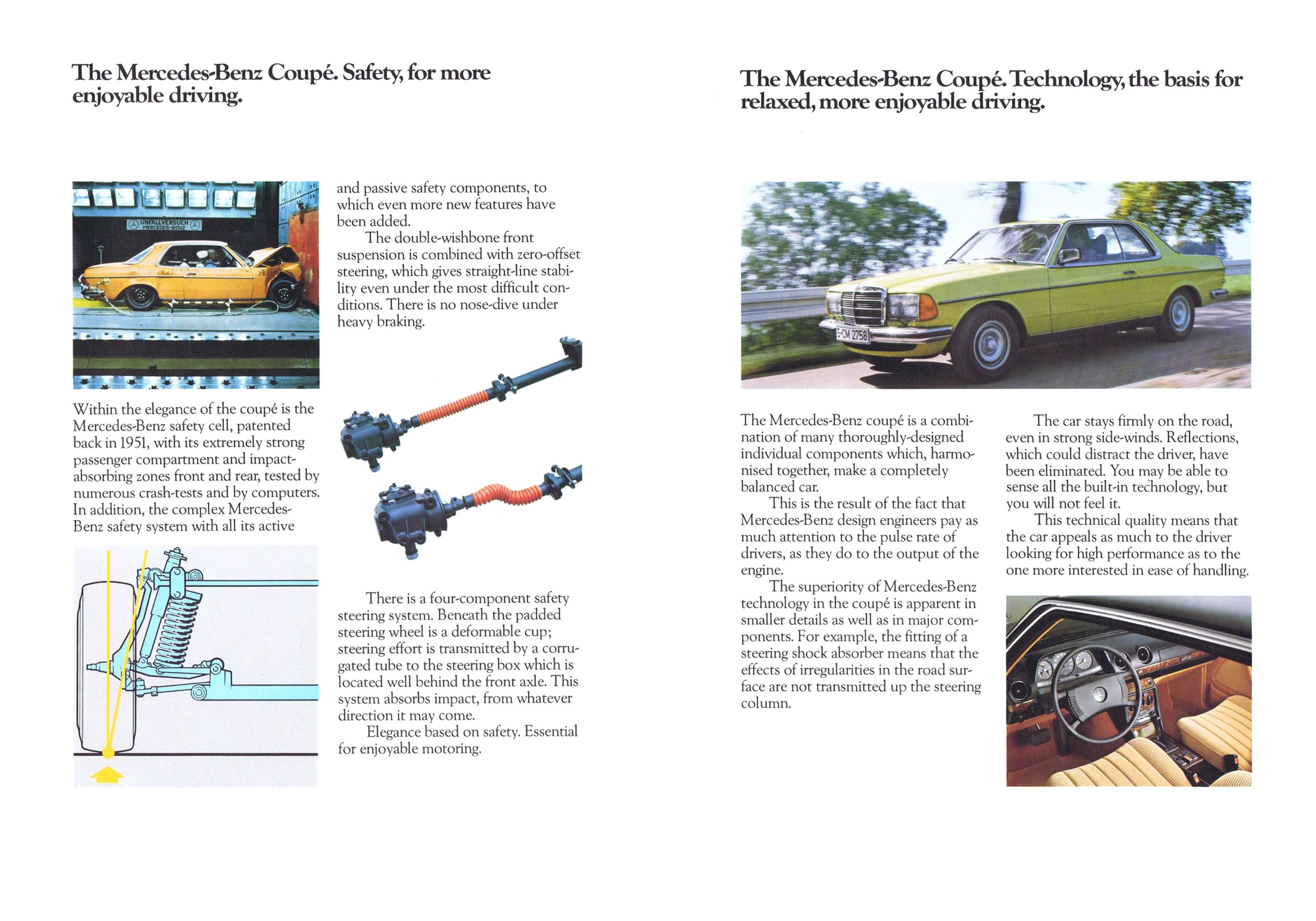
The safety page opens with an image of a Mimosa Yellow coupé that has been crash tested, shown deformed against a concrete barrier. The text below reads: “Within the elegance of the coupé is the Mercedes-Benz safety cell, patented back in 1951, with its extremely strong passenger compartment and impact-absorbing zones front and rear, tested by numerous crash-tests and by computers.”
The year 1951 is doing extraordinary work in that sentence. The safety cell did not emerge from the W123 programme. It preceded the car by a quarter-century. By invoking it, the brochure transforms what might otherwise read as a premium surcharge into an inheritance: 26 years of engineering seriousness, now enclosed in a coupé body. The crash photograph is not alarming. It is reassuring. This, it says, is what the money actually bought.
Diagonally below the crash image is a diagram of the four-component safety steering system: the padded wheel, the deformable cup beneath it, the corrugated energy-absorbing tube, the steering box located well behind the front axle. This system, the copy explains, “absorbs impact, from whatever direction it may come”. The page closes: “Elegance based on safety. Essential for enjoyable motoring.”
Technology, The Basis for Relaxed, More Enjoyable Driving
The opposite page introduces the coupé in a sharp citrus green, in motion on a clear road, followed by a detail shot of the warm velour and wood-trimmed cockpit. The headline: “Technology, the basis for relaxed, more enjoyable driving.”
The superiority of Mercedes-Benz technology, the copy argues, “is apparent in smaller details as well as in major components. For example, the fitting of a steering shock absorber means that the effects of irregularities in the road surface are not transmitted up the steering column.” This technical quality, the copy continues, “means that the car appeals as much to the driver looking for high performance as to the one more interested in ease of handling”.
And then: “You may be able to sense all the built-in technology, but you will not feel it.”
The technology is not designed to provide sensation. It is designed to eliminate it. The engineering achievement is the engineering’s own invisibility.
Aesthetics Determined by Function
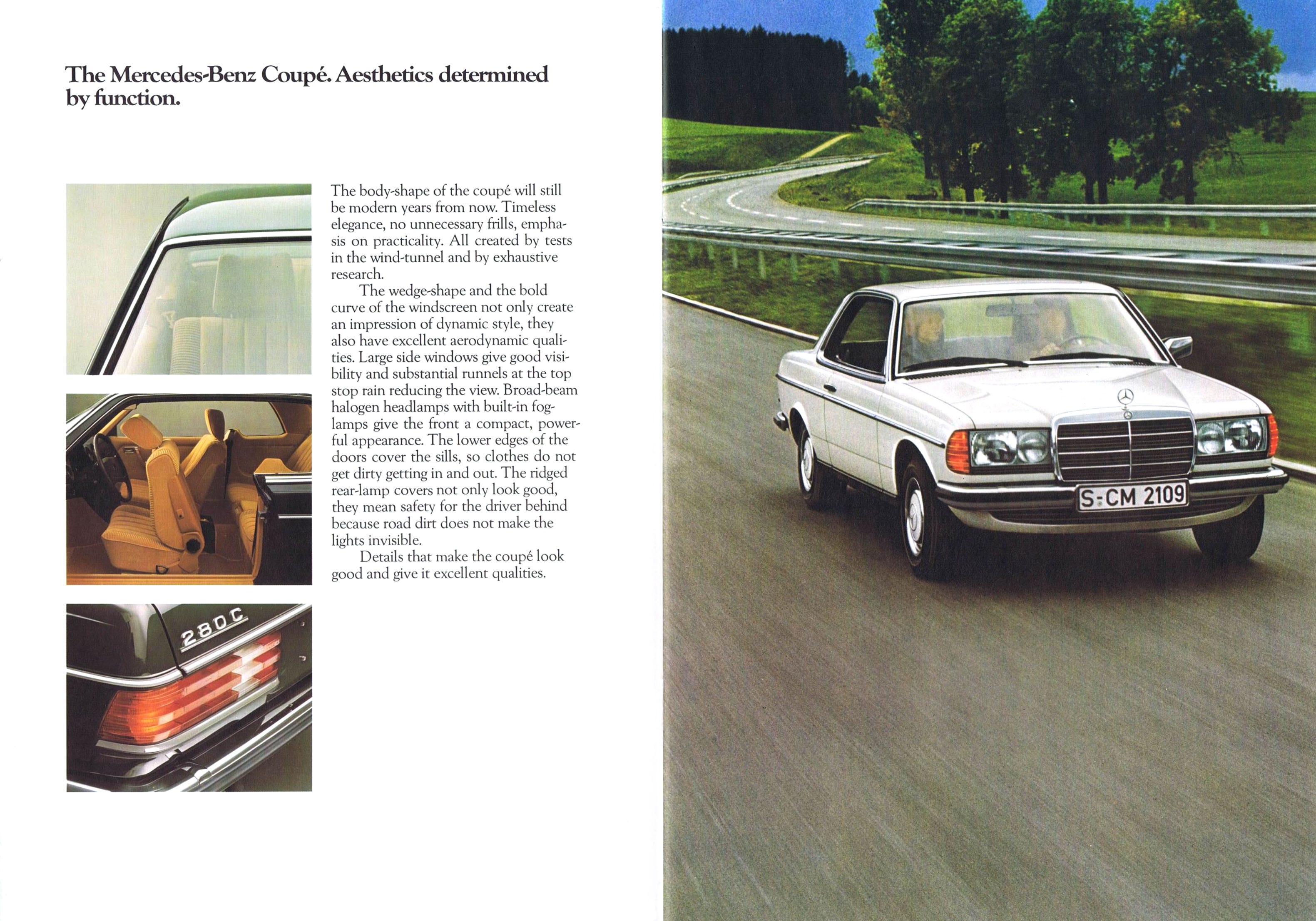
On page fourteen the brochure addresses the styling. A white 230C is shown from the front three-quarter, on a clear road with trees in the background. The headline: “Aesthetics Determined by Function.” The copy examines the body’s components in the manner of an engineer presenting a technical report.
The wedge shape and the bold windscreen curve: aerodynamic qualities, confirmed by wind-tunnel testing. The large side windows: visibility, and the pronounced roof runnel that directs rain away from the glass. The broad-beam halogen headlamps with integral foglamps: a compact, powerful frontal appearance. “The lower edges of the doors cover the sills”, the copy notes, “so clothes do not get dirty getting in and out.” The ribbed rear-lamp covers: “they mean safety for the driver behind because road dirt does not make the lights invisible.”
Detail photographs appear on the left: the roofline, the front seat folded to allow access to the rear seats, the ribbed taillight housing isolated in close-up. Every aesthetic choice is justified by function. The brochure has no patience for style as an end in itself. Beauty, here, is an engineering outcome.
Spaciousness — Not Just Space
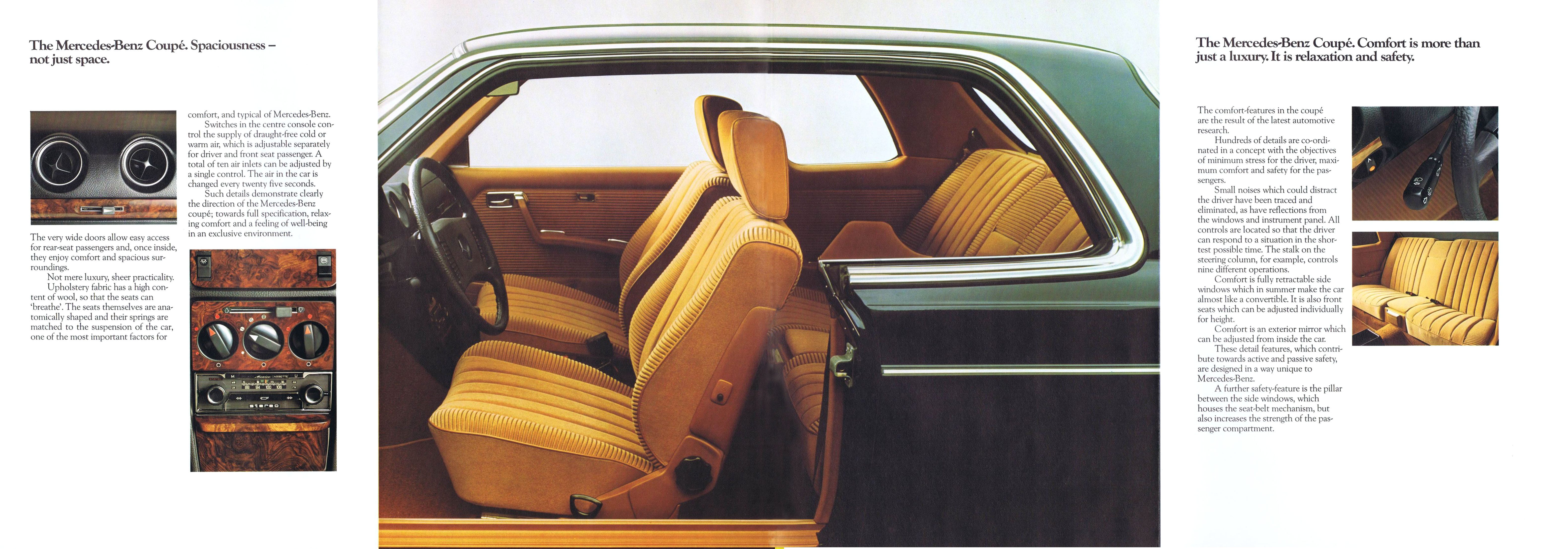
The fold-out interior spread is the brochure’s warmest page. The centrepiece is a view into the cabin through a pillarless open door. This is supplemented with detail images of cognac velour seats, Zebrano wood centre console, round ventilation dials.
The copy explains that “upholstery fabric has a high content of wool, so that the seats can breathe.” The seats are “anatomically shaped and their springs are matched to the suspension of the car.” The climate system is precise: “a total of ten air inlets can be adjusted by a single control. The air in the car is changed every twenty-five seconds.”
Twenty-five seconds. Luxury measured in cubic feet per minute. Not opulence. Physiology.
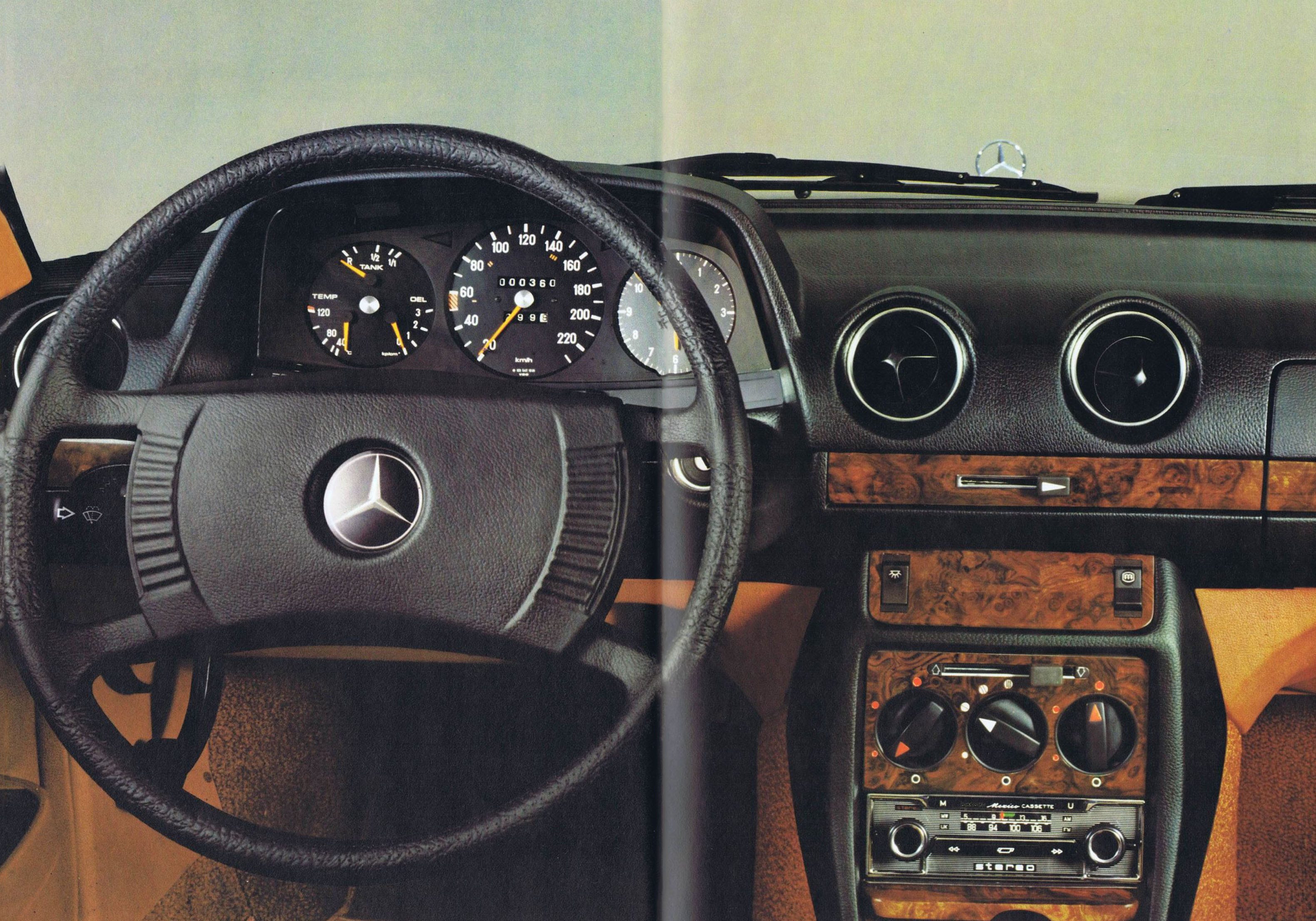
The cockpit shot on the following spread shows the full dashboard in detail: the clear instrument binnacle, the wood-framed console housing the cassette stereo and the three-dial climate controls, the padded wheel with its Mercedes star.
Individual as the Driver Himself and the Lasting Impression
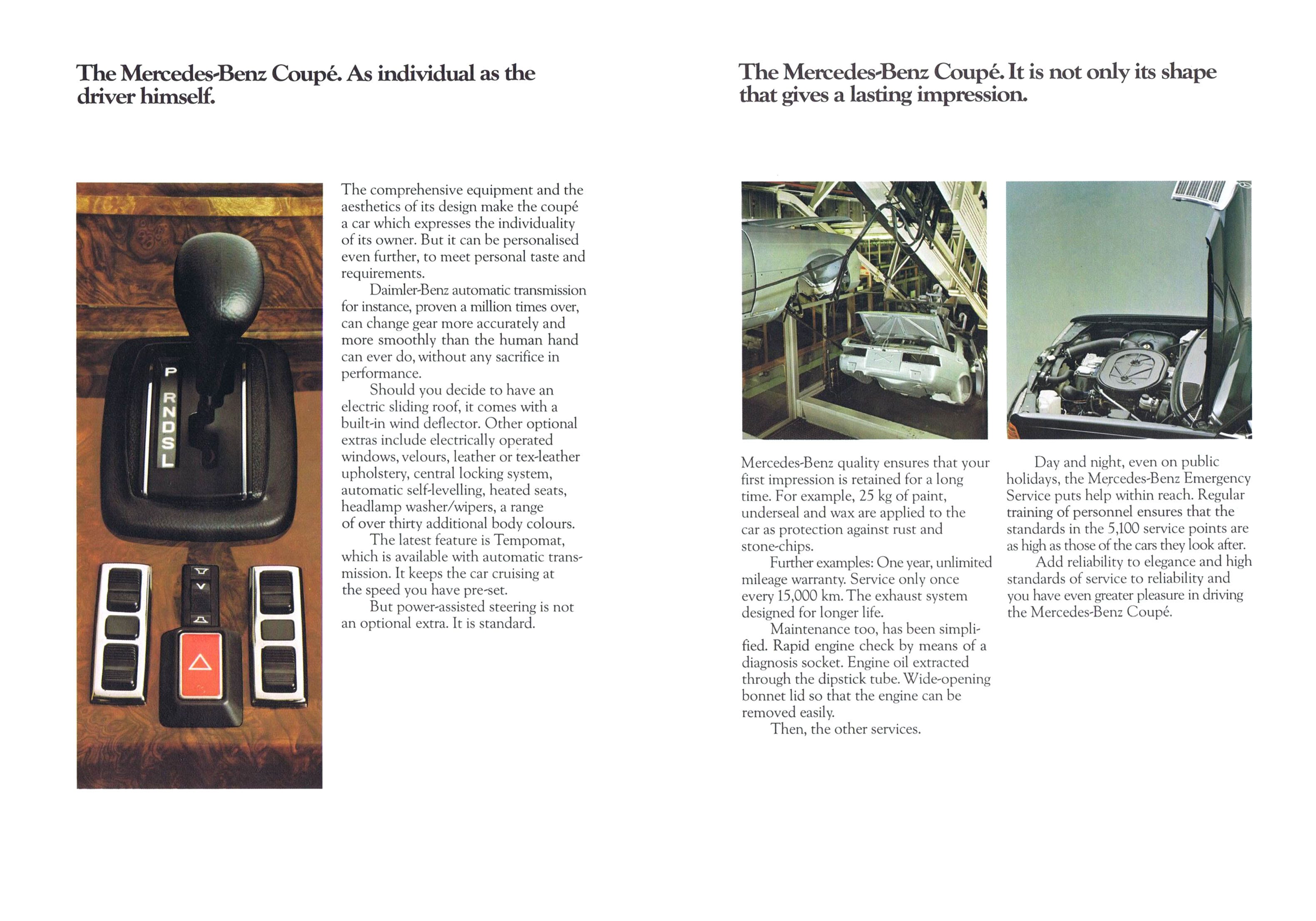
The individualisation spread is the brochure’s only moment of concession to feeling. The Daimler-Benz automatic transmission, the copy notes, “can change gear more accurately and more smoothly than the human hand can ever do, without any sacrifice in performance”. The optional electric sunroof comes with a built-in wind deflector. Optional extras run to: electric windows, velours, leather or tex-leather upholstery, central locking, automatic self-levelling, heated seats, headlamp washers/wipers and, noteworthy in 1977, “a range of over thirty additional body colours”.
The right-hand page examines durability: a factory photograph shows the bodyshell being processed in what appears to be a protective-coating line. “Mercedes-Benz quality ensures that your first impression is retained for a long time. For example, 25 kg of paint, underseal and wax are applied to the car as protection against rust and stone-chips.” Service only every 15,000 km. One year, unlimited mileage warranty. The exhaust system, we are informed, “designed for longer life”.
Two further items earn mention. The “rapid engine check by means of a diagnosis socket”, a 1970s precursor to the on-board diagnostic systems that would become mandatory across the industry within two decades. And engine oil extraction “through the dipstick tube”. The 280CE has the output of a thoroughbred sports car. Its maintenance, however, is designed for a gentleman who would rather not soil his cuffs.
The Rearview Mirror
The Problem: The Limits of Insulation
The W123 Coupé was never fast by any objective measure commensurate with its price. The 177bhp that the brochure invokes as a proxy for sports-car performance was carried by a heavy bodyshell and, in the majority of cases, a smooth but unhurried four-speed automatic. By the standards of 1977 it was a capable grand tourer. By the standards of its stated rivals (the 633CSi in particular) it was a well-mannered machine that happened to have a twin-cam engine.
The brochure understood this and solved the problem elegantly. It defined the competition as a category error. A car with “sporty aspirations” was by definition a car that had sacrificed correctness for sensation, engineering rigour for emotional appeal. The W123 Coupé did not compete with the 633CSi. It occupied a different genus: the genus of things that are simply correct.
This argument worked extraordinarily well for its moment. Whether it would survive the increasingly performance-focused European luxury market of the 1980s is, of course, a separate question that the brochure does not consider.
The Tax: What the 25 Kilograms Could Not Protect
Despite the “25 kg of paint, underseal and wax”, the front wings, the sill sections, and the jack points of surviving W123 Coupés were not immune to the passage of time. The 25kg of protection was genuine, and by the standards of 1977 it was measurably better than most rivals could manage: the W123 rusted later, and less catastrophically, than a contemporary BMW or Jaguar left in the same conditions. But it did rust. The battery tray, the spare wheel well, the inner front wings and, on coupés especially, the sunroof drain channels, which had a gift for directing standing water directly into the sill structures. Pre-1981 cars are particularly vulnerable.
The vacuum-operated central locking, presented as a feature of forward-thinking comfort, has, after five decades of rubber degradation, become the car’s most reliable producer of minor frustrations. Every W123 Coupé on the road today either has new vacuum line sets or has developed a characteristic reluctance about certain doors in certain weather. This is not a failure of the concept. It is, in the most literal sense, a natural consequence of time.
The M110 twin-cam engine in the 280CE is precisely as described: a thoroughbred. It is also a thoroughbred that has historically been candid about its oil seals. The twin camshaft design that justified the brochure’s sports-car comparison requires, in aged examples, a level of attention to valve shims and camshaft carrier gaskets that would have surprised the person who first read about it in terms of dipstick-tube oil changes.
The Success: The Myth That Proved True
Here is what the brochure got exactly right, and what almost no automotive advertising of its era managed to achieve: the car it described in 1977 is, nearly fifty years on, precisely the car that people seek out.
The W123 Coupé is the ultimate expression of a paradox: a car that was sold on the elimination of sensation has become, half a century on, an object of deep automotive affection precisely because it delivers an experience unavailable elsewhere. The calm is real. The composure on a fast A-road in a properly maintained 280CE, the unhurried progress through a motorway intersection, the particular quietness of the pillarless cabin with both windows partially lowered: these are not approximations of the brochure’s promise. They are the fulfilment of it.
The brochure built what is now called, in classic car circles, the “overbuilt Mercedes” myth: the idea that the cars of this era were constructed to a standard so far above commercial necessity that they could be expected to outlast everything. The myth is not entirely accurate; see above regarding sills and vacuum lines. But it has proven durable enough to define the marque’s vintage reputation for a generation of enthusiasts who were not born when the brochure was printed.
In 2026 the W123 Coupé has become a definitive analogue-era touring machine: chosen not for speed, not for involvement, but for exactly the composed, insulated quality the brochure specified. The pulse rate, as intended, remains low. It is a remarkable outcome for a piece of print advertising from Stuttgart, 1977.
The brochure was right. That is rarer than it should be.
Fantastic! Love the old brochures and great writing and research. I’d love to drive a C123 almost as much as I’d love to own a C124.