
The Pininfarina Paradox: Peugeot’s Italian Masterpiece
When Turin designed a grand tourer that Paris couldn’t sell

The 1998 Peugeot 406 Coupé is one of the most beautiful paradoxes in automotive history. Here was a French manufacturer, a maker of sensible family saloons and hot hatches, commissioning Italy’s most celebrated design house to build a grand touring coupé that would compete not on price, but on style. Not in Sochaux, but in Turin. Not as a Peugeot with Italian styling, but as a Pininfarina that happened to wear a lion badge.
The brochure opens with a declaration that borders on manifesto: “It is gloriously liberated from modern design orthodoxy and it has an originality that will inspire intense pride of ownership.” This was not merely confidence; it was a gamble. The 406 Coupé entered a market dominated by German engineering precision and the quietly understood truth that buyers shopping at £30,000-plus expected a badge that spoke of heritage, pedigree, and the accumulated weight of reputation. Peugeot had none of these advantages. What they had was Pininfarina, and the brochure treats this alliance not as a marketing footnote but as the entire point.
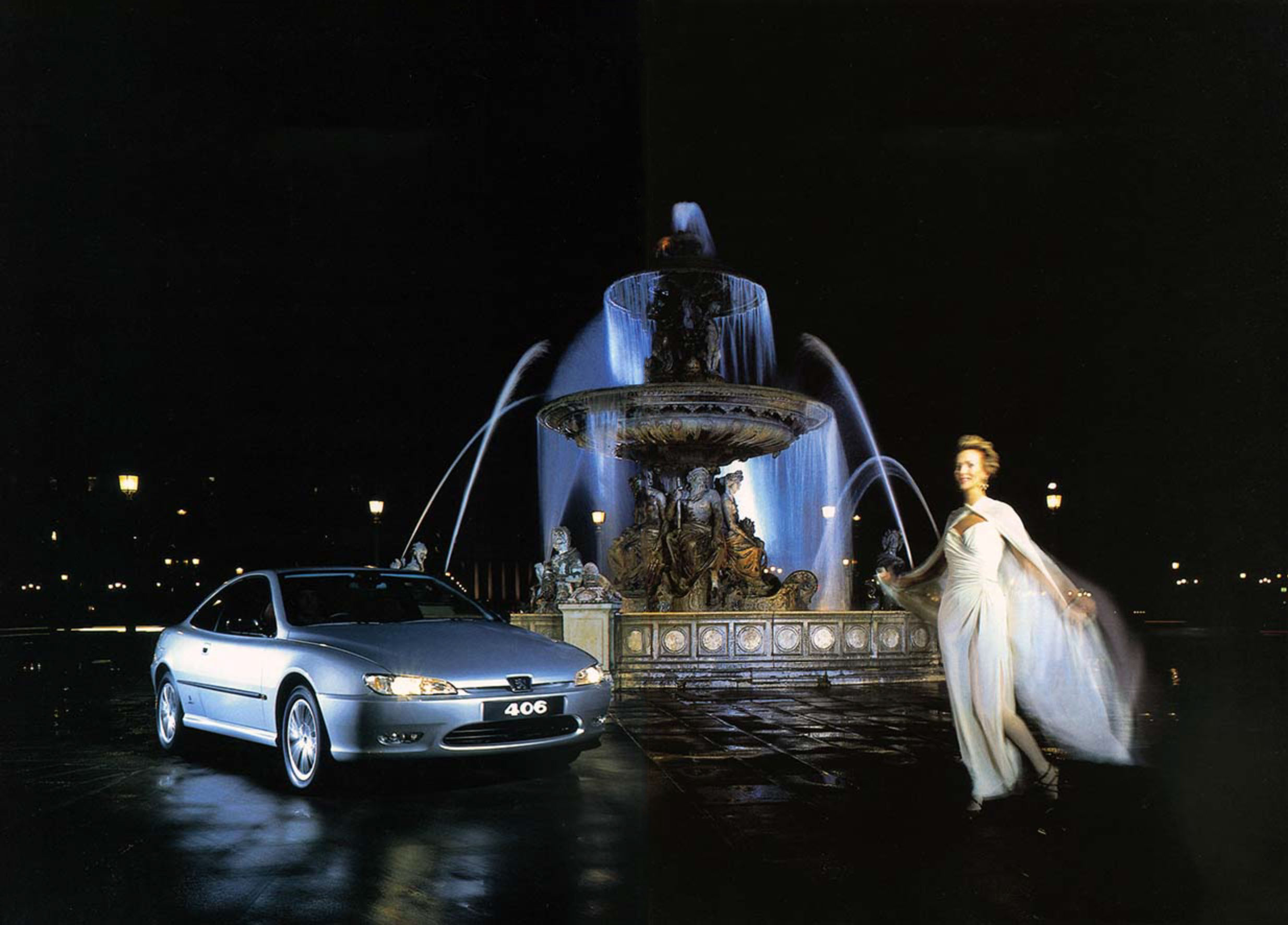
Parisian Nocturne: The Gallery of Night
The visual language of the 406 Coupé brochure is unmistakable. The photography is almost aggressively atmospheric, with night-time shots of the car alongside a grand, multi-tiered classical fountain. This is not automotive photography as it existed in 1998; this is editorial fashion work borrowed from the pages of L’Officiel or Vogue.
The colour palette is restrained to the point of severity. Deep blacks dominate, punctuated by midnight blues and the occasional flash of “Scarlet Red” (the flagship colour that appears in carefully rationed doses throughout the 32 pages). White space is deployed like an expensive silence; the brochure is not trying to fill every inch with information because information, in this context, would undermine the aesthetic. You do not explain art; you present it.
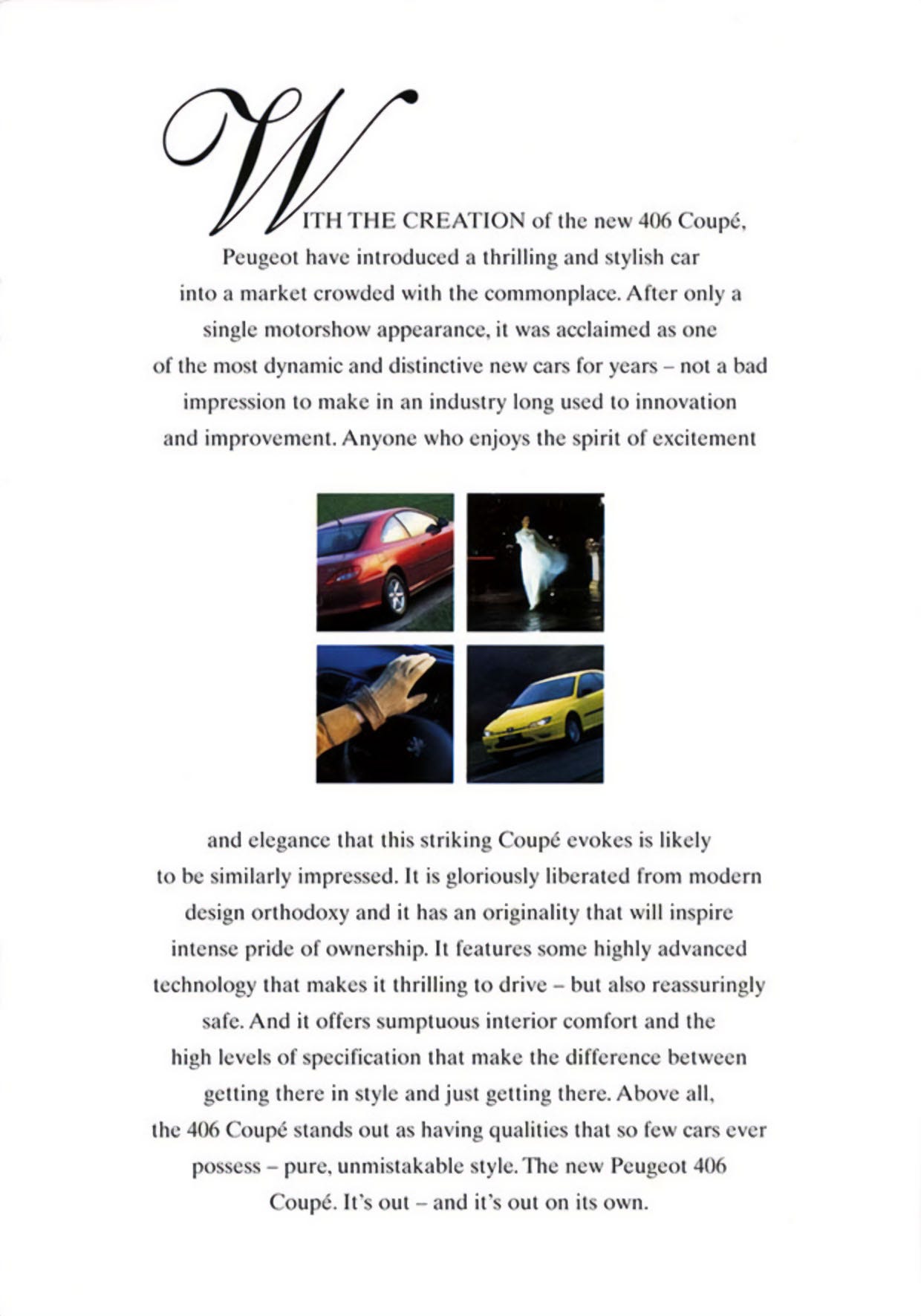
The typography follows suit: elegant serif headlines, paired with clean sans-serif body text when technical specifications demand clarity. The effect is of a gallery catalogue where the car is the exhibition and the brochure is your guided tour. Page three establishes this immediately with a four-panel grid that mixes the car with high-fashion lifestyle imagery. The copy does not sell; it declares the car's independence from convention.
This is the vocabulary of rebellion, but whispered rather than shouted. The 406 Coupé is positioned as an act of defiance against the “market crowded with the commonplace” (a shot across the bow of BMW’s predictable elegance and Mercedes’ stolid prestige).
The Heritage Play: When History Becomes Strategy
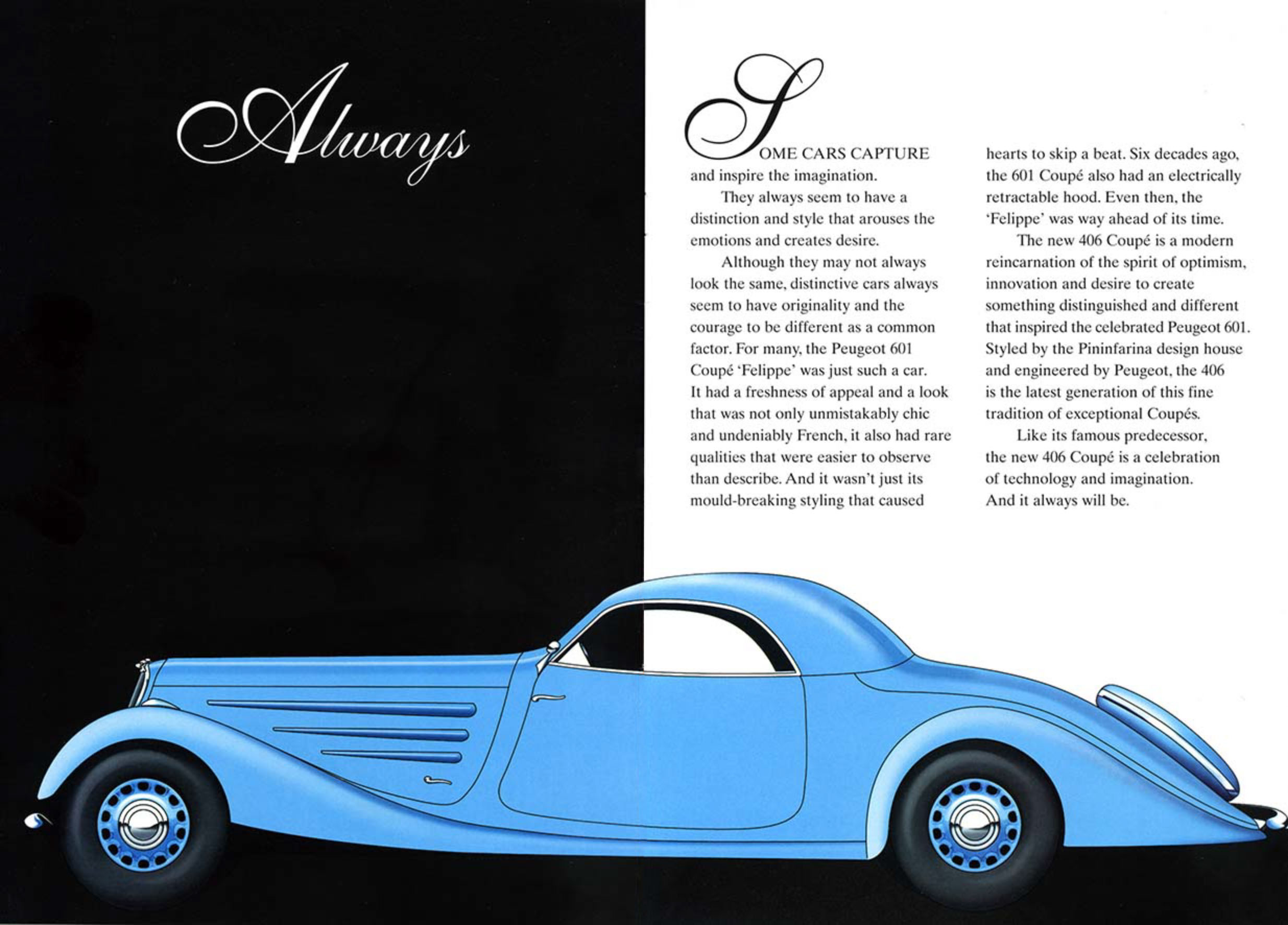
By Page eleven, the brochure has moved from aesthetic manifesto to historical legitimisation. Here we encounter the Peugeot 601 Coupé ‘Felippe’ of the 1930s, a car most readers would never have heard of, presented in profile with the caption: “The new 406 Coupé is a modern reincarnation of the spirit... that inspired the celebrated Peugeot 601.”
This is a calculated manoeuvre. Peugeot cannot compete with BMW’s motorsport pedigree or Mercedes’ century-long association with luxury, so they reach back to a different kind of heritage: to the era of coach-built glamour and Art Deco elegance. The 601’s “electrically retractable hood” is cited as evidence that innovation has always been in Peugeot’s DNA, an argument that requires you to overlook the forty intervening years of practical hatchbacks and diesel estates.
But in the context of the brochure’s nocturnal aesthetic, it works. The 601 exists not as a literal predecessor but as a spiritual ancestor, and the brochure treats this distinction as unimportant. What matters is the lineage of ambition, the thread of courage that connects a 1930s coach-builder’s creation to a 1998 collaboration with Pininfarina.
The Sculpture: When Metal Becomes Art
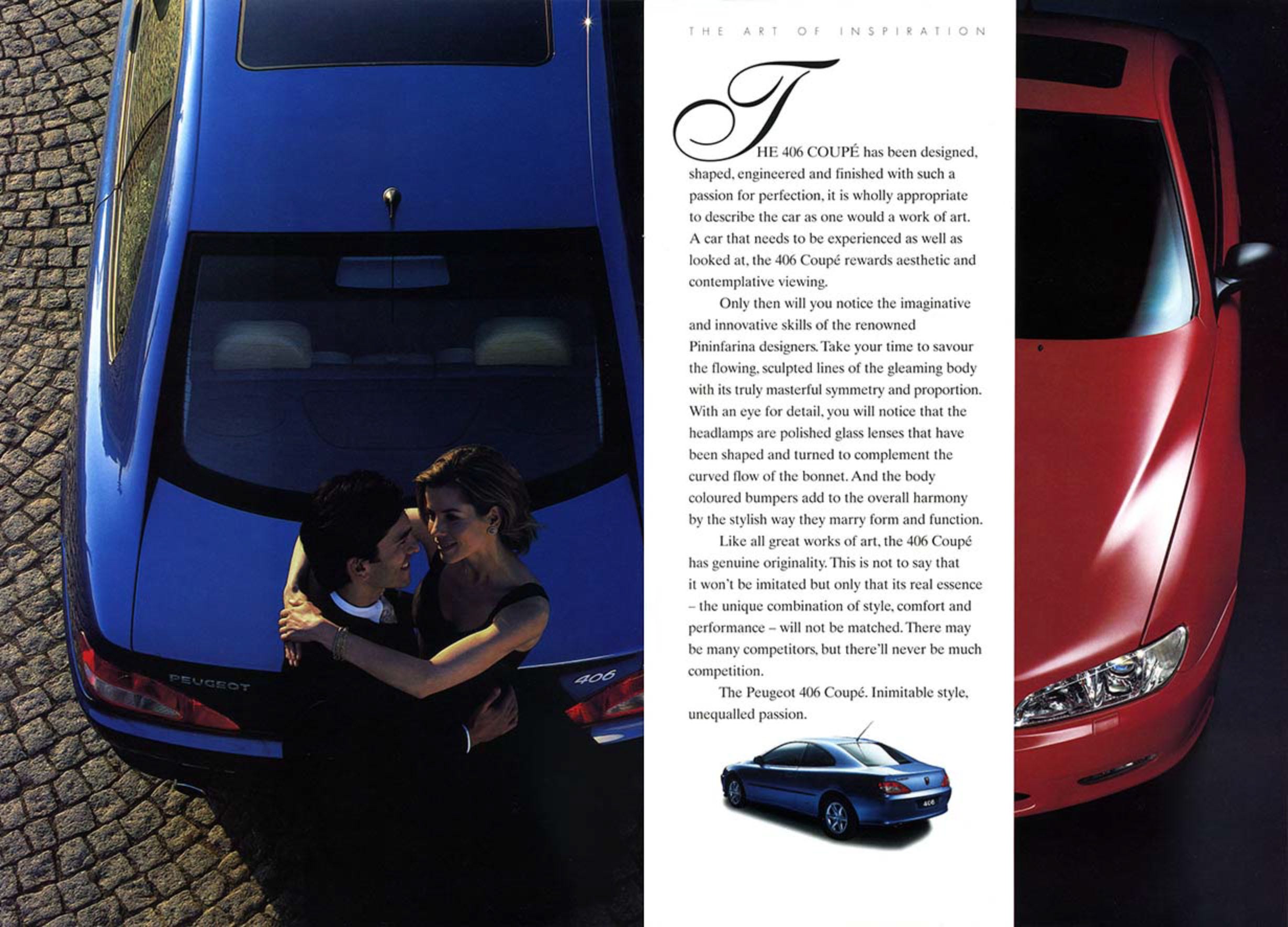
Page thirteen is where the brochure makes its most audacious claim. A red car is shot from above, harsh lighting accentuating the pure geometry of the form. The accompanying text reads: “It is wholly appropriate to describe the car as one would a work of art.”
This is not hyperbole; it is instruction. The brochure is teaching you how to see the 406 Coupé, guiding your eye along the “curved flow of the bonnet” as if you were studying a Brancusi sculpture. Every panel is presented as a deliberate artistic choice rather than an engineering compromise. The front wings, the glasshouse, the tail treatment: each is isolated and examined with the care of a curator discussing a mid-century modern piece.
The language shifts accordingly. Words like “shaped,” “turned,” and “complement” replace the typical automotive vocabulary of “aggressive” or “muscular.” This is cinematic luxury (the car as leading actor in a Lelouch or Sorrentino film, rather than a Hollywood action thriller).

Page seventeen deepens this approach by focusing on details that most brochures would relegate to footnotes. Macro shots of alloy wheels are presented as jewellery. The “polished glass headlamp lenses that have been shaped and turned to complement the curved flow of the bonnet” are given the same reverence as the entire exterior design. These are not merely functional components; they are evidence of a philosophy.
The brochure does not need to tell you that the 406 Coupé costs more than the saloon. Instead, it shows you why it should: because every element has been considered, refined, and executed with what the brochure repeatedly calls “extreme craft.”
The Atelier: Milanese Craft Comes to the Cabin
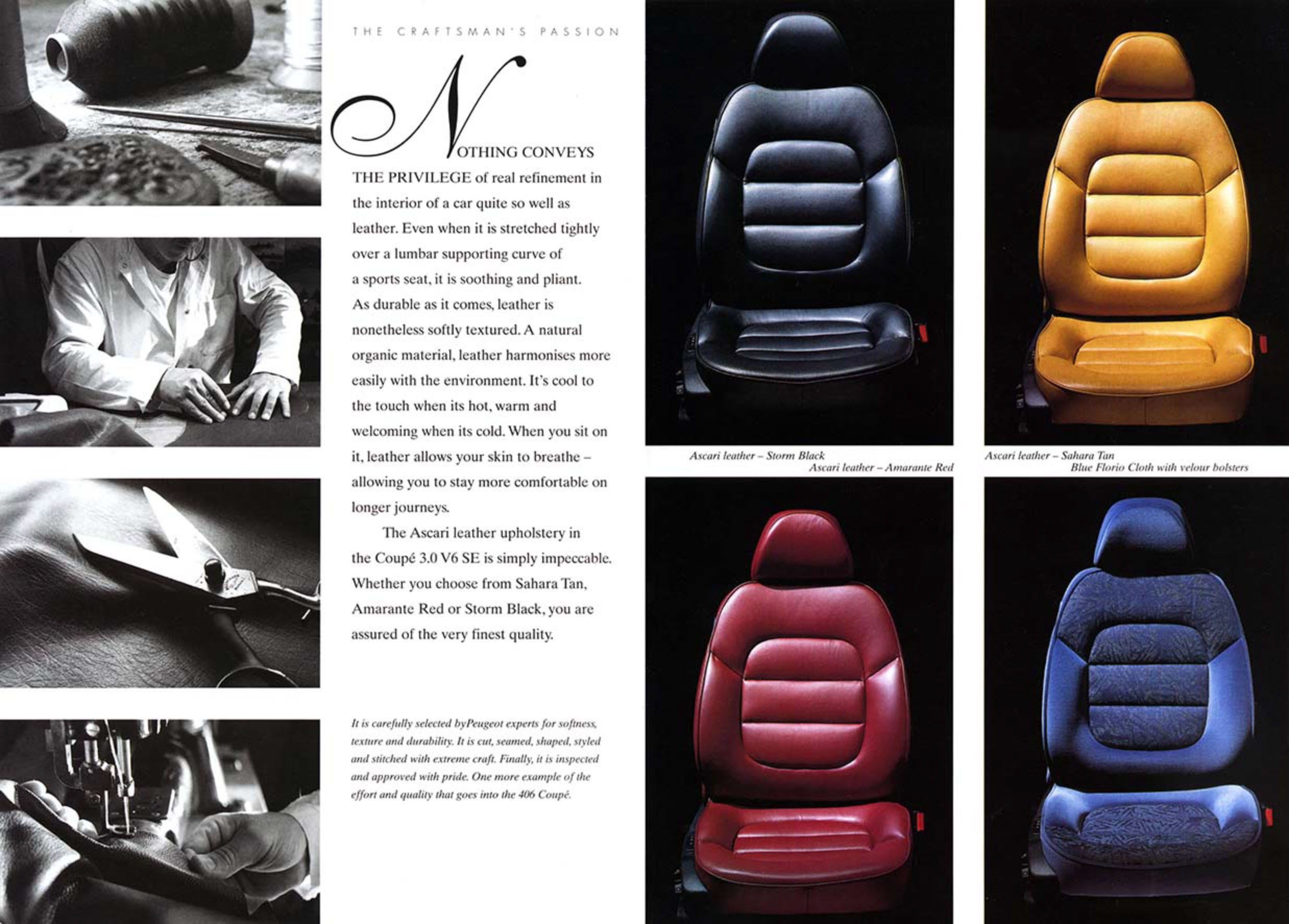
By Page twenty-two, the brochure has moved indoors, and the aesthetic does not waver. Black and white photography shows a craftsman working with leather, hands visible, tools in use, the scene staged to evoke a Milanese atelier rather than a production line. The copy reads: “It is cut, seamed, shaped, styled and stitched with extreme craft.”
This is the Caraceni reference made explicit. The interior is not assembled; it is tailored. The Ascari leather (available in the SE trim) is described with the same attention to texture and finish that the exterior panels received. Even the standard “Blue Florio Cloth” is elevated beyond mere upholstery; it becomes part of a carefully curated material palette.
The brochure dedicates space to elements that would normally merit a single bullet point: the grain of the leather, the stitching pattern, the way the dashboard trim flows “along the entire width of the instrument panel”. This is minimalist in execution, maximal in implication. The message is clear: this interior is not simply in a Peugeot; it is a Pininfarina creation that happens to share switchgear with lesser machines out of economic necessity.
The JBL audio system receives similar treatment. Described as a “system that would not disgrace the home of a true connoisseur”, the 8-speaker, 320-watt setup in the SE model is positioned not as a feature but as an experience. The brochure does not list specifications; it describes sonic presence, as if you were auditioning a high-end stereo in a dedicated listening room rather than selecting options from a spec sheet.
The Power Paradox: When Elegance Meets Aggression
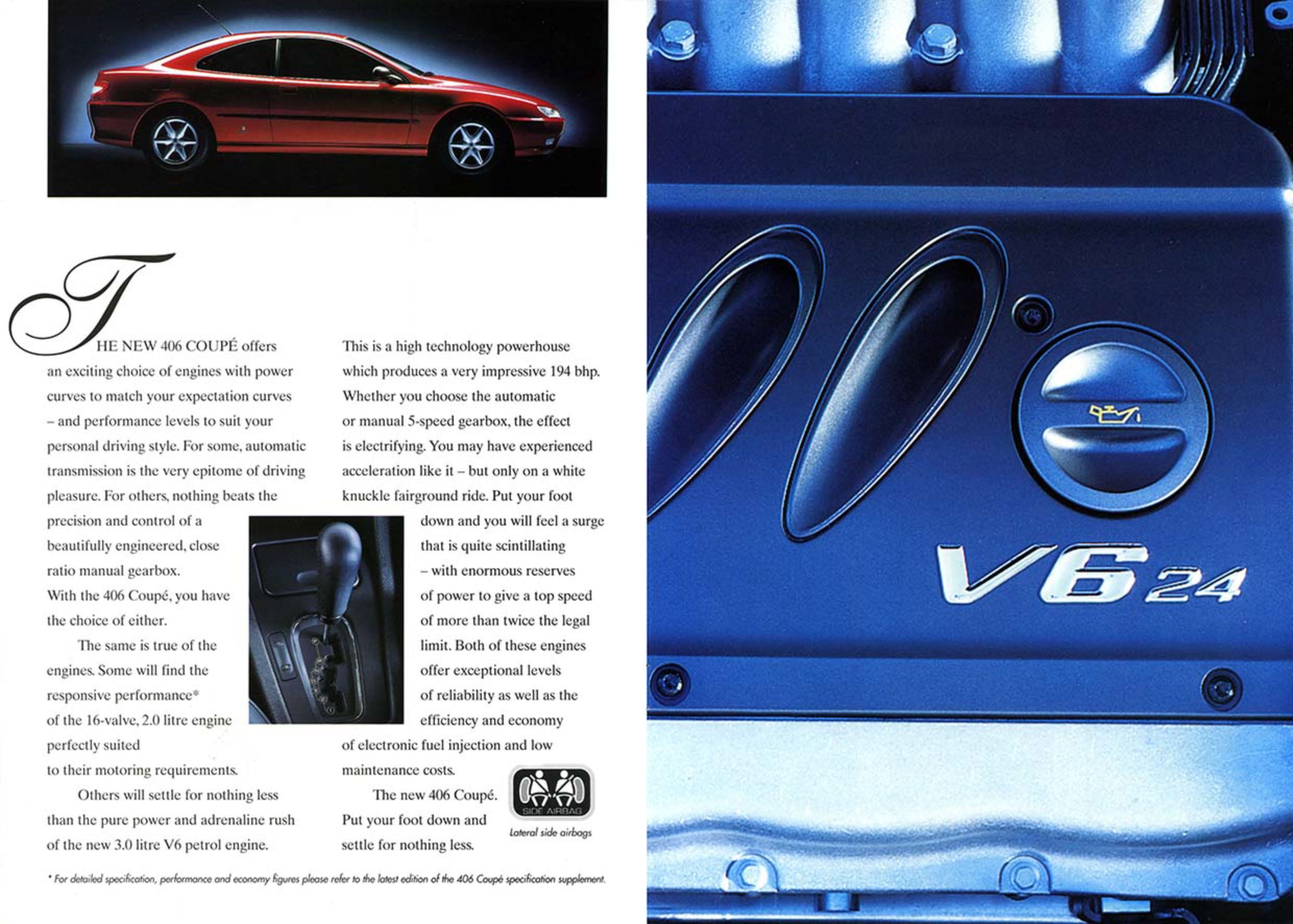
Page twenty-eight disrupts the gallery aesthetic with a jolt of uncharacteristic aggression. A red Coupé appears in profile against a dark background, and the copy abandons nocturnal elegance for something rawer: “You may have experienced acceleration like it - but only on a white knuckle fairground ride.”
This is the only moment in the brochure where the 406 Coupé is allowed to be fast rather than merely refined. The 3.0-litre V6 produces 194bhp (competitive with BMW’s 328i), and the brochure finally acknowledges that this car can move with genuine urgency. Top speed is described as “twice the legal limit”, a gentleman’s way of saying 140-plus mph without actually stating a number that might appear on a speeding ticket.
The language shift is deliberate. For thirty pages, the brochure maintains a tone of cultivated restraint, presenting the 406 Coupé as an object to be contemplated rather than driven hard. But here, briefly, it admits that beneath the Pininfarina bodywork lives a machine capable of genuine performance. The fairground ride metaphor is almost comically out of place (vivid, visceral, and slightly desperate, as if the brochure suddenly remembered it was selling a sports coupé and not a sculpture).
Then, just as quickly, the tone recalibrates. The technical specifications are hidden away, referred to only via a “specification supplement” that maintains the art book aesthetic by keeping messy numbers out of the main document. No nought-to-sixty times. No kerb weights. Just the promise of performance, wrapped in the same silken language that opened the brochure.
The Rearview Mirror
The Badge Problem: Psychology Versus Engineering
The 406 Coupé remains one of the most beautiful cars of the 1990s, but it was always fighting the wrong battle. Pininfarina delivered on every promise: the design was genuinely striking, the build quality was impeccable and the driving experience was refined in ways that put it alongside (and occasionally above) its German rivals. But none of this mattered when the moment came to sign the purchase agreement.
The problem was not the car; it was the badge on the nose. Buyers shopping at £30,000-plus in 1998 were not looking for objective quality. They were purchasing membership in a club, and the Peugeot lion was not the right badge. The brochure understood this, which is why it spent thirty-two pages constructing an alternative narrative: this is not a Peugeot with Italian styling, but a Pininfarina that happens to carry French mechanicals.
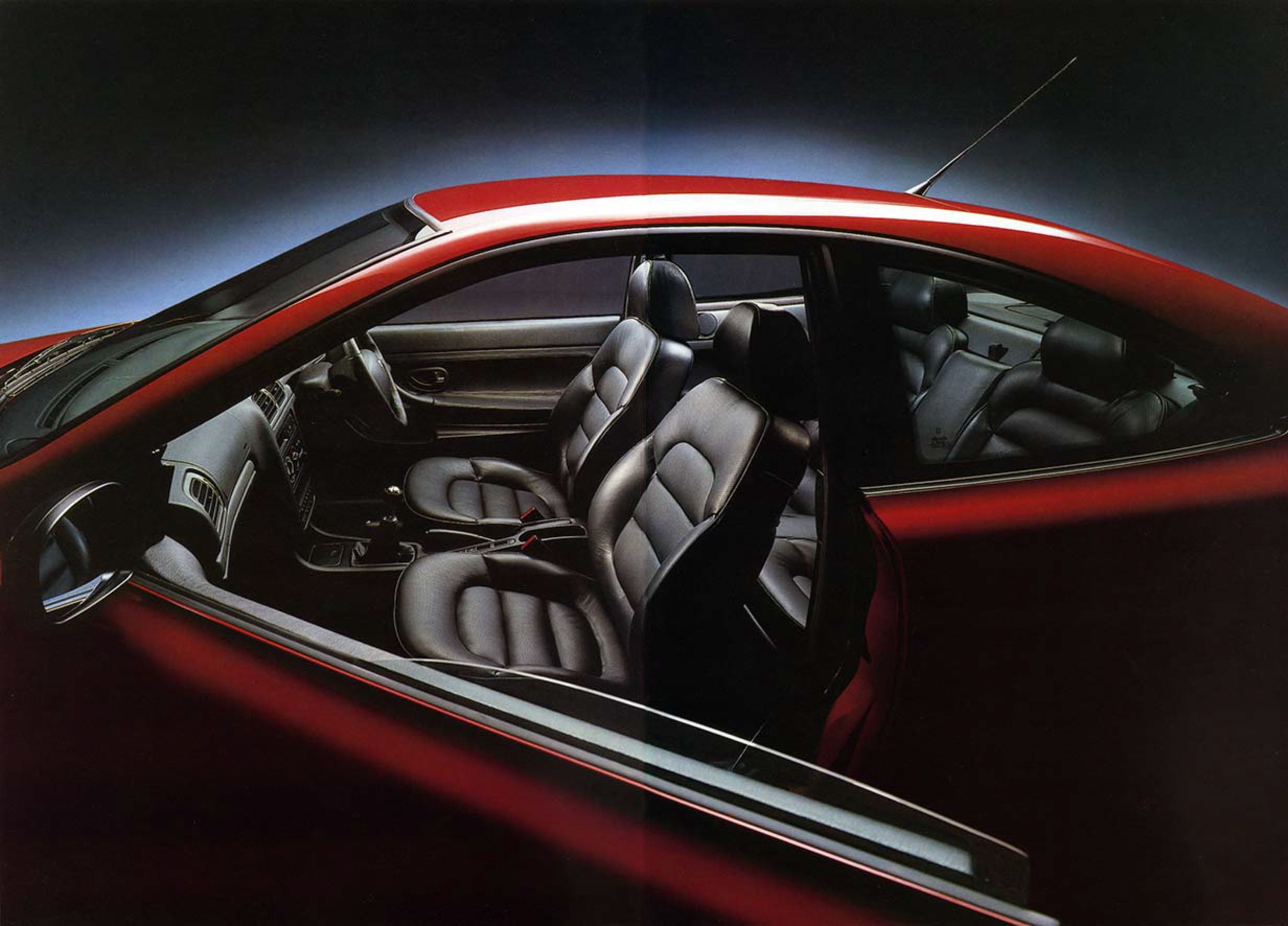
Yet the illusion could not survive contact with reality. The switchgear was shared with the 406 saloon. The dashboard was recognisably Peugeot. The dealership experience was not Pininfarina’s atelier but a showroom where the 406 Coupé sat next to the 206 and the Partner van. For buyers who had been seduced by the brochure’s nocturnal elegance, the reality was a reminder that this was still, fundamentally, a French family car in evening dress.
Today, this Badge Psychology Problem has inverted. The 406 Coupé is no longer competing with new BMWs and Mercedes; it is a period piece, and the Pininfarina name has aged better than any German alternative from the same era. Collectors now seek these cars because they are unusual, because they represent an era when mainstream manufacturers still took aesthetic risks. The badge that was once a liability has become a curiosity, and curiosities are collectible.
The Complexity Tax: The V6 Burden
The 3.0-litre V6 models are the ones to own in 2026, but they come with a maintenance tax that the brochure never mentioned. Changing the spark plugs on the rear bank is an involved process. Replacing the timing belt (a service interval item that cannot be ignored) requires patience, skill, and a workshop that remembers how these cars were assembled.
Coupé-specific body parts are now the real crisis. Those “polished glass headlamp lenses” that the brochure photographed like jewellery? NLA. No Longer Available. The unique bumpers, the bootlid, the trim pieces that make the Coupé distinct from the saloon—many are now unobtainable or eye-wateringly expensive on the rare occasions they appear. Crash damage that would be a minor inconvenience on a contemporary BMW can be a write-off on a 406 Coupé, not because the car is fragile, but because the parts no longer exist.
The V6 itself has aged well mechanically, but the interior has not. Peugeot’s electronic systems from this era are not known for their longevity, and the climate control modules, the electric seat motors and that JBL audio system that “would not disgrace the home of a true connoisseur” are now sources of intermittent faults that are expensive to diagnose and impossible to replace with OEM parts.
Ownership in 2026 is not impossible, but it requires either deep pockets or a specialist workshop that understands these cars. The brochure promised “extreme craft,” and in a sense, it delivered: owning a 406 Coupé now requires the same level of dedication that Pininfarina put into building it.
The Design Vindication: Pininfarina’s Finest Work
Here is what the sales figures cannot tell you: the 406 Coupé was not a failure. It was a proof that a mainstream brand could produce a genuine object of desire, and it represented a continuation of Pininfarina’s design philosophy that was already evident in their work for Ferrari. The 456 GT (1992) shares a design language with the 406 Coupé: restrained elegance over baroque complexity, long sweeping lines over aggressive angles, silhouettes that age gracefully rather than date immediately. The 406 Coupé was not a standalone project but part of a broader aesthetic movement within Pininfarina’s studio (a refinement of the grand touring ideal that found expression across both exotic and mainstream applications).
The legacy is also visible in Peugeot’s subsequent design language. The confidence to pursue beauty over market focus, to risk alienating mainstream buyers in pursuit of aesthetic purity; this did not die with the 406 Coupé. It lived on in the RCZ, another Peugeot coupé that defied conventions and accepted low sales as the price of doing something genuinely distinctive.
Today, the 406 Coupé is slowly being rediscovered by enthusiasts who understand what the brochure was trying to say in 1998: this was a car that stood “out on its own”, not because it was faster or cheaper or more practical than its rivals, but because it was beautiful. The brochure called it “a modern reincarnation of the spirit” of Peugeot’s coach-built heritage, and twenty-eight years later, that claim has been vindicated. The 406 Coupé was never about badge prestige or quarterly sales targets. It was about proving that a mainstream manufacturer could commission a masterpiece, even if the market was not ready to buy it.
Somewhere in Paris, Peugeot's marketing team knew this in 1998. The brochure they created was not trying to sell the 406 Coupé to everyone; it was speaking to the small subset of buyers who would understand what they were looking at. In that specific, narrow mission, the brochure (and the car) succeeded absolutely.
Damn, that was a pretty car.
It was indeed. Ironically, I’m not sure that shooting it at night really did it justice.
Unfortunately, beauty doesn’t seem to be in fashion these days.