The Freedom Paradox: Boxster’s Naturally Aspirated Swan Song
The flat-six signs off in style

Porsche sells freedom with a safety net you are never supposed to notice. They surround a driver with PSM, PASM, adaptive dampers and a dual-clutch gearbox, and frame it as liberation.
The 2015 Boxster brochure arrives as the naturally aspirated flat-six roadster has a year left in standard production. It reads, in retrospect, like a valediction composed by engineers who understood exactly what we were about to lose.
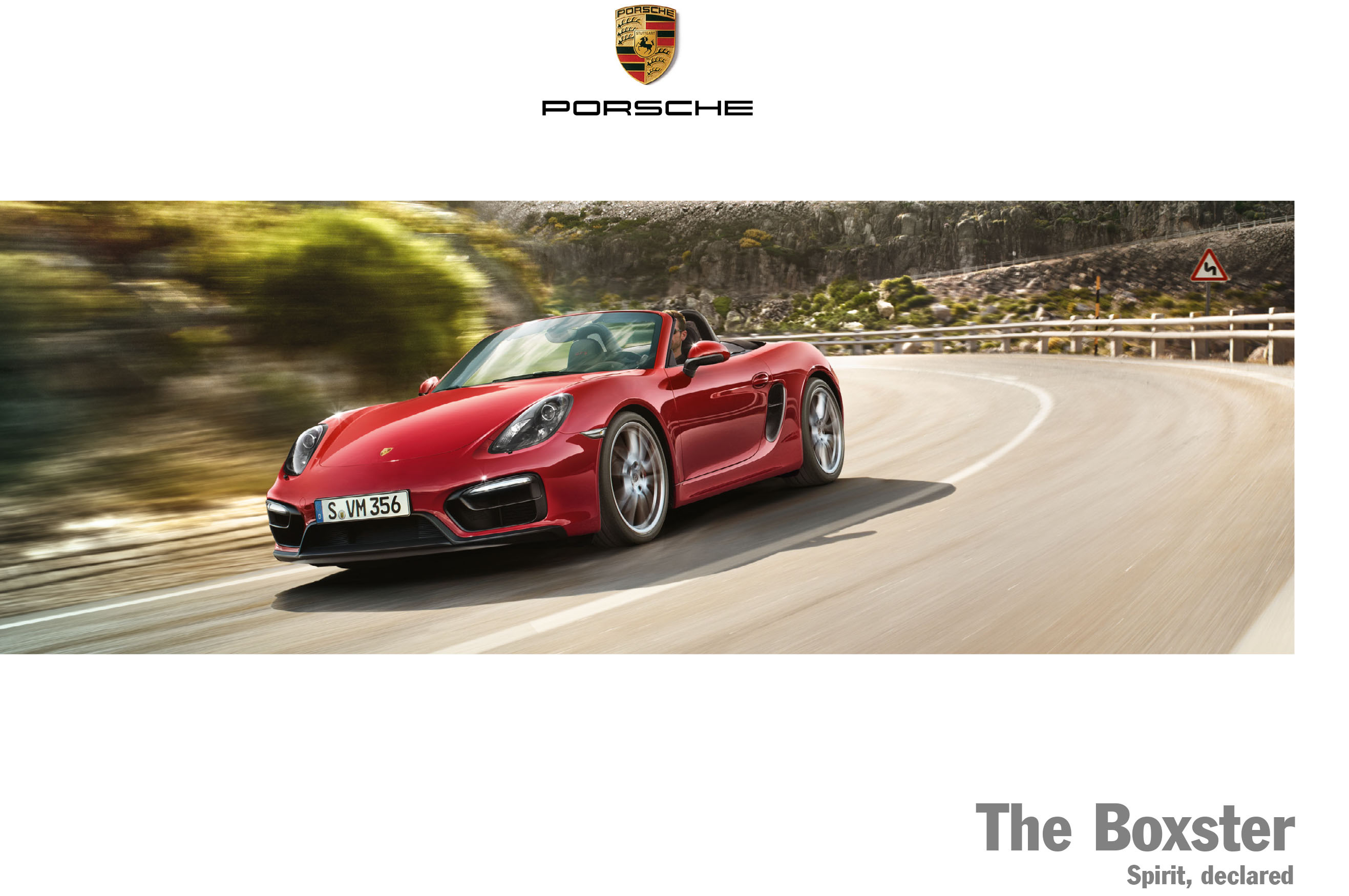
The cover announces the stakes immediately. A Guards Red GTS corners through a mountain pass, the steering loaded but not at full lock. The number plate reads S·VM 356. This is not an accident. The 356 is the first car Porsche ever built, the genesis of the philosophy: lightweight, mid-engined, honest. The plate appears on the GTS throughout the brochure. It is a thread, a lineage claim, and a quiet challenge all at once. The 981 is asking to be measured against its ancestors.
The Art of the Systems Catalogue
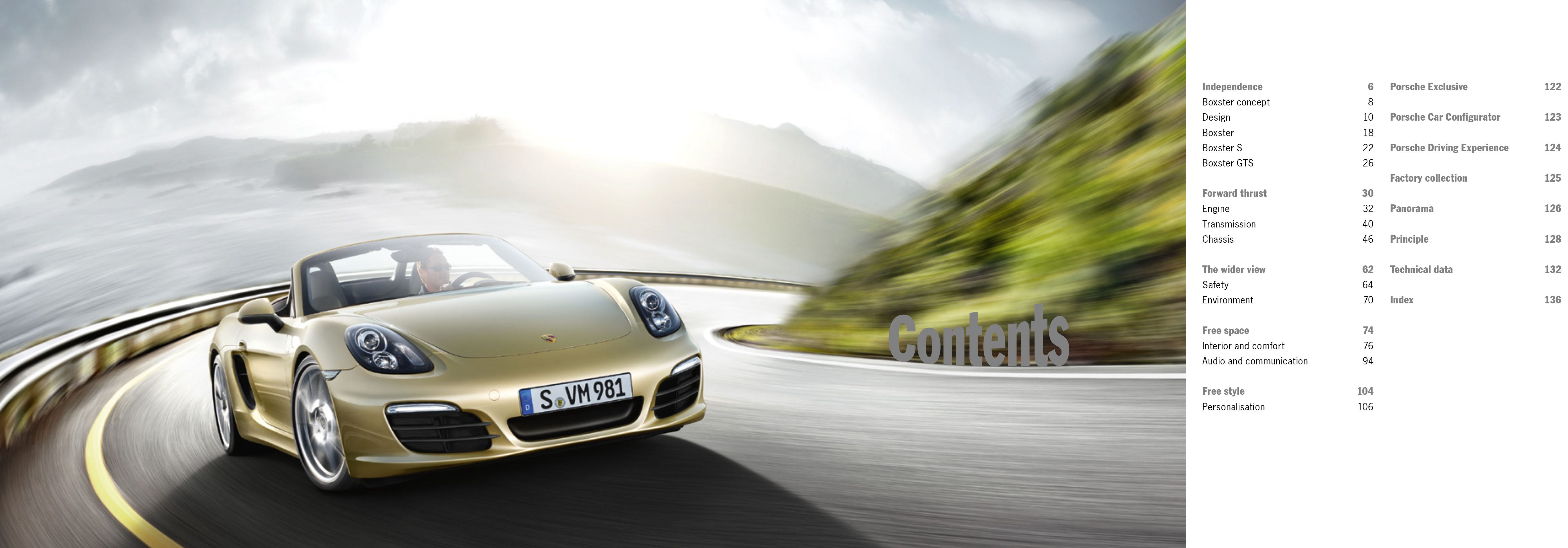
The brochure practises clinical taxonomy. Its structure is not atmospheric but architectural: Design, Engine, Transmission, Chassis, Safety, Environment, Interior, Audio. The car is presented as a series of solved problems, each warranting its own section, each photographed with the unsentimental precision of an engineering drawing.
The paper stock is semi-gloss and heavy, the typography Porsche’s own sans-serif (Porsche Next) with generous leading and unambiguous weight hierarchy. The colour palette runs from silver and anthracite through to Guards Red and Garnet, with white space used for technical clarity, rather than signalling luxury. The brochure does not breathe; it evaluates.
This is a deliberate aesthetic. Other manufacturers use atmospheric photography and evocative copy to manufacture desire. Porsche uses exploded mechanical diagrams and chassis cutaways. The implication is that the engineering is the desire, and you are sophisticated enough to understand this without being told.
What makes this strategy interesting is its honesty about complexity. The 981-generation Boxster was the most electronically sophisticated roadster Porsche had yet built. The brochure does not attempt to conceal this. It publishes, with evident pride, the workings of PSM, PASM, PTV, PDK and the magnetic-fluid transmission mounts, laying out each system in diagrammatic detail.
The pitch is this: technology is not the enemy of freedom; it is, properly deployed, its enabler.
The App Paradox
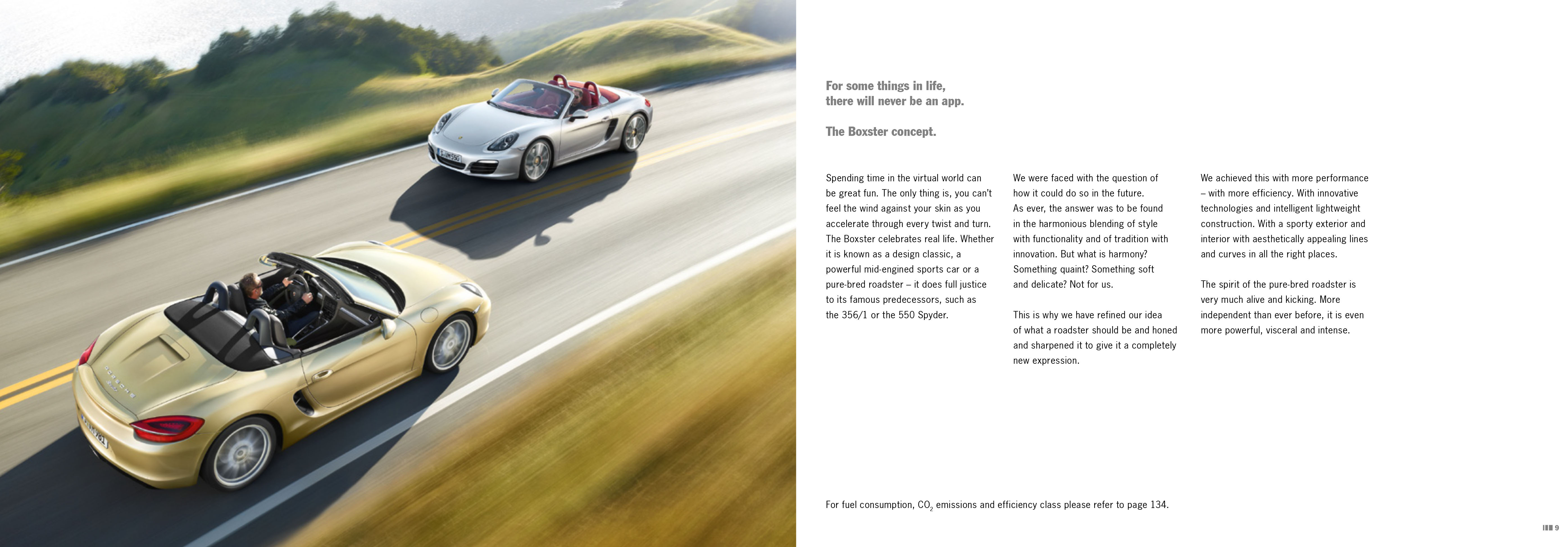
The brochure’s most quoted line arrives early. Opposite an aerial photograph of two Boxsters driving through sun-bleached hills, the text of the “Boxster Concept” section offers the manifesto statement: “For some things in life, there will never be an app.”
This is the brochure’s declaration of intent. In 2015, the smartphone had already eaten the camera, the map, the watch and the music player. The car was next. Porsche, in this single sentence, plants its flag: the tactile, physical act of driving a mid-engined roadster is irreducible. You cannot digitise wind in the hair. You cannot download a flat-six exhaust note.
The irony surfaces ninety-four pages later, in the audio and communication section, where the brochure advertises the free-to-download Aha Radio app, delivering podcasts and radio via the PCM infotainment system, without apparent self-consciousness. It is a magnificent contradiction, though perhaps not an entirely dishonest one. Porsche's position, stated clearly if obliquely, is that digital convenience and analogue driving pleasure are not in competition. The app is for the car park; the flat-six is for the mountain pass.
The defensive posture is period-accurate. Every major manufacturer in the early 2010s was having some version of this anxiety about relevance in a digital age. What distinguishes Porsche’s version is the specific confidence with which they frame it. This is not hand-wringing; it is a statement of category. The Boxster does not compete with an app. It competes with the memory of the best drive you have ever had.
The Racetrack Mandate
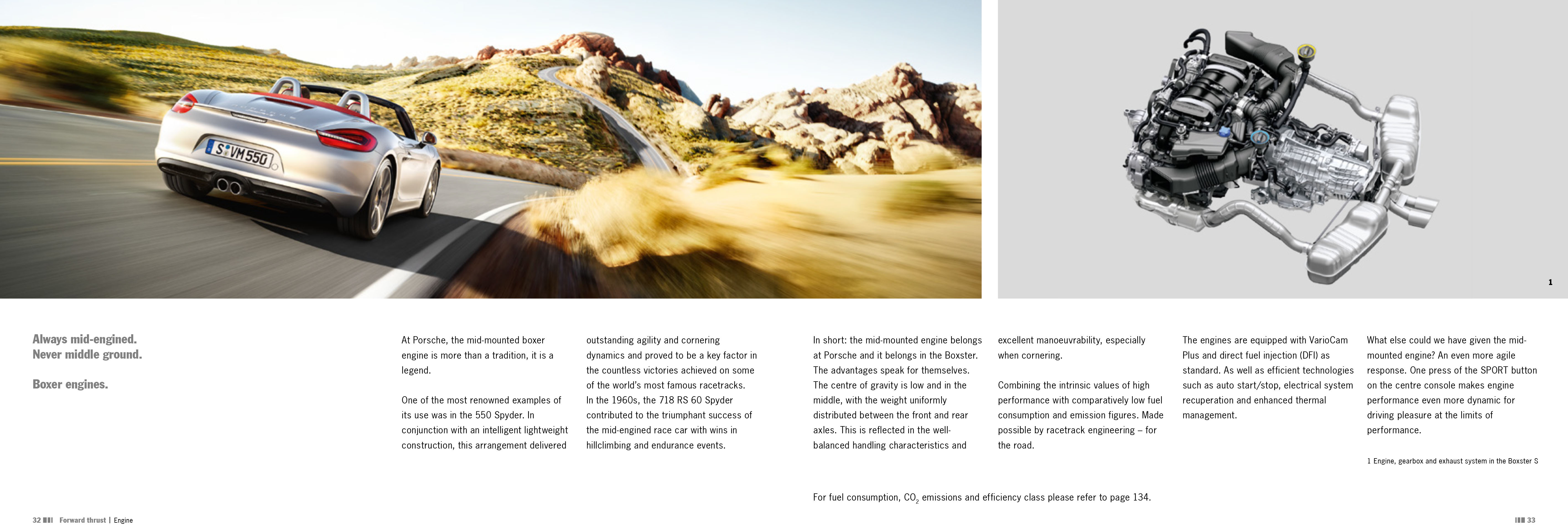
This is the brochure’s strongest assertion of lineage. The spread leads with a silver Boxster S at speed on a mountain road, number plate S·VM 550. Porsche does not show the 550 Spyder. It does not need to. The registration plate on a standard road car does the work entirely, invoking sixty years of racing heritage. The right page shows the engine, gearbox and exhaust system as a single isolated unit on white. The headline: “Always mid-engined. Never middle ground.”
The text builds its case for institutional purity. The 550 Spyder’s mid-engine layout delivered “excellent manoeuvrability, especially when cornering” and contributed to “triumphant success” at hillclimbs and endurance events. The 718 RS 60 Spyder is invoked. The argument concludes: racetrack engineering, for the road.
This is institutional hubris of a precise and particular kind. The base Boxster at this point produces 265bhp from a 2.7-litre flat-six. It is an objectively quick car with a technically exemplary chassis. But it is not, in any meaningful sense, descended from the 550 Spyder’s racing programme. The lineage claim is philosophical, not engineering genealogy. What the brochure is actually doing is something subtler: it is arguing that the mid-engine configuration is an unbroken Porsche principle, that philosophy is the real inheritance, and that a 2015 Boxster driver shares something genuine with a 1960s racing driver when they find the limit of adhesion at the apex of a corner.
The claim is not false, but it requires the reader to accept metaphysics as engineering.
The PDK Schism
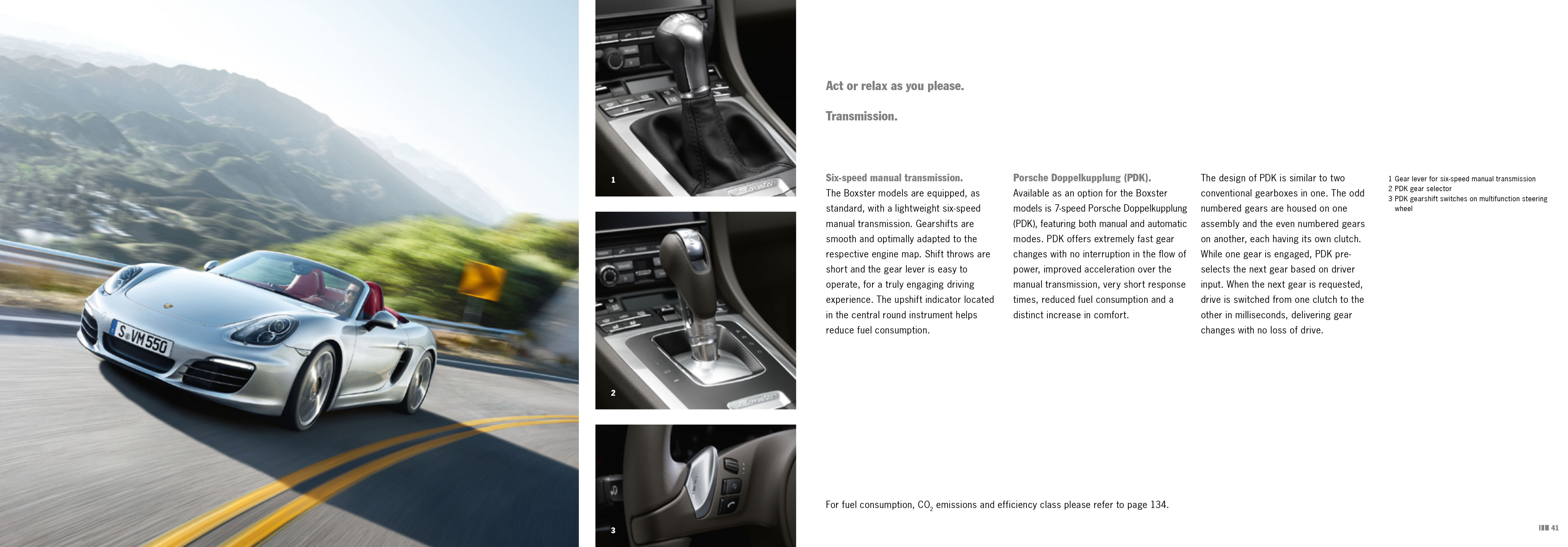
The transmission spread shows three images in vertical stack: the six-speed manual gear lever, the PDK selector, and the PDK shift paddles on the steering wheel. The headline is “Act or relax as you please.”
The manual gearbox is presented fairly and with appropriate precision: short throws, optimised shift map, an upshift indicator to assist fuel economy. But read the copy carefully and the hierarchy becomes clear. The PDK receives considerably more column inches and its advantages are presented in unambiguous terms: “extremely fast gear changes with no interruption in the flow of power, improved acceleration over the manual transmission, very short response times, reduced fuel consumption and a distinct increase in comfort.”
And then the defining phrase: “delivering gear changes with no loss of drive.”
This is a clever, careful piece of product writing. The PDK’s claim is technically accurate. The manual gearbox, in the act of changing gear, interrupts the flow of power to the rear wheels. PDK does not. In terms of lap times and 0-62mph figures (the manual Boxster takes 5.8 seconds; PDK does it in 5.7), the difference is marginal. In terms of maximum driver engagement on an open road, the argument runs the other way entirely.
The brochure does not make that counter-argument. It presents PDK’s virtues without equivalent advocacy for the manual. “Act or relax as you please” is neutrally framed, but the column inch allocation tells you which way the wind was already blowing in 2015. The manual gearbox was already being softly managed toward the exit.
Today, this page has acquired a melancholy tint. The subsequent 718-generation Boxster was offered in the UK overwhelmingly with PDK, and the manual variant became a special-order proposition. The signal was already present here.
The Servo Pivot
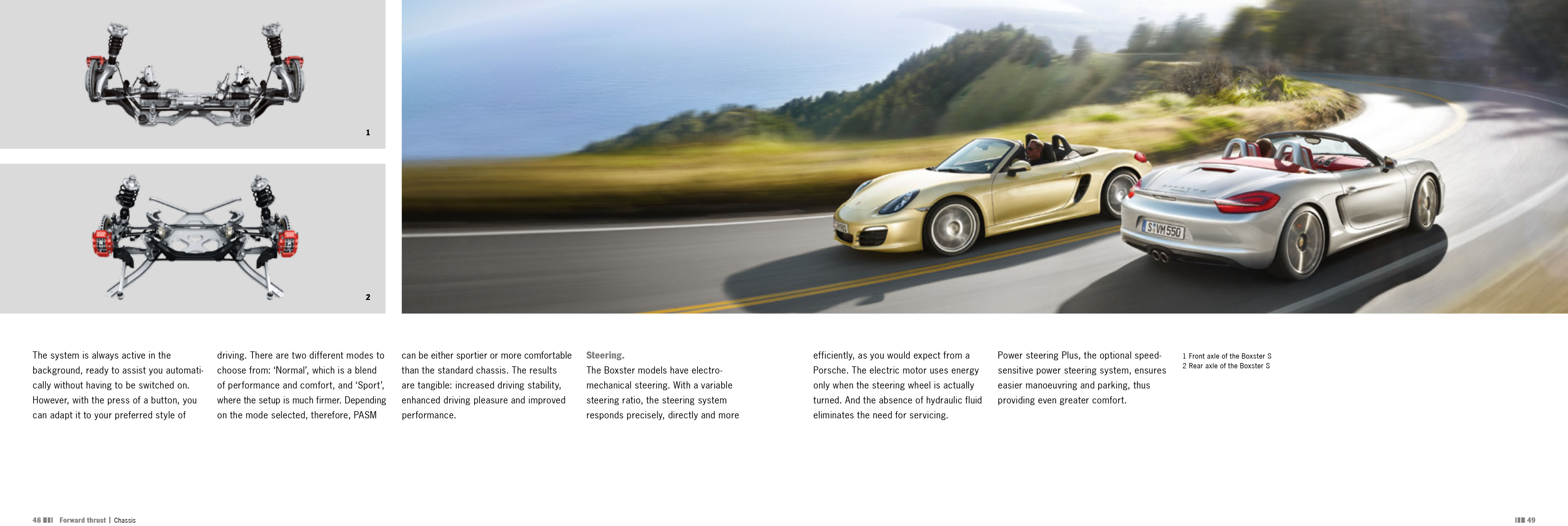
The chassis section reaches its most contentious moment at the steering description. The axle diagrams are precise and beautifully rendered: aluminium components mapped against their spatial relationships. The text introduces electromechanical steering and immediately addresses the controversy it had generated in the previous 981 generation.
“The electric motor uses energy only when the steering wheel is actually turned. And the absence of hydraulic fluid eliminates the need for servicing.”
This is a masterclass in reframing. When Porsche moved to electromechanical steering in the 981 generation, the enthusiast press was unkind. The hydraulic assistance of the previous 987 generation had been praised specifically for its communicative feel, the ability to sense road surface texture and weight transfer through the rim. Electromechanical systems of the period were widely perceived as filtering out precisely this information in the name of efficiency and consistency.
The brochure’s response is to make no claim at all about feel or communication. Instead, it locates the virtue in energy efficiency and service elimination. This is not deceptive; both claims are true. But the omission is instructive. Porsche chose not to make a steering quality claim they were not certain they could defend, and chose instead to anchor the argument in maintenance convenience and environmental virtue.
The absence of a claim can be as revealing as the claim itself. Zuffenhausen rationalism: honest about what it can prove, silent about what it cannot.
Magnetic Sorcery
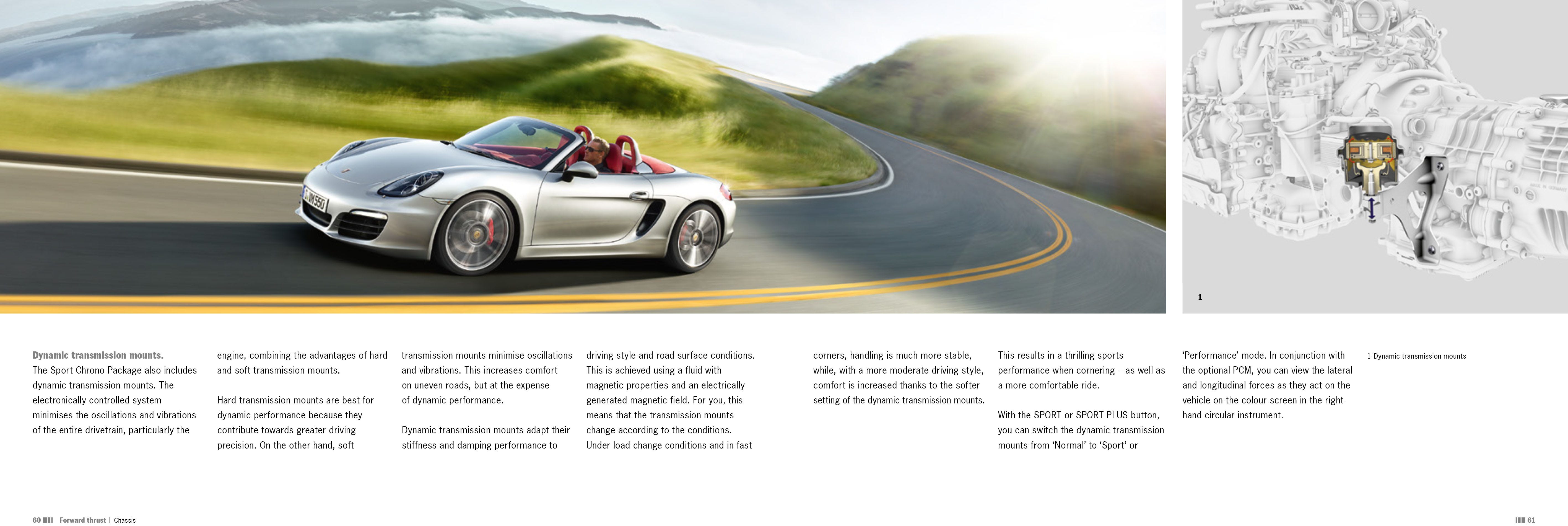
This is the brochure’s most complex passage, and it is handled with the confidence of a company that has stopped being embarrassed by engineering excess.
The Sport Chrono Package includes, as part of its proposition, dynamic transmission mounts. The system adjusts the stiffness of the connection between engine and chassis depending on driving mode. Hard mounts give precision; soft mounts give comfort. The dynamic mounts give both, simultaneously, by varying their characteristics in response to driving inputs. The mechanism by which they do this deserves quoting in full: “This is achieved using a fluid with magnetic properties and an electrically generated magnetic field.”
Magnetorheological fluid. In the engine mounts of a road car. In 2015.
The brochure does not apologise for this. It does not contextualise it against simpler alternatives. It states the mechanism with total placidity and moves on. The implicit message is: this is what Porsche does. If you find it unreasonable, you may have bought the wrong brand.
From a 2026 perspective, this passage has aged into a monument to a specific kind of engineering ambition. The dynamic transmission mounts work. They solve a genuine engineering problem in the mid-engine layout: the tendency for the drivetrain to generate vibration modes that conflict with ride quality. The solution is elegant and it functions as advertised.
The Green Alibi
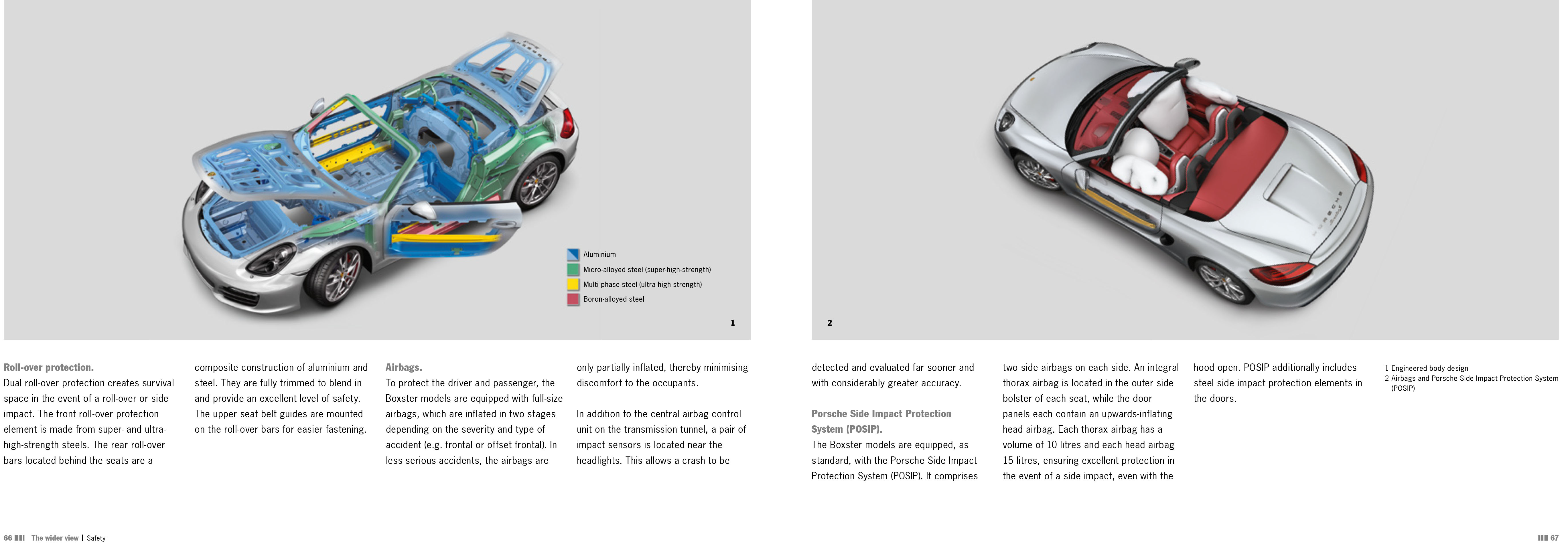
The Environment section of any sports car brochure faces a structural challenge: justify the object’s existence to a readership that already knows it produces 211g/km of CO₂. Porsche’s solution in 2015 is multifaceted and, on balance, honest.
The technical argument leads: direct fuel injection, VarioCam Plus, thermal management, electrical system recuperation and the auto start/stop function collectively reduce fuel consumption relative to the previous generation by what the brochure describes as a double-digit percentage. The material-mapped chassis diagram appears, showing the proportions of aluminium, high-strength steel and boron-alloyed steel that constitute the 981 bodyshell, including the 46% light-alloy content.
And then, with the careful delivery of a statement that has been very deliberately drafted: “the Boxster is around 95% recoverable.”
This is the brochure’s green alibi, and it is worth examining. The claim is genuine; the 981’s material specification does lend itself to high-percentage recycling at end of life. But invoking end-of-life recycling as an environmental virtue for a 330bhp sports car requires a particular kind of confidence that the reader will accept philosophical displacement as substantive environmental responsibility.
The brochure does not say the Boxster is environmentally virtuous in operation. It says it is responsibly built and responsibly designed for eventual disposal. These are different claims. The distinction is not dishonest. State only what you can prove. Let the reader draw their own conclusions.
The Rearview Mirror: Spirit, Declared, Then Quietly Revised
The Over-Correction: Freedom Through Compliance
The 981 Boxster has a problem that the brochure, with characteristic Porsche confidence, attempts to convert into a virtue. It is too good.
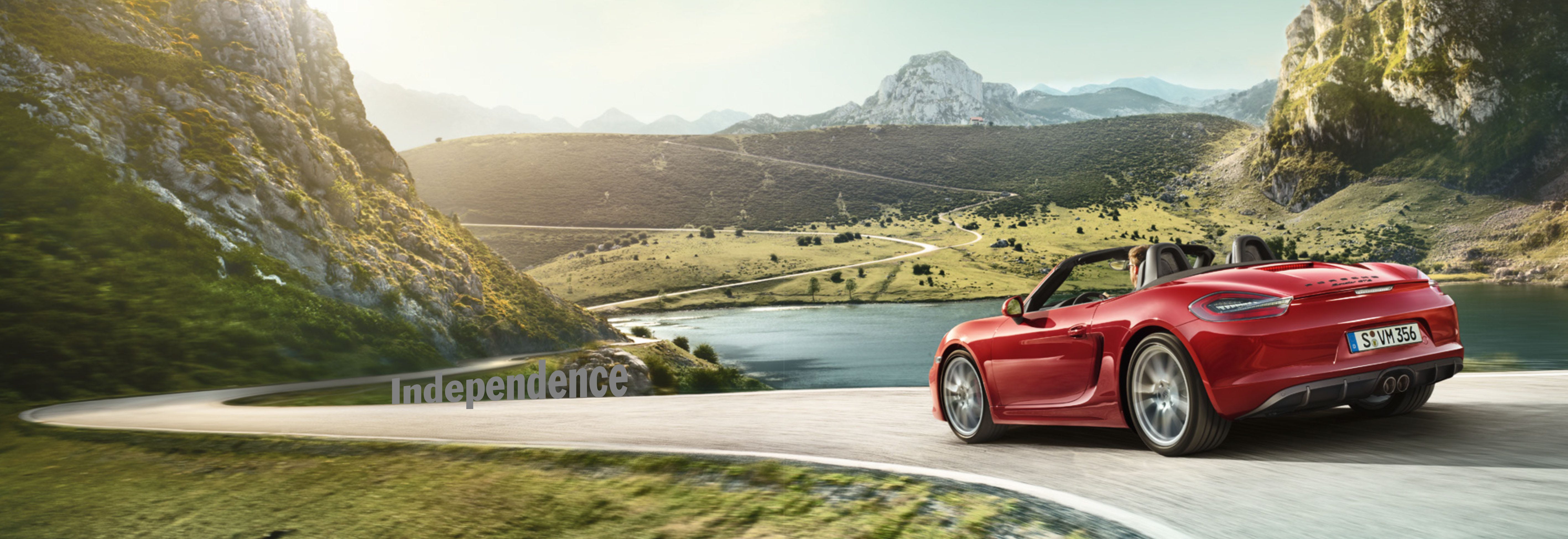
The word “Independence” opens the brochure on page six, rendered in large grey type across a mountain sweep. The principle, as articulated in the closing “Principle” section, is: “the principle by which we can think for ourselves, explore our own direction and live our own lives.”
The tension is that a car loaded with PSM, PASM, PTV and adaptive cruise control is not primarily about independence. It is about managed competence. The systems are excellent; they are, by the period standards, genuinely world-class. But they create a car that is, at the limit, almost impossible to destabilise without deliberately switching off every safety net.
This is not a failure of engineering. It is a philosophical contradiction that the brochure acknowledges obliquely and never resolves. The section headline for the Chassis reads: “A love of freedom is no reason to lose self-control.” This is brilliant copy and a perfect summary of the paradox. The car sells independence while guaranteeing you will never exercise it unsupervised.
From a 2026 perspective, this reads not as failure but as the inevitable endpoint of a trajectory. The 718 that followed the 981 is even more electronically sophisticated, even safer, even less likely to reward (or punish) the kind of exploratory driving the brochure describes on its opening pages. The 981 was the last generation in which you could still feel the car thinking, occasionally, rather than merely the systems thinking for it.
The Complexity Tax: What the Magnetic Fluid Costs
The 981 Boxster in 2026 occupies a peculiar ownership position. It is old enough to have passed through its worst depreciation; young enough that replacement parts remain available; complex enough that ownership without specialist knowledge carries meaningful financial risk.
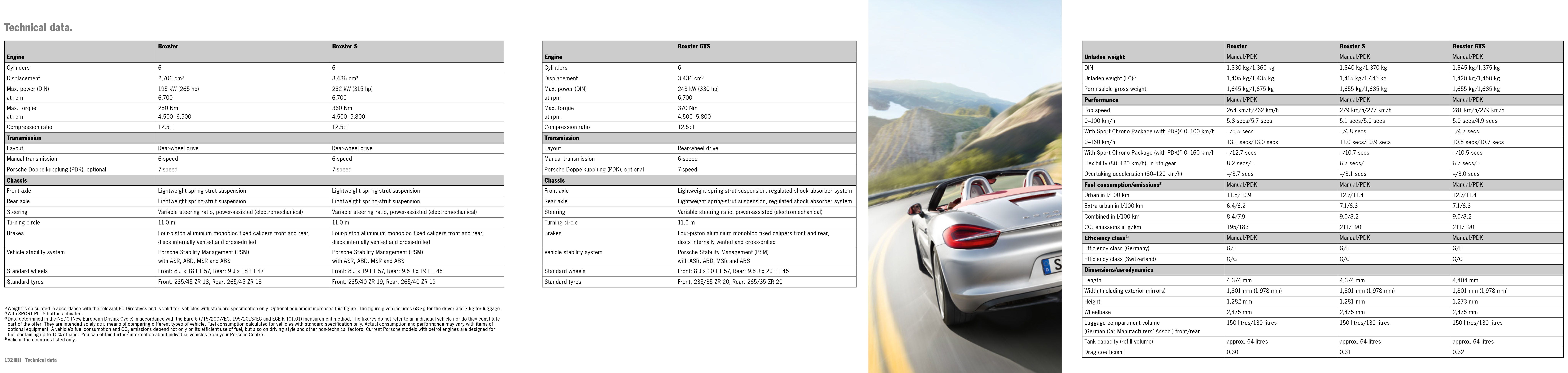
The PASM (Porsche Active Suspension Management) dampers, presented in the brochure as the core of the 981’s chassis refinement, carry replacement costs that can reach four figures per corner. The PTV (Porsche Torque Vectoring) rear differential, celebrated on pages 56-57 for its ability to modulate brake pressure to the inside rear wheel in fast corners, involves a mechanically locking differential that rewards inspection before purchase. The PDK gearbox, presented on page 41 as the logical transmission choice, has sensor and mechatronic unit failure modes that constitute the most significant single ownership risk on higher-mileage cars.
None of this was concealed by the brochure. Porsche does not sell on low maintenance claims; it sells on engineering quality. The complexity is the point. But complexity ages, and the passage on page 49 about electromechanical steering eliminating the need for hydraulic fluid servicing rather misses the larger picture: you traded one simple service item for a set of electronics that, when they fail outside warranty, can exceed the car’s current market value in repair cost.
The Six-Cylinder Sanctity: What the Brochure Actually Preserved
Here is what the 981 brochure genuinely achieved, and what it preserved for posterity.
The naturally aspirated flat-six engine, presented with power curves that tell the story more eloquently than any prose, is today a document of a particular kind of Porsche that ceased to exist in standard production form. The 718-generation Boxster introduced in 2016 replaced the 2.7 with a 2.0-litre turbocharged flat-four and the 3.4 with a 2.5-litre turbocharged flat-four. The decision was defensible: CO₂ targets, fuel consumption regulations, the direction of the industry. The result was, objectively, faster in all measurable parameters and noticeably less evocative in every parameter that resists measurement.
Porsche did not abandon the naturally aspirated flat-six entirely. The 718 Cayman GT4 and Boxster Spyder that followed revived it, and subsequent limited and special-edition variants continued the line. But these were deliberate, high-premium acts of nostalgia, priced accordingly and produced in constrained numbers.
The 981’s flat-six represents the final expression of that everyday naturally aspirated philosophy in the standard Boxster line. The brochure is, in this sense, an unwitting valediction for the ordinary. “The spirit of the pure-bred roadster is very much alive”, writes Porsche on page eight. It was. In this specific, accessible, standard-catalogue form, it also had approximately eighteen months left.
The 981 is now the benchmark against which subsequent standard Boxsters are measured and found, by a significant portion of the community, wanting. Not in terms of performance, which the turbocharged 718 delivers in abundance. In terms of that irreducible quality the brochure gestures at but cannot fully define: the flat-six’s voice, its linearity, its willingness to be explored rather than simply deployed, available to anyone who could write the cheque for a mid-range sports car rather than a rarefied special edition.
The brochure for the 2015 Boxster promised independence and delivered magnificent competence. The GTS number plate S·VM 356, appearing on the cover and on the closing principle pages, asked to be measured against the genesis of Porsche’s idea of a pure roadster. Measured against the 356/1, the 981 is heavier, faster, more comfortable, vastly more capable and irrefutably compromised in its purity.
Measured against the standard-production Boxster that came after it, the 981 is a high-water mark.
“For some things in life, there will never be an app.”
Today, read in the context of the turbocharged 718 and its PCM-managed efficiency, this line reads less like a declaration and more like a farewell. Porsche knew. They printed it on page five, in the largest type of any non-headline copy in the brochure, and they drove it into the mountain pass with the hood down and the flat-six doing what it was built to do.
Some things cannot be downloaded. Some cannot be recovered without paying a significant premium. And the standard-issue flat-six cannot be replaced.
The Fine Print