
The Stuttgart Ceiling: Porsche’s Beautiful, Engineered Conundrum
The 911's accomplished mid-engined sibling

In 2006, Porsche had a conundrum. They had just built the best-handling car in their range, and understood that the market could see exactly what they had done. Inconveniently, that car was not a 911. And so invisible limits were applied to ensure the established order held regardless. That is not incompetence; it is an institution protecting its most valuable asset from the thing it had just built.
The 2006 Cayman S is that car. Read the brochure today and you are reading a very well-produced argument for a car that Porsche simultaneously celebrated and quietly constrained.
What makes this brochure remarkable is not what it says. It is what it knows it cannot say. Ninety pages of heavyweight coated paper, perfect bound, every image a study in controlled tension. The surfaces are presented as gallery sculpture; the engineering, as biological necessity. It is a serious document about a serious car, and it is serious enough to know which subjects are best left unaddressed.
Anatomical Tautness: The Aesthetic of the Document
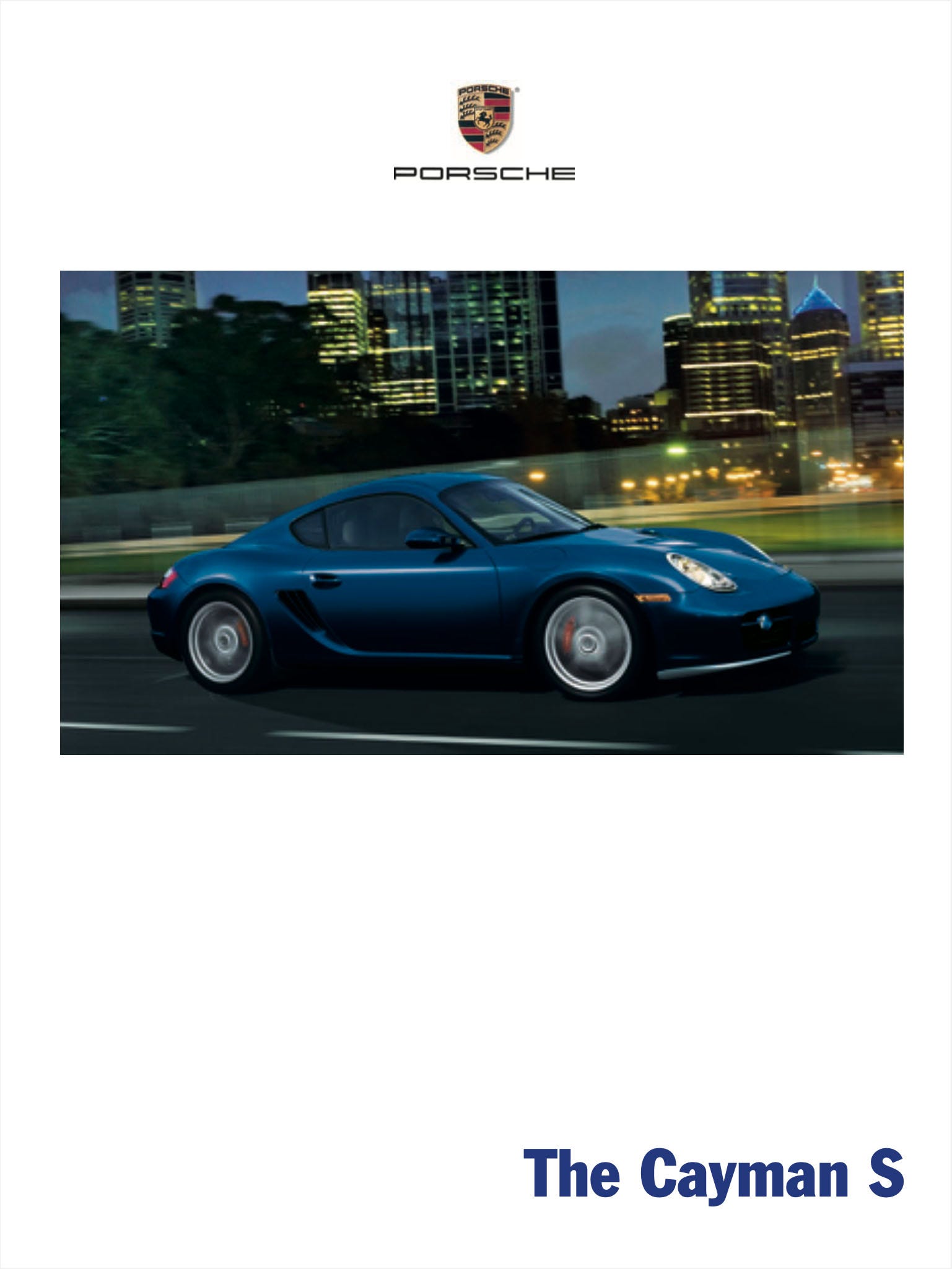
Open the brochure at the cover and you are greeted by a deep-blue 987 moving through a night cityscape, its silhouette low and purposeful. The image has been lit to maximise the haunches, emphasise the coupe roofline and place the mid-engine proportion at the visual centre of the frame. This is not an accident. The brochure knows that its most important technical argument is an architectural one: the engine is in the middle, and everything else follows from that fact.
The colour palette is almost entirely monochromatic, silver and grey cycling through multiple variations, until the yellow callipers of the Porsche Ceramic Composite Brake (PCCB) system appear on page fifty like a detonation. The choice is deliberate. Yellow is reserved exclusively for the ceramic brakes; it is the only accent colour in the document, hoarded until the brochure needs to justify its premium optioned price in a single visual argument.
Typography is Franklin Gothic in the Porsche house variant: tight tracking, high-fidelity legibility, the kind of type that says “we are not trying to impress you, we are informing you.” The body copy is set in a voice that oscillates between measured corporate confidence and clinical engineering hubris, sometimes within a single spread. The brochure does not shout. It does not need to.
The car is not presented as a machine; it is presented as a body. The engine is shown as if you are watching a physiological process. The suspension is exposed as bone and sinew. The car, as rendered in these pages, is a superb athlete — the brochure’s own phrase, reached for early and returned to throughout. You are not buying a vehicle; you are buying a musculoskeletal argument for how a car should be built.
The Manifesto
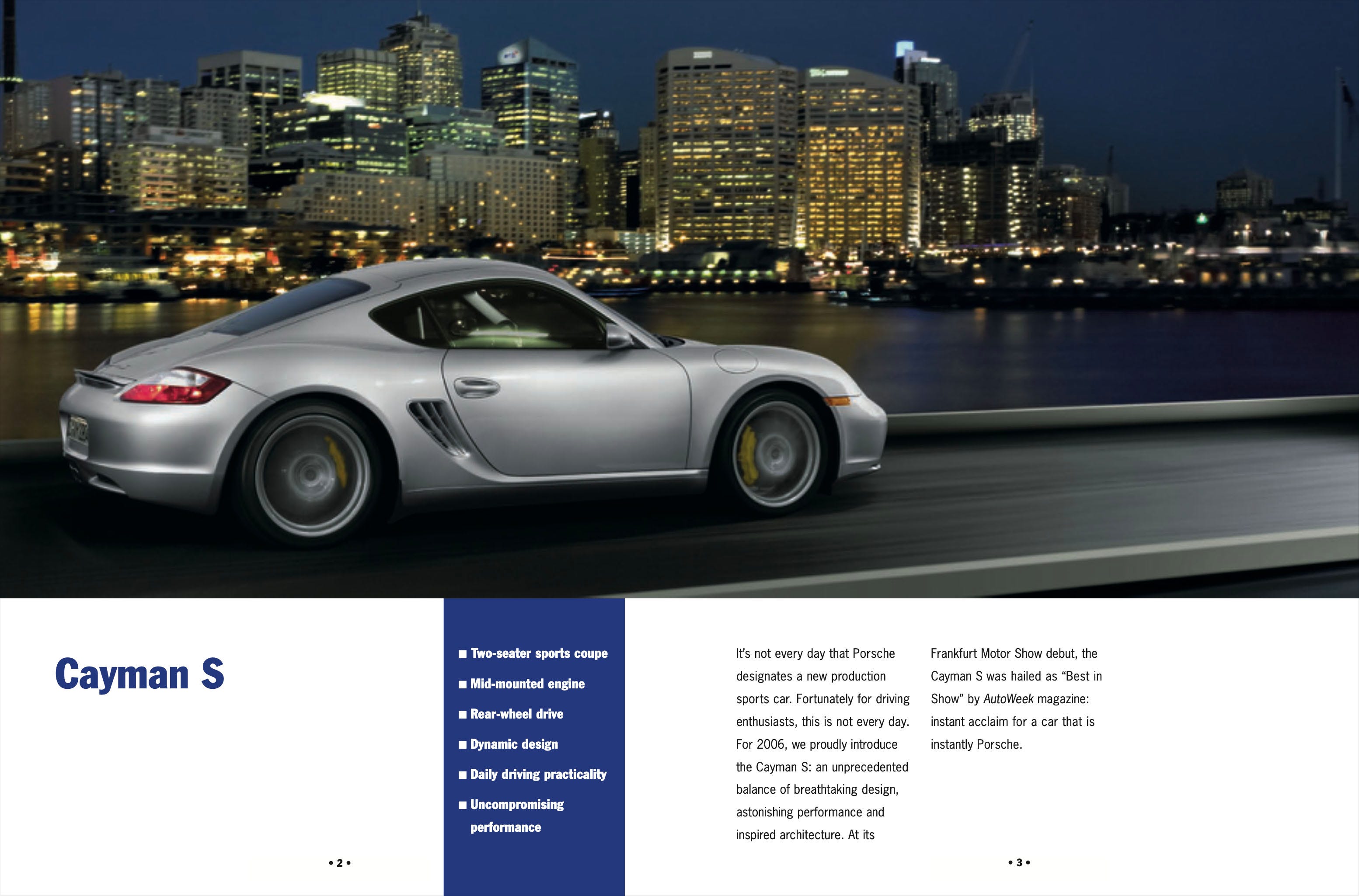
The brochure’s opening gambit is to announce a birth: “It’s not every day that Porsche designates a new production sports car.” The self-consciousness of this is revealing. Porsche is not simply introducing a model; it is telling you that you are witnessing history. The copywriter reaches immediately for the word “unprecedented”.
“...an unprecedented balance of breathtaking design, astonishing performance and inspired architecture.”
That word, “unprecedented”, is doing very specific work. It is not applied to the power output, which is admirable but not record-breaking. It is not applied to the speed, which is genuinely impressive. It is applied to the architecture. In one word, Porsche is claiming that no one has ever placed a mid-mounted engine this well, in this configuration, in a road car designed for everyday use. That is a complicated claim to make quietly, particularly when the manufacturer’s own 550 Spyder is cited on the following page as the historical precedent. The brochure is threading a needle: the car is unprecedented, but also a fifty-year legacy. Both things are true, and the contradiction is never acknowledged.
The 550 Coupe reference establishes the Le Mans genealogy, traces the architecture directly to mid-century racing success, and uses the Mulsanne Straight as proof of concept. The reader understands, without being told, that the Cayman S is the completion of something begun in 1953. The brochure positions this as a culmination, not an experiment.
The Body Language
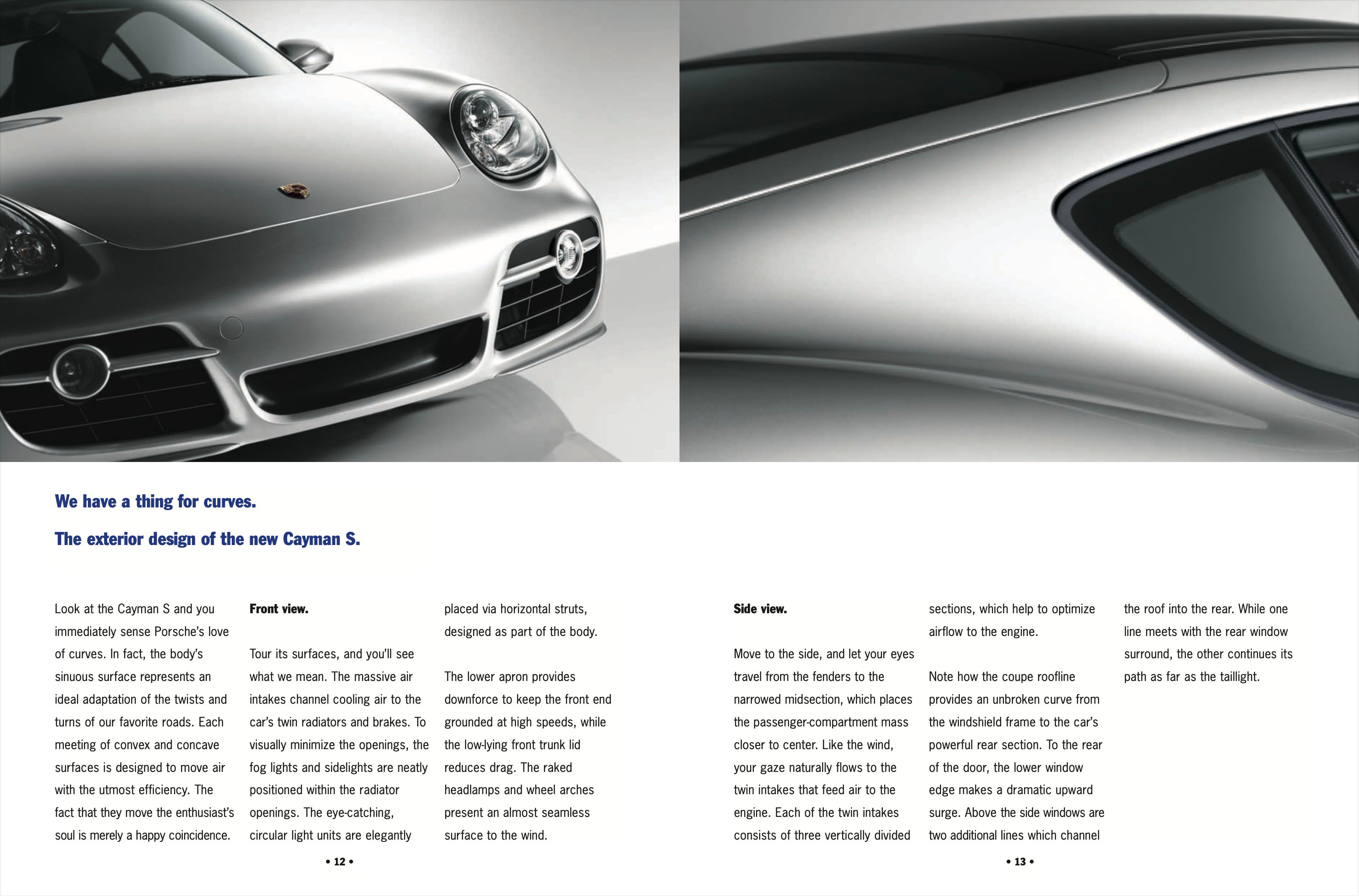
Pages twelve to fifteen are the brochure’s aesthetic centrepiece. The section is titled “We have a thing for curves”, which is both honest and strategic, given that the entire design argument Porsche is making rests on presenting aerodynamic necessity as artistic instinct.
The design analysis proceeds from front to rear with the rigour of an architectural critique. The fog lights are described as “neatly positioned within the radiator openings” to “visually minimise” them. The side intakes, feeding air to the mid-mounted engine, are analysed as three “vertically divided sections” that “optimise airflow”. The rear arches “bulge to enclose large high-performance wheels”. The biplane spoiler “extends at 75 mph”.
“Each meeting of convex and concave surfaces is designed to move air with the utmost efficiency. The fact that they move the enthusiast’s soul is merely a happy coincidence.”
That final clause is a deliberate piece of false modesty. Porsche knows precisely that it is moving souls. The phrase “merely a happy coincidence” is the brochure winking at the reader: we know this car is beautiful, you know this car is beautiful, but we are going to pretend together that it was only ever about aerodynamics.
The drag coefficient of 0.29, described elsewhere as “low even by sports car standards”, is the technical punchline to the aesthetic chapter. The sinuous surfaces that look like gallery sculpture are also, it turns out, functionally optimal. The brochure wants you to believe that beauty and engineering converged here through some natural inevitability.
The Heart of the Argument
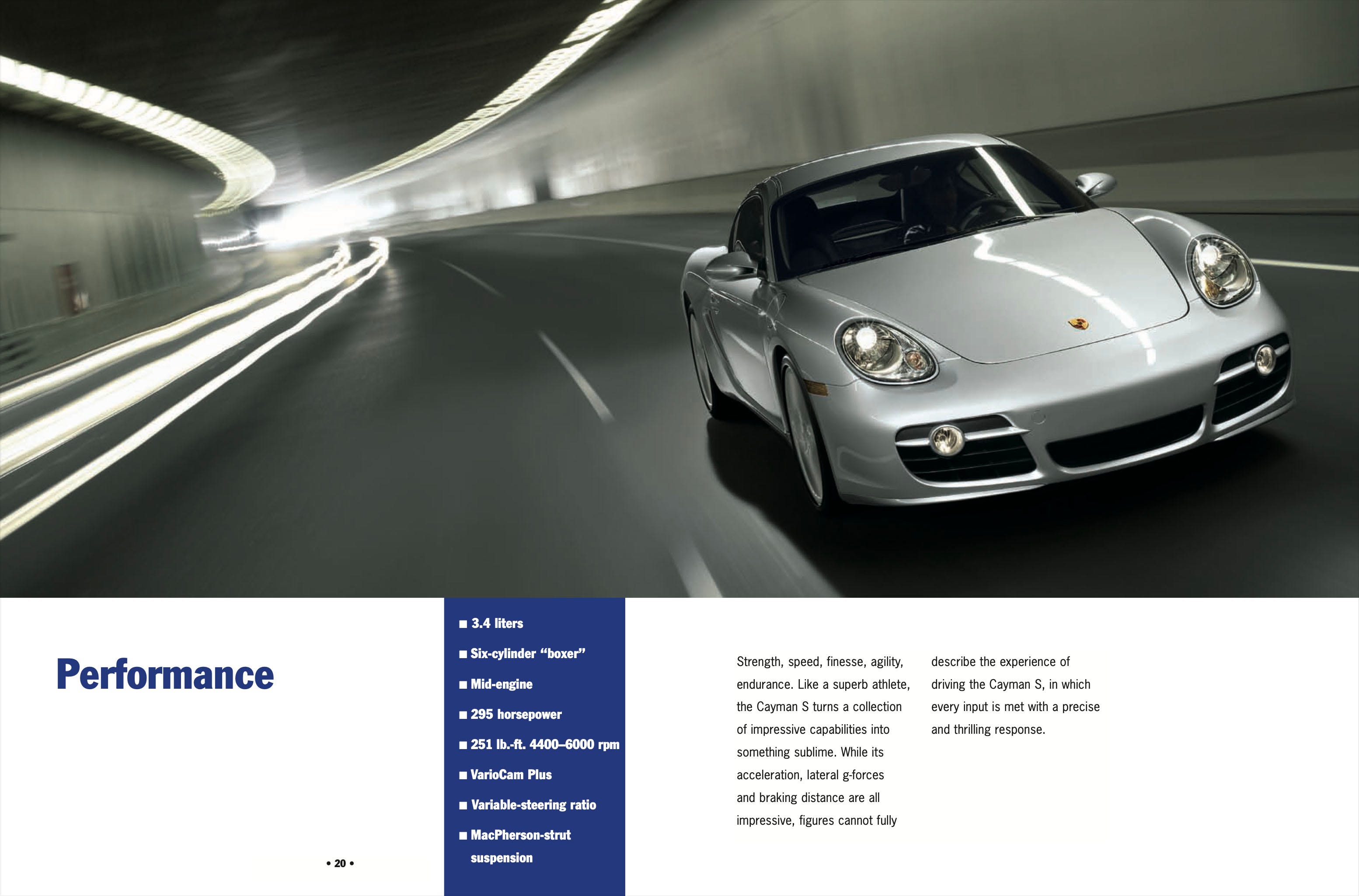
The Performance section opens with a sentence that deserves to be quoted in full:
“Strength, speed, finesse, agility, endurance. Like a superb athlete, the Cayman S turns a collection of impressive capabilities into something sublime.”
The athlete metaphor is the brochure’s most consistent literary device. It is deployed repeatedly throughout the document, and here it introduces the technical case for the drivetrain. The mid-engine layout is justified on the grounds of balance: “perfectly balances the weight between front and back wheels, for improved traction.” The 45/55 front-to-rear weight distribution is the architectural proof that the athlete metaphor is not merely rhetorical.
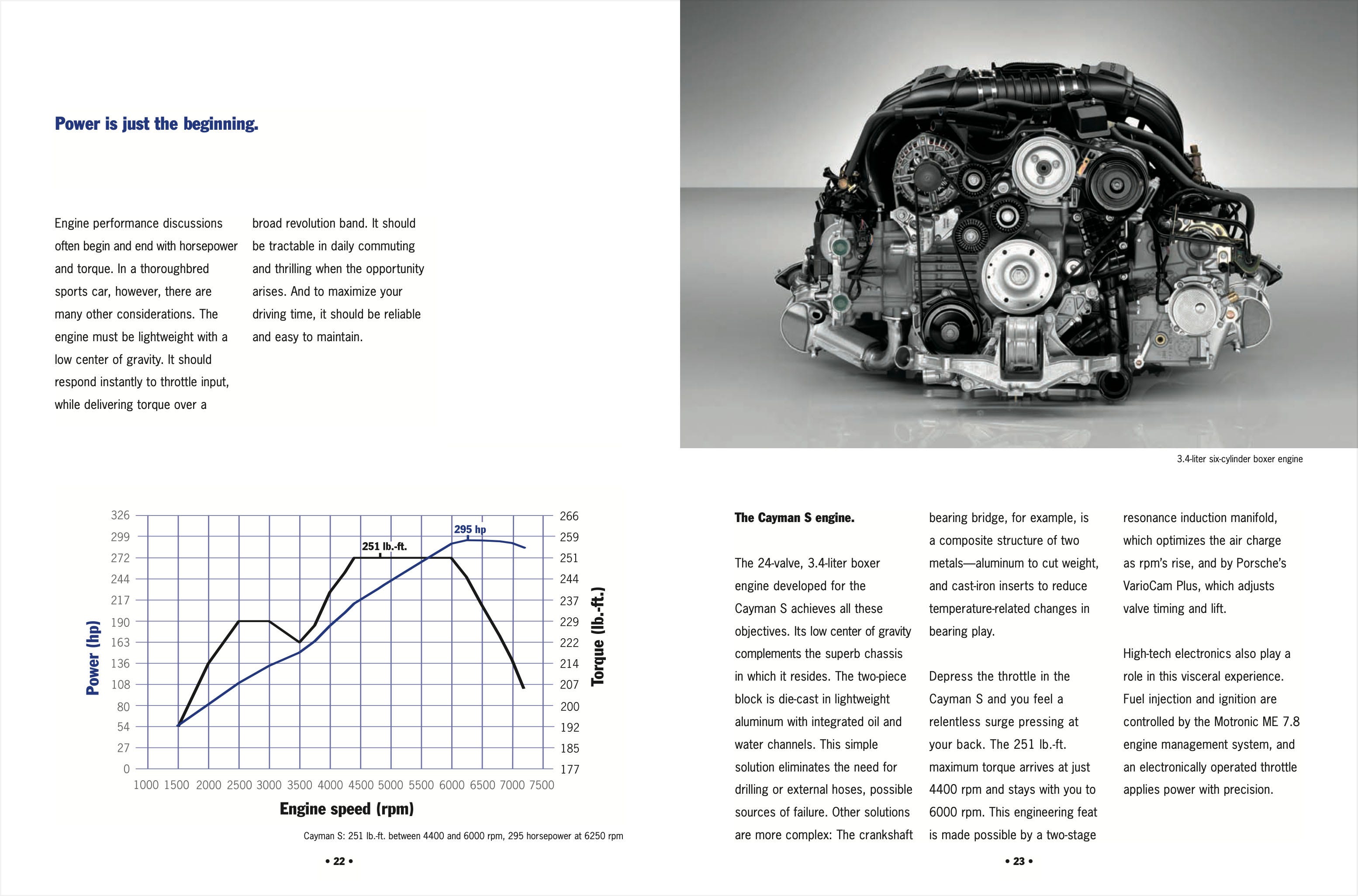
The engine section is the brochure at its most technically assured. The 24-valve, 3.4-litre flat-six is presented with a confidence that borders on the theological. The two-piece block, the Lokasil-coated bores, the crankshaft bearing bridge of composite metals, the dual dry-sump scavenge pumps: these details are rendered with the care of a watchmaker explaining a movement. Page twenty-three produces the resonance induction manifold as the key to the torque plateau:
“This engineering feat is made possible by a two-stage resonance induction manifold, which optimises the air charge as rpm’s rise...”
“Engineering feat.” Not engineering solution, not engineering detail. A feat. The word suggests something athletic, something achieved through exertion and mastery. The manifold that produces the flat torque curve between 4,400 and 6,000rpm is presented as a performance of engineering virtuosity.
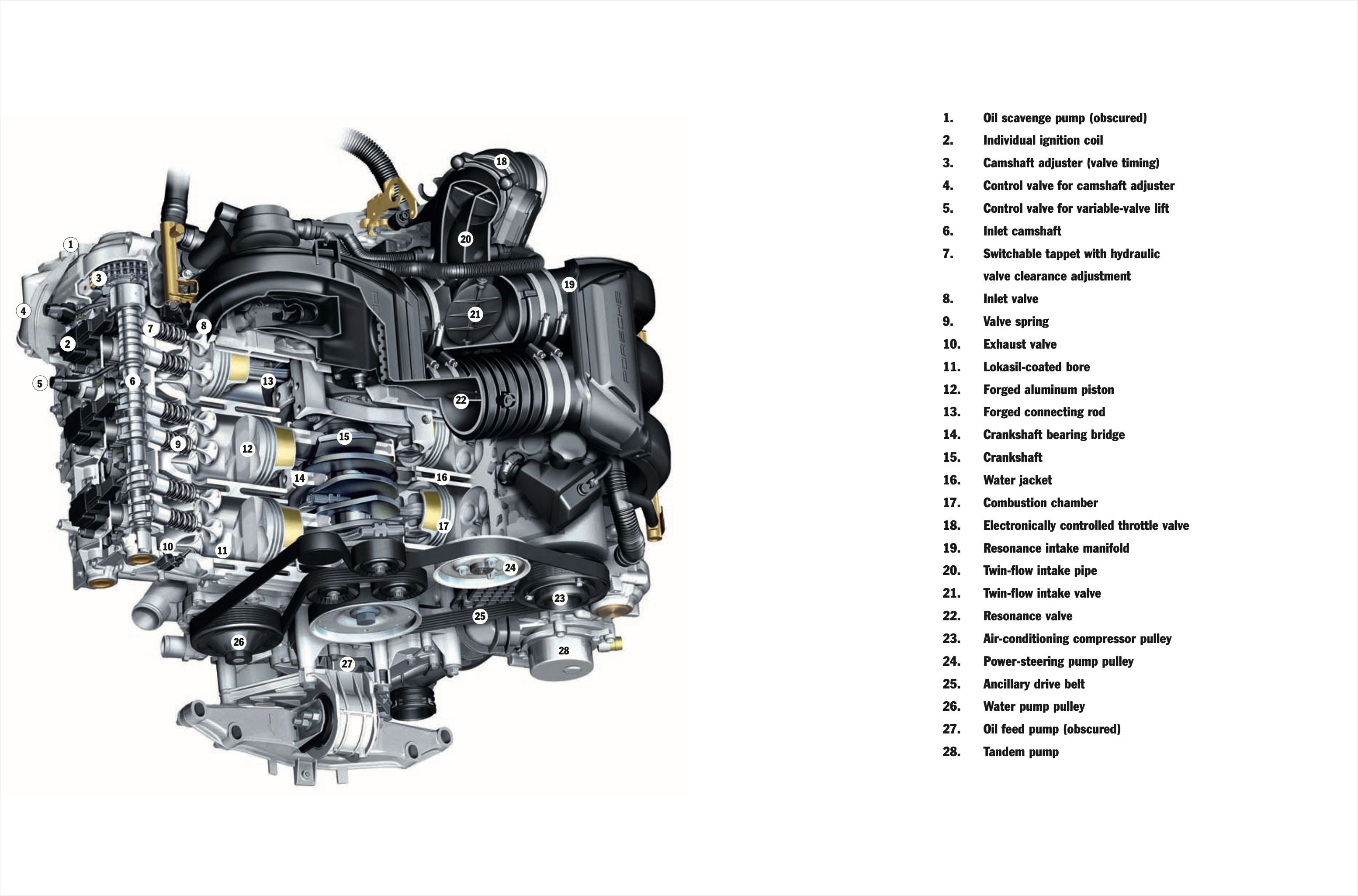
The engine cutaway on pages twenty-four and twenty-five is the most extraordinary image in the document. Twenty-eight numbered components, each labelled with clinical precision. Component eleven, the Lokasil-coated bore, is identified without commentary. In 2006, this is a point of pride. In 2026, it is an archaeological artefact of a known failure mode. The brochure, of course, does not know this yet.
The Thermal Penalty
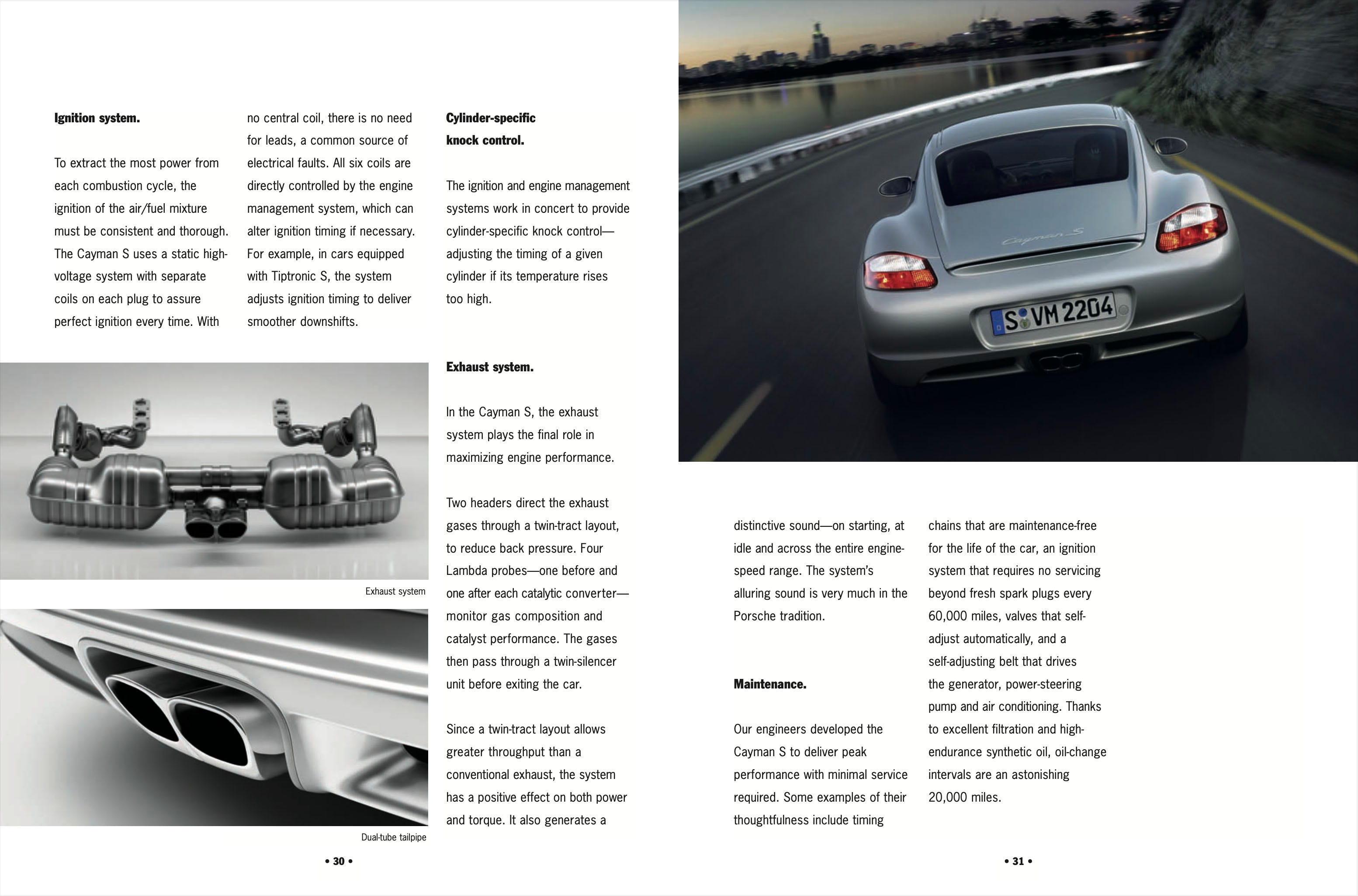
Porsche dedicated a section to what might politely be called the mid-engine’s primary engineering challenge: heat. The exhaust system section on page thirty describes a twin-tract layout with four Lambda probes, twin silencers, and a dual-tube tailpipe. Earlier, on the rear-view design pages, the brochure had already admitted to “arched openings that provide... an easy escape route for excess exhaust-system heat.”
The language “easy escape route” is a masterclass in reframing. The thermal management requirements of a compact mid-engine layout are being presented as architectural flourishes. The openings that allow heat to exit the engine bay are the same openings that give the rear end its purposeful, arched expression. Function and form are merged so thoroughly that the thermal constraint becomes an aesthetic asset. You would not know, reading this brochure, that managing heat was a problem that required a solution. You would think Porsche had designed an exhaust tunnel purely because it looked dynamic.
The Yellow Halo
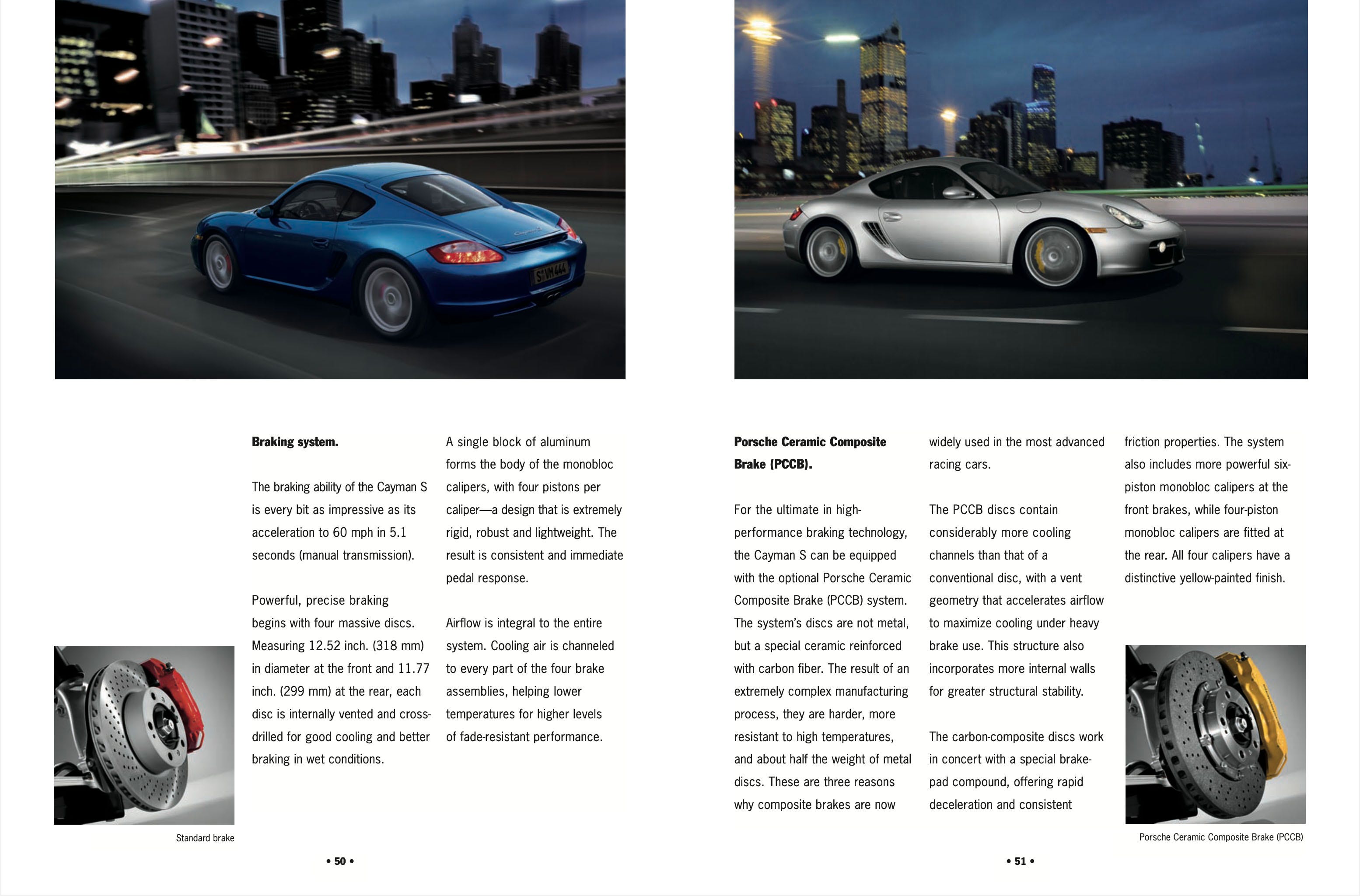
Page fifty represents the brochure’s most audacious moment. The standard brake system has already been presented as remarkable: four-piston monobloc aluminium callipers on cross-drilled, internally vented discs measuring 318mm front and 299mm rear. This would be a creditable stopping system by any standard.
Then the yellow callipers arrive.
The PCCB section is structured as revelation rather than option. The ceramic-composite discs are introduced with the language of materials science: “harder, more resistant to high temperatures, and about half the weight of metal discs.” Three concrete advantages in a single sentence, each calibrated to a specific performance concern. The weight saving, the thermal resistance, and the structural superiority are presented as the three reasons “composite brakes are now widely used in the most advanced racing cars”.
“The system’s discs are not metal, but a special ceramic reinforced with carbon fiber.”
“Not metal.” The definition is achieved through negation: these brakes are something beyond the conventional category. The yellow calliper finish, described as “distinctive”, is the brochure’s only concession to extravagance. In a document of controlled monochromatic sophistication, the yellow calliper is the single splash of colour permitted to express excess.
What the brochure does not say: these discs cost more to replace than many used cars are worth. The unsprung weight saving is genuine; the replacement bill is also genuine. The brochure positions ceramic brakes as a luxury upgrade. It is not wrong, exactly.
The Hydraulic Covenant
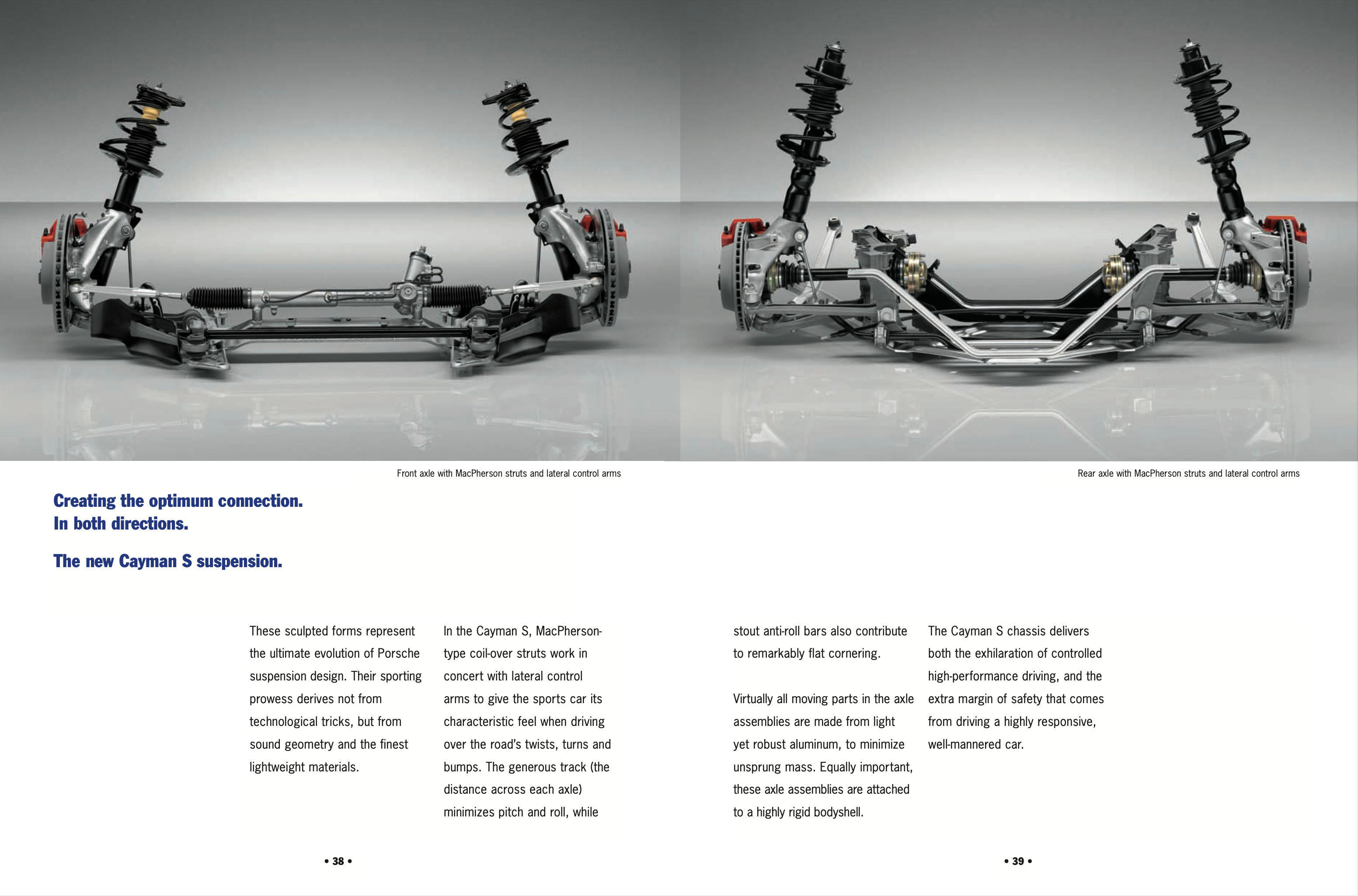
The suspension and steering sections contain the brochure’s most under-appreciated technical argument. MacPherson struts at both axles, aluminium lateral control arms throughout, generous track dimensions front and rear. The description is technically accurate and contextually modest: Porsche presents this as evolutionary rather than revolutionary.
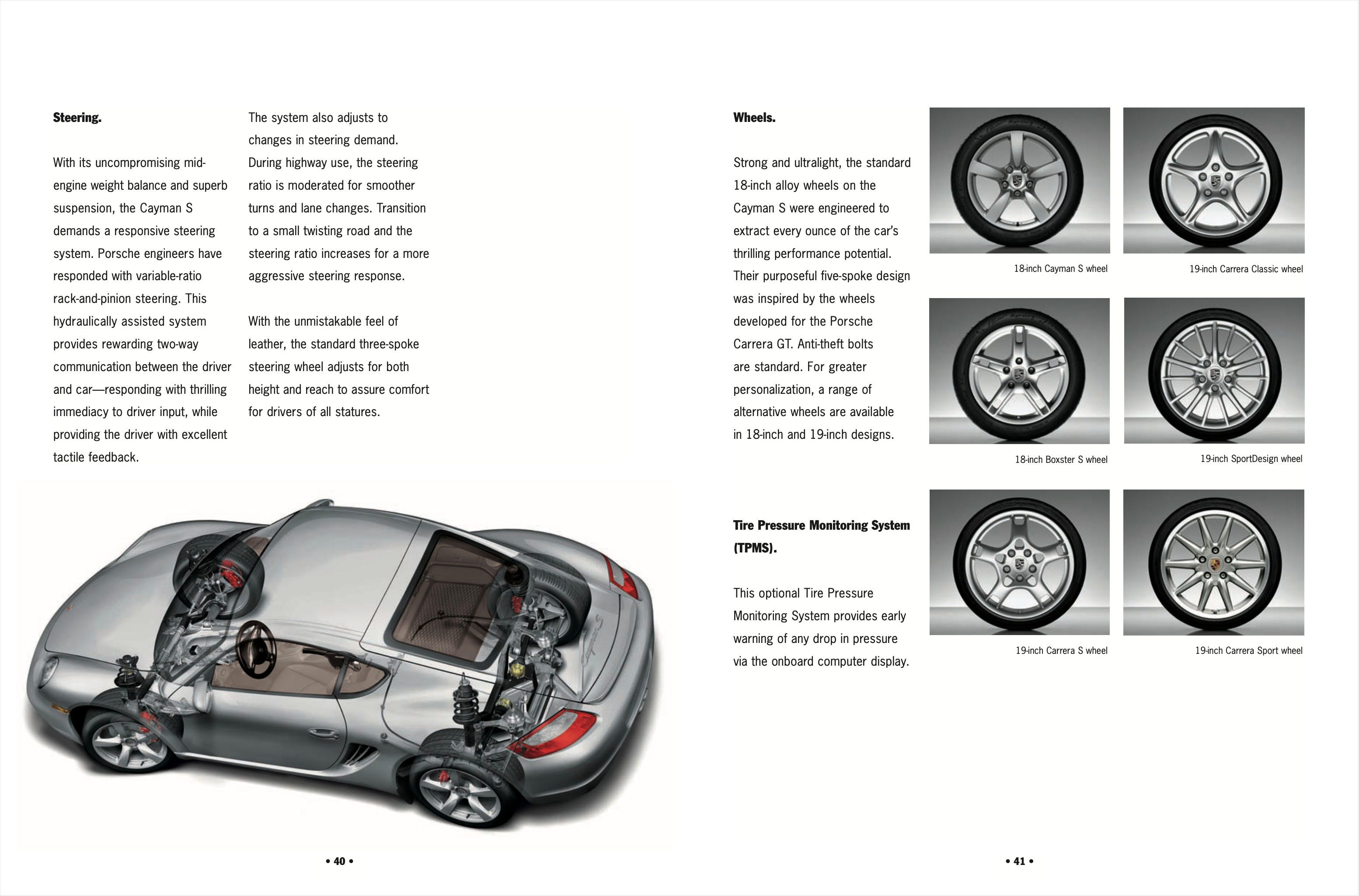
The steering section is where the document reveals its deepest conviction. The variable-ratio, hydraulically assisted rack-and-pinion system is described as providing “rewarding two-way communication between the driver and car”.
Two-way. Not one-way. Not filtered. The hydraulic rack, in 2006, is standard equipment that the brochure treats as almost a given. In 2026, having driven the electric racks that replaced it on subsequent generations, this single phrase reads as an elegy. The hydraulic system is described as providing “excellent tactile feedback”. The brochure does not know it is describing the last such system Porsche would fit to a car of this configuration. It writes about the hydraulic rack as if it will always exist.
It will not.
The Rearview Mirror: A Beauty in a Cage
The Problem: The Ceiling That Was Never Advertised
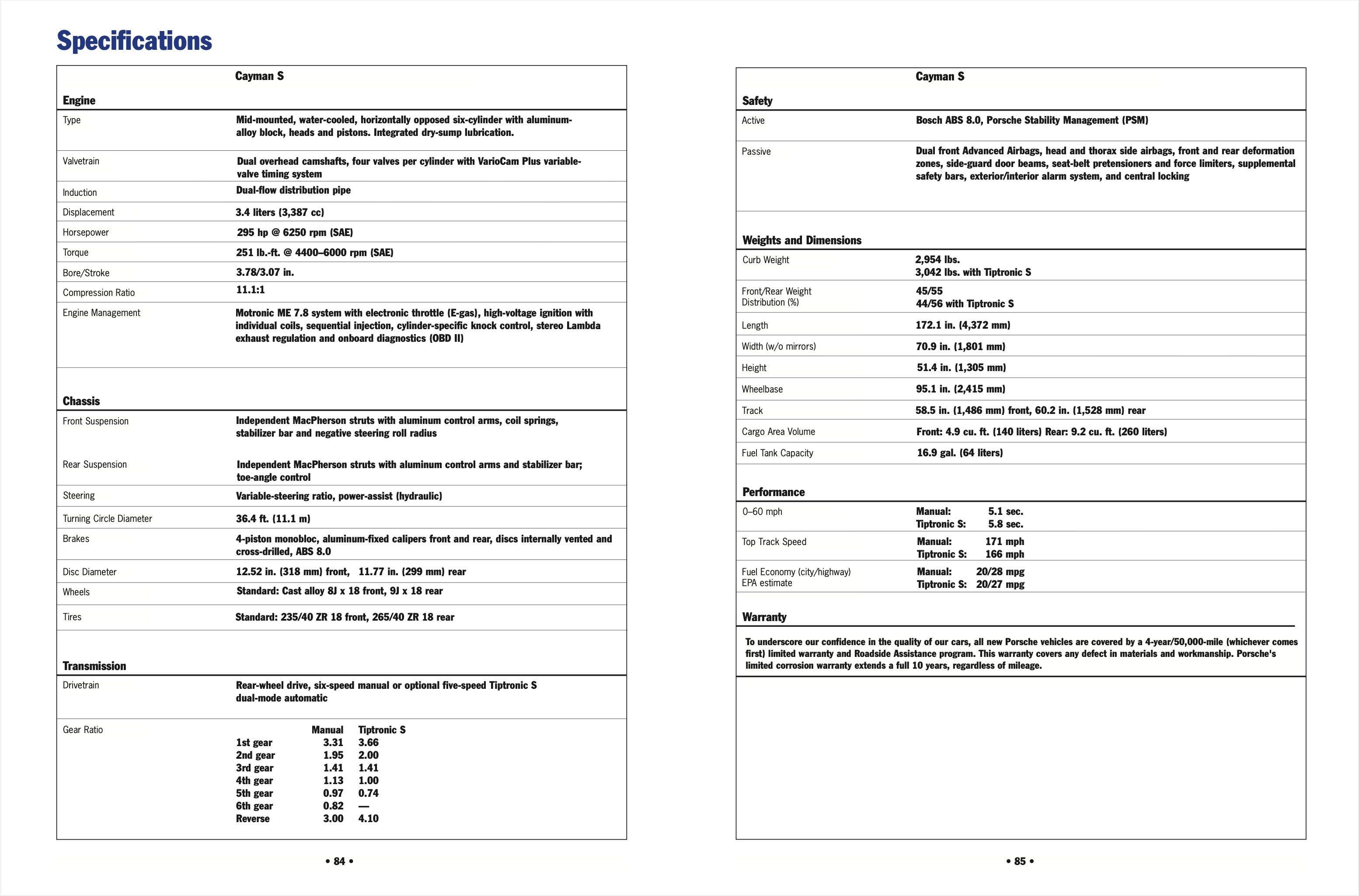
The 987.1 Cayman S was a victim of a constraint that the brochure could not acknowledge and that its marketing team was not permitted to explain. Porsche’s engineers, by placing the 3.4-litre M97.21 engine in a mid-mounted configuration in a rigid coupe body, produced a car whose chassis balance was demonstrably superior to the rear-engined 911’s. The physics are not complicated: a 45/55 weight distribution in a torsionally rigid coupe body, with hydraulic steering and MacPherson struts at both axles, will communicate the road with a directness that an overhanging rear engine cannot match.
Porsche knew this. The company’s solution was not to prevent the car from being built. It was to ensure the car could not be faster than the 911. The manual gearbox received shorter ratios. No limited-slip differential was offered at launch. The 295bhp figure was held precisely beneath the 300 bhp psychological ceiling. A performance car designed to be excellent but managed to remain second in its own manufacturer’s hierarchy is a peculiarly Porschean paradox: the 987.1 was arguably the finest chassis Porsche had produced for a road car, and it was calibrated to be permanently deferential.
The brochure, naturally, does not discuss any of this. It presents the Cayman S as the pinnacle of what Porsche wished to build. The ceiling is invisible.
The Tax: What the Brochure’s Technical Pride Left Behind
Page twenty-four identifies component eleven in the engine cutaway: “Lokasil-coated bore.” In 2006 this was a point of pride; the Lokasil silicon-particle coating allowed an aluminium cylinder block to run without conventional iron liners, reducing weight and improving heat transfer. By 2026, the Lokasil bore is associated with a known failure mode in higher-mileage M97.21 engines: a process called bore scoring, in which the coating degrades, leading to accelerated bore wear and eventual engine failure.
The intermediate shaft bearing, unmentioned anywhere in the brochure, is the engine’s more notorious weakness. The IMS bearing supports the intermediate shaft that drives the camshafts; early 987.1 engines used a single-row bearing susceptible to lubrication starvation. Failure ranges from expensive to catastrophic. Retrofit solutions exist; the problem has been documented extensively by owners and specialists. The brochure, writing about an engine that “should be reliable and easy to maintain”, is writing in good faith. The M97.21 was a high-revving masterpiece. It was also an engine that rewarded fastidious ownership and punished neglect.
Then there is the oil-level indicator. Page twenty-six, in the integrated dry-sump lubrication section: “The reading is so precise, a dipstick is not required.” The brochure presents the elimination of the dipstick as a refinement. The electronic oil-level sensor is the kind of complexity tax that only reveals itself years after purchase, when the sensor fails and the owner discovers that diagnosing oil level without it requires either a specialist endoscope or a great deal of patience. In 2006, the promise was precision. In 2026, the reality is that many owners have retrofitted solutions, or learned to treat the onboard indicator with the scepticism it has earned.
The Success: The Last Hydraulic Communicator
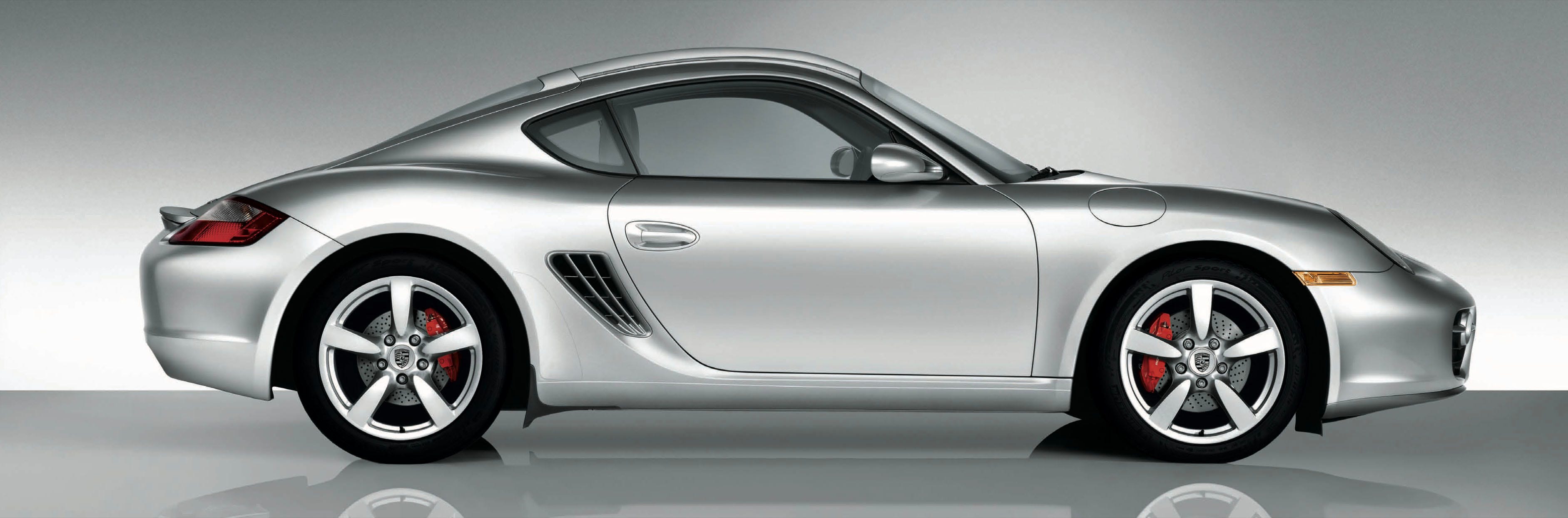
Here is the vindication the brochure earned without knowing it was earning it. The 987.1 Cayman S was the last Porsche sports car built with hydraulic power steering, mid-engine architecture, naturally aspirated power, and analogue chassis dynamics in a package below the 911’s price point. Every one of those qualities has subsequently been either lost or made substantially more expensive to access.
The steering feel that the brochure described as “rewarding two-way communication” is now, on later Cayman generations, delivered through an electrically assisted rack. The naturally aspirated flat-six has been replaced, progressively, by turbocharged four-cylinder engines in the entry-level variants. The limited-slip differential the 987.1 launched without has been standard for years on its successors. The 295bhp ceiling has been raised, lifted, and effectively forgotten.
What the 987.1 represents, then, is the most complete expression of a philosophy that Porsche has since compromised in the name of efficiency, emissions, and commercial positioning. The brochure’s rhetoric about “unprecedented balance” was correct. It was also, from a 2026 perspective, inadvertently describing a moment in time. The car and its brochure are, in retrospect, the record of a body at the peak of its form, just before the demands of the modern world began to ask it to become something else.
The Cayman S did not threaten the 911. It out-handled it. The brochure knew it. Porsche knew it. The ceiling held. But the car that was meant to live in the 911’s shadow has, twenty years on, become the one that many drivers remember more fondly.
The Fine Print
I really, really liked this car, but I could not take the risk on bore scoring and an IMS failure. I bought a 2009 997.2 instead. I am glad I did.
Nice write up. I remember this car being introduced very clearly, and a close friend has owned two of the 987 cars. Brilliant little cars to drive, and they are quite small inside. The price of them could be optioned to an eye-watering level IIRC, like all Porsches now I guess. The lack of a dipstick and the fact that you cannot even see the engine from above always seemed really stupid.