
The Homologation Hangover: Blue Blood and Mud
How the Renault Clio Williams accidentally became a hot hatch aristocrat

The Prologue
There is a peculiar honesty to the June 1994 Renault Clio Williams 2 brochure. It opens not with a sun-drenched coastal road or a tasteful family tableau, but with a rear-quarter view of a car entering a hard bi-chromatic void: pure black on one side, stark white on the other, the 449 Sports Blue of the bodywork and the gold of the wheels given maximum contrast against both. There is no model standing nearby, no lifestyle aspiration being hawked. Just the object, doing what objects of genuine pedigree do: existing with the particular self-assurance of something that knows exactly what it is.
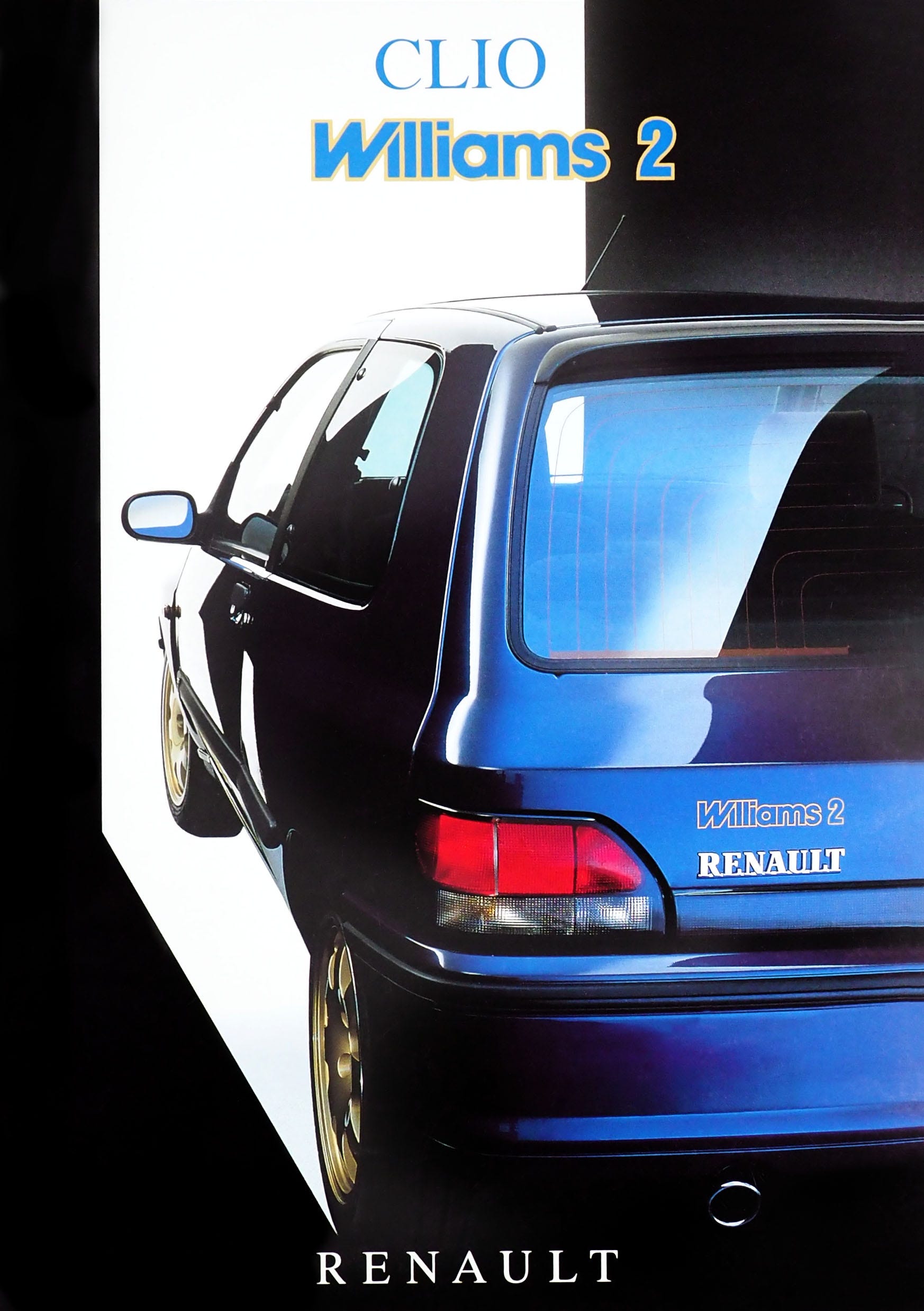
This was, of course, a calculated piece of theatre. But it was also, if you look closely, a completely accurate statement of intent. The Clio Williams 2 was not attempting to be anything other than what it was: a homologation special that had overstayed its welcome and, in doing so, had accidentally refined itself into something approaching elegance.
The backstory is well-rehearsed amongst those who care about such things. To compete in Group A rally with the Clio Williams, Renault needed to homologate 2,500 road-going examples. This was the Williams 1. They built the cars. They met the rules. And then the market, with its characteristically inconvenient appetite, demanded more. So Renault built the Williams 2, and then, perhaps inevitably, the Williams 3. The original racing necessity became a production line. The homologation special became a catalogue entry.
Purists have never quite forgiven the Williams 2 for this. It arrived with electric windows. Side impact bars. A small but measurable additional weight penalty. The argument goes that the homologation originals (the Williams 1, with their stripped-out directness) had been diluted by the concessions required to sell a performance car to people who also wanted to park it near a restaurant. This framing, while superficially coherent, rather misses the point. The Williams 2 was not a compromise. It was an evolution; and a philosophically interesting one at that.
150 Horses and a Brochure That Knew It
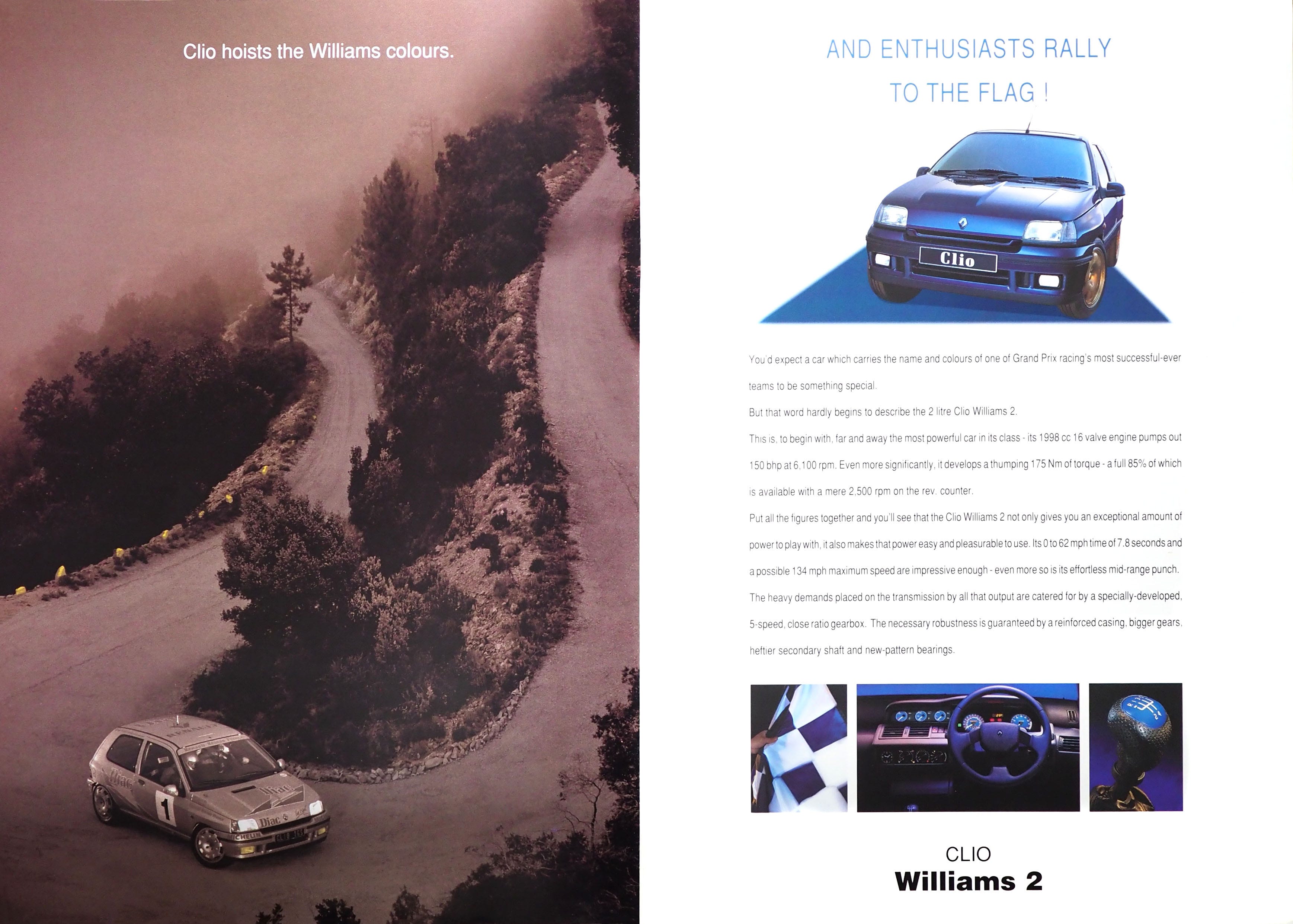
Pages 2 and 3 of the brochure make the hierarchy of values immediately clear. The left page is given entirely to a vast, misty rally photograph: a competition Clio, number plate obscured, working a tight hairpin on what appears to be a mountain stage, the car dramatically small against the scale of the landscape above it. The caption is terse and confident: “Clio hoists the Williams colours”. Opposite, the right-hand header announces: “AND ENTHUSIASTS RALLY TO THE FLAG!” The exclamation mark is doing significant work. This is not a car being sold to the cautious. It is a car being sold to the converted.
The copy that follows is equally blunt. The brochure describes the Williams 2 as “far and away the most powerful car in its class”, its 1998cc 16-valve engine pumping out 150bhp at 6,100rpm and developing 175Nm of torque, a full 85 per cent of which is available at a mere 2,500rpm on the rev counter. Put those two facts together and you understand immediately what the Williams 2 was engineered to feel like: not a car that needs to be worked hard to reward you, but one that loads the weapon at almost any speed in almost any gear and waits for instruction.
That figure of 150bhp deserves some contextual weight. This was 1994. Hot hatches were not yet the 200-plus horsepower turbocharged devices they would later become. The Peugeot 306 S16, the car most often cited as the Williams 2’s primary adversary, managed more power from a larger unit, but sat in a body that projected competent refinement rather than something forged on a stage road. The Ford Fiesta RS Turbo offered raw thrust, but the chassis beneath it was making no promises about what might happen when you asked it a direct question at high speed.
The Williams 2 occupied a different category entirely. Its F16.i.e. engine developed its power and torque in a car weighing 990kg. Sub-one tonne, in 1994, in a car with a two-litre engine. The kerb weight figure is worth dwelling on. This was not an accident but a primary engineering directive: Renault resisted the temptation to add bulk, keeping the shell lean enough for the chassis beneath it to do its job. The result was a 0–62mph time of 7.8 seconds and a maximum speed of 134mph. A drag coefficient of 0.33 suggests someone in Renault’s aerodynamics department was paying attention even on a car this small.
Neither performance number is remarkable in isolation. Together, in a car this size and this weight, they become something else entirely.
The Engine as Artefact
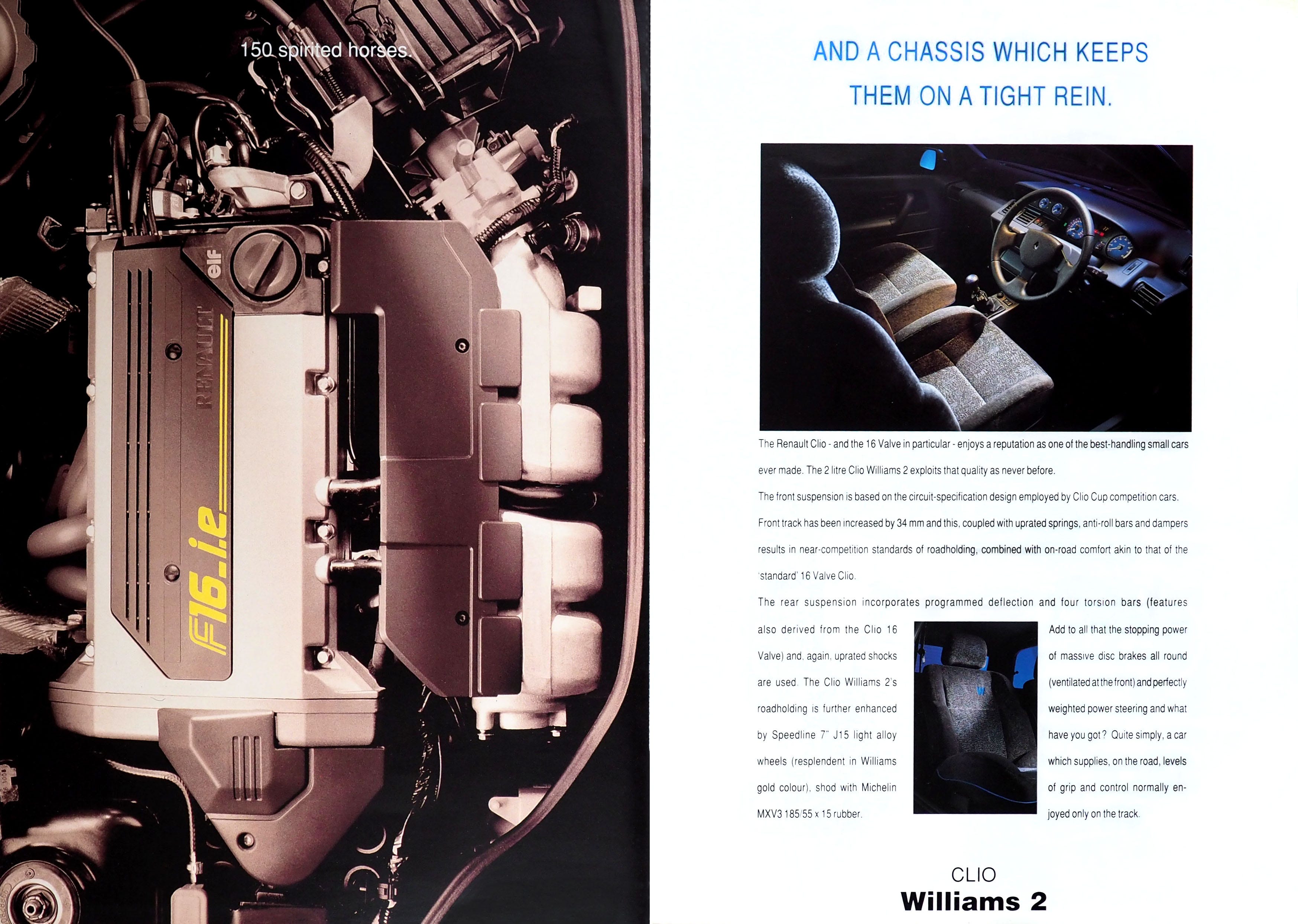
Pages 4 and 5 of the brochure are the most honest pages. Page 4 is consumed by a macro photograph of the F16.i.e. engine: the rocker cover with its yellow engine lettering, the intake manifold’s geometry, the supporting architecture of a unit that has been asked to do a specific job and has been engineered accordingly. The caption, set in white against the dark engineering mass, reads simply: “150 spirited horses.” The right-hand page header completes the sentence with admirable confidence: “AND A CHASSIS WHICH KEEPS THEM ON A TIGHT REIN.”
The chassis copy that follows is the most technically detailed in the brochure. The front suspension is explicitly described as based on the circuit-specification design employed by Clio Cup competition cars. The front track has been increased by 34mm, not a trivial change on a car this size, and one that fundamentally alters the turn-in geometry. Uprated springs, anti-roll bars, and dampers are mentioned alongside the rear suspension's programmed deflection and four torsion bars (themselves derived from the standard Clio 16 Valve's architecture, but recalibrated for purpose). To all of this, the brochure adds Speedline 7" J15 light alloy wheels shod with Michelin MXV3 185/55 x 15 rubber and disc brakes all round, ventilated at the front.
The interior photograph on the same spread confirms what the specification list implies and the dashboard plastic somewhat undercuts. Grey cloth sports seats, correctly bolstered. Blue-faced instruments. A sports steering wheel. The cabin is fundamentally a standard Clio’s, wearing its competition intentions as honestly as it can within the constraints of a production shell. The blue instrument faces are a period touch that reads, in 2026, as a relic of an era when car designers were permitted colour in unexpected places. It is not a sophisticated interior. It is a correct interior: a cockpit dressed for purpose rather than comfort, which is precisely what the car was.
The Palm Trees and the Paradox
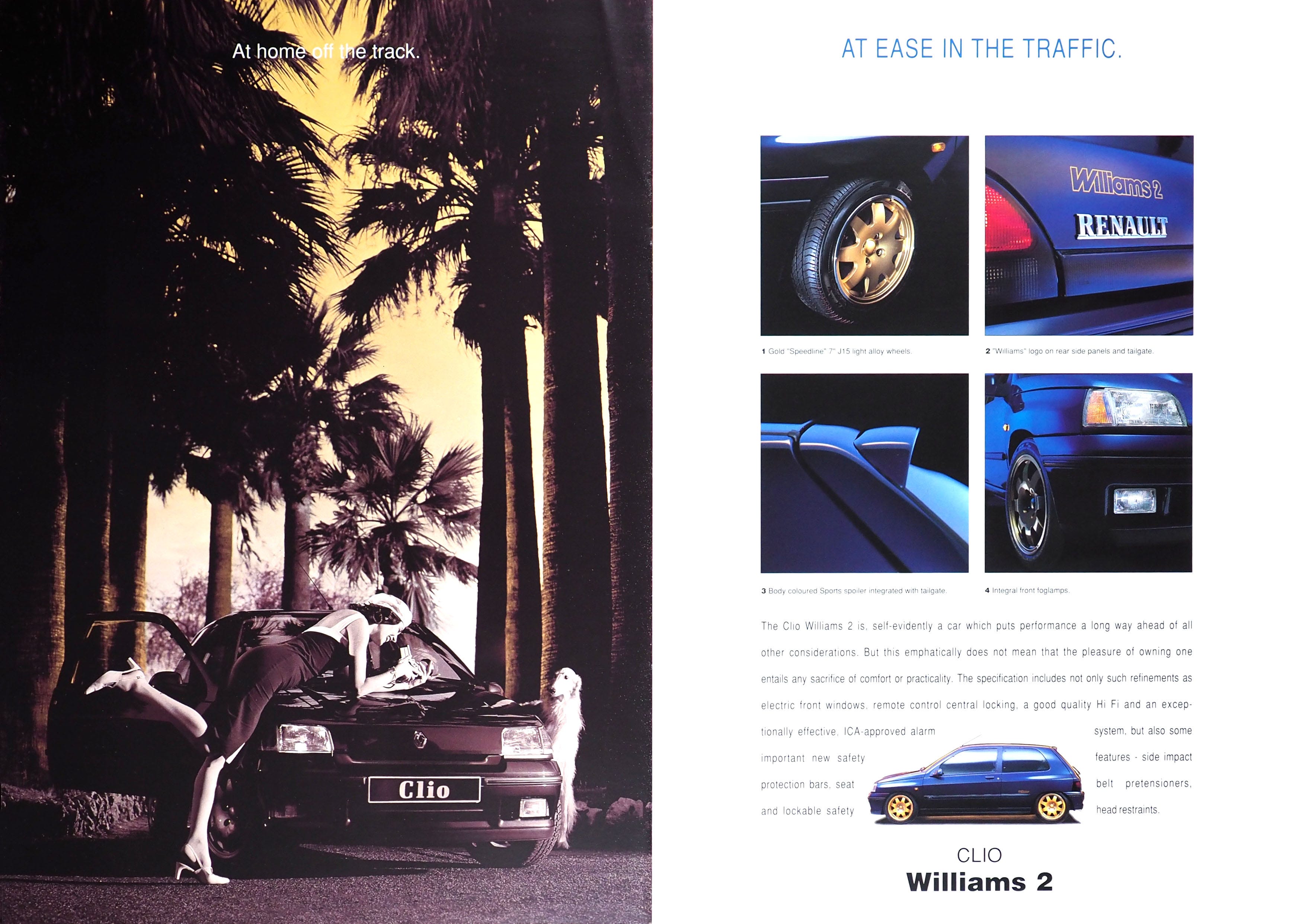
And then there is the lifestyle spread, which is the page that tells you everything about the peculiar cultural position the Williams 2 had been assigned, and about the specific marketing moment it inhabited.
The left page is sepia-toned and cinematic. Under a canopy of tall palm trees at what appears to be dusk or artificial light, a woman in a short dark dress leans across the bonnet of a Clio, a white dog looking at her. The caption reads: “At home off the track.” It is vaguely exotic, the palm trees and golden-sepia toning placing it somewhere between a perfume advertisement and a late-night television drama. The Clio in the same sepia tones as everything else in the frame: no blue, no gold, just the car as a shape within the atmosphere rather than an object on display.
The right-hand page snaps back to white, clean, and documentary. Four macro photographs detail the gold Speedline wheels, the Williams 2 badging on the tailgate, the body-coloured sports spoiler, the integral front foglamps. The header reads: “AT EASE IN THE TRAFFIC.” The copy explains, with the careful syntax of someone who has been briefed on the objections:
“The Clio Williams 2 is, self-evidently, a car which puts performance a long way ahead of all other considerations. But this emphatically does not mean that the pleasure of owning one entails any sacrifice of comfort or practicality.”
This was the core paradox the Williams 2 had to navigate, and the brochure navigates it with some dexterity. The specification includes electric front windows, remote central locking, a quality hi-fi, and an ICA-approved alarm system. The safety equipment (side impact protection bars, seat belt pre-tensioners, lockable head restraints) is itemised not apologetically but as evidence of thoroughness. The car that won rallies also has a passenger sun visor with vanity mirror. This is not inconsistency. It is the accidental aristocrat’s natural habitat: equally fluent in both languages.
What the brochure carefully avoids mentioning, of course, is that the dashboard of a 1994 Clio Williams 2 is, by any objective standard, its weakest argument. It is the kind of material that feels entirely consistent with a car that also came, in the base range, with a 1.2-litre engine and a price point aimed at first-time buyers. The “one year free RAC membership” in the servicing section, alongside the Renault Cordiale budget plan, is as close as the document gets to acknowledging that ownership of a French performance car in 1994 carried any practical dimension at all.
The Fine Print
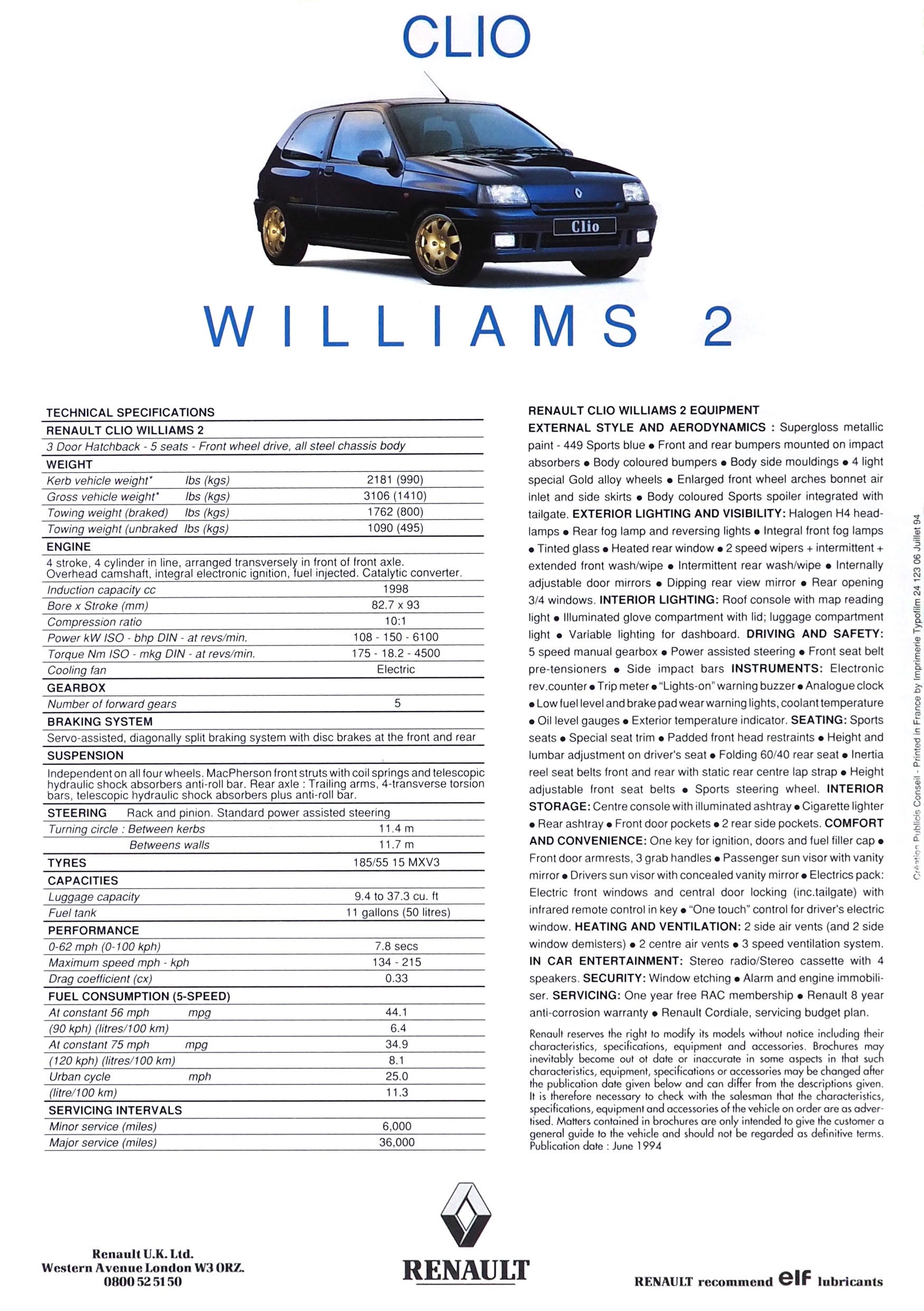
The back page of the brochure is the specification sheet: a full-page technical inventory that reads, with thirty years of distance, as a remarkably complete statement of purpose. Every number holds up. The kerb weight of 990 kg. The 5-speed close-ratio gearbox with its reinforced casing and uprated bearings. The fuel consumption figures (44.1mpg at a constant 56mph, 25.0mpg on the urban cycle) confirm this was a car capable of being lived with, not merely driven occasionally on clear roads. It is a document that knows what it is arguing, and does not blink.
The Sculpture in the Void
Return, finally, to that brochure cover. The rear-quarter view. The 449 Sports Blue paint resolving out of pure black on one side and a hard white on the other: a deliberate bi-chromatic split that frames the car as a sculptural object rather than a vehicle in an environment. The Williams 2 badging on the tailgate. The gold wheel just visible at the lower frame edge. It is, in retrospect, the most accurate image Renault ever produced of what this car was. Not a rally car. Not a shopping trolley. Not a compromise between the two. A singular, sculptural object that happened to have five seats, a boot, and one year’s free RAC membership.
The Rearview Mirror
The Williams 2 is a car that rewards patience and penalises ignorance. Buy the wrong one and you will spend the following years acquainting yourself with the specific financial pain of sourcing 449 Sports Blue touch-up paint, chasing rear-arch corrosion through layers of a previous owner’s filler, and explaining to specialists why the Speedline Turinis you found are the wrong offset. Buy the right one and you will own something that remains, by any measure that actually counts, one of the most complete driver’s cars of the 1990s.
What Holds Up
The chassis is the point. Thirty years on, the Williams 2’s competition-derived suspension geometry still communicates with a directness and honesty that most contemporary hot hatches, insulated by electronic management and variable damping, have forgotten how to offer. The steering is weighted and specific. The front end goes where you point it. The 175Nm of torque, arriving at 2,500rpm in a car that weighs less than a tonne, still constitutes a genuinely involving performance equation. It is not fast by modern standards. It is engaging by any standard.
What Doesn’t
The interior plastics remain a period document of French manufacturing economy, and no amount of patina converts them into something they are not. The gearshift, while mechanically sound on a good example, lacks the precision of its German contemporaries.
The Phase War
The Williams 1 was necessity: the original homologation car, built to meet a regulatory requirement, commanding a premium built on rarity and principle. The Williams 2 was a choice, and that choice is precisely what the purists cannot forgive. Produced in greater numbers, heavier by the small but symbolically significant margin of the electric windows and side impact bars, it occupies the uncomfortable position of the middle child: more capable than the purists admit, less collectable than the originals. It is, in this respect, rather like a second pressing of a celebrated limited-edition record. Technically the same music. Subtly different in the handling.
If you are buying a Williams for investment rather than enjoyment, the Williams 1 is the more defensible choice. The Williams 2 is the better car to drive. These two facts are not in conflict; they simply belong to different conversations.
The Ownership Reality
Find a genuine, unmodified example with a credible service history. Inspect the rear arches with a torch and a degree of pessimism. Verify the Speedline wheels are correct and structurally sound. Check the cambelt service history with particular care. Budget for a thorough recommissioning if the car has been standing. A Williams 2 that has been properly maintained is a fundamentally reliable machine. One that has been neglected is a project.
The Golden Ratio
The Clio Williams 2 was built as an afterthought, sold as a luxury, and has aged as a benchmark.
Its most significant contribution is not the car itself but the formula it proved: two litres, sub-one tonne, competition-sourced chassis. This combination, the Golden Ratio of what would become the Renaultsport programme, was inherited, refined, and ultimately perfected by the Clio 172, the 182, and eventually the 200. Each successive model owed a debt, acknowledged or otherwise, to the Williams’ demonstration that the standard Clio’s bones were capable of carrying a genuinely serious performance application without structural compromise.
The brochure, with its rally photography and its palm trees and its gold wheels against 449 Sports Blue, understood this before the rest of us did. It was not selling a car. It was establishing a mythology, and the mythology was entirely justified. Not a boy racer’s tool. A hot hatch aristocrat.
Bravo. I had a period Clio, a warm 16v version. It handled beautifully and was surprisingly comfortable for such a small car. I could never have afforded a Williams at the time, but they were special. A cut above at the time. Brilliantly written. Thanks for the drive down memory lane.