Blue-Sky Thinking: Subaru’s Crystal Palace
When Subaru dreamed big

The 1994 Subaru SVX European brochure is an intriguing document: twenty-four pages of carefully assembled argument explaining why a company that built honest, muddy, utilitarian four-wheel-drive wagons should be trusted to define the grand tourer for the coming century. It has a glass canopy borrowed from a fighter jet, a six-cylinder Boxer that nobody asked for, and a designer, Giorgetto Giugiaro, whose name carries more weight than the badge above the grille.
The brief, by all accounts, was to build nothing less than the climax of car design. The brochure believed it. On page six, in calm italic script above a rear three-quarter view of a crimson coupe floating against that distinctive nebula of watercolour blue, the copy states without embarrassment: “SUBARU SVX — the car history has waited for. The climax of a century of car design.” Not a century of Subaru design. A century of cars. Full stop.
This is what we are dealing with.
Aeronautical Brutalism and the Blue Nebula
The brochure justifies the SVX’s most alienating design choices by recasting them as engineering inevitabilities, borrowed wholesale from the language of aviation and aerospace. The car does not have a peculiar split window; it has a glass-to-glass round canopy, a term carried directly from cockpit design. The bodywork does not merely look smooth; it achieves a drag coefficient of 0.29 through flush surfaces, three-dimensional curved glass, and integrated front fender mirrors, aeronautical form-language that treats the car as a fuselage, not a consumer product.
This is backed by the brochure’s colour world. The photography is consistently staged against a liquid, painterly blue, a nebula wash that is part frozen ocean, part stratosphere at altitude. The cars appear to float within it. The crimson Mica body on pages four to seven and the black silhouette on page two read not as automotive paint finishes but as objects in a depressurised environment, suspended and examined. It is a remarkably consistent visual strategy for 1994, when competitors were typically shot against European mountain roads or photographic grey.
The typography is clean and purposeful: a sans-serif for headers that speaks quietly of engineering competence; a serifed italic for the longer body passages and the manifesto declarations. The serifs do the social work. They signal luxury, time, consideration. They are the brochure’s equivalent of a wood-grain dashboard in a car that might otherwise read as purely technical.
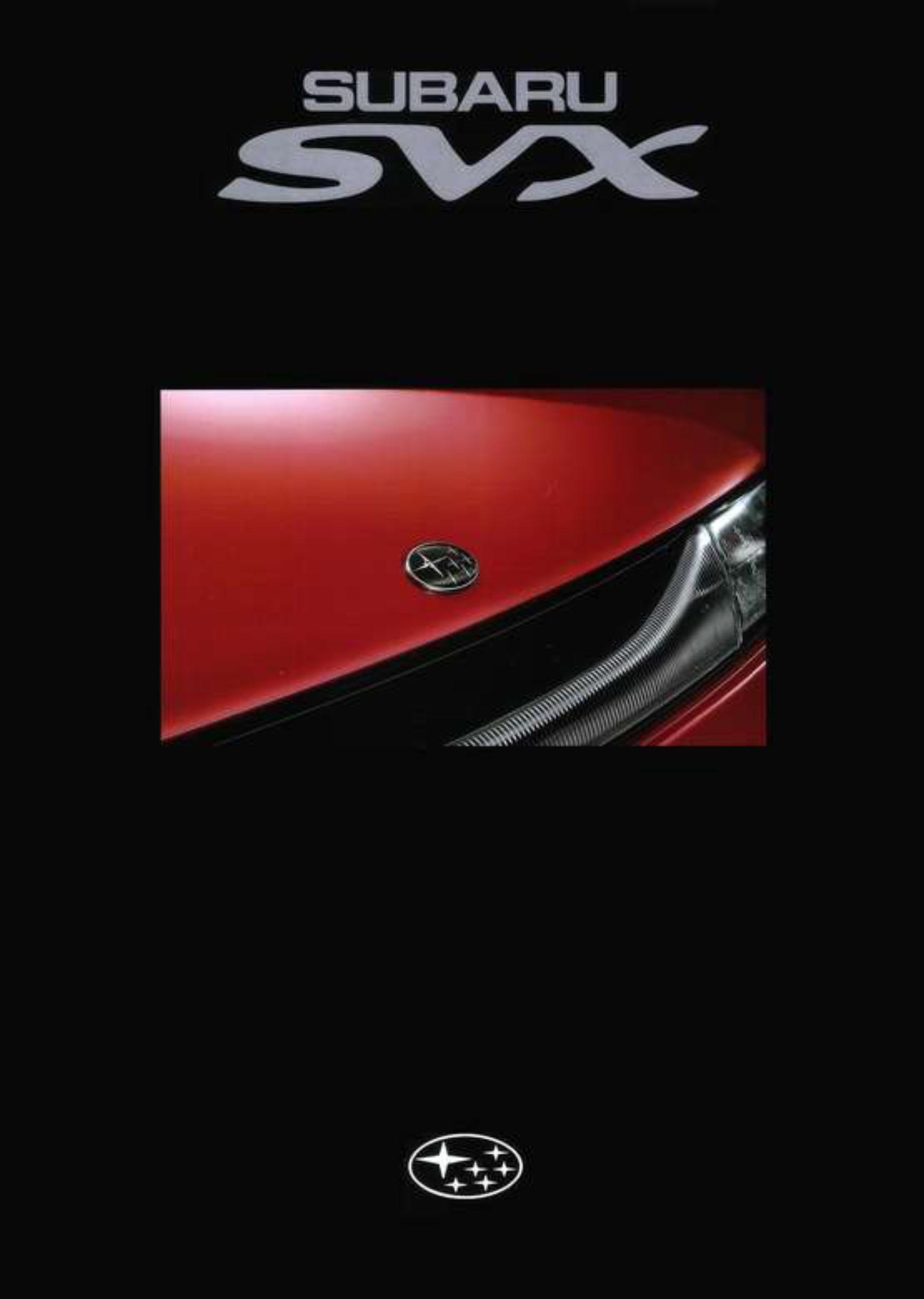
The front and back covers are pure black. The front cover offers nothing but the SVX logotype in silver, and beneath it, a tightly framed close-up of a crimson bonnet corner, the Subaru badge, and the stacked louvre of a headlamp housing. It is a confident opening. No context, no landscape, no lifestyle. Only form.
The Manifesto
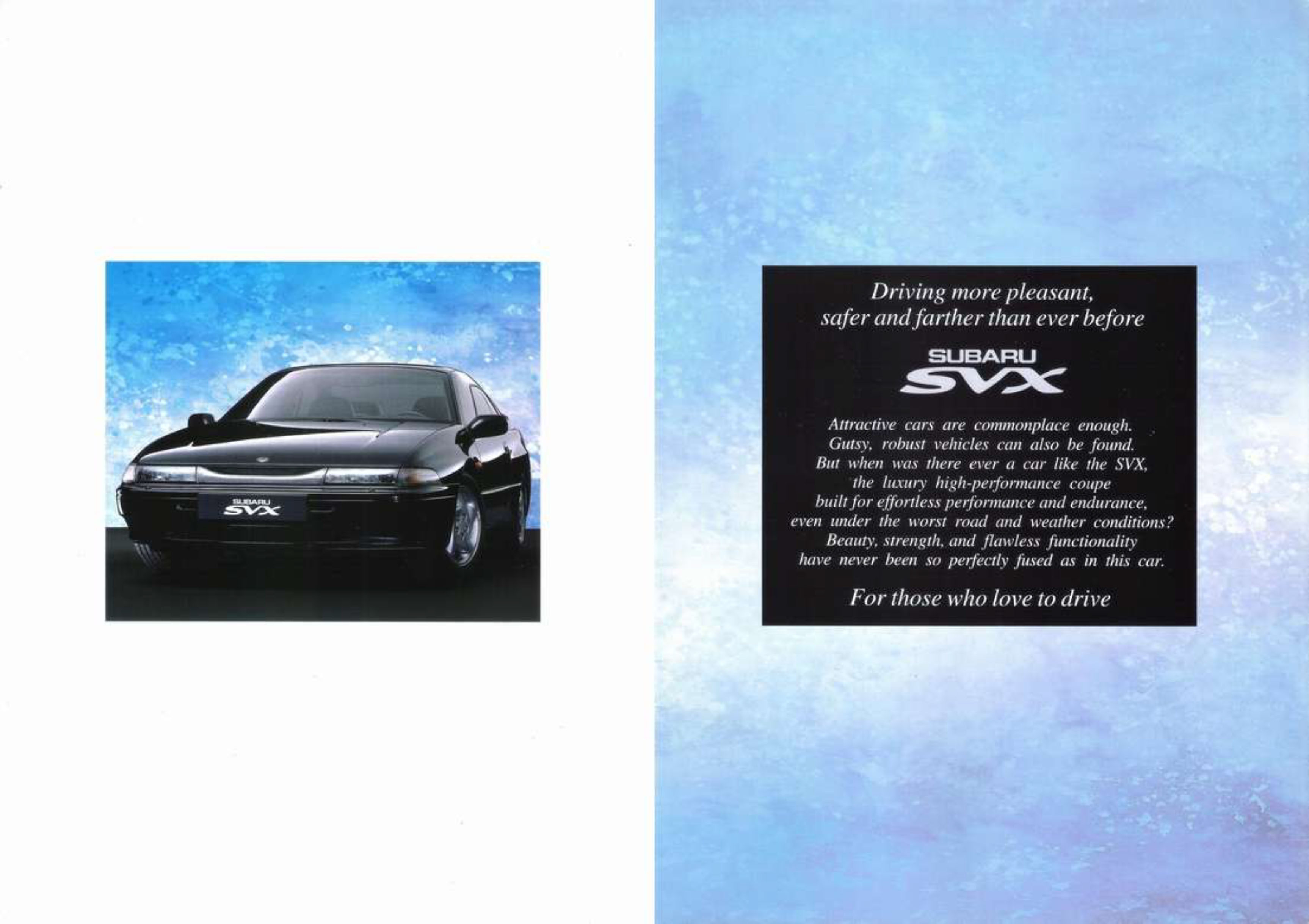
The first interior spread makes its argument before you have properly found your bearings. A black SVX faces the lens against the characteristic blue-white bokeh. To its right, on a black card panel, the founding text of the entire document:
“Attractive cars are commonplace enough. Gutsy, robust vehicles can also be found. But when was there ever a car like the SVX, the luxury high-performance coupe built for effortless performance and endurance, even under the worst road and weather conditions? Beauty, strength, and flawless functionality have never been so perfectly fused as in this car.”
Subaru is not claiming to be the fastest, or the most powerful, or the most technologically complex, though those claims arrive later. It is claiming to have fused qualities that no other car has fused. Beauty and utility. Power and all-weather competence. The luxury coupe as off-road-capable grand tourer. The paradox stated cleanly, as though it were not a paradox at all.
The tagline below is “For those who love to drive”. It is almost offensively understated for a car that was also, implicitly, for those who love aeronautics.
The Dream Sequence
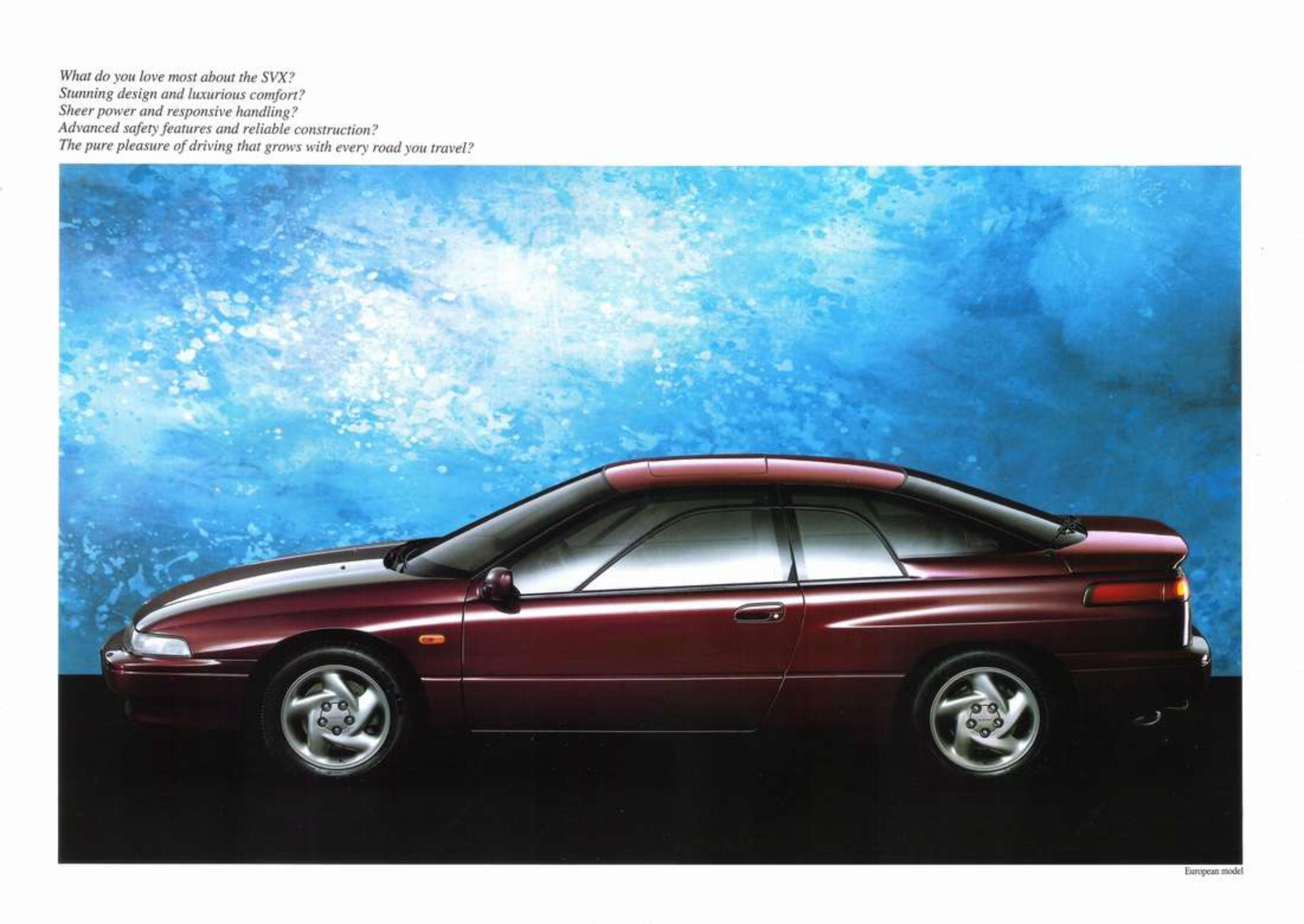
The next two spreads function as pure aspiration. Pages four and five are devoted to a full-width side profile of the crimson European-specification car against the blue ground, with five rhetorical questions floated above it in italic:
“What do you love most about the SVX? Stunning design and luxurious comfort? Sheer power and responsive handling? Advanced safety features and reliable construction? The pure pleasure of driving that grows with every road you travel?”
It is a device borrowed from the luxury goods catalogue, the enumerated virtues, each dangled as a question so that no single answer excludes any buyer. Yet there is something oddly sincere in its construction. Subaru knows it cannot be all things; it is asking you to identify which particular impossible thing you believe this car has managed.
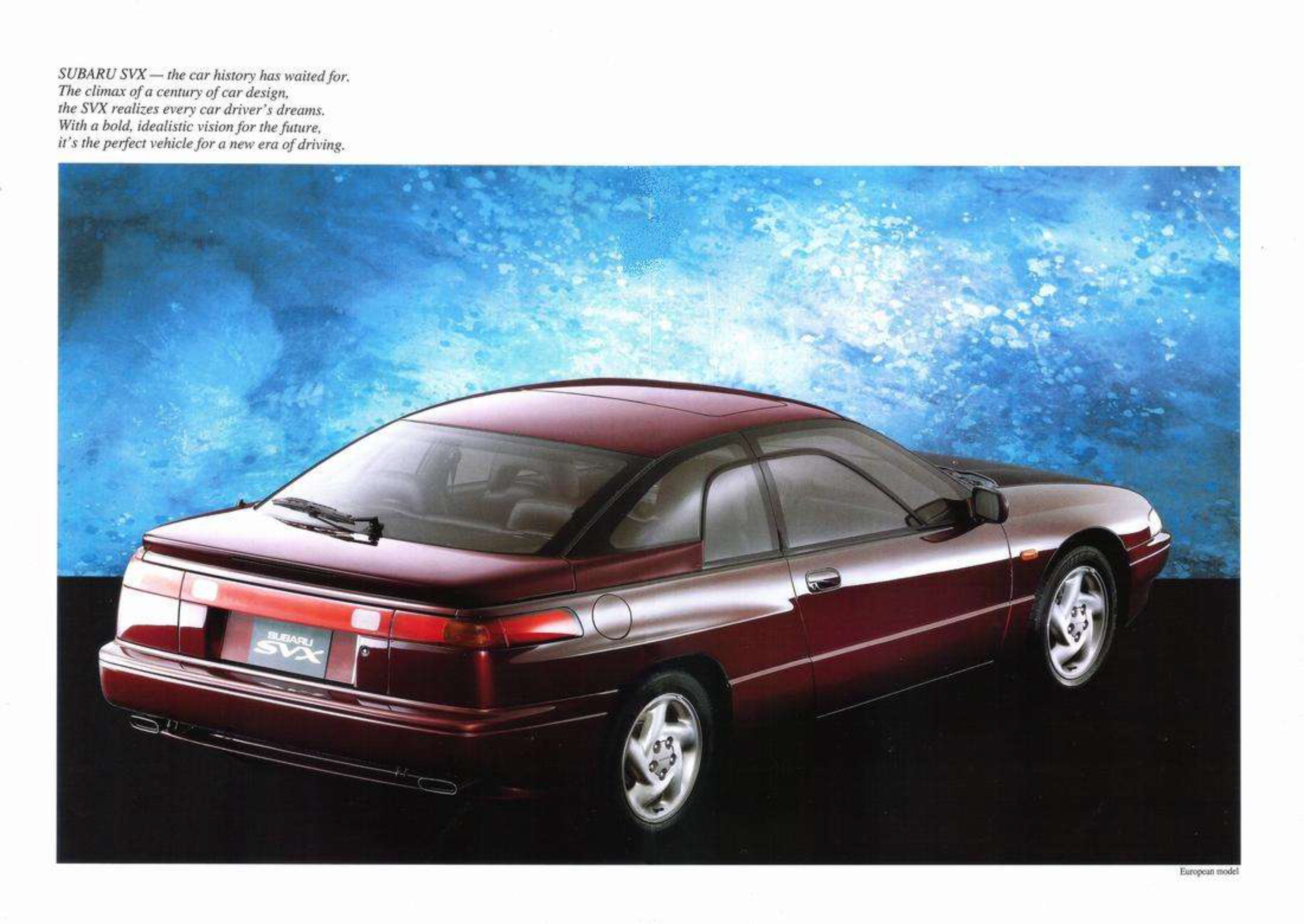
Pages six and seven offer the rear three-quarter view and the century-of-design declaration. Together, these four pages constitute the dream sequence: pure imagery, pure assertion, minimal evidence. The evidence is being saved.
The Cockpit
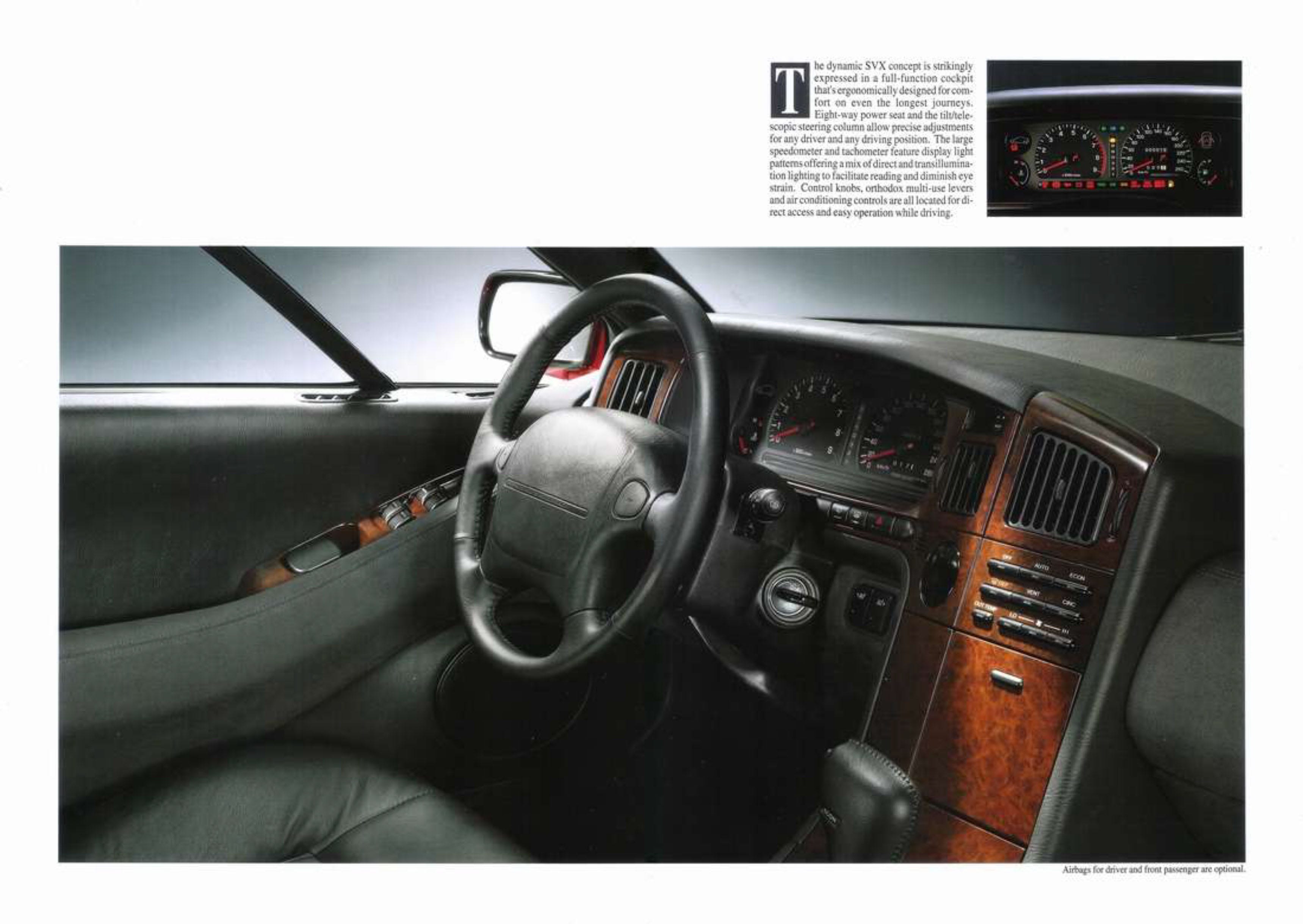
The interior spreads are where the Grand Tourer mission crystallises. Pages eight and nine lead with a full-width dashboard photograph, wood-grain trim panels flanking a well-organised instrument cluster, an automatic transmission selector sitting in a leather console. The copy describes a “full-function cockpit” that is “ergonomically designed for comfort on even the longest journeys”.
Two things are notable here. First, the wood trim. In 1994, on a car with a Subaru badge, burr veneer is a significant commitment. It says: we are not building a sports car. We are building a grand tourer, and grand tourers arrive at their destinations without the occupants having aged a decade en route. Second, the instrument lighting: the brochure notes that the large speedometer and tachometer dials use “a mix of direct and trans-illumination lighting to facilitate reading and diminish eye strain”. Diminishing eye strain. On a car that reaches 230km/h. The ergonomic ambition is that of a business-class seat, not a track-day weapon.
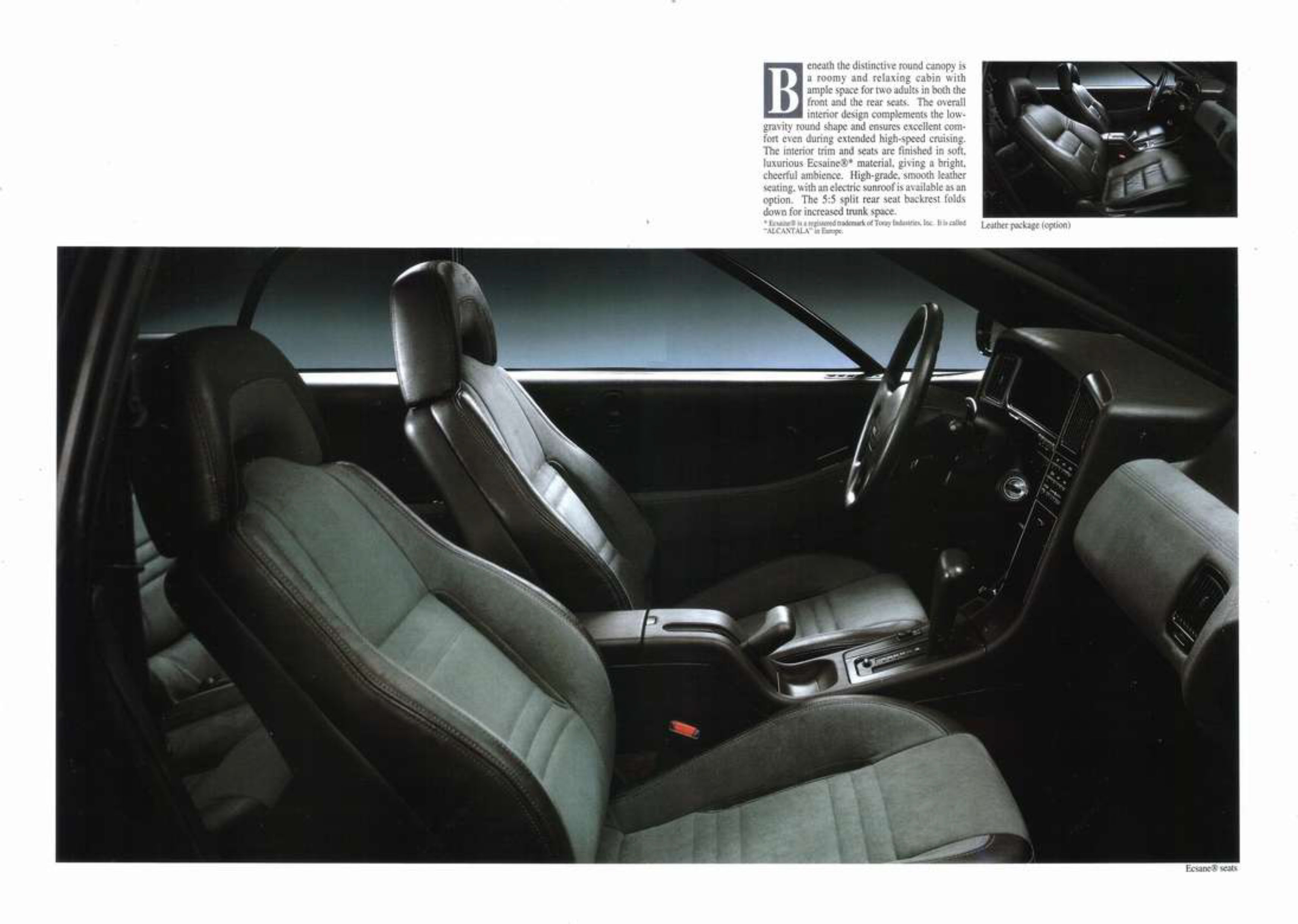
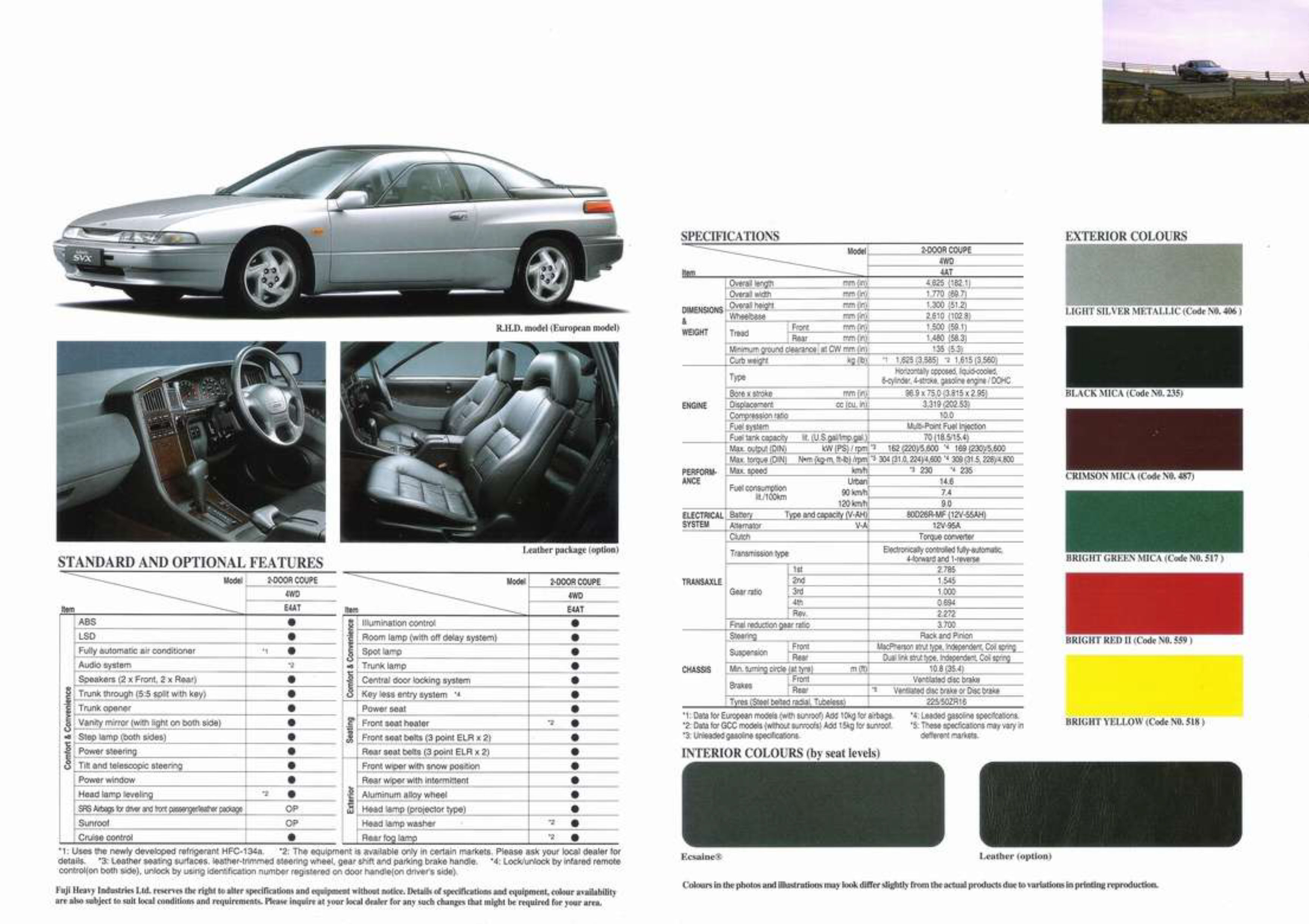
Pages ten and eleven move to the cabin in plan view, a dramatically low camera angle that emphasises the sweeping window line and the unusual proportions of the interior beneath the round canopy. The seats are Ecsaine, a registered Toray Industries material (sold in Europe under the name Alcantara), described as offering “a bright, cheerful ambience”. Optional leather is also listed, with the European market photograph showing the Leather package specification, its seats bolstered more formally, its atmosphere cooler.
The 50:50 split rear backrest and fold-through capability are noted. An SVX is not a car you buy to carry things, but Subaru wanted you to know that you could.
The Structural Core
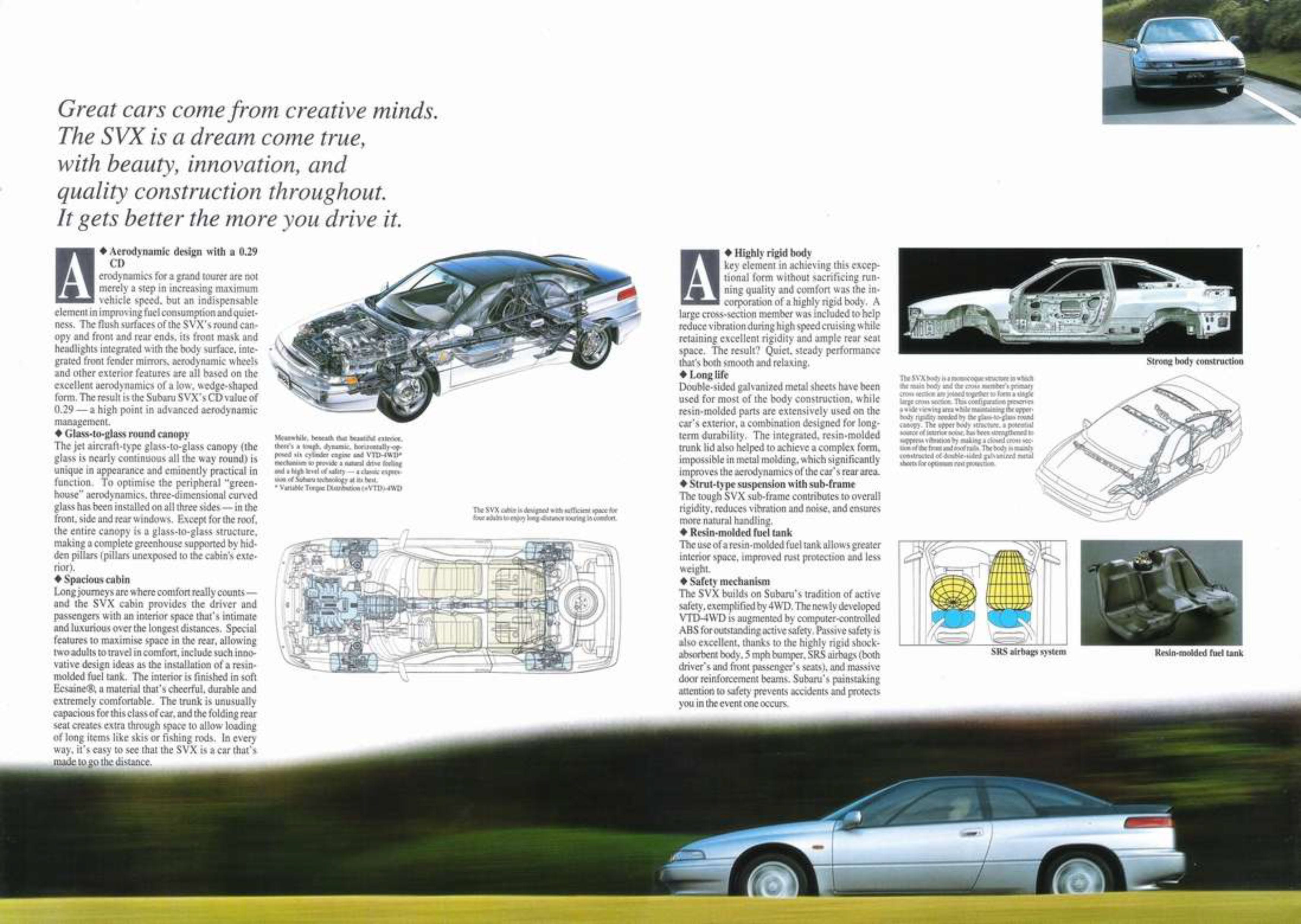
On page fourteen, the dream is over, and the brochure starts to make its case. This is the densest spread in the document: a cutaway illustration of the SVX’s full mechanical architecture, a top-down chassis plan, numerous smaller detail photographs, and six distinct engineering sub-sections. It is the brochure at maximum technical velocity.
The aerodynamics section leads: “Aerodynamics for a grand tourer are not merely a step in increasing maximum vehicle speed, but an indispensable element in improving fuel consumption and quietness.” The 0.29 Cd figure is introduced, positioned not as performance data but as a dividend of “excellent aerodynamics of a low, wedge-shaped form”.
Then comes the canopy claim. The brochure deploys it with the self-assurance of an engineering presentation to a sceptical boardroom:
“Except for the roof, the entire canopy is a glass-to-glass structure... making a complete greenhouse supported by hidden pillars (pillars unexposed to the cabin’s exterior).”
This is the SVX’s most genuinely extraordinary feature, treated here as though it were merely logical. The window-within-a-window, that peculiar fixed upper band and retractable lower glass, is a structural solution to an aesthetic problem. The round canopy demanded uninterrupted glazing; uninterrupted glazing demanded hidden pillars; hidden pillars meant only the lower portion of the side glass could open. It is, as engineering compromises go, one of the more spectacular. The brochure does not call it a compromise. It calls it “unique in appearance and eminently practical in function”.
Additional structural claims are dense and confident: a resin-moulded fuel tank offering improved rust protection; double-sided galvanised steel for long-term durability; a monocoque body in which the main body and cross members form a single large cross-section for high-speed vibration control. The 5mph bumper standard is noted. Subaru is building its case on engineering legitimacy.
The H-6 Heart
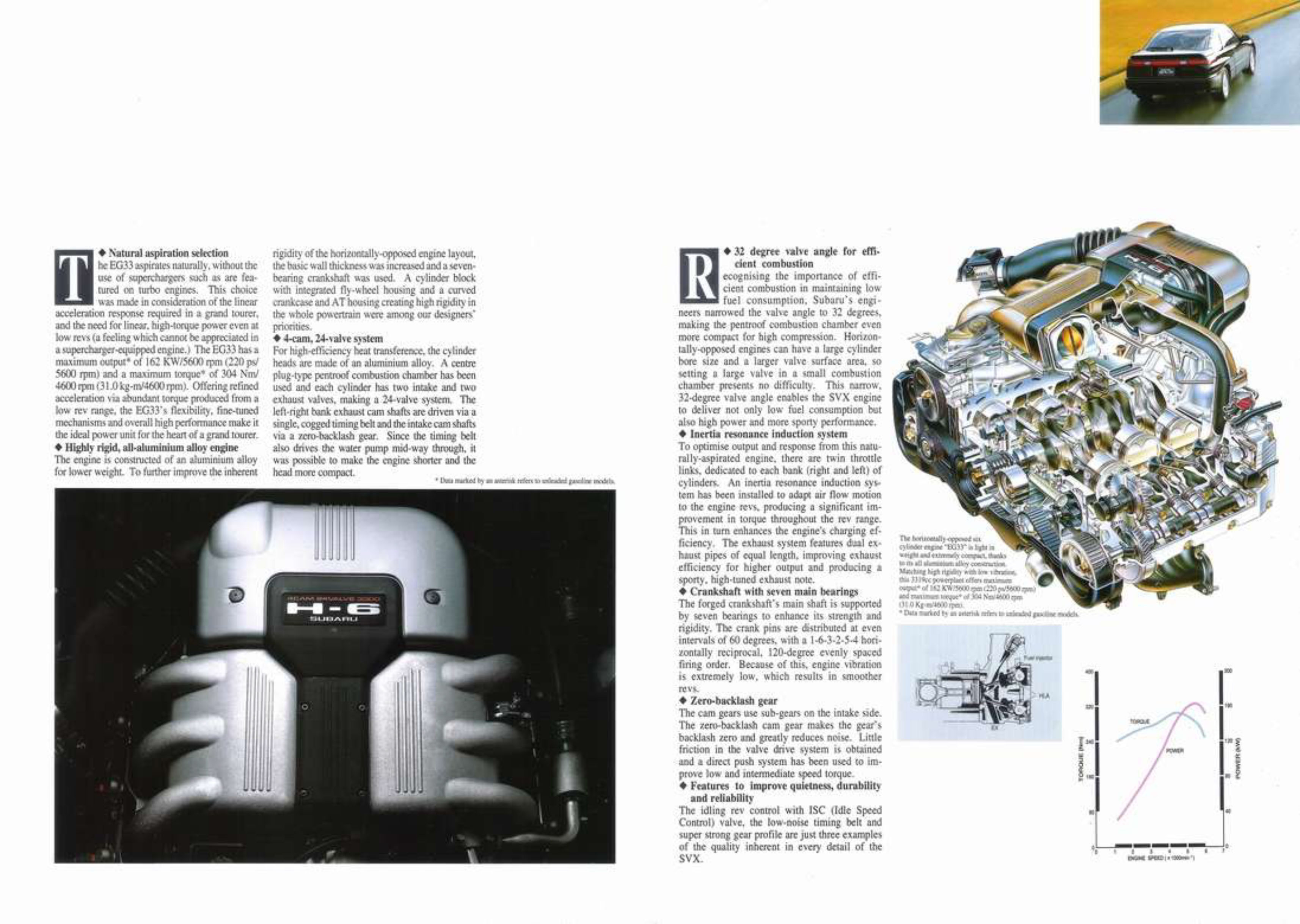
Pages sixteen and seventeen are the engine pages. The EG33, Subaru’s horizontally-opposed six-cylinder, 3,319cc, all-aluminium, 4-cam 24-valve, is presented in a large studio photograph from above: its twin intake plenum chambers, its cam covers, its compact footprint. To the right, a power and torque curve diagram, plotted with the gentle, smooth arcs of an engine optimised for breadth rather than peaks.
The first sub-section is titled “Natural aspiration selection”. Subaru knew this needed explaining. In 1994, the Toyota Supra had twin turbos. The Nissan 300ZX had twin turbos. The Mitsubishi 3000GT VR4 had twin turbos. Not having a turbocharger on a flagship performance coupe required a philosophical position, and the brochure provides one:
“The EG33 aspirates naturally, without the use of superchargers such as are featured on turbo engines. This choice was made in consideration of the linear acceleration response required in a grand tourer, and the need for linear, high-torque power even at low revs.”
It is a precise argument. Grand tourers do not surge; they deliver. The turbocharger, in this framing, is not omitted but rejected, on the grounds that a pressurised power delivery is antithetical to the character of the car. The engineering details that follow support this: seven main bearings for low vibration and smooth running; an inertia resonance induction system with twin throttle links per bank for torque improvement across the rev range; a 32-degree valve angle for combustion efficiency. Each feature is listed as evidence for the same proposition: that refinement and flexibility are more valuable, in a grand tourer, than headline power figures.
The maximum output is 162kW (220PS) at 5,600rpm. Maximum torque is 304Nm at 4,600rpm: smooth, broad, accessible. The brochure, sensibly, does not linger on the numbers.
The VTD Logic
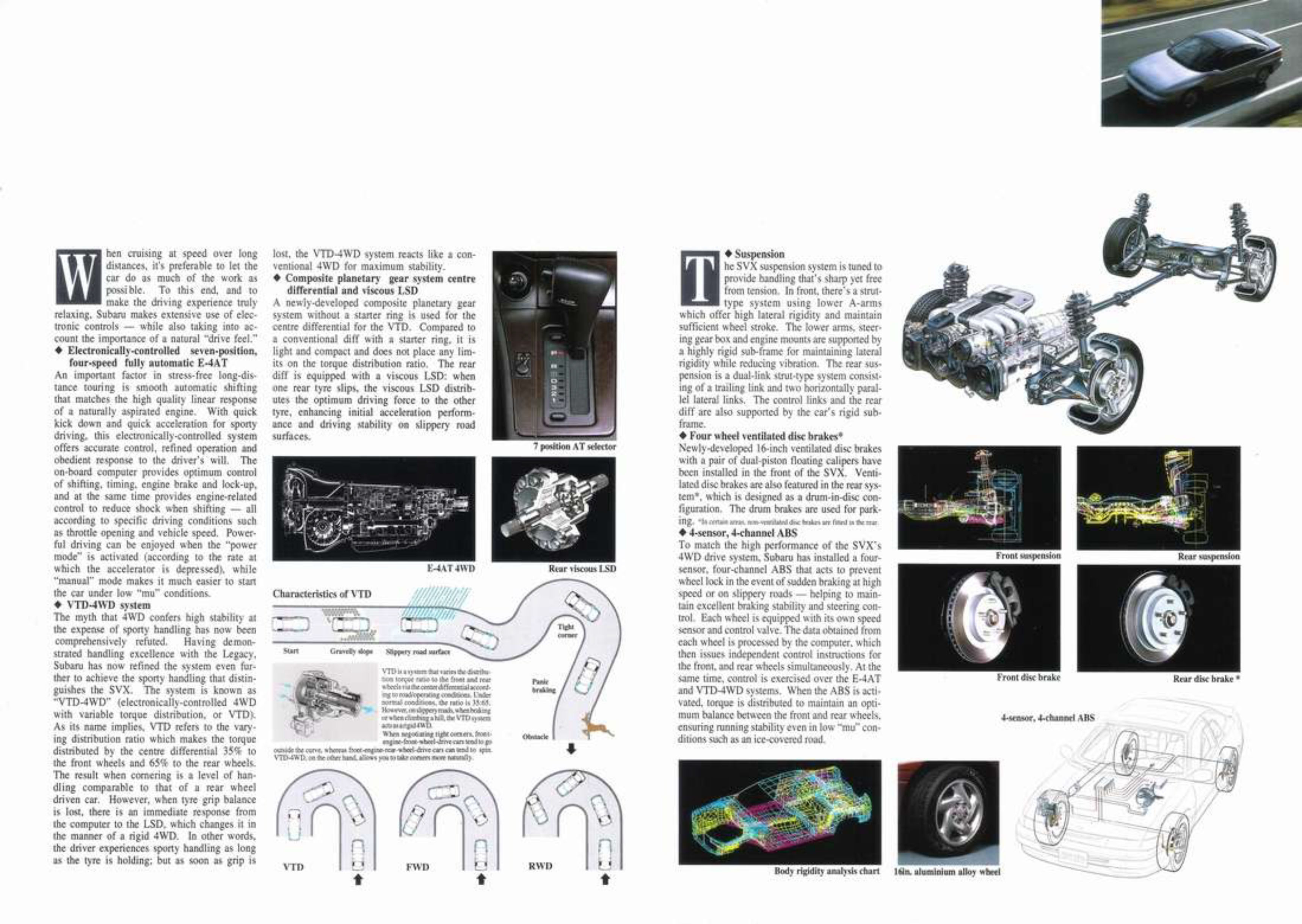
Pages eighteen and nineteen deal with the transmission and drivetrain, and contain the following extraordinary sentence:
“The myth that 4WD confers high stability at the expense of sporty handling has now been comprehensively refuted.”
Myth. Not misconception. Not outdated assumption. Myth, with its implication of folklore, of stories told by people who don’t know better. The VTD-4WD system (Variable Torque Distribution) is presented as the tool that kills it. The system varies its torque split between front and rear axles via a composite planetary gear centre differential and viscous LSD, nominally apportioned 35:65 front-to-rear in normal driving, rear-biased, in other words, with AWD correction available on demand.
A diagram illustrates the contrast between VTD, FWD, and RWD behaviour in cornering scenarios. The SVX sits closest to RWD in the diagram’s visual language. The message is precise: this is not a four-wheel-drive estate car with a coupé body. This is a rear-biased driver’s car that happens to also be all-weather competent.
The transmission delivering this is the four-speed E-4AT electronically-controlled automatic, described with genuine enthusiasm as offering “smooth automatic shifting that matches the high quality linear response of a naturally aspirated engine”. The brochure does not mention that a manual option does not exist, has never existed, and will never be offered. This is the brochure’s single most significant silence.
The Rearview Mirror: On Flying Too Close to the Sun
The Problem: The Badge the Market Couldn’t Follow
Subaru’s difficulty was not the car. The car was, by the measure of its brief, largely excellent. The brochure had told no significant lies, made no claims the engineering couldn’t support. The aerodynamics were real. The canopy was genuinely remarkable. The EG33 was as smooth and refined as advertised. The VTD system delivered a driving character closer to a rear-wheel-drive car than any rival AWD coupe.
The problem was the badge on the bonnet, and what that badge meant to the British buyer specifically. In the UK, Subaru’s reputation was built on one thing: four-wheel drive that worked. Farmers bought them. Vets bought them. People who needed to get somewhere in January bought them. The brand’s credibility was entirely practical, rooted in ground clearance and traction and the kind of durability that didn’t mind being hosed down. A buyer with £30,000 to spend on a luxury coupe in 1994 was not walking past a BMW 840Ci to look at an SVX. The SVX’s own brochure had tried to recast that 4WD competence as a grand tourer virtue, all-weather effortlessness, stability without compromise, but the translation didn’t hold. British buyers trusted Subaru precisely because it had never tried to be glamorous.
The deeper irony is that while the SVX was making its careful, twenty-four-page argument for elevation, the Impreza WRX was simultaneously making a completely different and far noisier case for the same badge. By 1994 Colin McRae was already competitive in the WRC. The jump from muddy farm track to muddy Welsh forest stage was a short one; it was the same 4WD DNA, expressed at full volume. The jump to a Giugiaro grand tourer with a glass canopy and wood-grain trim was a different leap entirely, across a much wider gap. The market answered the WRX within the year. The SVX never got its answer.
The Tax: What 2026 Ownership Actually Means
The SVX’s survival rate is an act of attrition. The 4-speed E-4AT transmission is the primary concern: a heavy car, AWD system, and four-speed gearing in stop-start conditions creates sustained thermal load that the units were not, in retrospect, entirely prepared for. In 2026, the transmission specialists who understand the E-4AT are few; the units that survive in sound condition fewer still.
The glass-to-glass canopy, the centrepiece of the entire engineering proposition, is now a source of ownership anxiety that the brochure could not have anticipated. The fixed upper glass section is no longer available as new-old-stock in most markets. A stone chip in the wrong place is not an inconvenience; it is a restoration project. The window-within-a-window mechanism, likewise, requires specialist attention that the dealer network of 2026 is not equipped to provide.
Wheel bearings suffer under the combined demands of AWD stress and 1,615kg of mass. The EG33 itself is, generally, robust; it is the drivetrain surrounding it that bears the weight of the years. Parts are available, but not easily, and not cheaply.
The Success: What Lived On
The SVX was a commercial failure measured in sales numbers and a success measured in engineering legacy. The EG33 proved that Subaru could build a world-class six-cylinder Boxer: smooth, quiet, refined. That proof of concept migrated directly into the H6 engines that appeared in the Outback and Tribeca, engines that powered hundreds of thousands of cars across two decades and established Subaru as a credible manufacturer of something beyond the EJ-series four-cylinder workhorse.
Giugiaro’s design has aged, by any reasonable assessment, extraordinarily well. The SVX looks today as it looked in 1994: completely unlike anything else. This is partly the canopy, partly the wedge proportions, partly the integrated headlamps and the subtle rear spoiler. It was too strange for its market in 1994. In 2026, it reads as unapologetic futurism of precisely the kind that enthusiasts now seek out. Surviving examples are not merely collectors’ pieces; they are conversation objects, cars that make people stop and ask questions that have interesting answers.
The brochure made one claim that, above all others, has been quietly vindicated by the years. It called the SVX “the car history has waited for”. History was not ready in 1994. But history, patient, revisionist, and rather more interested in beautiful failure than competent success, has come around.
The Fine Print