The Dresden Manifesto: Volkswagen's $1bn Ego Trip
Archiving the Brochure That Sold Nothing


The 2006 UK edition brochure is not merely a sales tool; it is a record of a company betting everything on an idea that the entire industry told it was stupid.
The idea was stated plainly: Volkswagen would make a luxury car designed to set new standards. Not a luxury-adjacent car, but a statement of craftsmanship and innovation. It would out-engineer the establishment by pouring pathological attention into every component (from torsional rigidity of 37,000Nm/degree to a chassis utilising sixteen different metals) until the badge, eventually, wouldn’t matter.
Dresden-Chic and the Art of the Silence
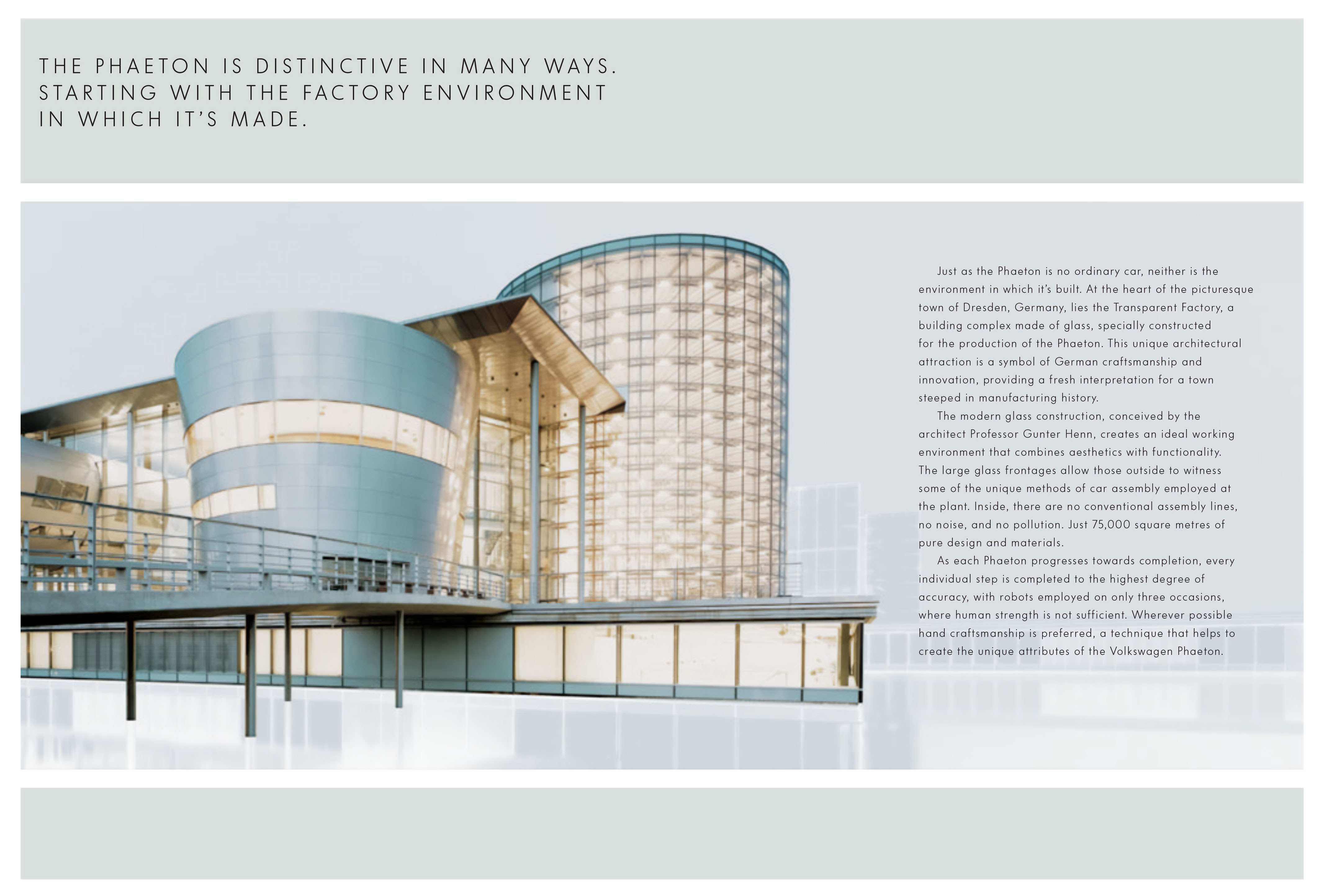
The first image in the brochure is not a car; it is a building. Page two is devoted entirely to the Gläserne Manufaktur: the Transparent Factory in Dresden. The photograph is stunning in its restraint. Light floods through glass in a space that is almost aggressively devoid of visual clutter. No conventional assembly lines, no noise, and no pollution.
“Inside, there are no conventional assembly lines, no noise, and no pollution. Just 75,000 square metres of pure design and materials.”
— Phaeton Brochure, Page 2
Volkswagen stripped every industrial word from this passage and replaced it with the vocabulary of a gallery. The architect, Professor Gunter Henn, is named; you do not name the architect of a factory unless you are naming the architect of a manifesto. From this single page, the personality of the Phaeton is established: minimalist, shadowy, and unhurried.
The brochure’s typography (a light, generous sans-serif) barely whispers above the white space. It is a tactical necessity; the document has to behave like a Rolls-Royce artefact because the car is carrying a badge that, at the time, was more closely associated with a Polo.
The Interior as Evidence
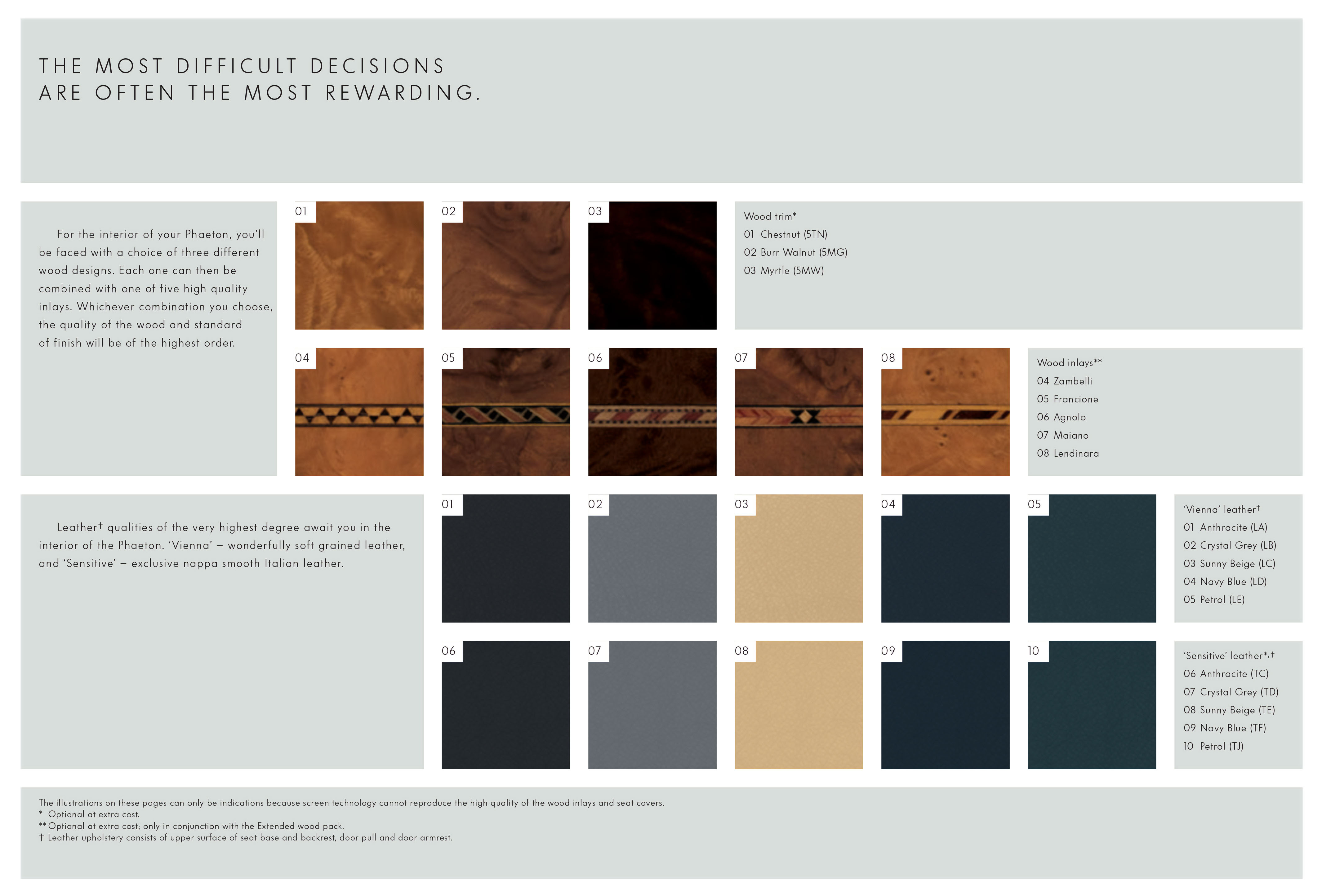
Move inward, and the brochure moves with you. Pages 6 and 18 are devoted to the interior, where the layout is extraordinary. Wood trim samples are presented in selection grids (Chestnut, Burr Walnut, and Myrtle), each photographed with the precision of a botanical illustration.
“Everywhere you look, you can see, feel and breathe craftsmanship notice the way the wood decor runs along the entire width of the instrument panel...”
— Phaeton Brochure, Page 6
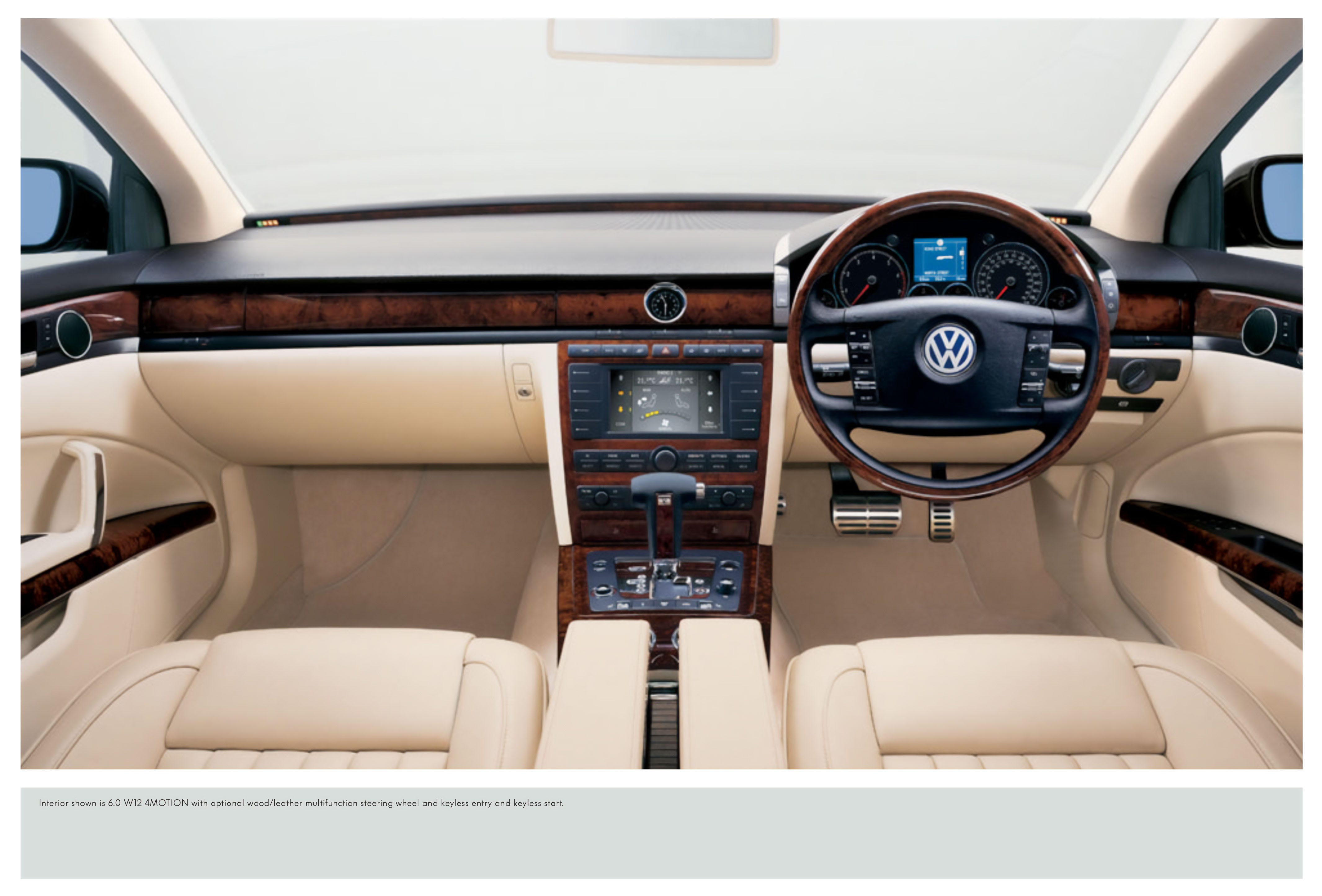
You do not breathe a dashboard, but the brochure insists you do; and the way it insists matters. This is Dresden-chic at its most refined: the brochure doesn’t tell you the interior is beautiful; it arranges the evidence and lets you reach that conclusion yourself.
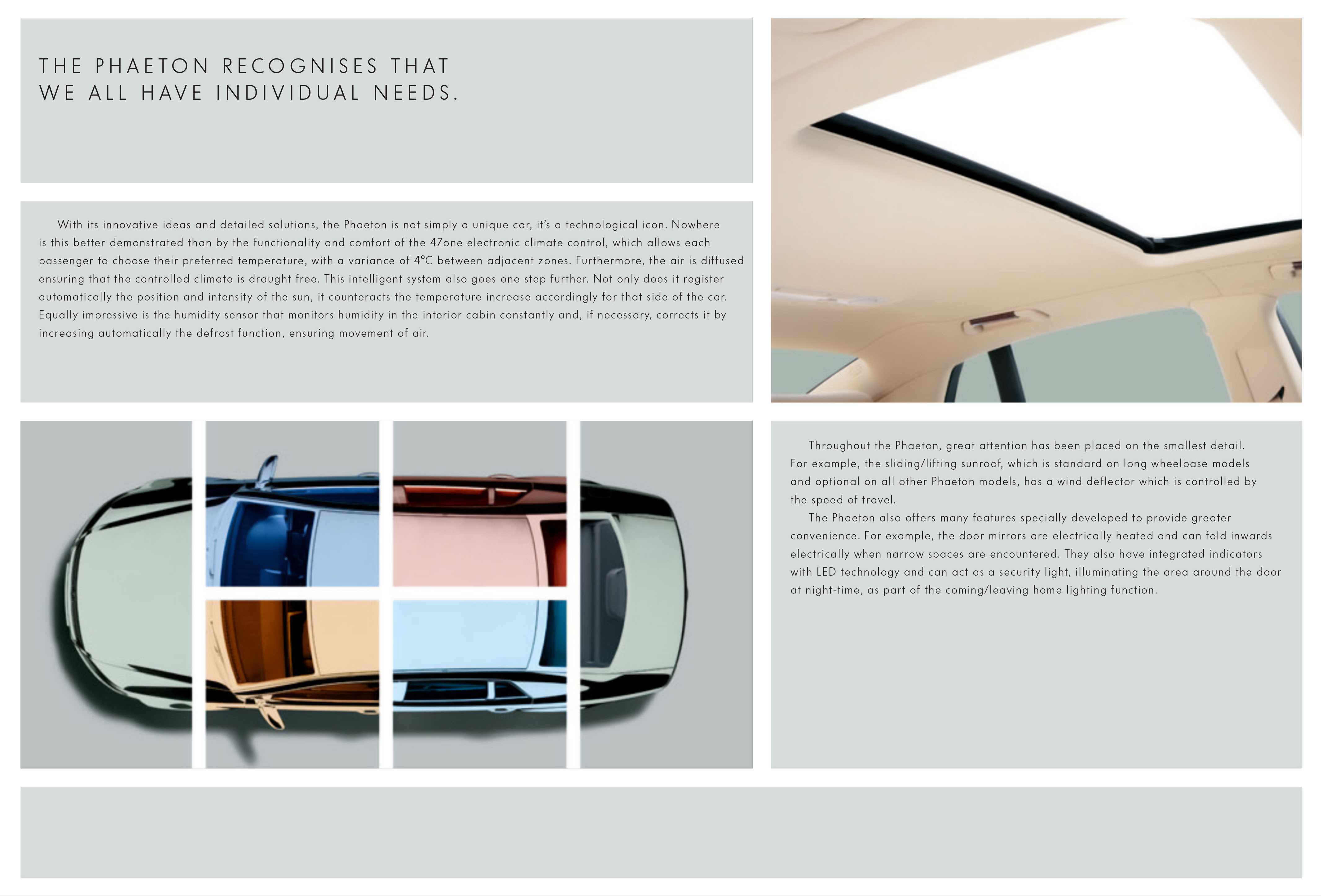
The comfort systems arrive mid-brochure, and here the braid between car and document tightens. Page 13 introduces the 4Zone electronic climate control with a masterpiece of technical minimalism: a top-down grid of the cabin partitioned into thermal zones.
“Furthermore, the air is diffused ensuring that the controlled climate is draught free.”
— Phaeton Brochure, Page 13
Draught-free in a car. In 2006. The thermal-mapping diagram makes this claim feel like an engineering guarantee rather than marketing copy. Even the sliding sunroof has a wind deflector controlled by the speed of travel to ensure the hush remains undisturbed.
The Art of Engineering
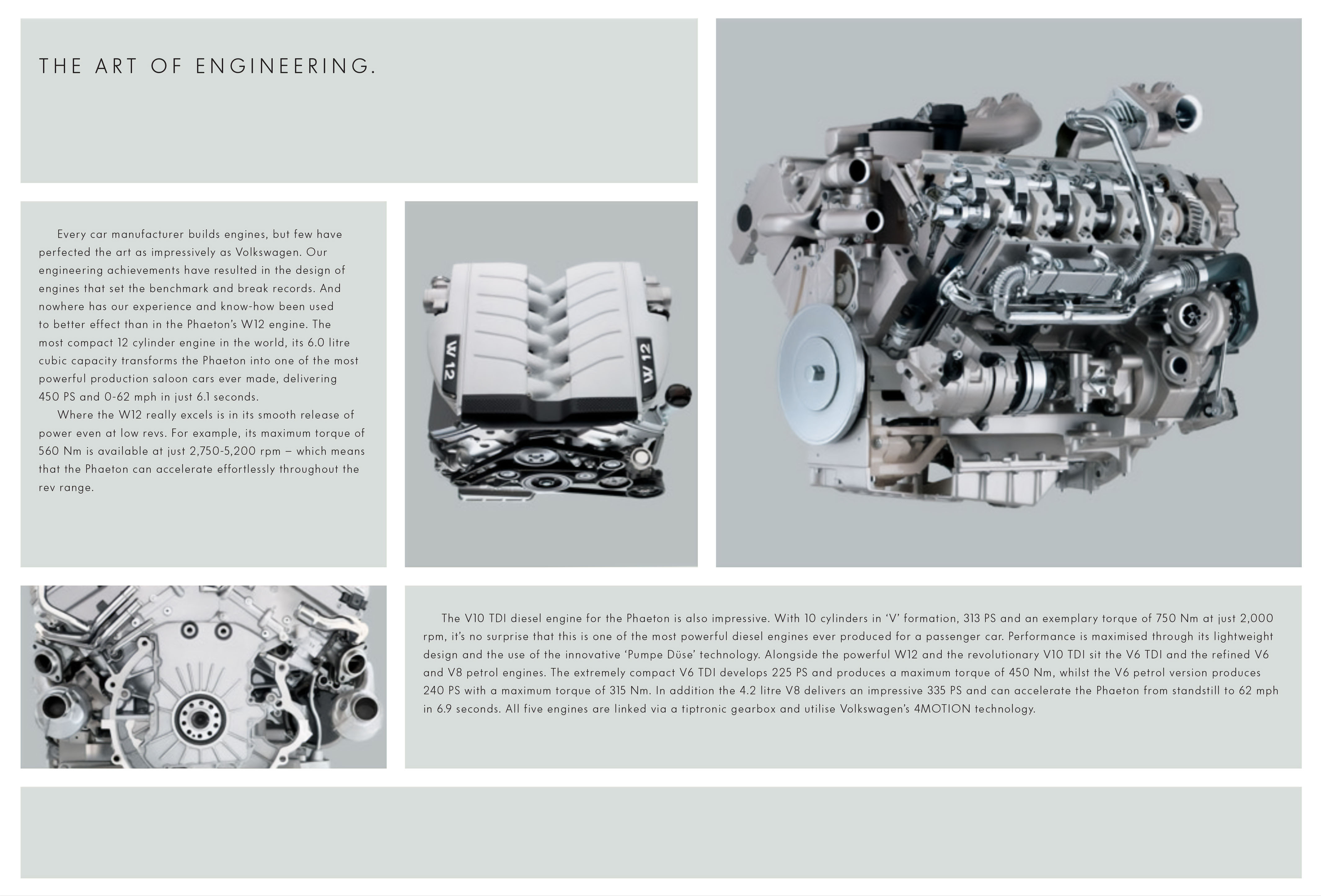
And then, page 24: The W12. A detailed technical cutaway of the engine block fills the page, rendered with the care of an anatomical study. The brochure treats the W12 like high-end horology, isolating it to highlight its compact “W” configuration: the most compact 12-cylinder engine in the world at the time.
Two V6 engines, each with a 15-degree bank angle, combined at 72 degrees on a common crankshaft. Six litres. 444bhp. The brochure does not flinch at the complexity; it celebrates it as the “benchmark”.
“Where the W12 really excels is in its smooth release of power even at low revs.”
— Phaeton Brochure, Page 24
Smooth release. Not surge, not explosion. The language mirrors the illustration: precise and unhurried. The W12 does not need a cheerleader; it needs a translator.
The Rearview Mirror: A Monument to Hubris
The Badge Problem: The One Thing Engineering Cannot Fix
The Phaeton’s failure was not mechanical; it was psychological. The brochure told the truth: the glass factory was real, the craftsmanship was real, and the W12 was genuinely one of the finest engines of the decade. But a luxury buyer’s first question isn’t “Is it well-made?” but “Why?”. You cannot buy your way out of a brand’s history (the Polo, the Golf, the Transporter) with a single model, no matter how magnificent. The brochure’s total absence of desperation makes this, in retrospect, almost tragic. It sold in numbers that would embarrass a coachbuilder; buyers didn’t want invisible perfection, they wanted a badge that announced they’d arrived.
The Complexity Tax: When Modules Cost More Than the Car
The brochure celebrated “millions of computer functions per second” as an unambiguous virtue. In 2026, it reads as an obituary written in advance. The density of comfort modules and air suspension systems has aged into a liability so severe that a single failure can exceed the car’s market value. The W12’s packaging (so tight that routine service often requires total engine removal) is the ultimate grit reality. Dresden built a masterpiece; the modern workshop is still paying for it.
The Secret Success: The Ghost Inside the Bentley
Here is the thing the sales figures cannot tell you: the Phaeton was not a failure. It was a $1bn proof-of-concept. The W12 engine (celebrated on page 24 with its 15-degree bank angles) did not die with the Phaeton. It found its true home in the Bentley Continental GT, where it found a badge the market would pay for. The platform architecture and the chassis engineering filtered upward into cars that wore the right bonnet ornament. The Phaeton was the laboratory where the modern Bentley was born. Somewhere, in every W12 Bentley rolling down a country lane, a brochure no one bought is still being vindicated.
The Fine Print