
The Final Trip to the Red Line: Honda's FN2 Civic Type R
Or: How Honda tried to sell the triangle as a performance advantage

There was a moment in December 2007 when Honda looked at the burgeoning world of turbocharged hot hatches and decided to politely ignore it. While rivals were bolting on bigger blowers and bragging about mid-range torque, Honda delivered a 52-page manifesto that asked the UK market to believe in the tensile strength of triangles and the spiritual purity of an 8,400rpm red line.
This was the FN2 Civic Type R. It wasn’t just a car; it was a belief system wrapped in a design language that referenced fighter jets, Formula 1, and Soichiro Honda’s personal philosophy. The strategy was audacious: convince buyers that waiting until 5,600rpm for peak torque wasn’t a compromise, it was a privilege. The market would ultimately disagree. We could argue that the market was wrong.
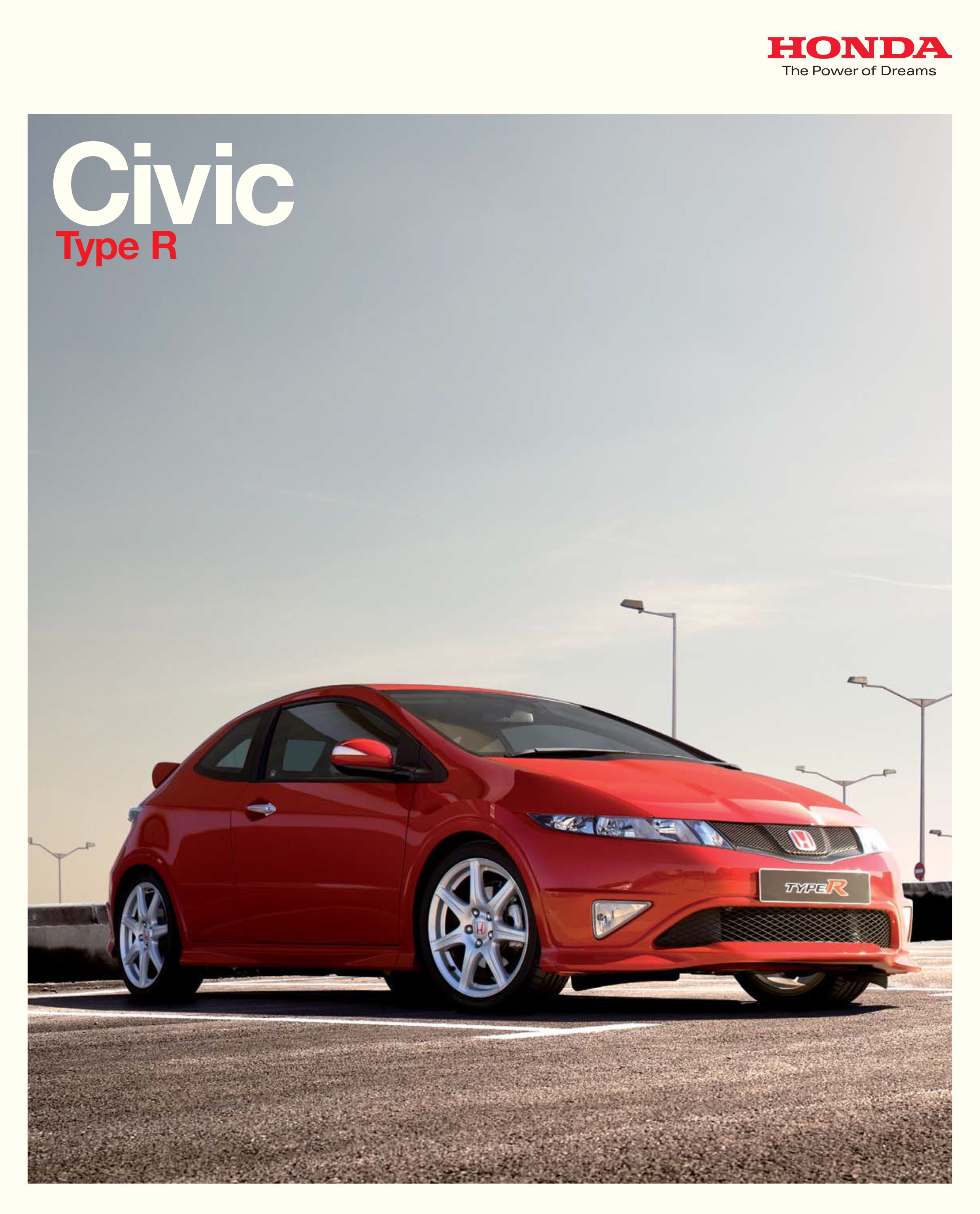
The Visual Language: Shadows, Red, and Mechanical Certainty
The brochure’s photography operates in a state of high-contrast tension. There are no sun-drenched coastal roads here; instead, Honda commits to a clinical, forensic aesthetic. Milano Red bodywork is pitted against heavy shadows that dramatise mechanical textures: honeycomb grilles, aluminium shift knobs, and red start buttons rendered as precision instruments rather than car parts.
“Without racing, there is no Honda.”
— Soichiro Honda, quoted on the opening spread.
The typography is unapologetically bold; this isn’t refined minimalism. The colour palette is ruthlessly edited: white, red, grey, black. Nothing else. Page headers sit in red bars. Section dividers are abrupt, geometric.
This isn’t the aspirational lifestyle imagery of other marques. This is engineering pornography for people who care about valve lift profiles, presented with the visual confidence of a brand that believes its own mythology.
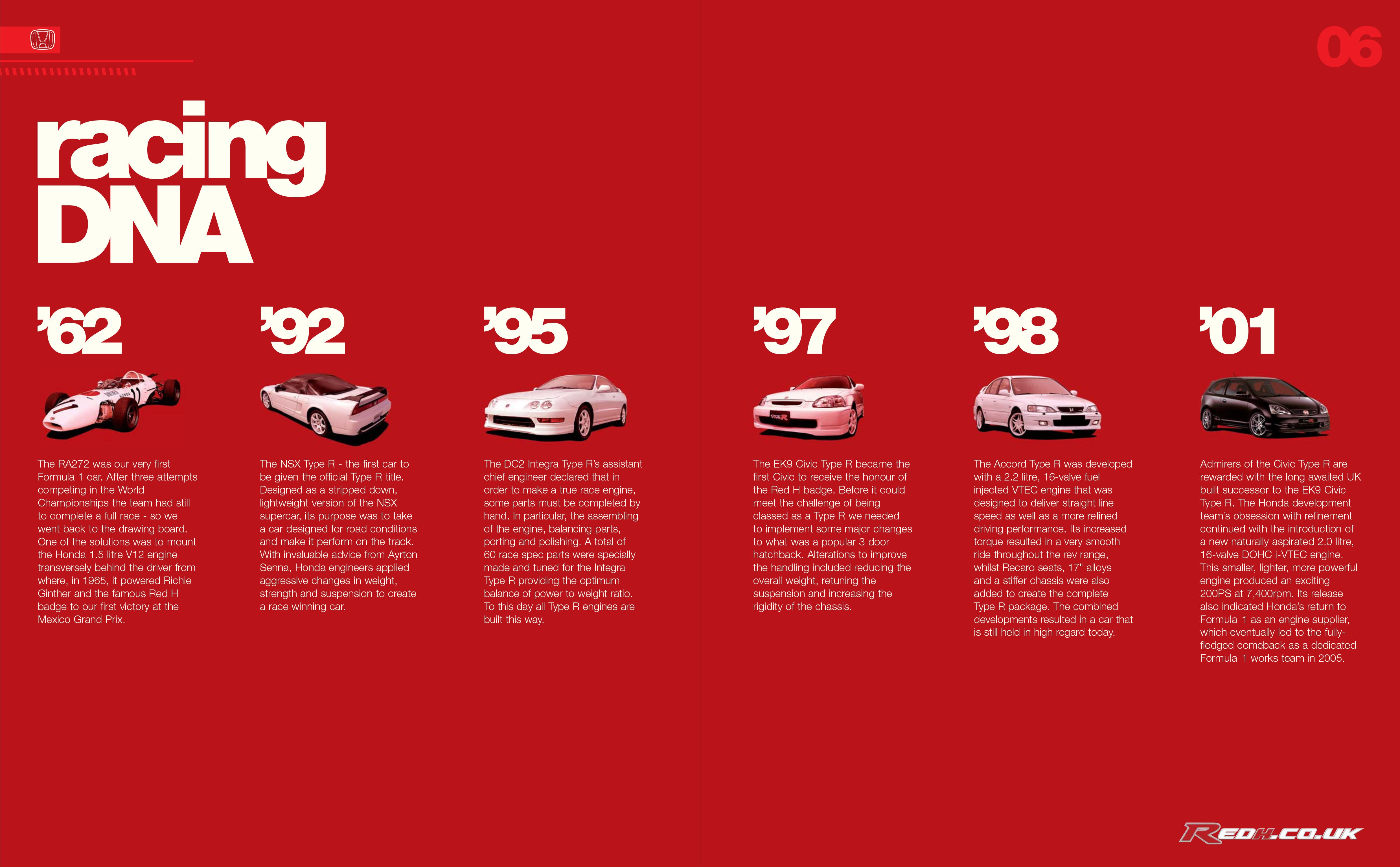
The brochure opens the argument with a timeline of performance Hondas against a bold red background. The headline reads simply “racing DNA,” and the copy invokes Ayrton Senna: “With invaluable advice from Ayrton Senna, Honda engineers applied aggressive changes... to create a race winning car.” This is the foundational move, tethering the FN2 to F1 legends and hand-built predecessors. You’re not looking at a hot hatch derivative. You’re looking at racing technology adapted for public roads.
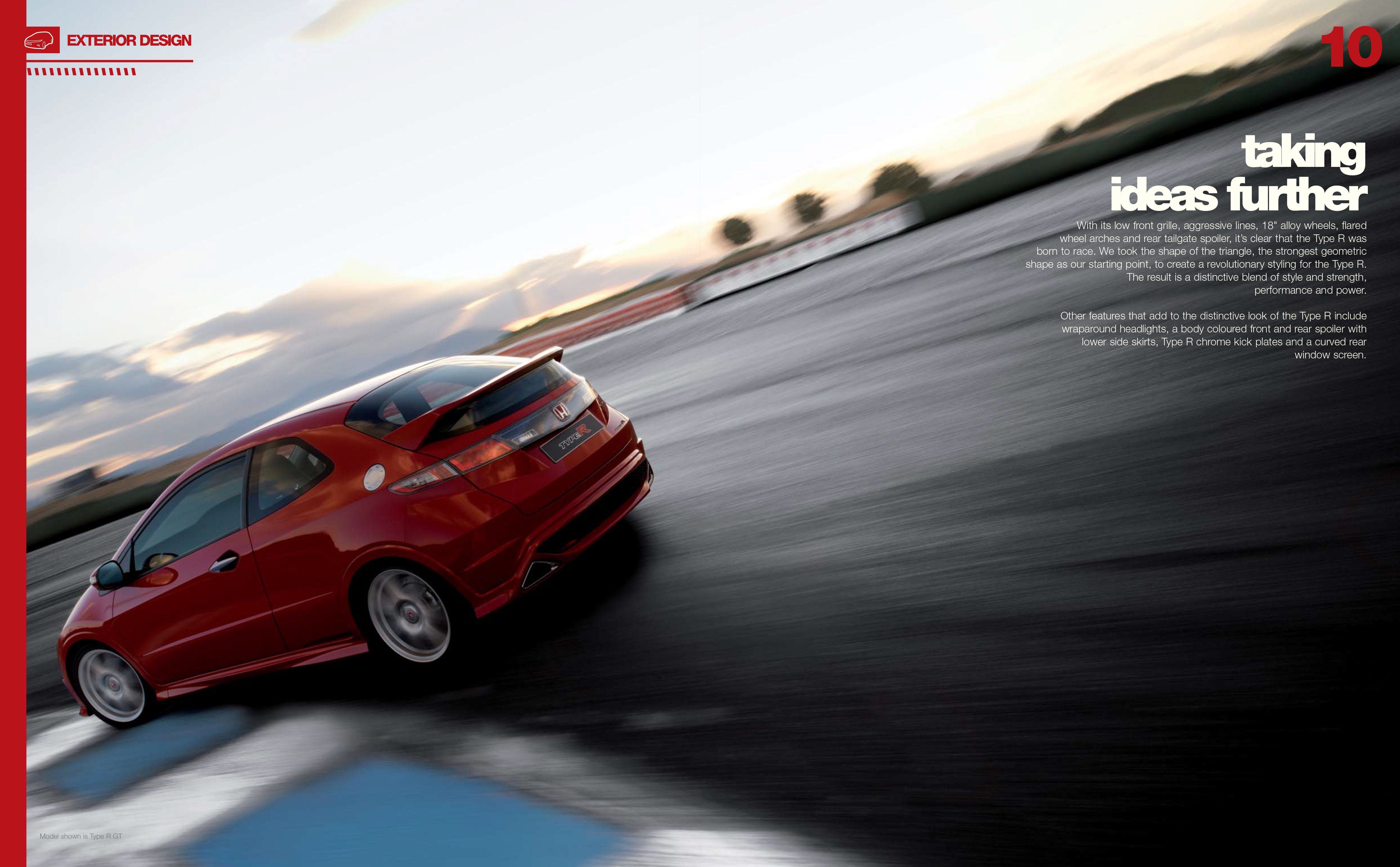
The brochure shifts from heritage to pure Euclidean theory. But the visual does the heavy lifting: the Type R photographed mid-corner on a race circuit, motion-blurred tarmac racing past, the car leaning into a turn with visible body roll and weight transfer. This isn’t a static beauty shot. It’s proof of intent. The headline reads “taking ideas further”, and the copy frames the car’s radical wedge profile as functional necessity: “We took the shape of the triangle, the strongest geometric shape, as our starting point.” The triangle isn’t just aesthetic. It’s structural truth, demonstrated at speed.
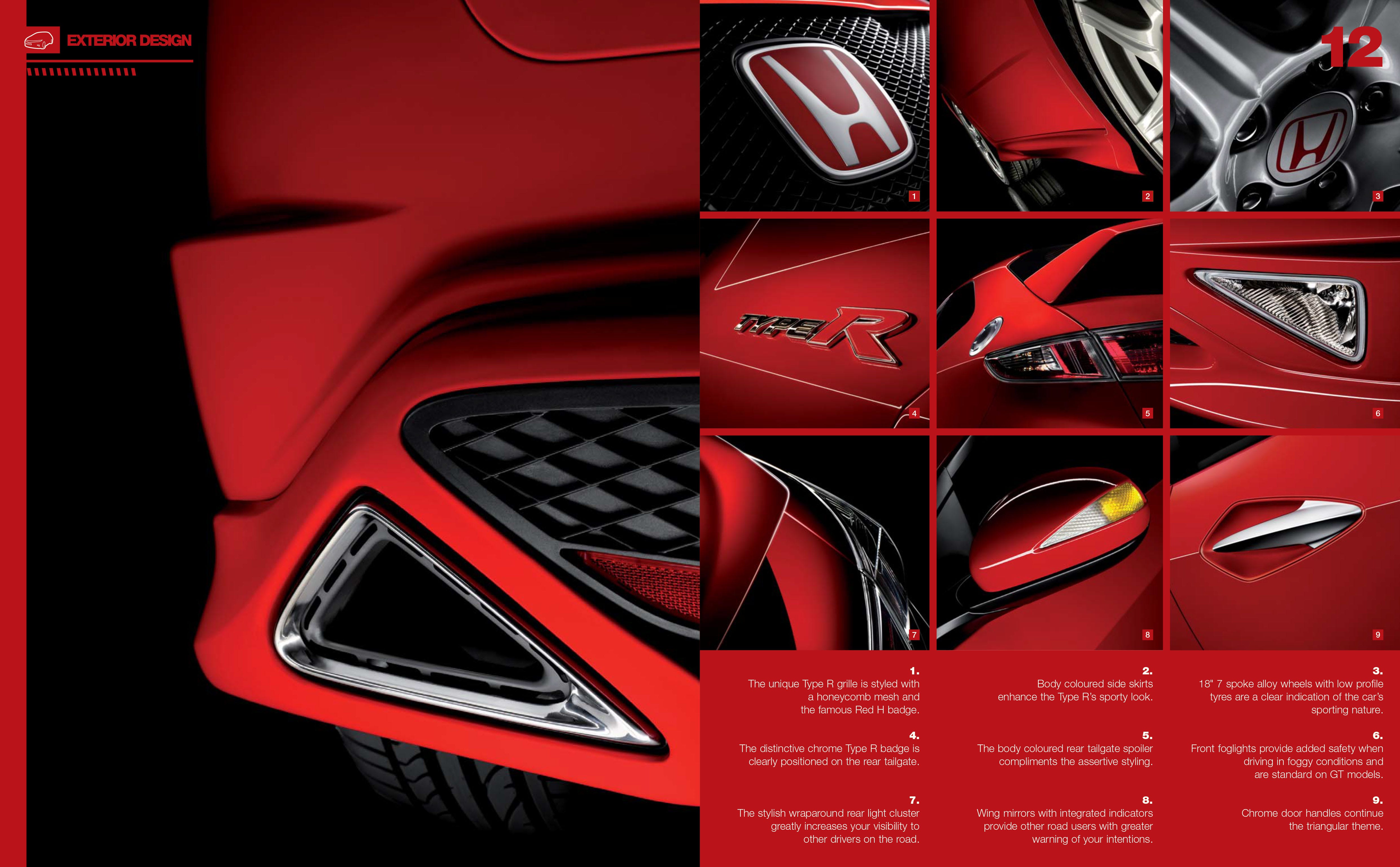
A numbered technical breakdown of exterior features is given under the banner “EXTERIOR DESIGN”. But this isn’t a traditional spec sheet. Nine numbered macro photographs, each showing isolated details. Each detail gets its own frame, its own moment of fetishistic attention. The copy focuses on “the unique Type R grille styled with a honeycomb mesh and the famous Red H badge”. This is where iconography becomes theology. The Red H isn’t just corporate branding. It’s presented as a performance signifier shared only with Formula 1 machinery, a badge that separates the legends from the rest.
The Cockpit: Joining the Squadron

Inside, the brochure abandons all pretence of being a family hatchback, with a two-page spread giving a driver’s-eye cockpit view. The tachometer dominates the instrument cluster, flanked by temperature and fuel gauges, with the speedometer relegated to the upper dashboard. The leather steering wheel, stitched in red, frames the Red H badge at its centre. Every surface visible to the driver, carbon-effect trim, machined aluminium, perforated leather, communicates purpose over comfort. The copy promises: “Every Type R is fitted with its very own, unique serial number positioned above the gearshift”.
This sells exclusivity through fighter-pilot ergonomics. You aren’t buying a car; you’re joining a squadron. The serial number plaque, showing “R-00007,” transforms a production vehicle into something that feels bespoke, limited, chosen.

Page 18 focuses on the deep-bolstered racing red Alcantara seats, but the photograph is what sells it: a close-up so tight you can see the texture of the Alcantara fabric, the contrast stitching, the Type R logo embossed on the headrest. These seats dominate the page, shot from an angle that emphasises their sculptural bolstering. The question: “how do you bring it all together?” The answer: “The Type R’s racing red Alcantara seats are sculptured, ultimately designed to hold you firm.”
These aren’t described as “comfortable” or “supportive” in the traditional sense. The copy explains: “In racing we’ve learned exactly which forces affect cars and drivers through corners and under hard acceleration.” The seats aren’t furniture. They’re equipment, designed to counteract lateral G-forces. Form following function, photographed like art.

Then another nine-panel detail grid, but this time focused inward. Each photograph isolates a tactile element. The copy for item 9 reads: “The red engine start button, where it all begins.” This isn’t ignition; it’s an invocation. The mechanical act of starting the car becomes the first step in a performance ritual that requires commitment. Each detail gets equal visual weight, equal reverence, as if every component deserves individual contemplation before you’re worthy of pressing that red button.
The Engineering Poetry: Selling the Howl
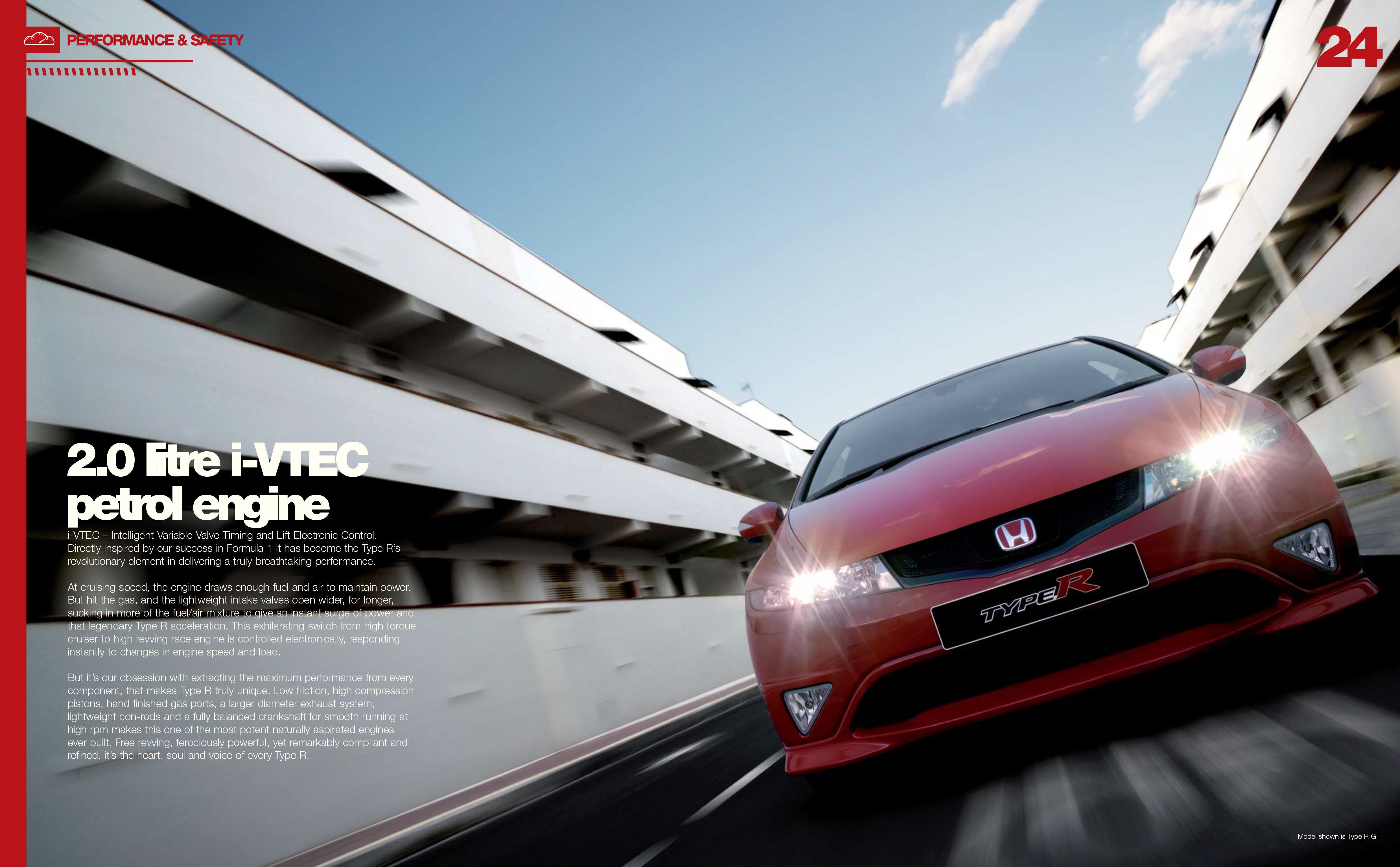
Now we reach the heart of the matter: the K20Z4 engine. Honda understood that the VTEC crossover at 5,800rpm couldn’t be photographed, so they chose to describe it with language that borders on the erotic:
“As the revs climb towards the red line, the i-VTEC howl is irresistible.”
Note the word choice: not sound, but howl. Not appealing, but irresistible. This is automotive copywriting that understands it’s selling an addiction. To justify the high-rev requirement, Honda claims artisanal craftsmanship usually reserved for watchmaking:
“Low friction, high compression pistons, hand finished gas ports, a larger diameter exhaust system, lightweight con-rods and a fully balanced crankshaft for smooth running at high rpm makes this one of the most potent naturally aspirated engines ever built.”
The phrase “hand finished gas ports” carries tremendous weight. In an era when automotive production was increasingly automated, Honda was claiming cylinder head-level artisanship. Whether strictly true or marketing embellishment, it positioned the K20Z4 alongside bespoke tailoring and Swiss watchmaking: human hands completing what machines could not perfect.
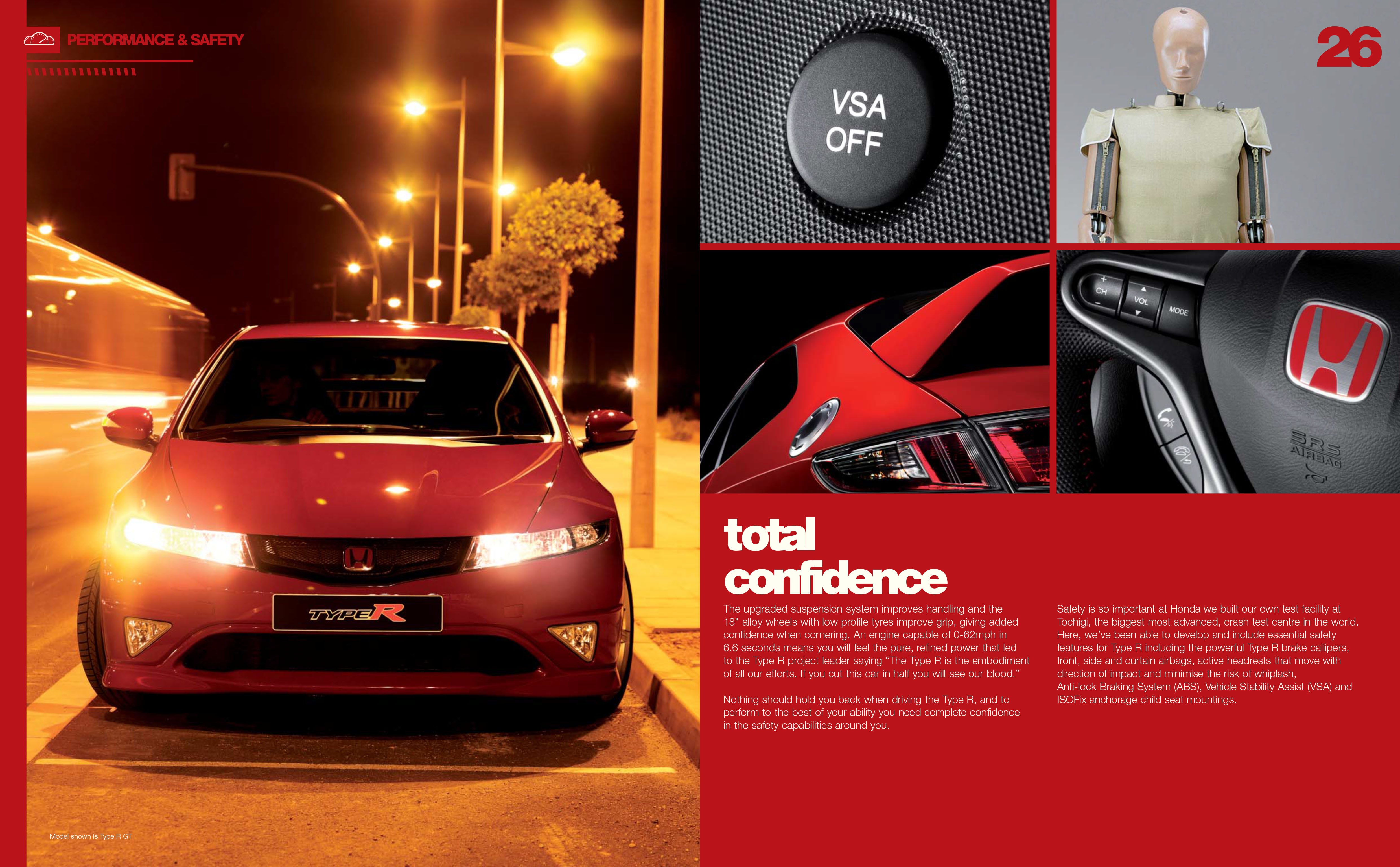
Here is where the brochure performs its most impressive high-wire act. The chassis engineering receives equally poetic treatment on Page 46:
“The special sport suspension’s oblique-angled trailing arm optimises side-force steering to provide a flatter roll centre and give superb handling. Combined with a high tensile steel frame... the Type R provides exceptional levels of stability.”
To address the controversial move to a torsion beam rear suspension, Honda’s copywriters invented the “oblique-angled trailing arm”. It’s a masterclass in rebranding a cost-saving measure as a “performance innovation” that “optimises side-force steering”. By framing it in technical language, flatter roll centre, optimised geometry, Honda attempts to recast a compromise as engineering advancement. History would not be kind to this argument.

Then comes a reality check, with the introduction of the Type R GT that includes “cruise control for a more relaxed driving experience”. This is Honda’s admission that not everyone wants to heel-and-toe to Tesco, an attempt to bridge the gap between hardcore track hatch and daily GT without diluting the performance mythology.
The Rearview Mirror
The 2007 Honda Civic Type R brochure is a masterclass in selling performance philosophy over raw specifications. Where German rivals were publishing Nürburgring lap times and boost pressure figures, Honda asked you to believe in triangles, hand-finished engine ports, and the wisdom of Soichiro Honda himself.
It worked, at least initially. The visual language, all shadows and red accents and geometric precision, communicated technical sophistication. The copy transformed potential weaknesses into selling points: high-rpm power delivery became “exhilarating switch”, torsion beam suspension became “oblique-angled trailing arm optimisation”. Even the modest 0-62mph time was buried in poetic language about the “irresistible howl”.
But nearly two decades later, the brochure’s promises have aged unevenly.
What the Brochure Got Right
The Community of Believers
Those unique serial numbers created a sense of membership. The racing heritage positioning attracted buyers who actually understood what VTEC crossover meant and were willing to work for it. The hand-built narrative established maintenance expectations that, when met, produced genuinely reliable high-performance engines. In 2026, the K20Z4 remains a masterpiece, but only for those who understand the ritual: premium synthetic oils, regular timing chain inspections, and VTEC solenoid cleaning.
The Irresistible Howl
“As the revs climb towards the red line, the i-VTEC howl is irresistible.” That promise, at least, has proven empirically true across nearly two decades. The FN2 Type R was the last of its kind, a high-revving, naturally aspirated holdout in an era of torque-on-demand. For those willing to wait until 5,600rpm for torque and stretch to 7,800rpm for power, the reward was a mechanical symphony that no turbocharger could replicate.
What the Brochure Concealed
The Suspension Compromise
No amount of copy about “oblique-angled trailing arms” could compensate for the handling limitations that became apparent once owners started attending track days. Enthusiast consensus has solidified: the torsion beam was a cost-reduction measure, not a “geometric optimisation”. Track testing revealed what the brochure couldn’t admit: under hard cornering, the FN2’s rear end could become unsettled in ways the EP3’s independent setup never did. By 2026, every forum discussion about FN2 suspension includes the phrase “if only it had independent rear”.
The triangle was supposed to be the strongest geometric shape. On a bumpy B-road at the limit, the rear axle had other ideas.
The Hand-Built Tax
The brochure’s claim of “hand-finished ports” wasn’t false advertising, but it created expectations about maintenance that many owners discovered too late. High-mileage FN2s that weren’t maintained to Honda’s specifications developed expensive problems. Clogged VTEC solenoids became common enough that specialist forums dedicated entire threads to DIY cleaning procedures. The hand-built narrative implied bespoke care; the reality is that the car demands it, with maintenance budgets that would make Porsche owners nod in recognition.
The Market’s Verdict (Not Ours)
What the brochure couldn’t predict was how quickly the hot hatch landscape would shift toward turbocharged torque and all-wheel-drive traction. By 2010, the buying public had spoken: they wanted low-rev accessibility over high-rpm reward. The FN2’s naturally aspirated ethos became commercially anachronistic, even if it remained mechanically superior to those who understood what they were losing. By 2026, it’s a relic of a specific moment when manufacturers still believed enough buyers would accept the high-rev bargain, before focus groups and bean counters decided otherwise.
The Ironic Legacy
The marketing gimmicks have become authentication tools. That unique serial number plaque, once a fighter-pilot fantasy, is now the essential verification of a genuine UK-built survivor in a market flooded with replicas and modified examples. The brochure’s emphasis on exclusivity has created a peculiar secondary market: original Alcantara seat covers are now scarce and expensive to replace. The specific 18-inch alloy wheels, described in the brochure as “lightweight”, command premium prices when found undamaged.
The marketing gimmick became the proof of provenance.
The Ownership Experience
Some buyers kept faith with the proposition for decades, maintaining fastidiously, revving religiously, accepting that VTEC engagement at 5,800rpm was a privilege rather than a compromise. Others sold up after one winter of realising that peak torque at 5,600rpm makes overtaking on B-roads an exercise in gear selection and religious conviction.
In the end, the 2007 Type R brochure asked you to believe in geometry, heritage, and the transformative power of high-revving naturally aspirated engines. It asked you to accept that a torsion beam rear suspension could be optimised through clever marketing copy. It asked you to trust that waiting for VTEC to kick in was a feature, not a bug.
And for those who still own well-maintained examples, who still rev to 8,000rpm on empty roads, who still feel the addictive kick when the cam profile switches and the intake note transforms from growl to scream, the brochure’s core promise remains unbroken.
You just have to be willing to climb to the red line, every single time.
The triangle was always a gamble. But the howl? That was never in doubt.
The Fine Print
