The Frankenstein Masterpiece: BMW 1 Series M Coupé
When M Division went rogue and built a weapon from parts

In 2008, the luxury-first philosophy had taken root inside BMW M GmbH. The old guard (the engineers who remembered when M cars were homologation specials) were watching their creations grow soft. The E92 M3 was magnificent, but its V8 was wrapped in a kerb weight that suggested a preference for crossing continents over carving apexes. The purists were restless. They wanted something raw.
So, a small team inside M Division went rogue. They took the humblest platform in the lineup, the E82 1 Series, and began a transformation that required no permission slips or marketing focus groups. They bolted on the wide-body track of the M3, the suspension geometry, the massive cross-drilled brakes, and a Variable M Differential Lock.
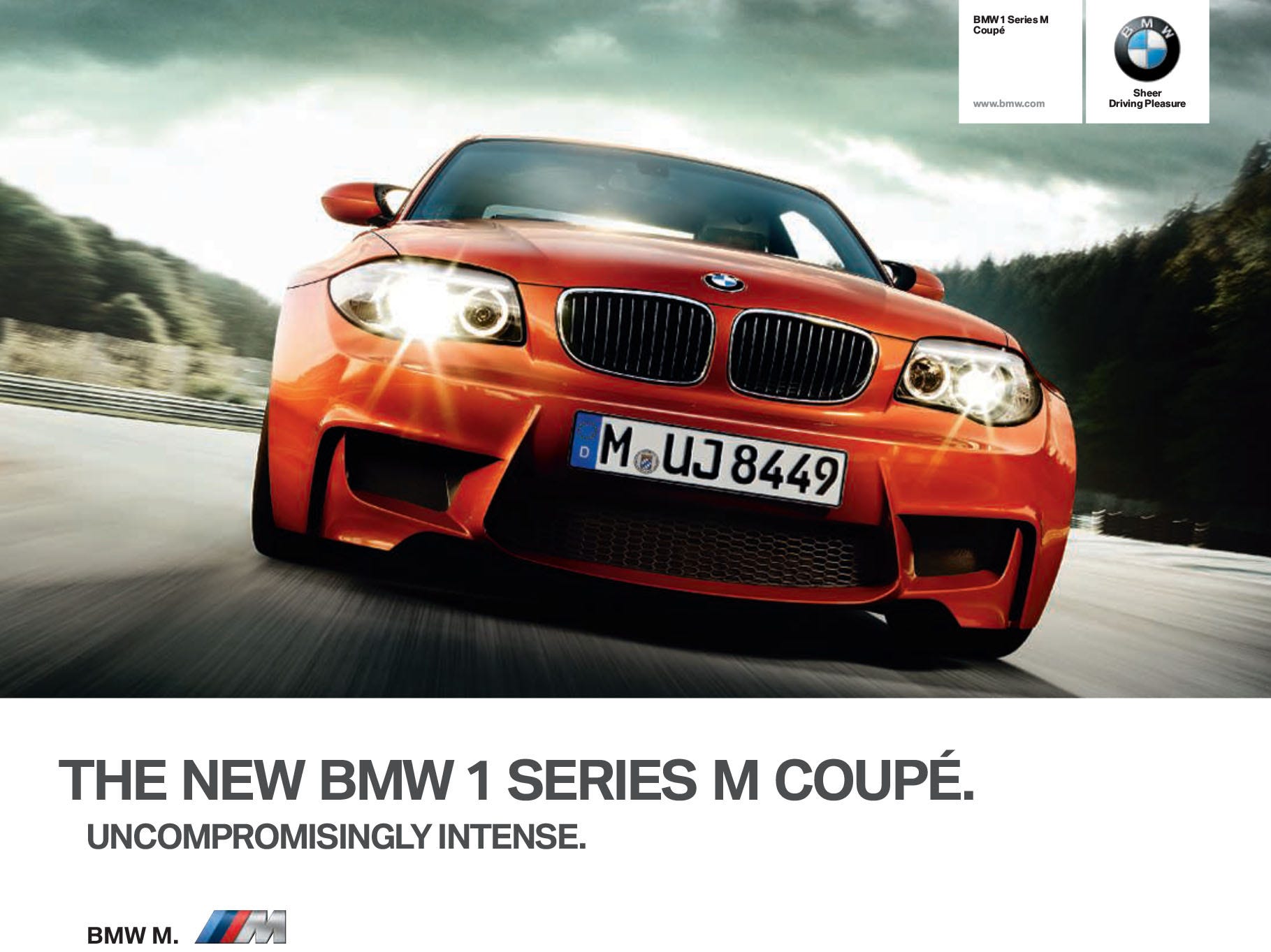
In the spring of 2010, the 1 Series M Coupé emerged. It wasn’t a flagship; it was a correction. It was proof that M Division still remembered how to build a weapon.
INDUSTRIAL AGITATION
The 24-page brochure from 2010 refuses the language of luxury car marketing. There are no vineyards or sun-dappled coastal roads here. No lifestyle aspiration whatsoever. Instead, the vocabulary is one of industrial agitation: rigid, capitalised sans-serif headlines that crash through images like physical barriers.
The colour palette is dominated by Valencia Orange metallic (a shade so aggressive it looks like it could burn through the page) contrasted against deep charcoal-toned Alcantara and industrial grey concrete.
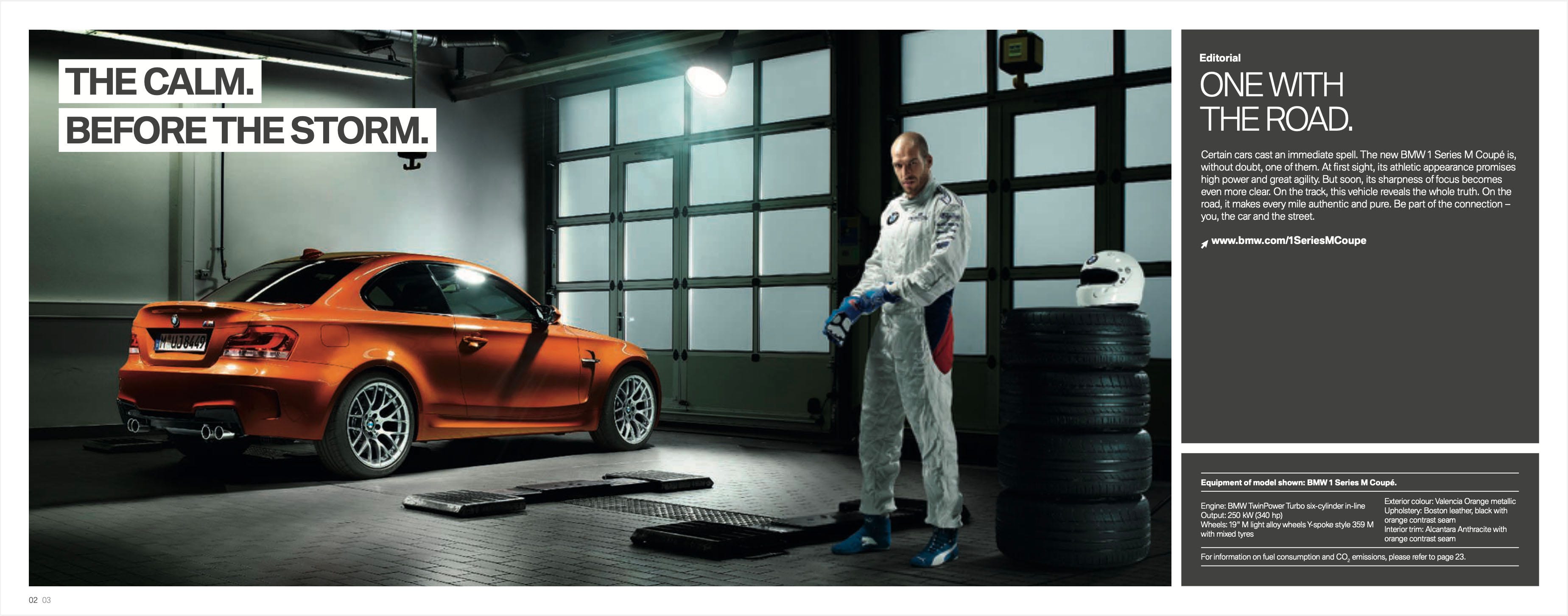
THE CALM. BEFORE THE STORM. A racing driver in full gear stands in a spotlit garage. To his right, the 1M. The lighting is harsh, unforgiving. The copy frames the car not as a purchase (not as something you acquire to signal status or taste) but as a spell that the driver enters. A commitment. A pact. “Certain cars cast an immediate spell,” it reads. “Be part of the connection — you, the car and the street.”
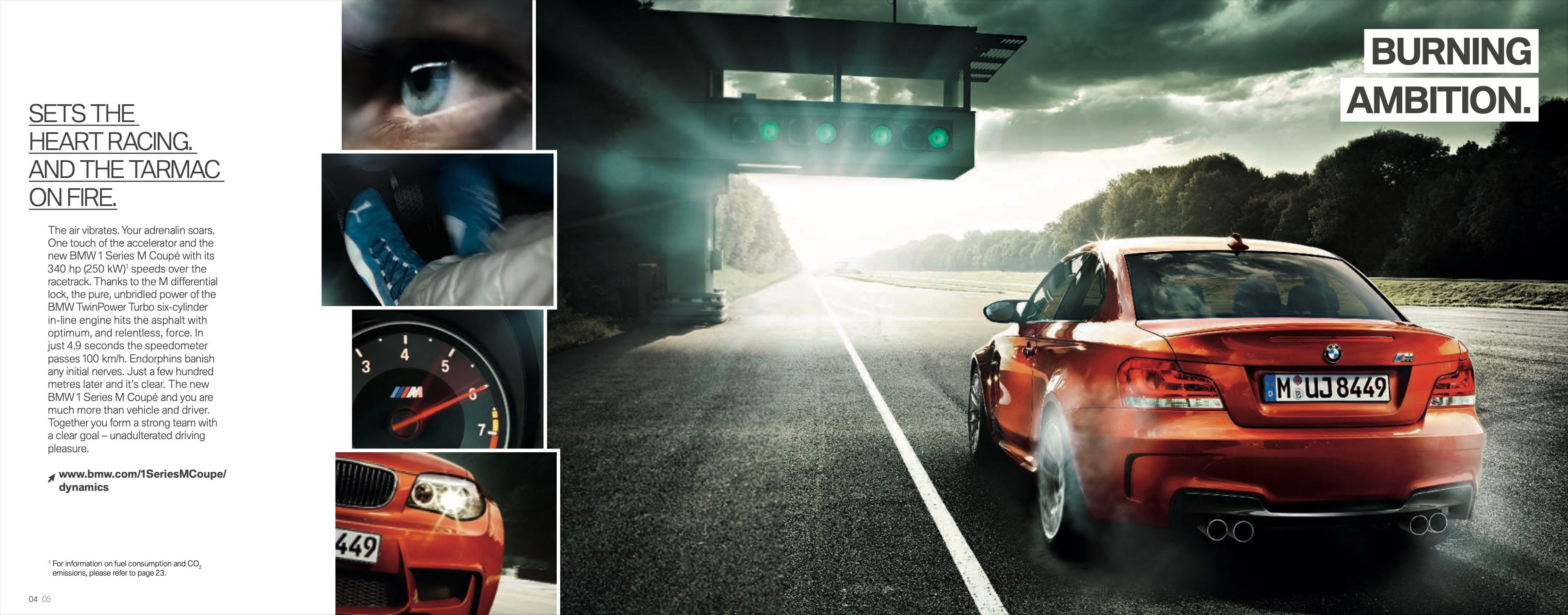
SETS THE HEART RACING. AND THE TARMAC ON FIRE. Velocity blur. The 1M at speed on a track. The copy describes the N54 TwinPower Turbo six-cylinder delivering 340bhp and sprinting to 100km/h in 4.9 seconds. “The air vibrates. Your adrenalin soars.” The focus is explicitly on physiological response: adrenalin, endorphins, heart rate. This is not a car you buy to impress colleagues. This is a car you buy to feel something.
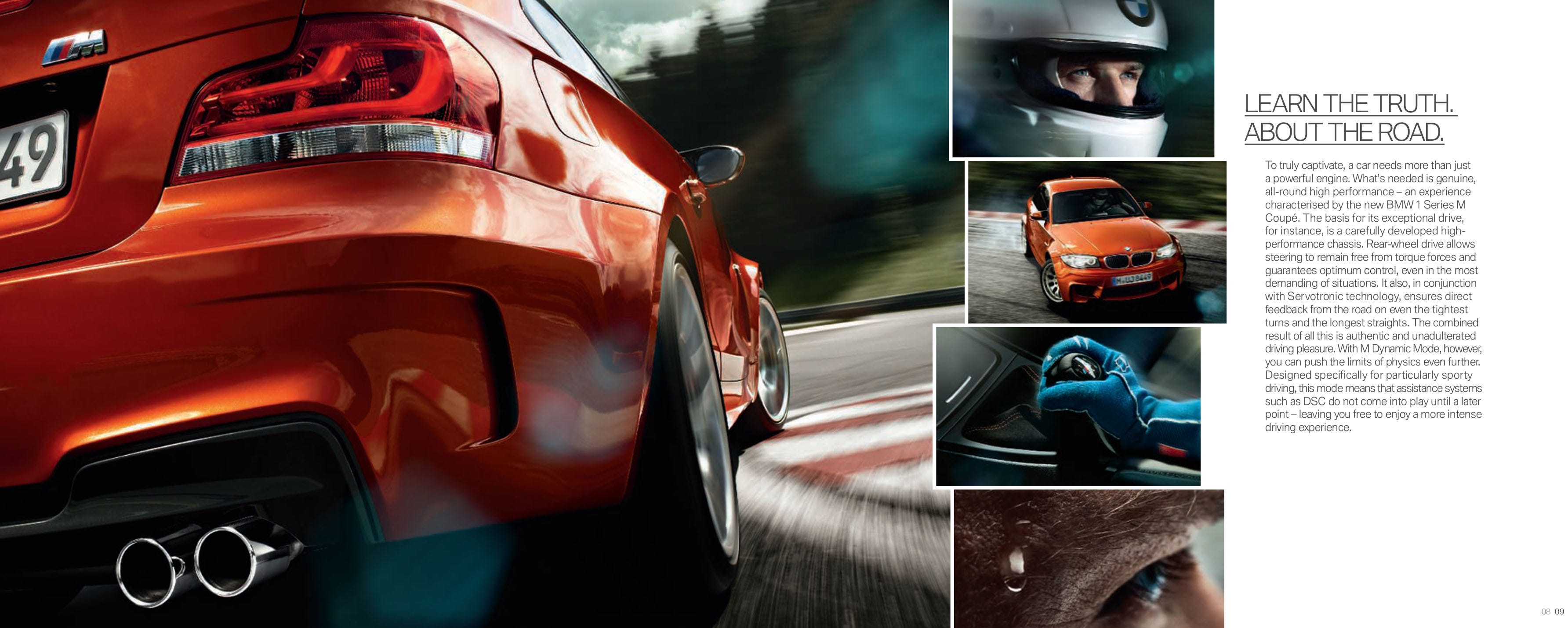
LEARN THE TRUTH. ABOUT THE ROAD. The copy explains the high-performance chassis, the rear-wheel drive that keeps steering free from torque forces, the Servotronic technology that ensures direct feedback. The combined result of all this is authentic and unadulterated driving pleasure. Direct feedback (the unfiltered connection between driver, machine, and tarmac) is marketed as a moral truth, something sacred that has been lost in the march towards refinement.
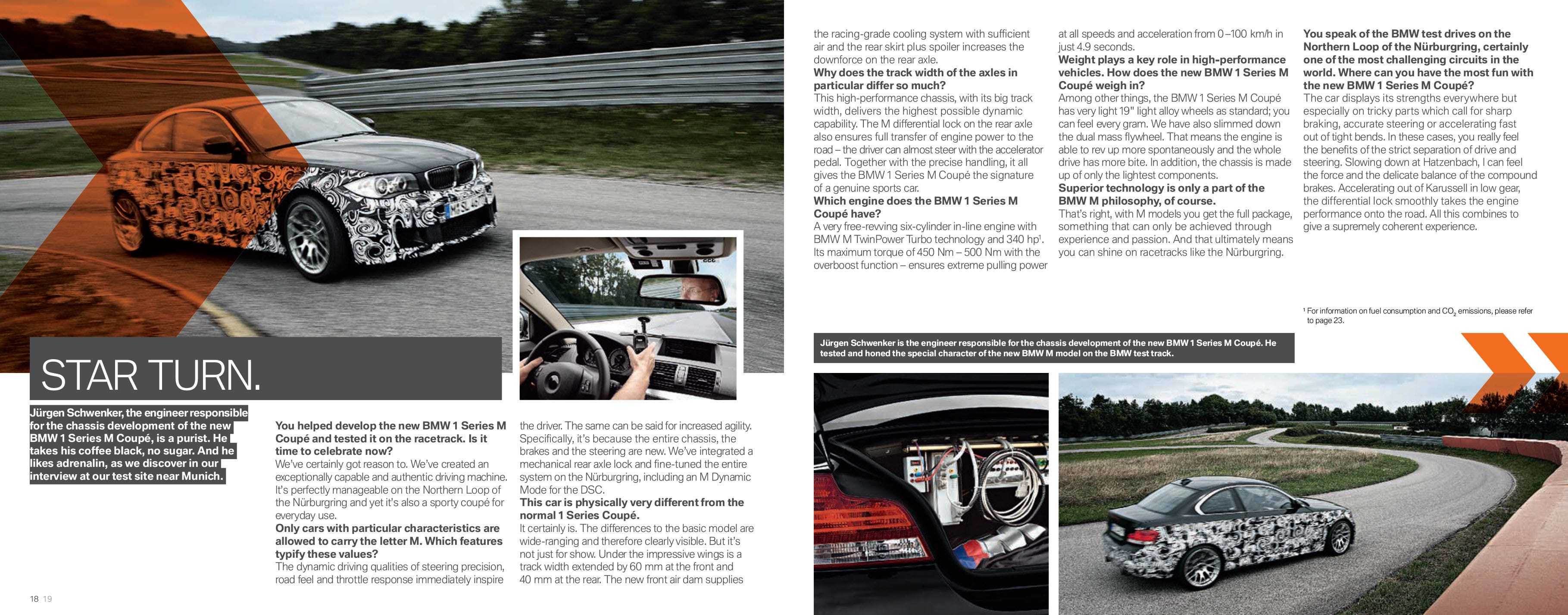
STAR TURN. An interview with Jürgen Schwenker, “the engineer responsible for the chassis development of the new BMW 1 Series M Coupé”. The brochure describes him as “a purist. He takes his coffee black, no sugar. And he likes adrenalin.” This detail is not accidental. It establishes Schwenker (and by extension, the car) as belonging to the purist tradition. No compromise. No dilution.
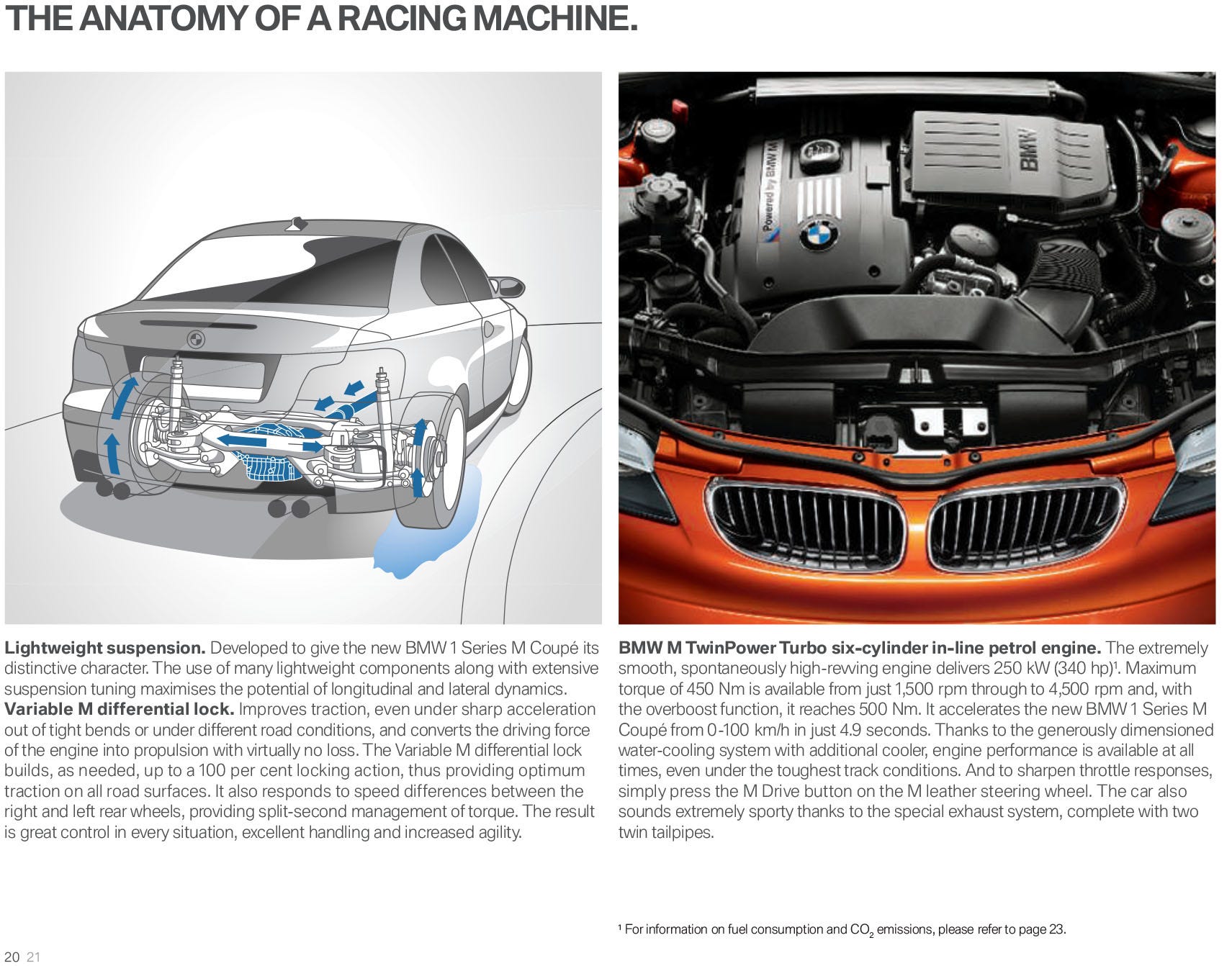
THE ANATOMY OF A RACING MACHINE. Here the spread abandons photography for a blueprint-style X-ray diagram and surgical technical study. It is designed to prove to the purists that the 1M is a structural triumph, not a cosmetic one.
To the left is an X-ray diagram of the rear subframe and the Variable M Differential Lock. The brochure explains how this system builds up to a 100% locking action to manage torque in “split-second” intervals effectively allowing the driver, in Schwenker’s words, to “steer with the accelerator pedal”.
Beside the differential sits the N54 TwinPower Turbo heart. The brochure highlights the “generously dimensioned water-cooling system” and additional cooler, essential evidence that explains why this mass-production motor could survive the “toughest track conditions”.
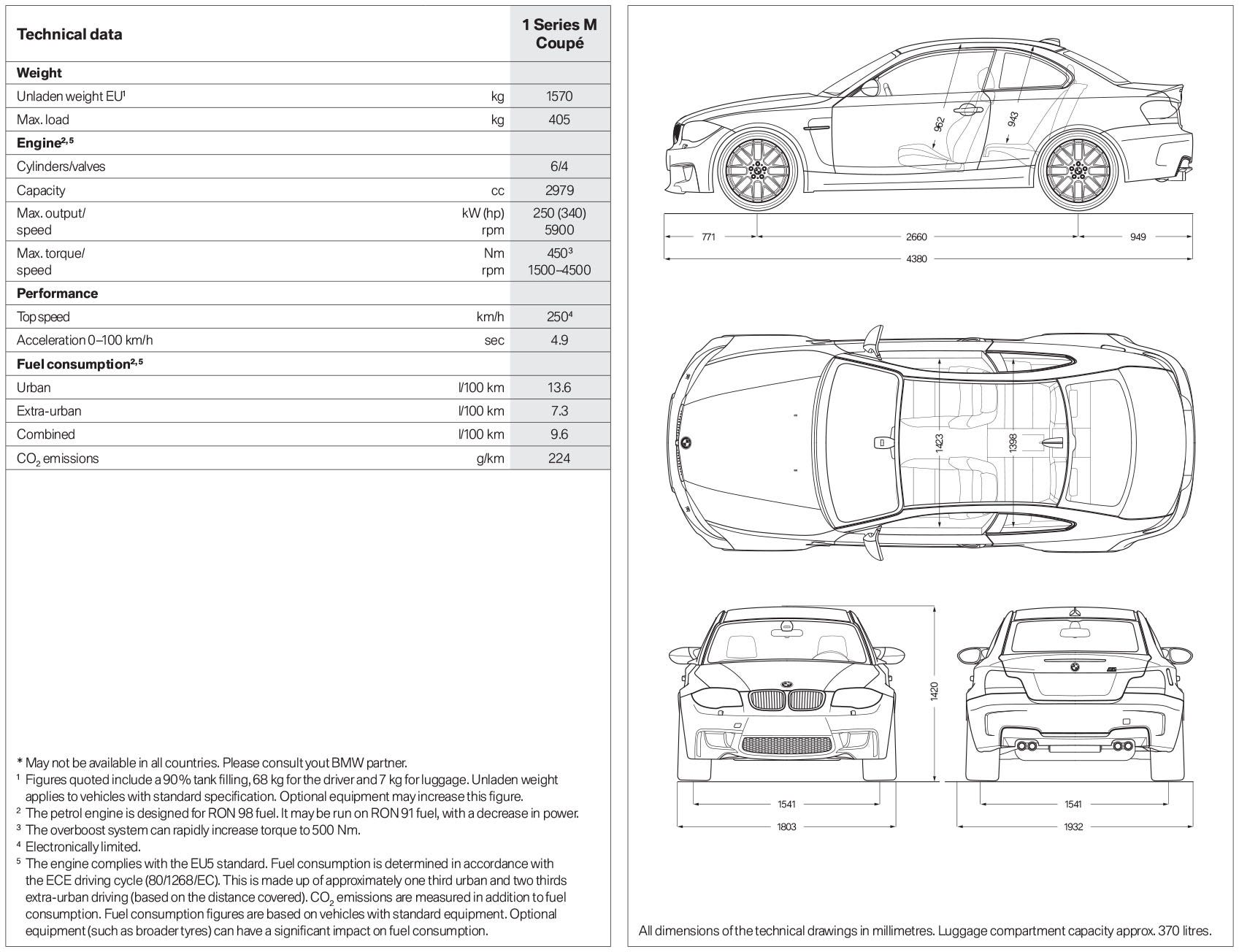
This truth is structural. The wide-body track (extended by 80mm at the front) required unique, flared steel arches that were never shared with the standard 1 Series. The brochure’s X-ray diagram makes it clear: this isn’t a body kit. This is a Frankenstein masterpiece, optimised for the Nürburgring Nordschleife, where lap times are measured in blood pressure spikes.
THE REARVIEW MIRROR
The N54 Tax
In 2026, the 1M rewards commitment but punishes neglect. The N54 engine, brilliant as it is, suffers from early-turbo BMW frailties: high-pressure fuel pumps, carbon-choked intake valves, and cooling systems made of plastic that eventually surrenders. Walnut blasting the valves and refreshing the water pump are the entrance fees to the 1M club.
The Scarcity of Steel
Perhaps the most daunting 2026 reality is the bodywork. The wide-arch steel panels are unique to the 1M. If you damage a wing in a car park, you aren’t looking at a parts catalogue; you are conducting an archaeological hunt for New Old Stock inventory that insurance companies are increasingly unwilling to fund.

The Legacy of the Rogue
The 1M’s legacy is not about performance metrics; modern M cars are faster and more refined in every measurable way. Its legacy is what it saved. By demonstrating a massive market for small, manual, analogue-feeling cars, the 1M saved the soul of the M Division and paved the way for the M2 lineage.
The Verdict
The brochure promised a car that would set your heart racing and the tarmac on fire. It promised direct feedback as a moral truth. It promised the calm before the storm.
Sixteen years later, the promise holds. The 1M remains what it was in 2010: proof that M Division could still build a weapon. A Frankenstein masterpiece assembled from parts that shouldn’t work together, but somehow create something greater than their sum.
The brochure’s vocabulary was industrial agitation. The car’s legacy is mechanical truth. Coffee black. No sugar. No apologies.
The Fine Print