
The Rectification: How the 997 Reclaimed the 911’s Soul
The return of the round eye and hydraulic steering's last stand

There are apologies, and then there are restorations. The 2006 Porsche 911 Carrera (997.1) was not marketed as either; the brochure speaks only of evolution, consistency, versatility. But every contour of its ovoid headlight housing, every millimetre of the dashboard, every carefully chosen sans-serif character in that heavy-stock launch edition told the same story: We heard you.
The 996 generation had been Porsche’s venture into cost rationalisation, its flirtation with shared Boxster components, its brief experiment with headlights that resembled, as critics endlessly noted, a pair of fried eggs. The interior quality drew comparisons to rental cars. The brand that had built its mythology on air-cooled purity and silhouette consistency had stumbled. By 2005, when the 997 launch brochure went to print, Zuffenhausen had learnt a lesson about heritage that marketing departments across the automotive industry would study for the next two decades: you cannot engineer away nostalgia.
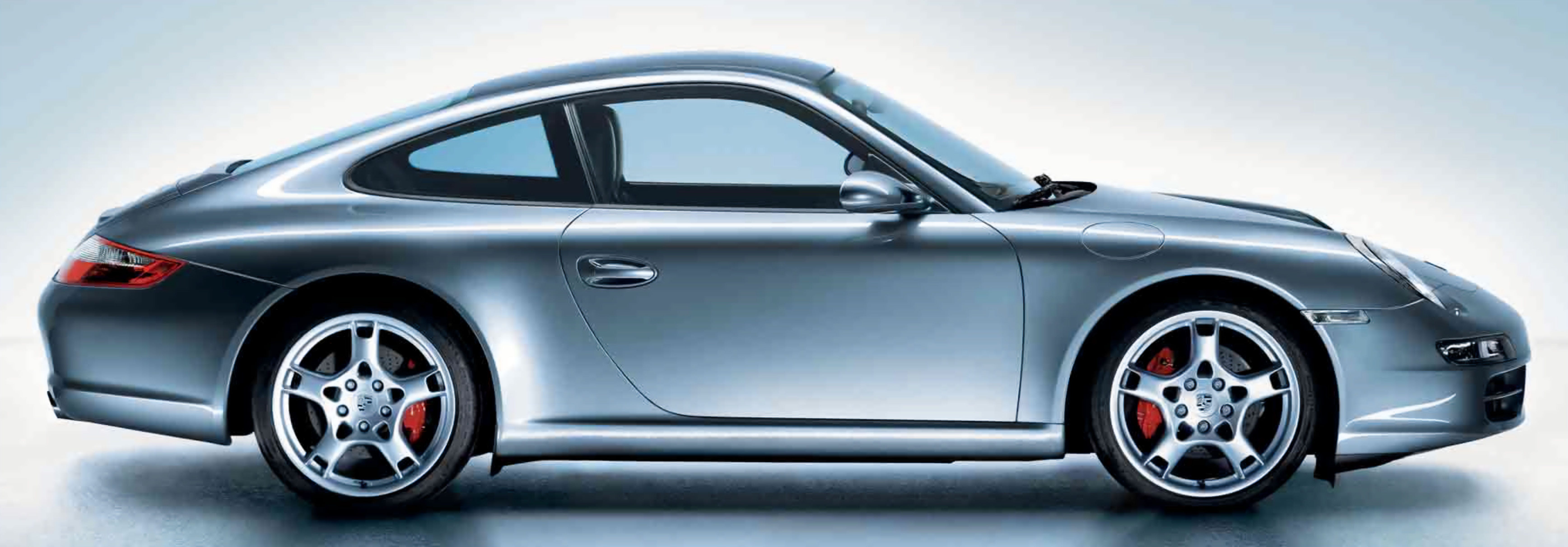
The 997 was the correction. Not a revolution (Porsche does not do revolutions) but a meticulous, almost surgical return to form. It is Zuffenhausen rationalism at its most clinical: identify the error, isolate the variables, restore equilibrium.
The Silhouette Restoration
The brochure opens with the return of the round eye. Not perfectly circular, not teardrop, not biomorphic; ovoid. The design element that had defined every 911 from 1963 to 1998 was back, and Porsche wanted you to notice. Page twelve of the UK launch edition features a three-quarter front view, GT Silver Metallic paintwork catching studio light at precisely calibrated angles. The copy reads: ”Inherently consistent, the 911 concept is also remarkably versatile.”
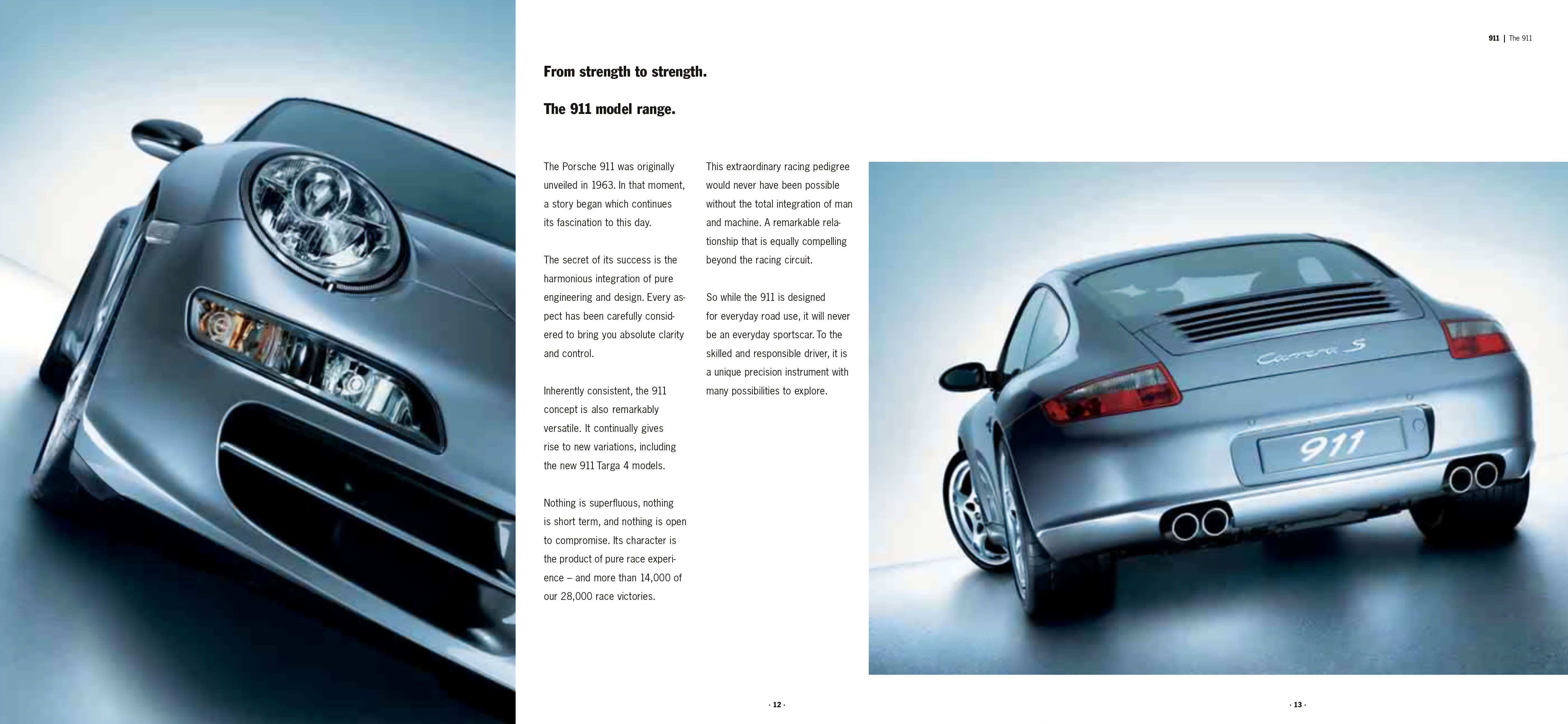
This is marketing language working overtime. Consistency is not typically sold as luxury (reliability, perhaps, or heritage) but the 997 brochure elevates it to aesthetic philosophy. It is the visual equivalent of a Dieter Rams toaster or a Braun calculator: form refined until only function remains, then refined again until function becomes form. The 996 had broken this covenant. The 997 restored it.
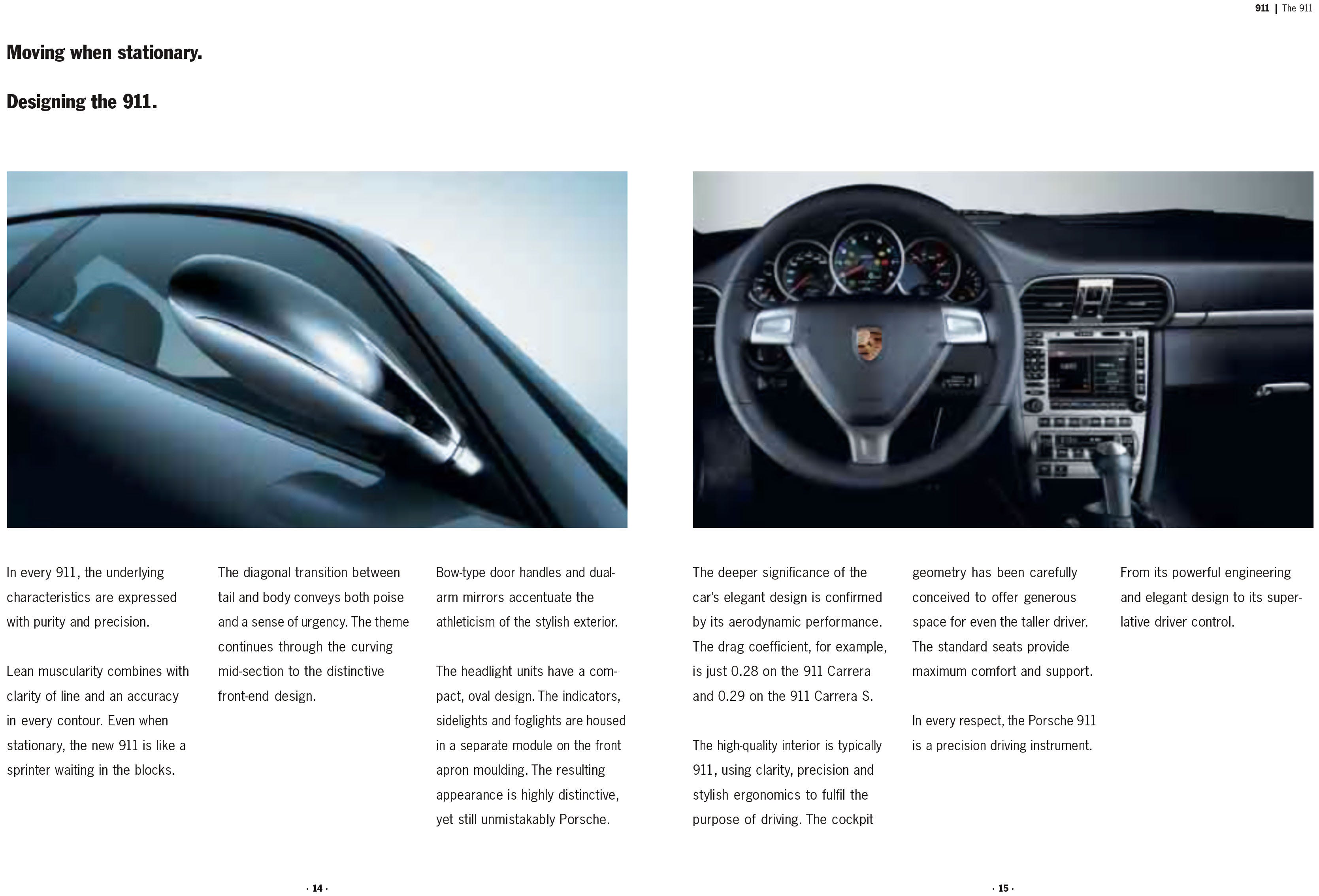
The headlight was merely the most visible correction. The interior received equal attention. Where the 996’s dashboard had been criticised for overlapping gauges and questionable material choices, the 997 returned to the five-dial layout that had characterised the classic models (tachometer dead centre, all others symmetrically flanking).
“The secret of its success is the harmonious integration of pure engineering and design. Every aspect has been carefully considered to bring you absolute clarity and control.”
- Porsche 911 (997.1) Brochure, Page 12
That phrase (absolute clarity) appears throughout the launch materials. It is both technical specification and aesthetic manifesto. Every surface in the 997’s cabin appears intentional, every switch and dial placed with the precision of surgical instruments in an operating theatre. This is not the raw, oil-scented chaos of a 1970s 911; this is the clean, architectural precision of a Vitra showroom. The materials are tactile without being ostentatious. The geometry is deliberate.
Even the ISOFIX mounting points in the rear seats are presented as evidence of rational design: a 182mph supercar that accommodates child safety seats is not a contradiction but a triumph of German engineering logic.
The Gap Between 3.6 and 3.8
The 997 generation launched with two engine configurations: the Carrera with a 3.6-litre flat-six producing 325bhp, and the Carrera S with a 3.8-litre variant generating 355bhp. On paper, this is a thirty-horsepower differential. In reality, it represented two distinct philosophies about what a 911 should be.
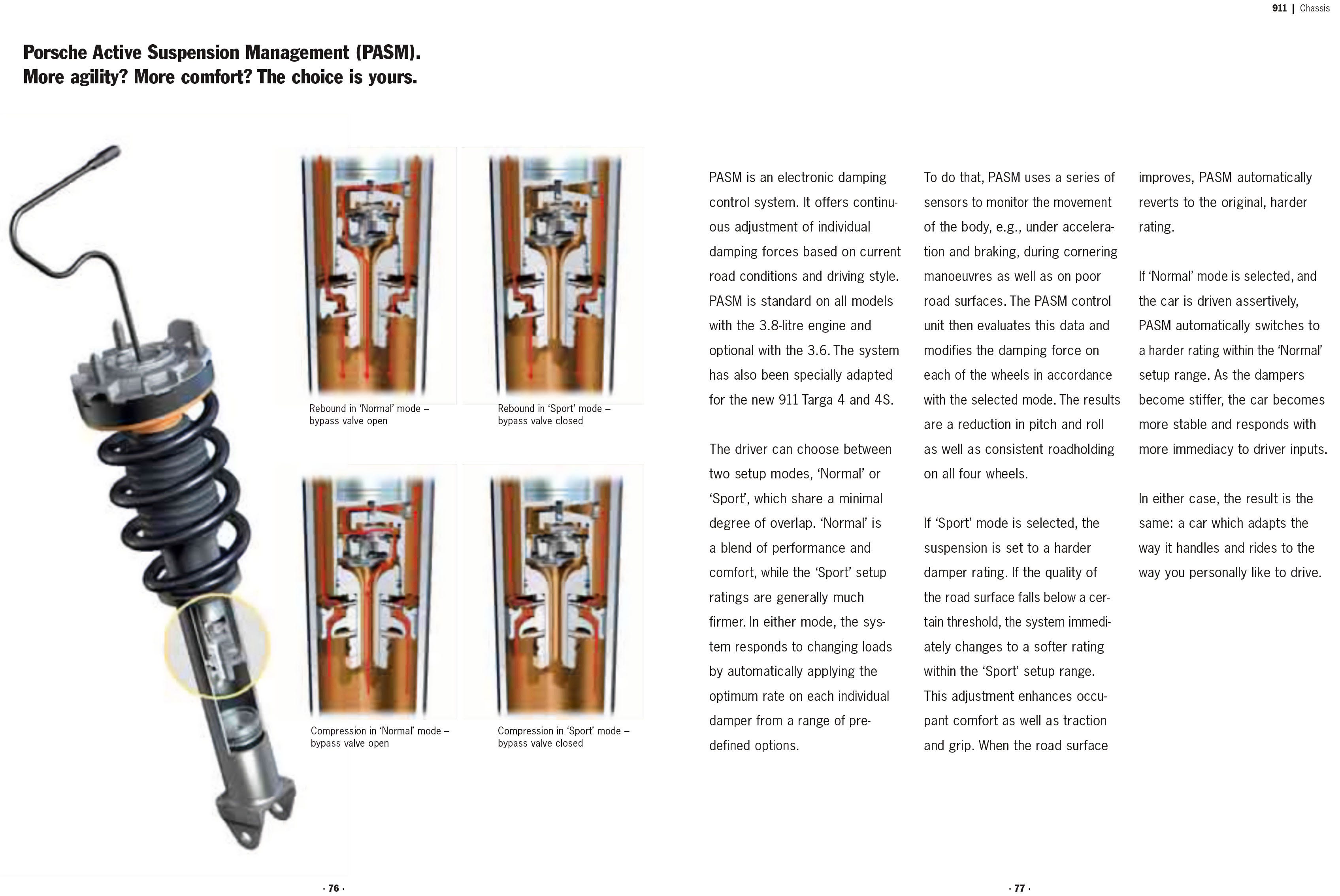
The thirty-horsepower premium bought more than velocity. It purchased membership in the sub-five-second acceleration club (4.8 seconds to 62mph versus 5.0) and entry into the 180-plus-mph top speed tier, a psychological threshold that separated serious performance machines from merely quick ones. The Carrera S also received Porsche Active Suspension Management (PASM) as standard equipment, a system that allowed the driver to toggle between Normal and Sport damping curves with the press of a button. Page 76 of the brochure features diagrams that show precisely how the system modulates compression and rebound.
But the specifications tell only part of the story. The 3.8-litre M97 engine (featured in exploded-view anatomical detail on Pages 49 and 50) represented Porsche’s commitment to what the brochure termed ”VarioCam Plus with continuously variable intake valve timing.”
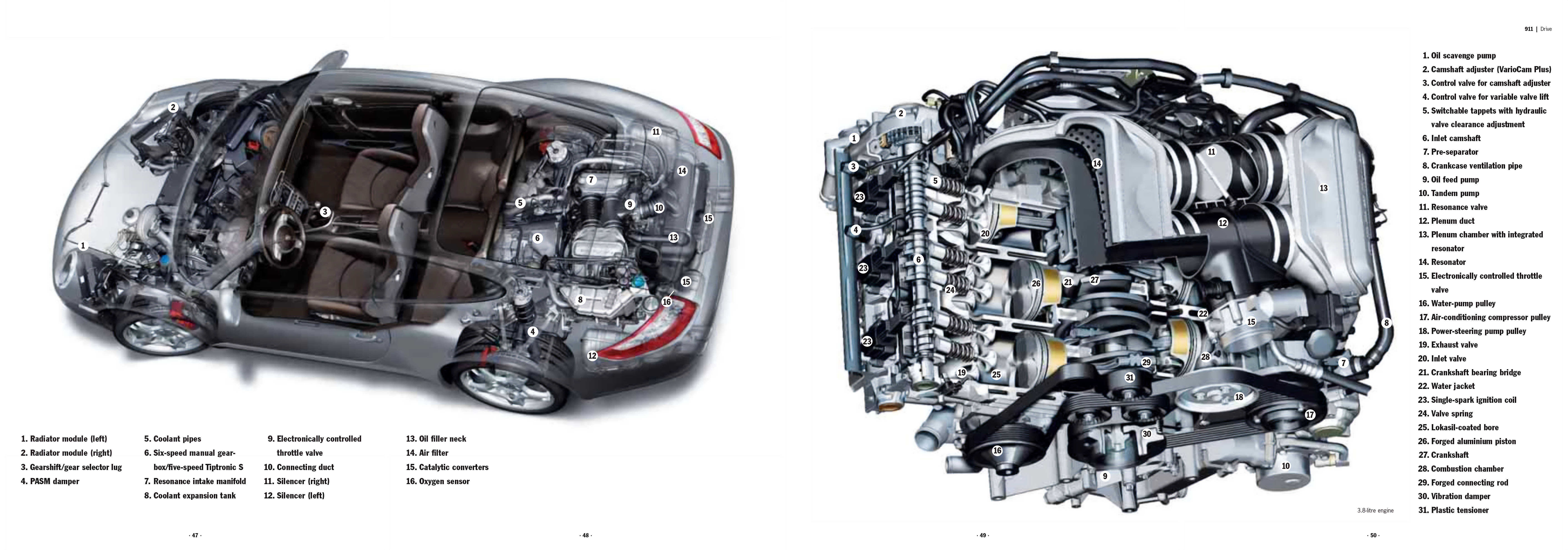
This was the death knell of air-cooling rendered in marketing language. The 996 had already made the transition to water-cooled engines, but the 997’s variable valve technology represented a further departure from the raw mechanical simplicity that had defined earlier generations. Porsche was digitising the powertrain, introducing electronic management systems to optimise efficiency and emissions while maintaining the flat-six’s characteristic howl. The result was an engine that delivered peak torque at 4,600rpm in the S configuration; high enough to feel alive, low enough to remain accessible in daily driving.
The Carrera S was less aerodynamically efficient than the base Carrera: a coefficient of drag of 0.29 versus 0.28. The wider tyres and additional cooling requirements sacrificed slipperiness for stability and thermal management. This is Zuffenhausen rationalism in microcosm: accept the measurable deficit in one parameter to optimise the whole.
The Analogue-Digital Equilibrium
The 997 generation arrived at a unique moment in automotive history: late enough that electronic driver aids had become reliable and sophisticated, early enough that traditional mechanical systems still dominated the driving experience. This was the last 911 with hydraulic power steering. The 991 generation that followed would switch to electrical assistance, gaining packaging flexibility and efficiency whilst losing what enthusiasts would later describe as ”the conversation.”
The hydraulic rack in the 997 transmitted road texture with unfiltered clarity. Camber changes, surface irregularities, load transfer during cornering; all of this information travelled through the steering column to the driver’s hands. It was analogue feedback in an increasingly digital machine, and it created a sensory connection that subsequent generations would attempt to replicate through software but never quite recapture.
Yet the 997 was far from a luddite’s machine. PASM represented a significant leap forward in chassis control technology. The system used sensors to monitor vehicle dynamics (wheel speed, lateral acceleration, steering angle) and adjusted damping rates in real time. In Normal mode, it prioritised comfort without sacrificing control. In Sport mode, it stiffened the dampers to reduce body roll and sharpen turn-in response. The driver could toggle between these settings whilst underway, transforming the car’s character at will.
This was the equilibrium: mechanical steering that spoke in analogue language, electronic suspension that thought in digital code. Porsche had found the precise balance point between tradition and progress, between feel and function. The 997 would be remembered not for being the fastest 911 or the most powerful, but for being the last to occupy this specific intersection of technologies.
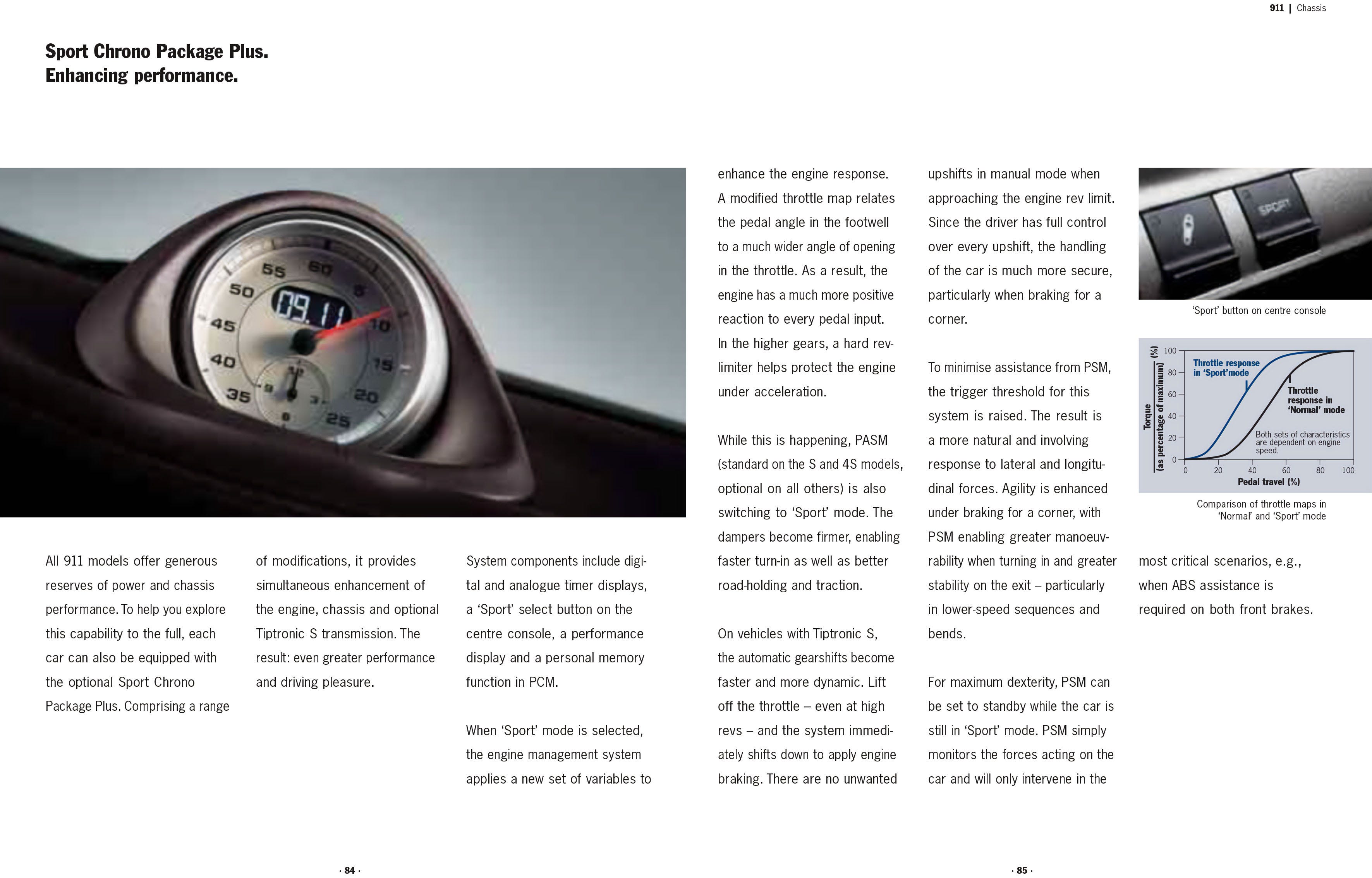
The Sport Chrono package (identifiable by the stopwatch mounted atop the dashboard) extended this philosophy.
It added a performance timer and a more aggressive throttle mapping in Sport mode. These were digital tools that enhanced the analogue experience rather than replacing it. The stopwatch became the visual symbol of this generation: a mechanical timepiece in an electronic chassis, anachronism and innovation coexisting without contradiction.
The Everyday Supercar
In 2006, the 997 occupied a precise position in the performance hierarchy. It sat above the BMW M3 (quicker, more exotic, more expensive) but remained more usable than a Ferrari F430. Where the Aston Martin V8 Vantage offered beauty and the BMW M6 provided a howling V10, the 997 promised precision. This was Porsche’s competitive advantage: the ability to build a car that could lap the Nürburgring on Saturday and transport children to school on Monday.
The brochure dedicates considerable space to this duality. Pages 116 and 117 feature photographs of the luggage compartment (surprisingly spacious for a rear-engine sports car) and the roof transport system.

The message is clear: this is not a toy for sunny weekends but a tool for daily life. The 182mph top speed is real, but so is the practicality.
This positioning required careful calibration. Too comfortable, and the 997 risked becoming a grand tourer rather than a sports car. Too hardcore, and it would alienate the buyers who needed rear seats and luggage space. Porsche threaded this needle with characteristic German logic: make every system dual-purpose. The PASM suspension could be civilised or aggressive. The rear seats could accommodate adults for short trips or children for longer ones. The luggage compartment could swallow a week’s worth of soft bags. Nothing was compromised; everything was optimised for its intended use case.
The sales pitch, then, was not about raw performance numbers (though those were competitive) but about the absence of compromise. You did not need a second car. You did not need to choose between involvement and comfort. The 997 could be both, and Porsche had the engineering receipts to prove it.
The Rearview Mirror: Today’s Perspective
Twenty years after the 997’s launch, the engineering promise has been complicated by mechanical reality.
The M97 engine, particularly in 3.8-litre form, developed a reputation for bore scoring: cylinder wall damage caused by thermal expansion and insufficient lubrication at certain temperature ranges. The Lokasil cylinder linings, chosen for their light weight and thermal properties, proved vulnerable to wear patterns that could necessitate engine replacement. This was not a universal failure, but it occurred frequently enough that ”pre-purchase inspection with bore-scope” became standard industry language when discussing 997.1 acquisitions.
The IMS (intermediate shaft) bearing, inherited from the 996 generation, remained a point of anxiety. Whilst the failure rate was statistically low, the consequences (catastrophic engine damage) were severe enough that preventative replacement became a common modification. Porsche would eventually redesign this component for the 997.2 facelift, but the early cars carried this vulnerability.
These issues have not destroyed the 997’s reputation, but they have added cost and complexity to ownership. The ”everyday usability” promised by the brochure remains achievable, but it now requires deep-pocketed maintenance budgets and careful mechanical monitoring. The car is not fragile, but it demands attention that later generations, with more robust engineering, do not.
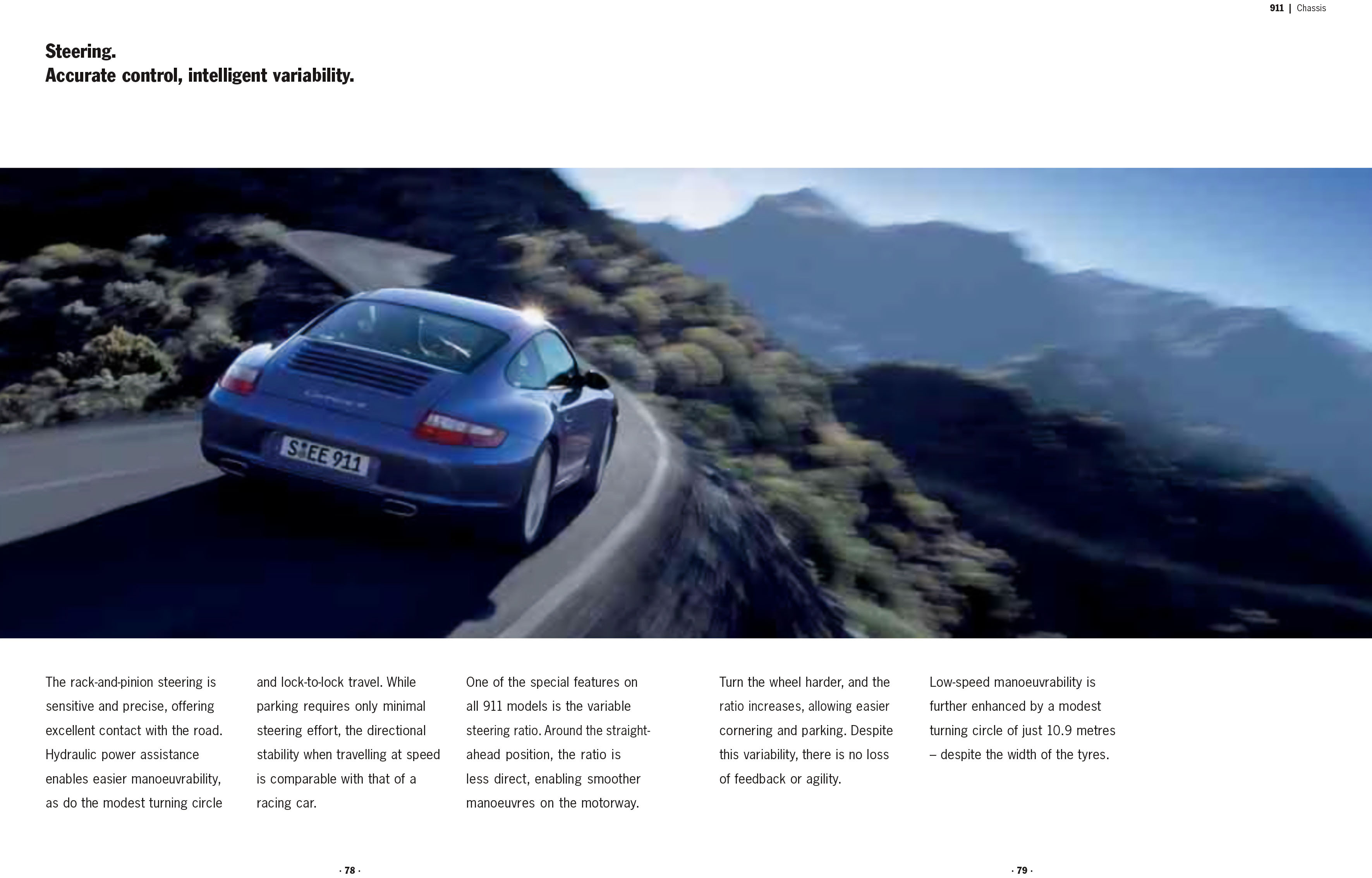
What has aged exceptionally well is the hydraulic steering. As electrically-assisted systems became universal across the industry, the 997’s unfiltered mechanical feedback has become a defining characteristic: the reason collectors seek these cars over newer, faster, more technologically advanced models. The 991 generation improved in nearly every measurable way (quicker, more efficient, better handling at the limit) but it lost the conversation. The 997 was the last 911 that talked to its driver through the steering wheel.
This has elevated the 997.1 to ”high-water mark” status amongst enthusiasts: the final iteration of the analogue-digital bridge. It was modern enough to be reliable (when properly maintained) but traditional enough to deliver sensory experiences that newer cars, for all their sophistication, cannot replicate. It is period-correct rather than outdated, a distinction that matters in a market increasingly interested in mechanical purity.
The bore scoring and IMS bearing issues mean that acquisition requires due diligence rather than faith. A comprehensive pre-purchase inspection is not optional. But for buyers willing to manage these known quantities, the 997.1 offers something that subsequent generations traded away: unmediated connection between driver and machine, digitally assisted but never digitally dominated.
The Rectification
The 2006 Porsche 911 Carrera was marketed as evolution, but it functioned as correction. The oval headlights were not merely aesthetic preference but corporate admission: we understand what this car is supposed to be. The improved interior quality, the return to the five-dial instrument cluster, the meticulous attention to material selection; these were not incremental refinements but deliberate restoration of principles the 996 had compromised.
Porsche had learnt that the 911’s identity was not negotiable. The silhouette could evolve, the technology could advance, but the core philosophy (mechanical precision rendered in consistent form) was inviolable. The 997 rectified the errors of the previous generation not through revolution but through careful, rational return to fundamentals.
Two decades later, what endures is not the specifications (those have been surpassed many times over) but the equilibrium. The 997.1 sits at the precise intersection of analogue feedback and digital assistance, of traditional mechanical systems and modern electronic control. It is the last 911 that could claim this specific balance, and that has made it valuable in ways the 2006 brochure could not have anticipated.
The rectification succeeded. The 911’s soul, briefly misplaced, was reclaimed. What Porsche discovered in the process (that heritage is not optional, that identity cannot be cost-engineered away) would inform every subsequent generation. The 997 was not just a car but a lesson in institutional memory, proof that sometimes the best way forward is a carefully calculated step back.
The Fine Print
