
The Triangle Heretics: Mazda RX-8 and the 9,000rpm Apostasy
How a four-door rotary sports car became the mechanical equivalent of a religious text, and why we're still reading it in 2026

The Cover: The Manifesto in Velocity Red
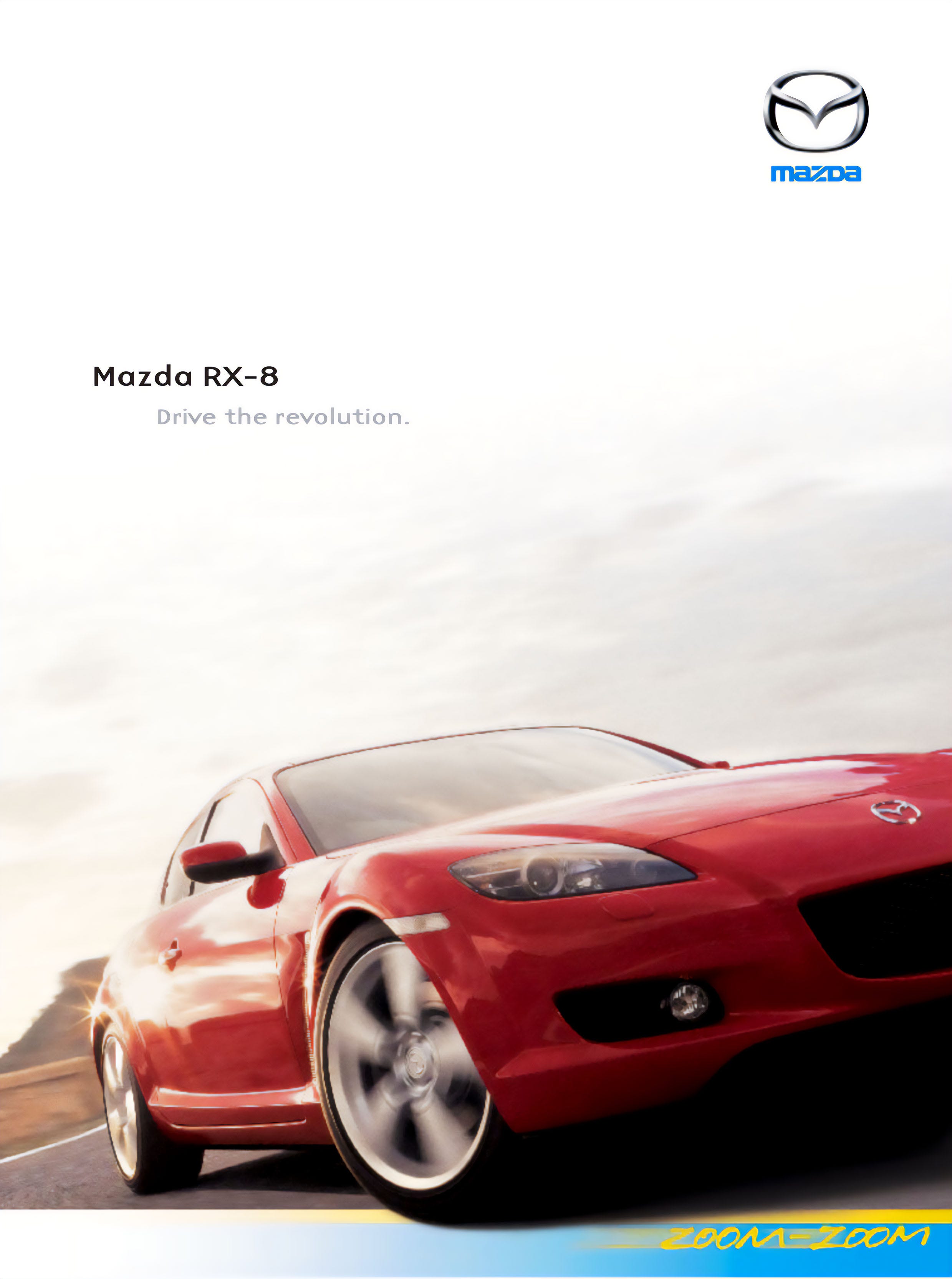
There it is. Velocity Red nose, three-quarter angle, the words “Drive the revolution” stamped across the top like a declaration of war against common sense. This is 2003, and Mazda has decided that what the world needs is a four-door sports car powered by a Wankel rotary engine that redlines at 9,000rpm.
Not 8,500. Not “approaching nine thousand in optimal conditions.” Nine. Thousand. Revolutions. Per. Minute.
The Zoom-Zoom era’s apex wasn’t the MX-5’s cheerful accessibility or the RX-7’s turbo-lag drama. It was this: the RX-8, a car so conceptually bizarre that it required an entire brochure to justify its existence. And justify it Mazda did, with photography so high-contrast and millennium-modern that it made the car look like it had been beamed down from a future where internal combustion hadn’t been regulated out of existence.
The promise was simple: you could have your rotary cake and eat it with three friends. The reality was more complicated. But we’re getting ahead of ourselves.
The Designer’s Vision: Rotor-Shaped Bonnet Bulges and Other Acts of Faith

Hero shot. Motion blur. That distinctive dip in the bonnet that Mazda’s designers insisted was “rotor-shaped” because of course it was. Everything about this car had to genuflect to the Triangle. The wheels? Five spokes arranged to echo the rotor’s form. The oil filler cap? Stamped with a triangle. The very architecture of the bonnet? A three-dimensional tribute to Felix Wankel’s epitrochoidal chamber geometry.
This spread calls the RX-8 a “visionary sports car.” Which is marketing-speak for “we know this doesn’t make rational sense, but bear with us.”
The vision was this: take the RENESIS 13B-MSP (Multi-Side Port, naturally aspirated, 654cc per rotor) and build around it a chassis so geometrically pure that it would shame the piston-engine orthodoxy. Front-midship layout. Perfect 50/50 weight distribution. Suspension geometry lifted from racing car philosophy and dumbed down just enough for road use.
The result? A drag coefficient of 0.30, which wasn’t class-leading but was respectable for something with four doors that opened like a butterfly’s wings. Those 18-inch five-spoke alloys weren’t just pretty; they were functional, designed to ventilate the brakes without creating turbulence that would upset that carefully calibrated Cd figure.
The Interface: 9,000rpm and the Death of the Digital Speedometer
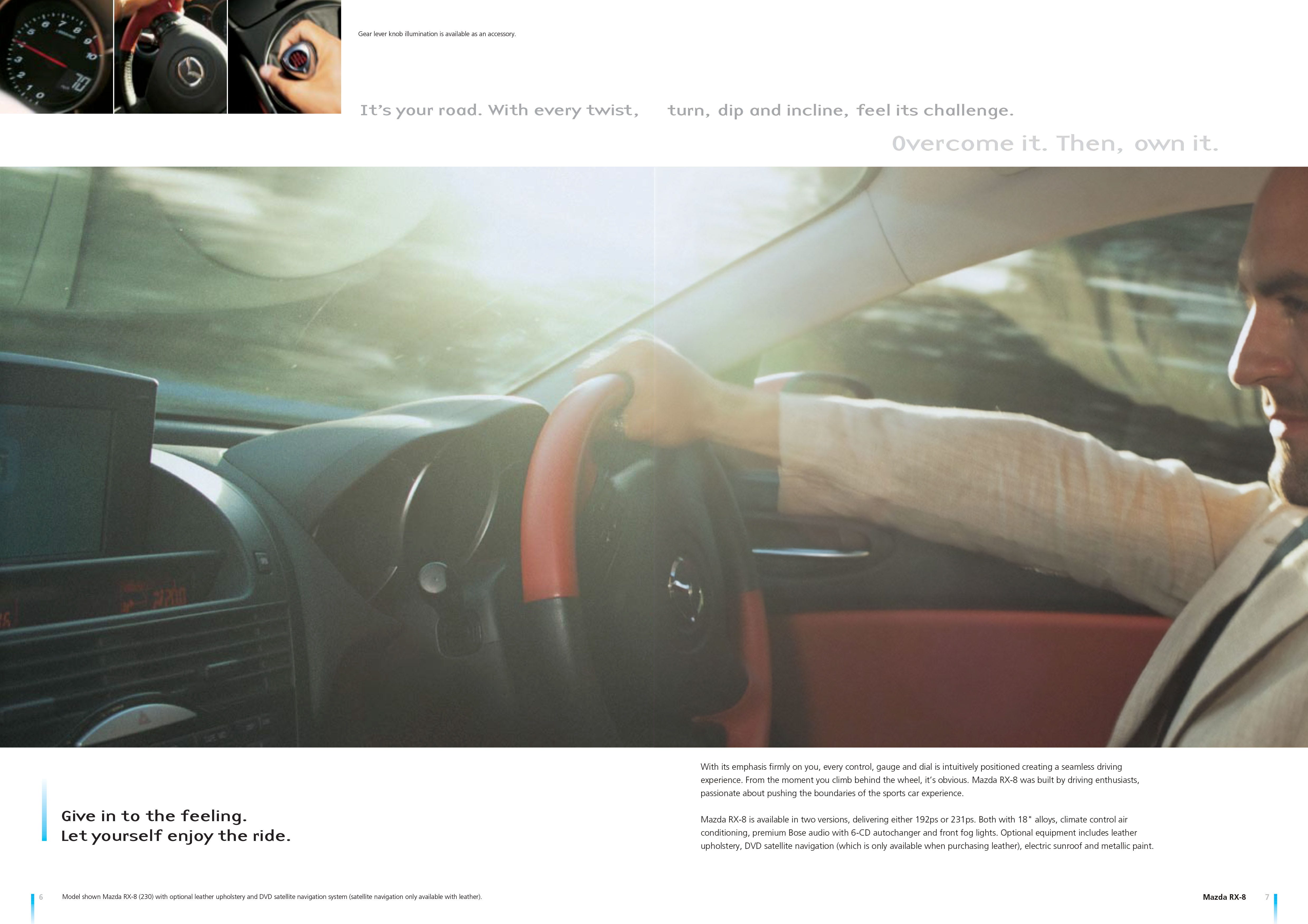
Close-up: the instrument binnacle. Central analogue tachometer, dominant and unapologetic. Digital speedometer relegated to secondary status, tucked into the gauge cluster like an afterthought.
This hierarchy tells you everything. In the RX-8, you don’t watch your speed; you monitor your engine speed. The redline isn’t a suggestion, it’s a destination. And that destination is 9,000rpm, a number so psychologically significant that it becomes the car’s entire raison d’être.
The 228bhp (231 PS) high-power variant delivered its peak output at 8,200rpm, but the engineers gave you another 800 revolutions just for the soundtrack. Because the RENESIS didn’t sound like a normal engine. It didn’t have the bass rumble of a V8 or the angry buzz of a high-strung four-cylinder. It had a glassy, turbine-like scream that climbed octaves as you held the throttle wide, the twin rotors spinning in their housings with the mechanical purity of only three moving parts.
Compare that to forty moving parts in a conventional piston engine. Mazda wasn’t subtle about this calculation.
The RENESIS Anatomy: Three Moving Parts vs. Forty (Mazda Did the Maths)
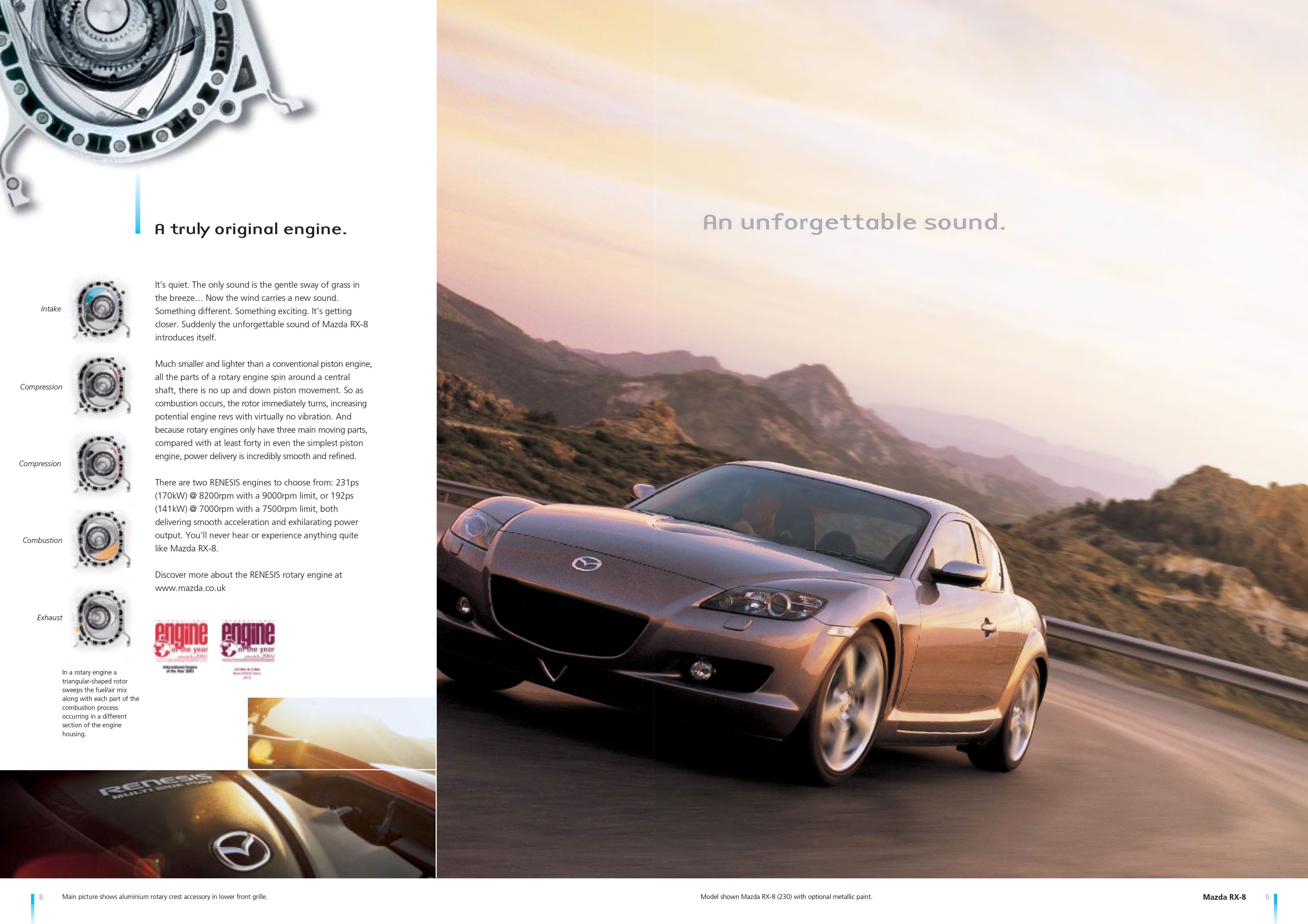
Exploded view. The rotor, suspended in technical drawing precision, its three-sided form rotating through the chamber like some kind of mechanical mandala.
The brochure claims “smoothness unattainable by 40-part piston engines.” This is technically true and also wonderfully misleading. Yes, the rotary has fewer moving parts. Yes, there are no reciprocating masses creating primary and secondary vibrations. But “smooth” is doing a lot of work here, because what the brochure doesn’t mention is that rotaries have their own quirks: they’re thirsty (17 mpg if you’re gentle), they consume oil by design (you check and top up the oil every other fill-up), and those apex seals (the strips that maintain compression between rotor and housing) have a lifespan that makes piston rings look immortal.
But none of that mattered to Mazda’s engineers. They’d solved the peripheral port exhaust’s emissions problem by moving to side ports, which killed some top-end power but meant the RENESIS could actually meet Euro 4 standards. The Multi-Side Port designation wasn’t marketing fluff; it was evidence of genuine engineering evolution.
The result was an engine that made 228bhp from 1.3 litres. That’s 175bhp per litre, which in 2003 was absurd for a naturally aspirated engine. It achieved this by spinning. Fast. And the torque figure, 156lb ft at 5,500rpm, was laughable compared to any turbocharged rival. But you didn’t buy an RX-8 for torque. You bought it for the experience of wringing that engine to 9,000rpm in second gear and hearing God’s own tuning fork.
The X-Ray Chassis: 50/50 Balance as a Religious Text

Ghost view. The engine, rendered transparent, sits entirely behind the front axle centreline. The gearbox extends rearward. The propeller shaft dives toward the rear differential with the inevitability of perfect physics.
This is the front-midship layout, and it’s why the RX-8 handled like a car half its size. Low polar moment of inertia (a phrase the brochure uses without definition, because if you need it explained, you’re not the target buyer) meant the car pivoted on its axis with an eagerness that bordered on telepathic.
The numbers: kerb weight around 1,390 kg. Not featherweight by modern standards, but distributed so perfectly that the RX-8 could change direction with a steering input that felt like thought transmission. The electric power steering, usually the death of feel, was calibrated to weight up progressively delivering what Mazda termed “razor-sharp” response.
For once, the hyperbole was justified.
The Geometry: Double-Wishbone Theology and Multi-Link Faith
Technical diagrams. Front: double-wishbone suspension, offering precise control of camber and caster throughout the travel. Rear: multi-link arrangement, five separate links per side, allowing Mazda’s engineers to dial in handling characteristics with surgical precision.
This wasn’t cost-engineering. This was a chassis designed for people who understood that suspension geometry mattered more than horsepower. The RX-8 didn’t win straight-line drag races. It won the battle for your soul in the first properly fast corner, where the chassis told you clearly, immediately, that it was on your side.
The brochure calls this “intuitive response.” What they mean is: the car did what you asked it to do, when you asked it to do it, without drama or negotiation. No understeer. No oversteer unless you provoked it. Just a sense of connection between steering wheel and road surface that made you feel like you were actually driving rather than negotiating with a computer.
In 2026, we’d kill for this. Modern sports cars are faster, grippier, more capable in every measurable way. But they’re also more isolated, more algorithmic. The RX-8 was analog in the best sense: inputs had outputs, and you could feel every one of them.
The Freestyle Open: Pillar-less Heresy and Structural Compromise

All four doors open. Sunset background. The visual message is clear: “Unparalleled access.”
This was Mazda’s great conjuring trick; four doors, zero visible B-pillars. The rear doors were rear-hinged, suicide-style, opening backward once the front doors were opened. The result was an aperture so wide you could load a washing machine through it. Or four adults, which was ostensibly the point.
The brochure calls this practical. What it doesn’t say is that those rear seats were genuine, adult-sized accommodation only if your adults were under 5’8” and didn’t expect knee room. But compared to the token rear perches in a 911 or the nonexistent rear seats in an MX-5, the RX-8’s rear pews were legitimately usable for actual journeys.
This is how Mazda sold the RX-8 to people who needed justification. Yes, it’s a sports car. But it’s also a practical family transport. You can drop the kids at school. You can take clients to dinner. You can maintain the illusion of sensible adult decision-making while owning a car that redlines at 9,000rpm.
The Integrated B-Pillar: Hidden Strength and the Weight of Safety
Structural diagrams. High-tensile steel vertical reinforcements embedded in the rear door edges. When closed, these pipes lock into receiving structures in both the roof and floor, creating a “hidden” B-pillar that maintains crash safety without visual interruption.
This was engineering heroism disguised as styling gimmick. Those reinforcements weren’t light (they added kilos that would have made Colin Chapman weep) but they enabled that uninterrupted shoulder line, that sense of openness, that made the RX-8 visually distinct from every other four-door car on sale.
Did it work? The crash test ratings suggested yes. The insurance premiums suggested no. But Mazda committed to the bit, and in 2026 we appreciate the ambition even if we can see the compromise.
The Sensory Playground: Bose, Leather, and the Illusion of Civilisation
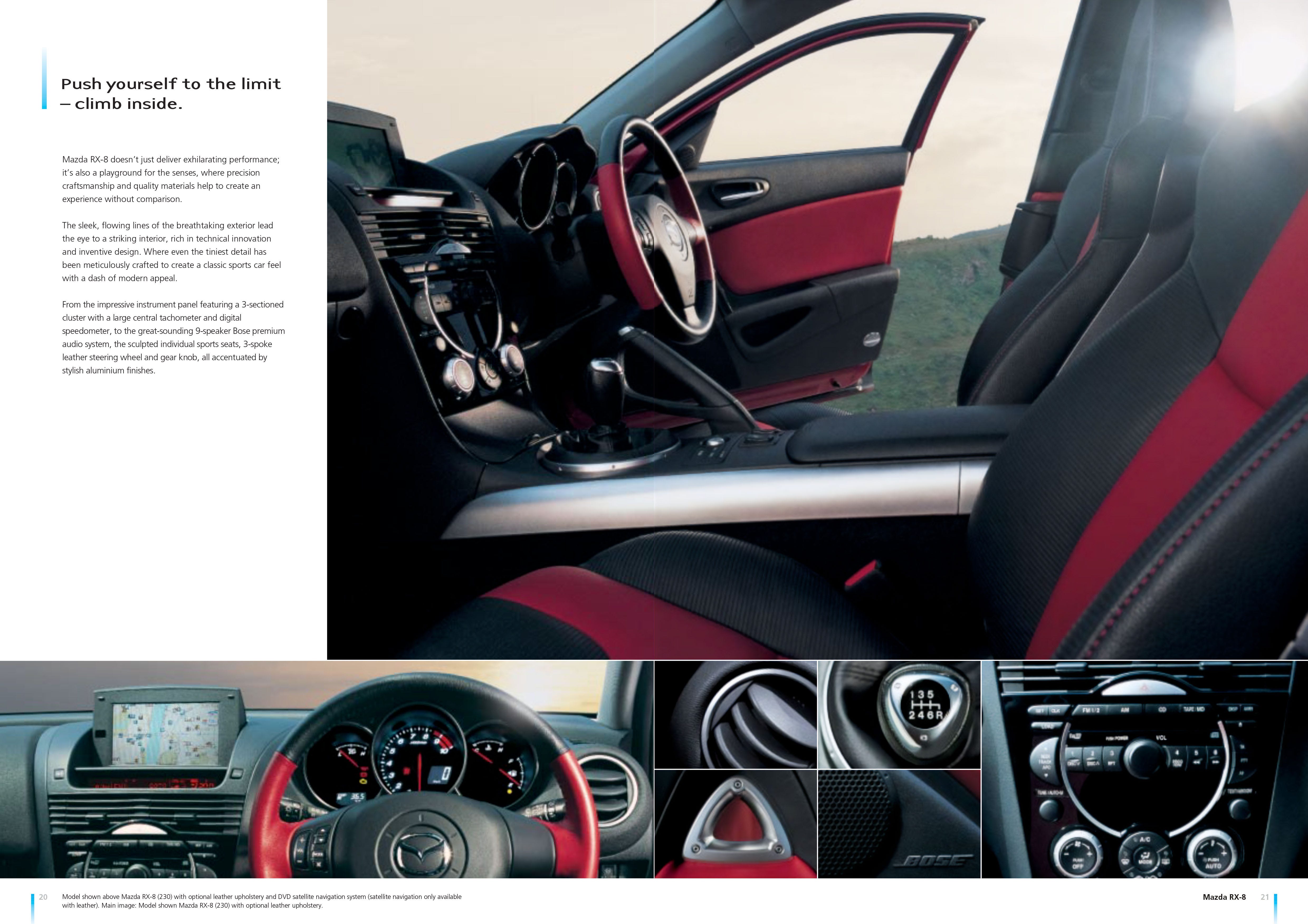
Interior shot. Nine-speaker Bose audio system, 240 watts of power, designed to create a “sensory experience” that extended beyond the mechanical. Sculpted sports seats with leather facings. Standard climate control. Optional DVD satellite navigation for those who occasionally needed to find their way home.
The brochure sells this as refinement. What it really was: distraction. Because on the right road, with the windows down and the engine spinning past 7,000rpm, you didn’t need the Bose system. The RENESIS provided all the audio you required; a glassy, climbing scream that had more in common with a turbine than a traditional reciprocating engine.
The seats held you in place through corners that lesser chassis would have turned into drama. The air conditioning kept you from sweating through your shirt during summer track days. The navigation system meant you could actually locate those back roads that made the RX-8’s chassis sing.
This was the RX-8’s quiet genius: it was a serious sports car that didn’t demand you live like a monk. You could daily-drive it. You could use it in winter (though you shouldn’t, because rust). You could maintain the illusion of being responsible while secretly knowing that you owned one of the last truly bizarre production cars.
The Accessory Catalog: Fetishising the Triangle
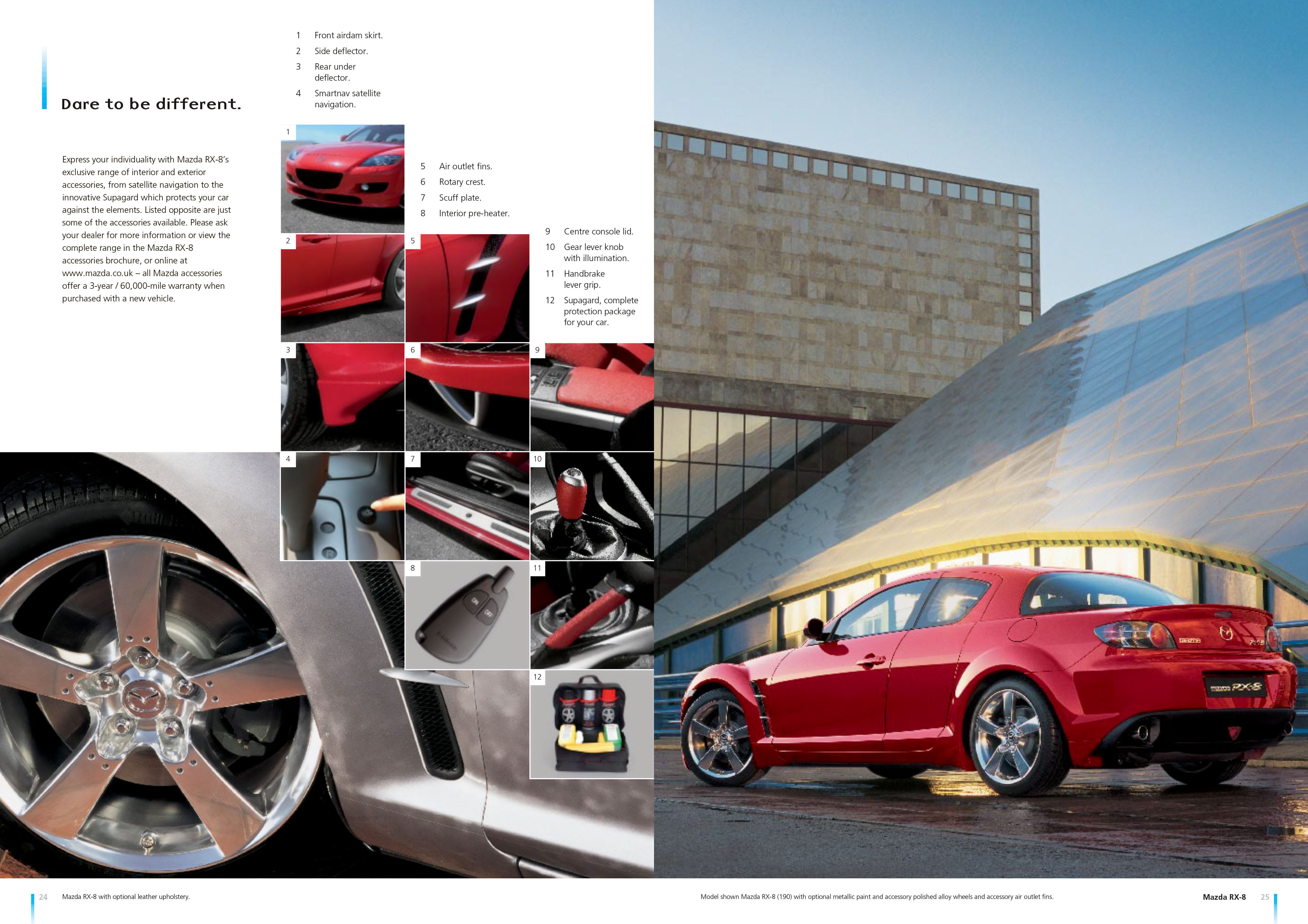
Detail shots. Rotary crest oil filler cap. Illuminated gear knob with triangle motif. Air outlet fins stamped with the rotor shape. Scuff plates that announced “ROTARY ENGINE” in case you’d somehow forgotten.
This is where Mazda’s obsession became almost religious. The Triangle wasn’t just a logo; it was a complete identity system. Every accessory, every styling detail, every piece of brightwork had to reference Felix Wankel’s genius. Or madness. Depending on your perspective and your fuel bills.
The brochure’s call to action: “Dare to be different.” Which in 2003 meant buying a four-door sports car that drank oil, consumed fuel like a V8, and required 3,000-mile service intervals if you wanted the engine to survive past 60,000 miles.
In 2026, we call this “character.” In 2003, it was called “questionable life choices.”
The Rearview Mirror: Why We’re Still Talking About This in 2026
Here’s what happened: production ended in 2012. The RENESIS was killed by emissions regulations, fuel economy mandates, and the creeping realisation that most people would rather have a Volkswagen Golf GTI. No successor emerged. The rotary dream died.
But something strange occurred in the collector market. Low-mileage, unmodified 228bhp models started appreciating. Not slowly. Not subtly. Because the RX-8 had become the last naturally aspirated rotary sports car Mazda would ever build. The final expression of a philosophy that prioritised mechanical soul over spreadsheet efficiency.
The maintenance requirements, those 3,000-mile oil changes, that religious avoidance of short trips that could flood the engine, became the “price of entry.” Owners who understood the liturgy were rewarded with reliability. Those who didn’t faced apex seal replacement bills that made grown adults weep.
But for those who got it, who understood what Mazda achieved with that front-midship layout and those structurally integrated B-pillars and that 9,000rpm redline, the RX-8 represented something increasingly rare: it was genuinely different.
Not better, necessarily. Not more practical. Not more efficient. Just different. A mechanical anomaly that somehow made it to production, survived for nine years, and left a legacy that no electric motor will ever replicate.
The RX-8 was the rotary rebellion. It was the last gasp of Wankel faith. And that brochure, with its millennium-modern photography and its technical diagrams and its fetishisation of the Triangle, wasn’t just marketing material.
It was scripture.
Phenomenal breakdown! The way the RX-8 priortized mechanical soul over spreadsheet logic captures something we've totally lost. My uncle owned one and I remember him checking the oil more often than gas, which sounded absurd until you drove it. That 9000rpm redline wasnt just a number it was the entire point of existence. Makes me think we traded characterfor competence somewhere along the way.