The Return of Hachiroku: Toyota's Deliberate Act of Subtraction
How the GT86 Proved Less Was More

In 2012, Toyota, the company that had recently given the world the Prius and was busy evangelising the hybrid powertrain to an entire generation of motorists, released a rear-wheel-drive sports coupe with 200 brake horsepower, Prius-spec tyres, and no interest whatsoever in its own lap times.
The GT86 (Hachiroku, eighty-six in Japanese) was a deliberate echo: the AE86 Corolla, Toyota's lightweight rear-wheel-drive coupe of the 1980s, had carried the Hachiroku identity into motorsport legend.
This was the return, and it did not arrive hedged or cautious. It arrived with a thesis.
The 2013 UK edition brochure presents that thesis. It opens not with a spec sheet but with a photograph of two ancestors: the 2000GT and the S800, parked behind the newcomer on what appears to be a grand stone courtyard. Three Toyota sports cars across five decades.
What you are looking at is a manifesto for the proposition that the driver’s relationship with a machine had been eroded, systematically, by the very technology that was supposed to improve it. And that Toyota, of all manufacturers, was going to build the antidote.
Heritage-Agility and the Art of White Space
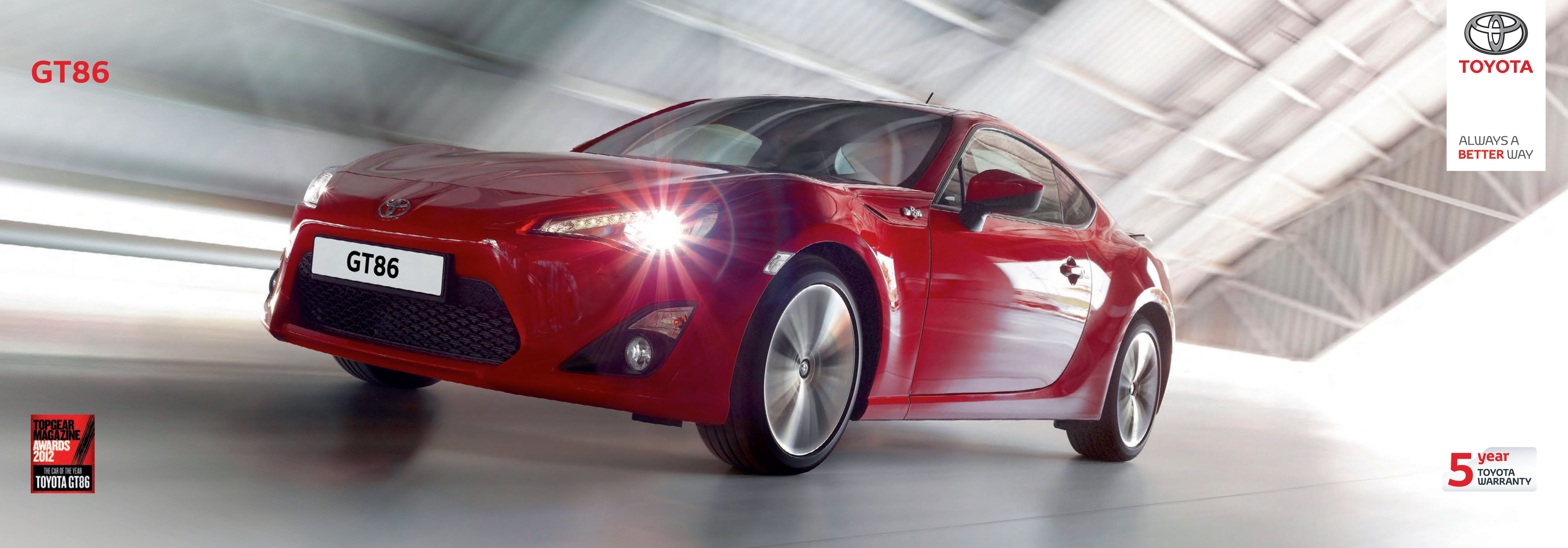
The brochure’s aesthetic is immediately distinctive. White space dominates the early spreads in a way that is unusual for a mainstream Toyota publication; it is a presentation strategy borrowed from gallery design, and it works the same way. Emptiness creates anticipation. The introductory copy is small, almost shy, set in Toyota Type (the brand’s clean, modern sans-serif), so that a single sentence carries the weight of a paragraph.
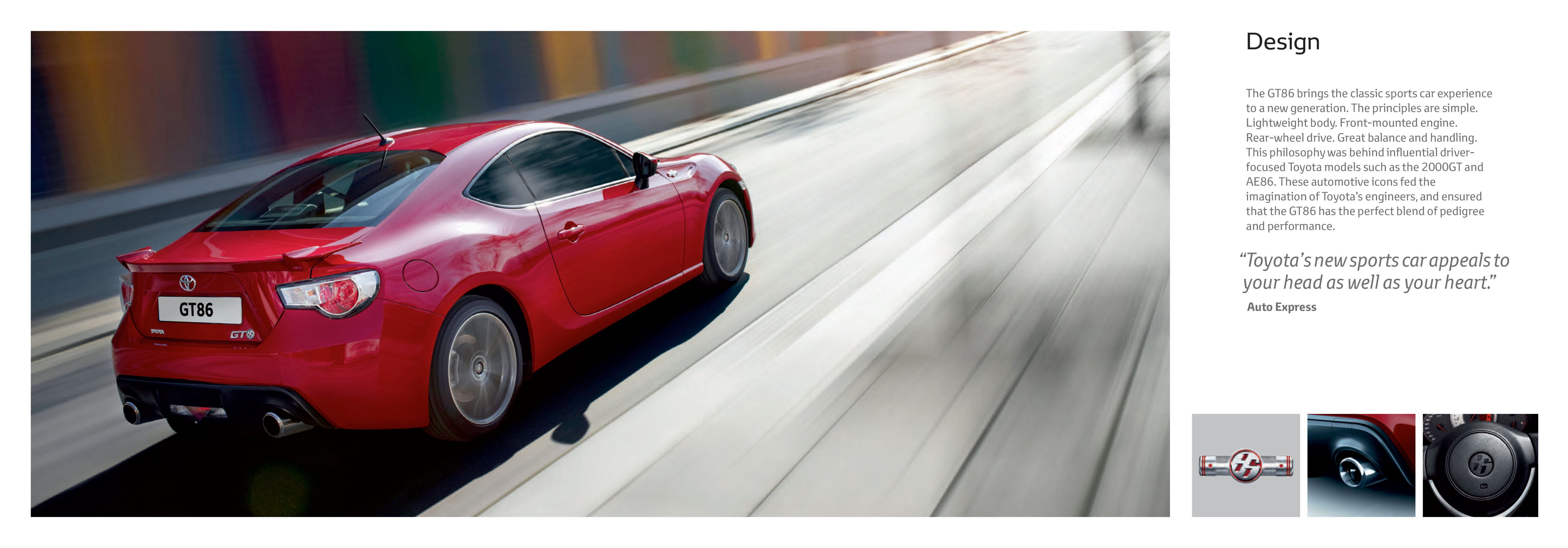
There are two distinct styles of photography. The high-motion shots, directional blur, panning shots at low angles, the car mid-corner with its weight just beginning to shift, are doing kinetic work. They are not selling speed in the conventional horsepower-and-exhaust-note sense. They are selling agility, which is a subtler and more specific thing. The car never appears to be going very fast. It appears to be going correctly. There is a difference, and the brochure understands it.
The colour palette (red, black, white) is a direct inheritance from the AE86’s motorsport history. Racing Hachiroku liveries, Japanese touring car imagery, the BTCC Corolla of Chris Hodgetts: the palette signals this lineage without spelling it out. The product is the red one. The TRD is the white one. The ancestors, on page two, are a red 2000GT and a blue S800.
What the brochure does not do is equally instructive. There are no lifestyle shots: no winding Italian roads, no young professionals in cashmere, no poolside arrivals. It is entirely free of the signifiers of aspiration-as-wealth. The GT86 brochure sells to people who want to drive, and it trusts that such people exist.
The Lineage
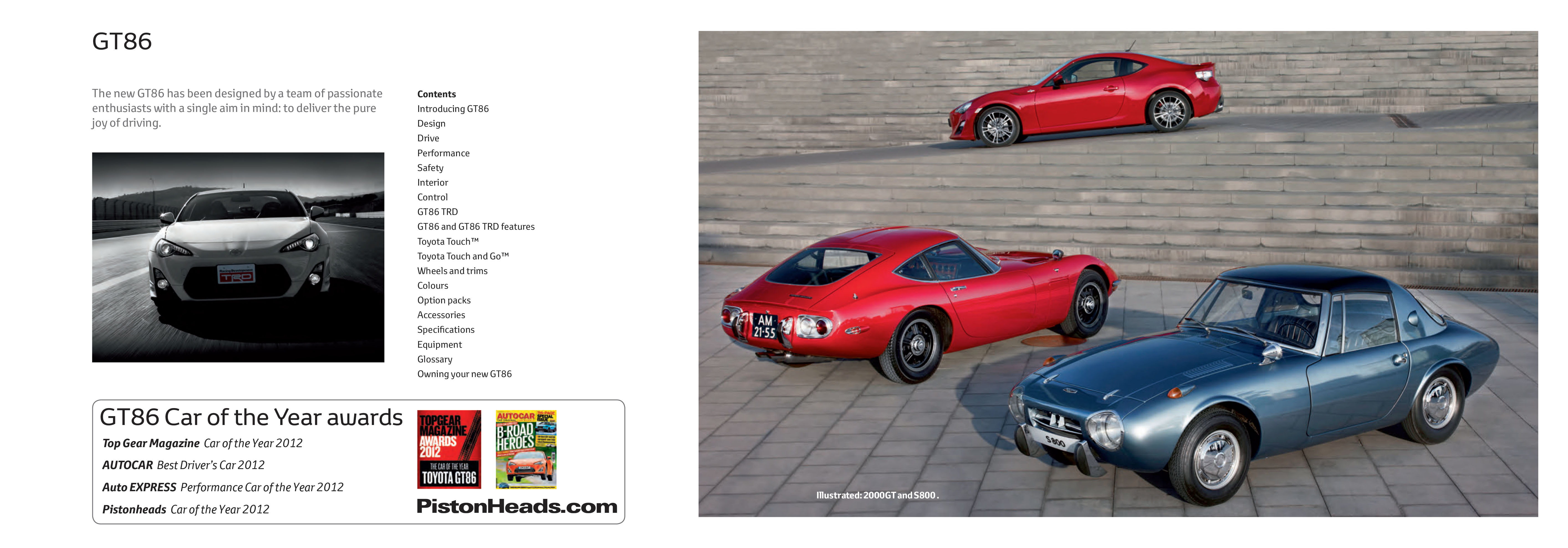
The first act is historical. The GT86 is shown with the 2000GT and the S800, a staging that establishes an unbroken line of intent running from the 1960s to the present. The copy is restrained to the point of severity:
“The new GT86 has been designed by a team of passionate enthusiasts with a single aim in mind: to deliver the pure joy of driving”
No qualifier. No “while maintaining segment-leading fuel efficiency”. No “for the whole family”. The singular aim stated without apology. In an era when most product copy is written by committee to offend nobody, this sentence reads as almost confrontational in its focus.
The 2000GT is a significant choice of ancestor. It is not a hot hatch, not a saloon car made sportier, not a front-wheel-drive compromise. It is a genuine mid-century sports car, small and light, made when Toyota was trying to prove something to the world. The brochure is arguing, implicitly, that the GT86 is made from the same material: proof, rather than product.
The Philosophy of Control
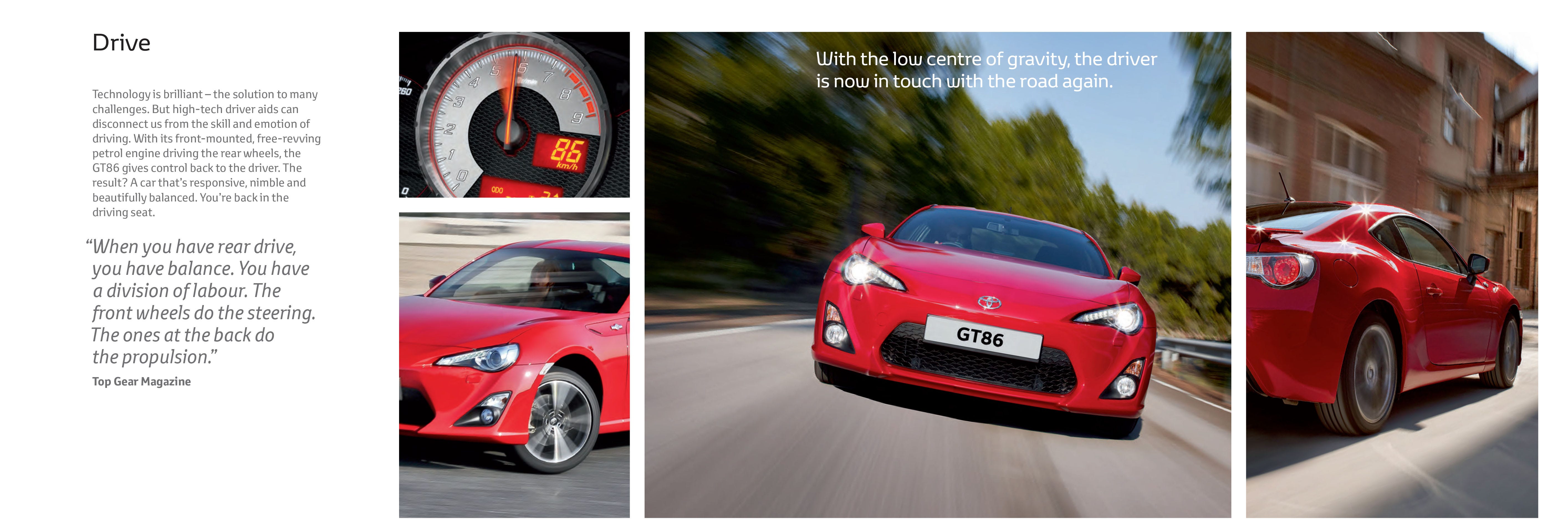
The Drive spread places a tachometer photograph on the upper-left, the needle racing towards 6,000rpm, together with three pictures of the GT86 in motion. The copy opens with what is, for a corporate brochure, a fairly extraordinary admission:
“Technology is brilliant - the solution to many challenges. But high-tech driver aids can disconnect us from the skill and emotion of driving.”
Toyota is criticising driver aids. In 2013. The company that manufactures more cars per year than almost anyone else on the planet is, on page four of its sports car brochure, positioning electronic intervention as a form of loss.
This is the brochure’s sharpest move: it reframes the GT86’s relative simplicity not as a budget constraint but as a design philosophy, and it does so by arguing that complexity has costs the customer hasn’t been told about.
Top Gear Magazine is quoted: “When you have rear drive, you have balance. You have a division of labour. The front wheels do the steering. The ones at the back do the propulsion.” It is a clean, mechanical description of something that drivers feel rather than articulate. The brochure is offering its readers the vocabulary for something they already knew instinctively.
An image shows the GT86 mid-corner with the caption overlaid: “With the low centre of gravity, the driver is now in touch with the road again.” That “again” is doing significant work. It implies the connection existed, was lost, and has been restored. The brochure is not selling a new experience; it is selling a recovered one.
The Boxer Heart
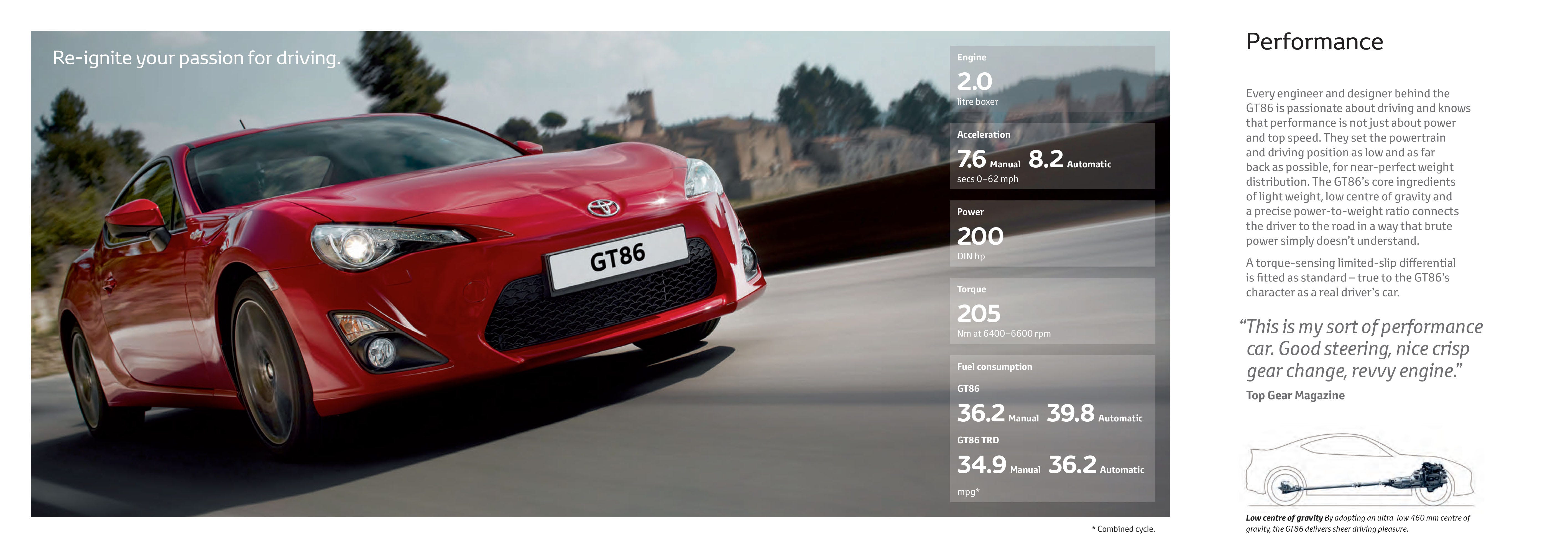
The Performance spread is where the brochure must defend its numbers, and it does so with striking directness. The engine specifications are presented over a cornering shot of the red GT86: 2.0-litre boxer, 200 DIN hp, 205Nm at 6,400-6,600 rpm, 0-62mph in 7.6 seconds (manual). On a purely numerical basis, none of these figures were that impressive in 2013. A hot hatchback would embarrass this car from a standing start.
The copy addresses this without flinching:
“GT86 is passionate about driving and knows that performance is not just about power and top speed... The GT86’s core ingredients of light weight, low centre of gravity and a precise power-to-weight ratio connects the driver to the road in a way that brute power simply doesn’t understand.”
Brute power simply doesn’t understand. It is the brochure’s best sentence. Not “brute power is insufficient” or “brute power has limitations”. Brute power doesn’t understand. Power is cast as intellectually limited, a blunt instrument unable to comprehend the nuanced conversation the GT86 is trying to have with its driver.
The specification panel is cleverly designed. The large numerals, 200, 205, 7.6, are isolated in dark cells against a dark background, which gives them visual weight they would not otherwise carry.
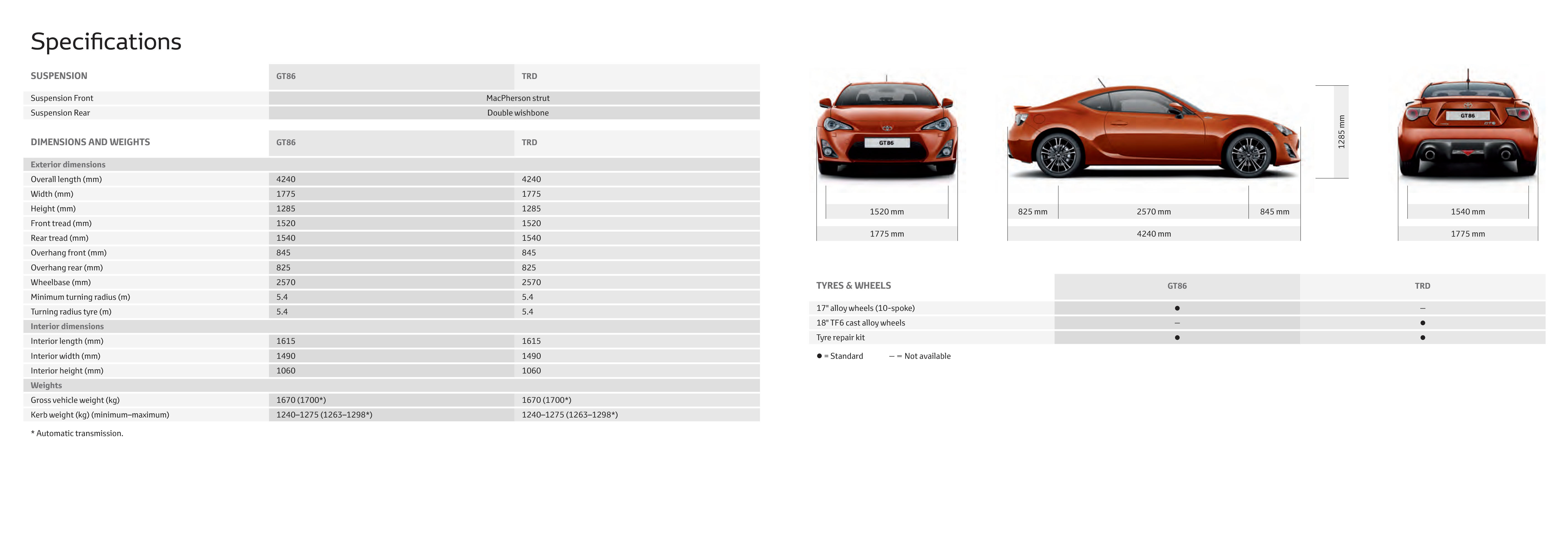
The 460mm centre-of-gravity figure appears in the caption of the powertrain diagram at the base of the page, labelled with quiet confidence:
“Low centre of gravity: By adopting an ultra-low 460mm centre of gravity, the GT86 delivers sheer driving pleasure.”
Lower than many dedicated supercars of the period. The brochure knows this, but doesn’t say so directly. It doesn’t need to.
The torque-sensing limited-slip differential (”fitted as standard”) is dropped in as a parenthetical: “true to the GT86’s character as a real driver’s car.” An LSD is not a luxury feature; it is a tuning tool. On a sub-£25,000 sports car, in 2013, it is a statement of intent.
The Cockpit Hierarchy
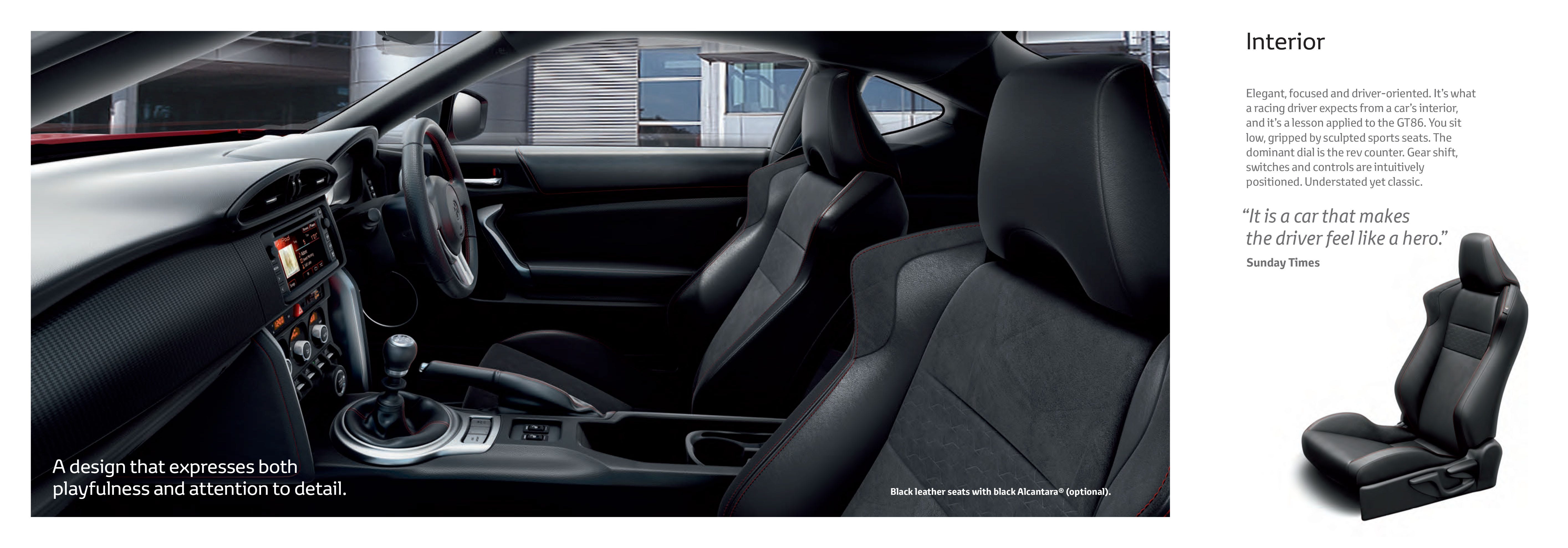
The Interior page is architecturally significant. The opening sentence establishes the framing:
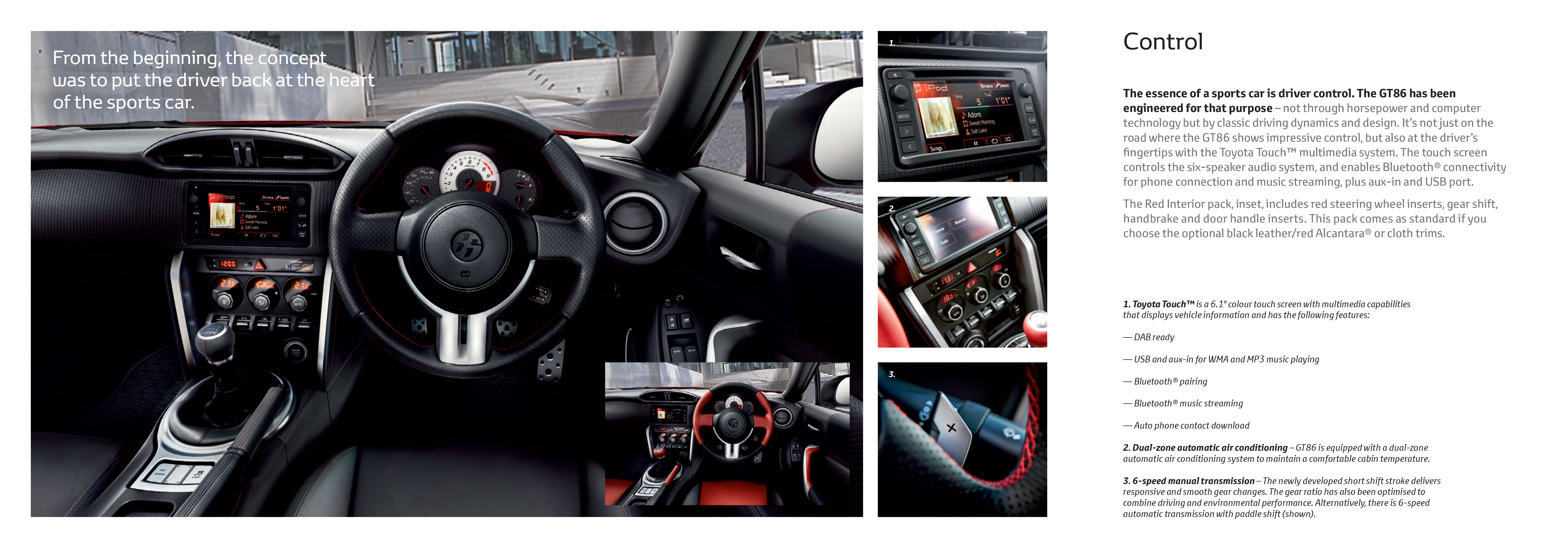
“Elegant, focused and driver-oriented. It’s what a racing driver expects from a car’s interior, and it’s a lesson applied to the GT86.”
Not what a driver expects. What a racing driver expects. The GT86 cockpit is measured against motorsport ergonomics. The claim then made, that the GT86 meets this standard, is supported not by feature lists but by the layout of the instruments. The dominant dial is explicitly identified as the rev counter. In most cars, the speedometer is dominant; here, rpm is king. This is the correct priority for a car meant to be driven at the top of the rev range, and the brochure is quietly telling you that.
The Sunday Times quote selected for this page (”It is a car that makes the driver feel like a hero”) is cleverly chosen. It does not say the car is fast. It says the driver feels heroic. This distinction is the brochure’s central argument in nine words.
Racing Development
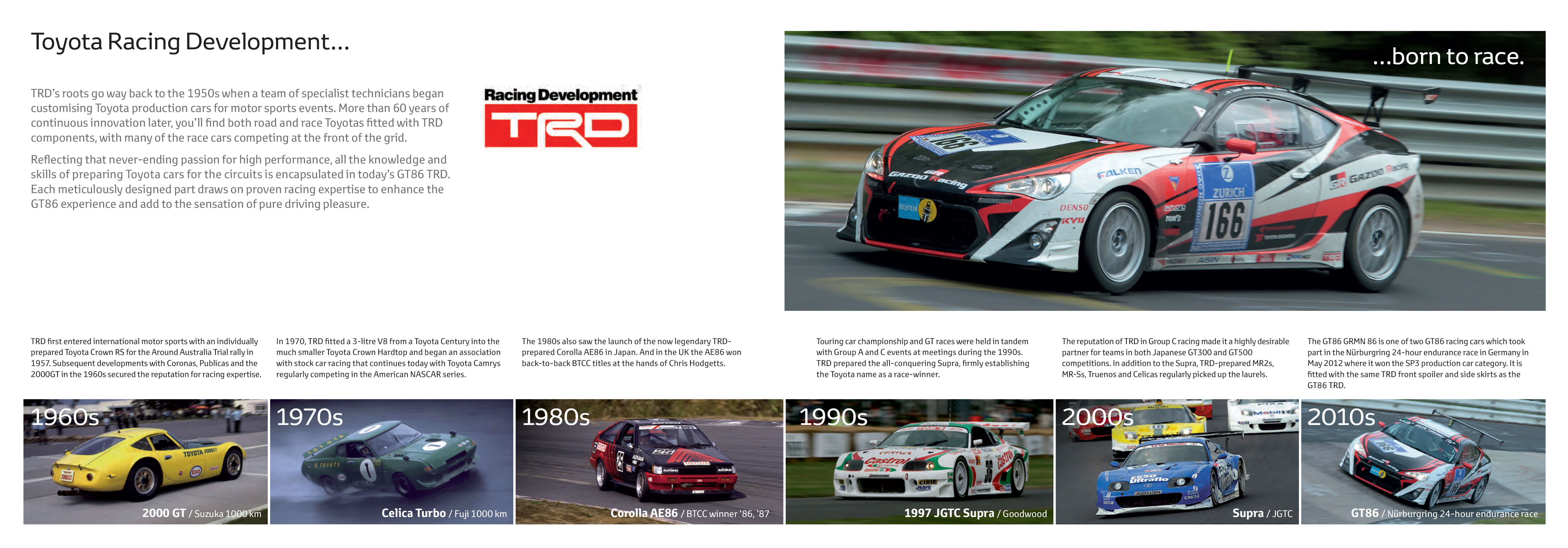
The TRD history spread is structured as a timeline running from TRD’s 1957 entry into international motor sport through to the GT86 GRMN’s class win at the Nürburgring 24-hour race in 2012. The timeline format places the GT86 at the end of a continuous racing lineage rather than presenting it as a new product.
The copy is careful: “Reflecting that never-ending passion for high performance, all the knowledge and skills of preparing Toyota cars for the circuits is encapsulated in today’s GT86 TRD.” The word “encapsulated” is precise.
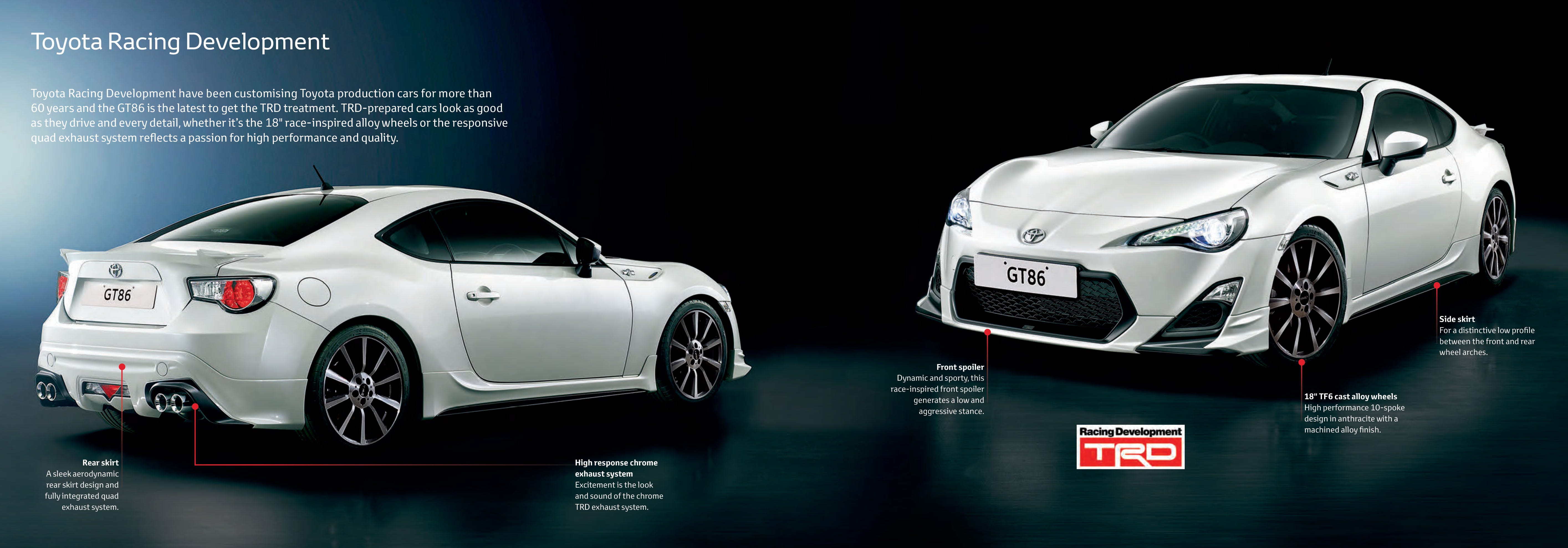
The TRD spec doesn’t add power; both models produce the same 200 DIN hp. It adds the aesthetic and aural language of motorsport (the quad exhaust, the front spoiler, the anthracite TF6 alloys) without changing the mechanical proposition. The brochure presents the TRD as an expression of heritage rather than an upgrade in the conventional sense, which is an honest framing and an unusual one.
The Easter Egg
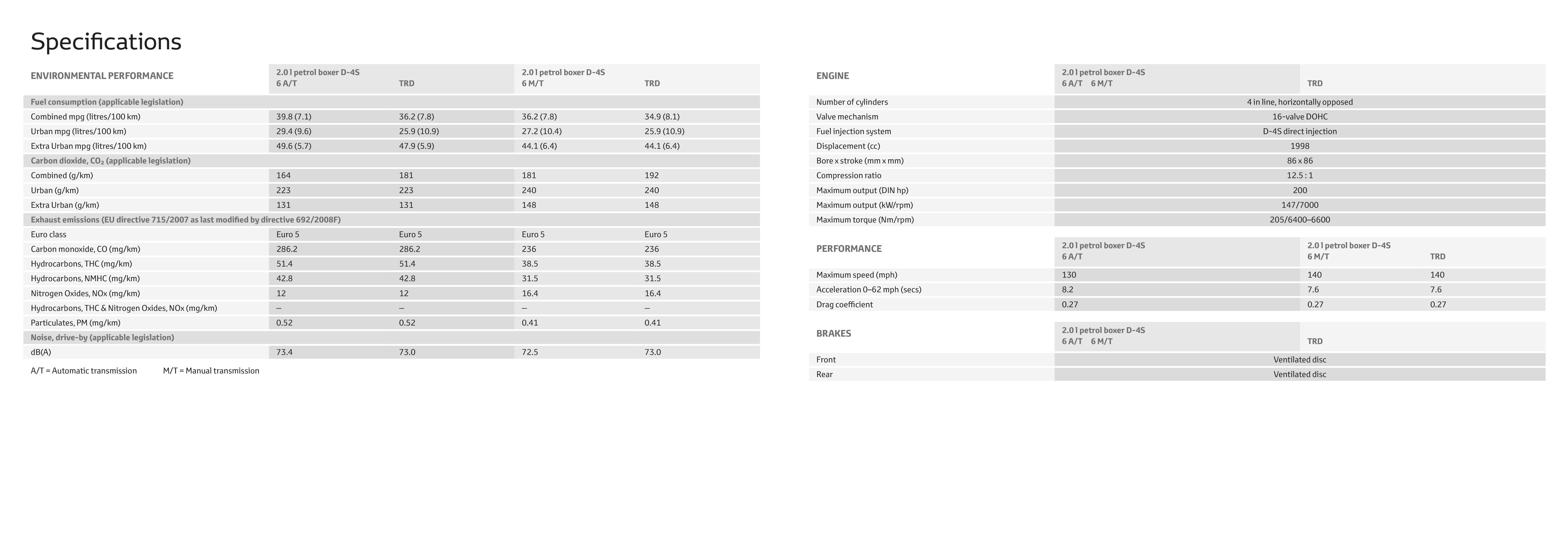
The specification pages are where brochures usually abandon all literary ambition. Not this one. Buried in the engine data table, amid the valve mechanism and compression ratio, is a single line: Bore x stroke (mm x mm): 86 x 86.
Square bore and stroke. The engine’s internal dimensions are literally the car’s name. This is an engineering Easter egg, a joke made in metal, at the level of tooling, which only the reader of the specification table will notice. The brochure does not draw attention to it; it simply places the number in the table and lets the enthusiast find it.
The Rearview Mirror: Purity at a Price
The Problem: The Torque Dip and the Twitter Review
The GT86’s commercial trajectory was shaped by a single mechanical characteristic the brochure declined to discuss: the torque dip. Between approximately 3,000 and 4,500rpm, precisely the band most relevant to urban and suburban driving, the D-4S injection system produced a breathless, slightly inert sensation that struck buyers accustomed to turbocharged torque curves as definitive evidence that the car was underpowered.
This was, in a narrow sense, correct: the engine is not powerful. But the torque dip is a specific thing, distinct from a general lack of performance, and it required a style of driving (keeping the engine above 4,500rpm, using the gearbox purposefully, reading the road ahead) that many buyers found inconvenient. The car rewarded patience and technique. Social media, which was by 2013 the primary medium through which sports car opinions were formed and transmitted, does not have a great deal of patience or technique. The verdict, underpowered, spread rapidly, and it was not entirely wrong, only incomplete.
Chief Engineer Tetsuya Tada had fought to keep the car naturally aspirated and light. He won that argument internally. He lost it on social media.
The Tax: Mod Culture and the Corrosion Question
Finding a fully stock GT86 in 2026 is a task requiring more optimism than searching the classified advertisements can generally sustain. The car attracted, with remarkable speed, a modification culture that treated it as a base from which to build something louder, lower, wider, or more powerful. Aftermarket turbo kits arrived within months of the car’s launch; coilover suspension followed; wide-arch body kits proliferated. This is, in its way, a measure of the car’s success. It inspired the sort of relationship between owner and machine that the brochure was specifically trying to create, but it makes unmolested examples rare.
Early UK cars are now showing corrosion, particularly on the rear wheel arches and subframe, in cases where underseal was not applied or has deteriorated. The valve spring recall of the early production run was addressed under warranty but remains a known question for buyers of cars with untraceable history. The mechanical platform is otherwise robust, with service intervals long enough to not constitute an ordeal. The engine, shared with Subaru, is well-understood by independent specialists.
The “Mod Tax” is the more insidious cost. Not the money spent on modifications, but the depreciation applied to returned-to-standard cars that buyers approach with suspicion, regardless of receipts.
The Success: The Gold Standard
In retrospect, the GT86’s cultural impact was disproportionate to its sales volume. It re-established, in a market moment dominated by SUVs, turbocharged hatchbacks, and DSG gearboxes, that a rear-wheel-drive, naturally aspirated, driver-focused coupe could still be commercially viable and critically acclaimed. The four Car of the Year awards displayed on page two of the brochure (Top Gear Magazine, Autocar, Auto Express, PistonHeads) were not participation prizes; they represented a genuine critical consensus that Toyota had built something that mattered.
The car’s legacy is the GR86, which resolved the torque-dip complaint with a larger engine and a revised injection system while retaining everything the brochure identified as essential: the 460mm centre of gravity, the rear-wheel drive, the accessible balance, the philosophy of the driver over the computer. The GR86 is the GT86 with the argument already won; it did not need to explain itself to a sceptical market. The 2013 brochure did that work.
The GT86 remains the reference point for the entry-level sports car as it should be: not the fastest, not the most powerful, not the most technologically sophisticated. Simply the most honest. Tetsuya Tada’s car asked a question, what if we built something purely for the driver? The answer, read in a brochure thirteen years later, is still perfectly legible.
The bore is 86 millimetres. The stroke is 86 millimetres. The name is in the engine. Everything else follows from there.