
Bonsai Engineering: Toyota’s Impossible Arithmetic
How Toyota's iQ Proved That Brilliance Doesn't Sell

There is a number that haunts this brochure. It appears on page 22, buried in the specification table, and it reads: 2,985. Two thousand, nine hundred and eighty-five millimetres. That is the total length of the Toyota iQ, a figure so improbable given what Toyota claims for the car surrounding it that you find yourself reading the specification page twice, checking for a misprint.
It is not a misprint. The car is, indeed, less than three metres long. The car also contains, Toyota tells you with quiet confidence, a 5-star Euro NCAP safety rating, nine SRS airbags (including a world-first rear window curtain shield unit), genuine seating for three adults of any appreciable height, and a 1.33-litre four-cylinder engine with dual variable valve timing. This is the central arithmetic of the iQ: the numbers do not add up, and yet they do.
The iQ spent a surprisingly large amount of Toyota’s money proving something philosophically pure: that physics itself could be renegotiated, if only the engineers were willing to start from a sufficiently blank sheet of paper. The question it asked was more fundamental than anything the segment had previously entertained: why should a car be this long?
Toyota, to their considerable credit, never found a satisfactory answer.
The Car as a Consumer Electronic
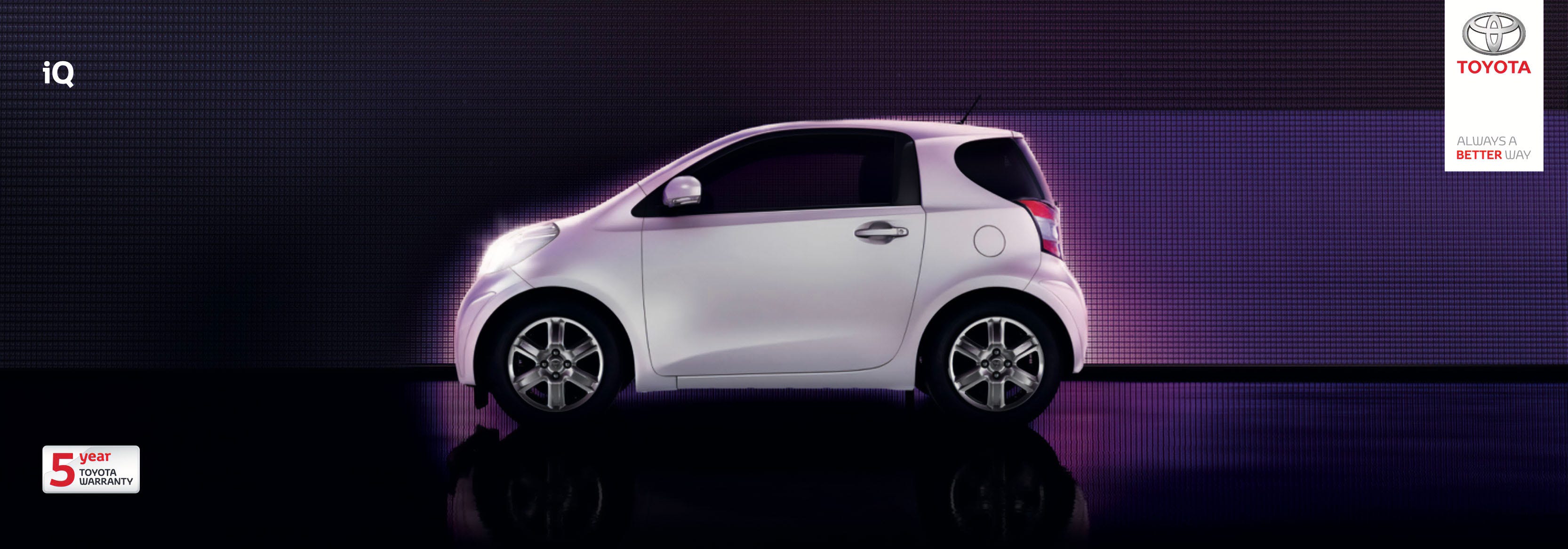
The 29-page brochure that Toyota GB published in January 2012 is an object of remarkable visual self-assurance. It does not look like a car brochure. It looks, with its deep saturated purples, its clinical blacks, and its magenta typographic accents, like the launch materials for a premium Japanese consumer electronic. An audiophile headphone amplifier. A limited-edition mobile phone. Something, at any rate, that is sold not by the yard but by the gram.
This is not an accident of the design department. It is a deliberate position. The iQ’s own marketing team understood, correctly, that their product would be dismissed as a city runabout by anyone who approached it with the traditional metrics, and so they chose different metrics entirely. The brochure’s visual language says: this is a precision instrument. It is to be evaluated the way one evaluates a Leica camera or a Braun kitchen appliance, on the density of its resolved problems rather than the volume of its interior.
The cover image is instructive. The car sits against a pixelated purple-and-black backdrop that resembles nothing so much as a Tokyo nightclub rendered in LED. The iQ is photographed in pure white, side-on, in a composition of almost aggressive minimalism. There is no lifestyle. There is no aspirational couple. There is no winding coastal road. There is only the object, presented with the confidence of something that requires no context because its existence is its own argument.
Throughout the brochure, this visual grammar holds. High white space in the copy blocks. Sans-serif typography with wide tracking. Product close-ups that frame mechanical components, a flat fuel tank, a wheel rim, an airbag diagram, with the same formal attention a luxury goods photographer would give to a watch dial. The brochure understands instinctively what much automotive marketing does not: that restraint, applied consistently, reads as confidence.
The Architecture of a Disruption
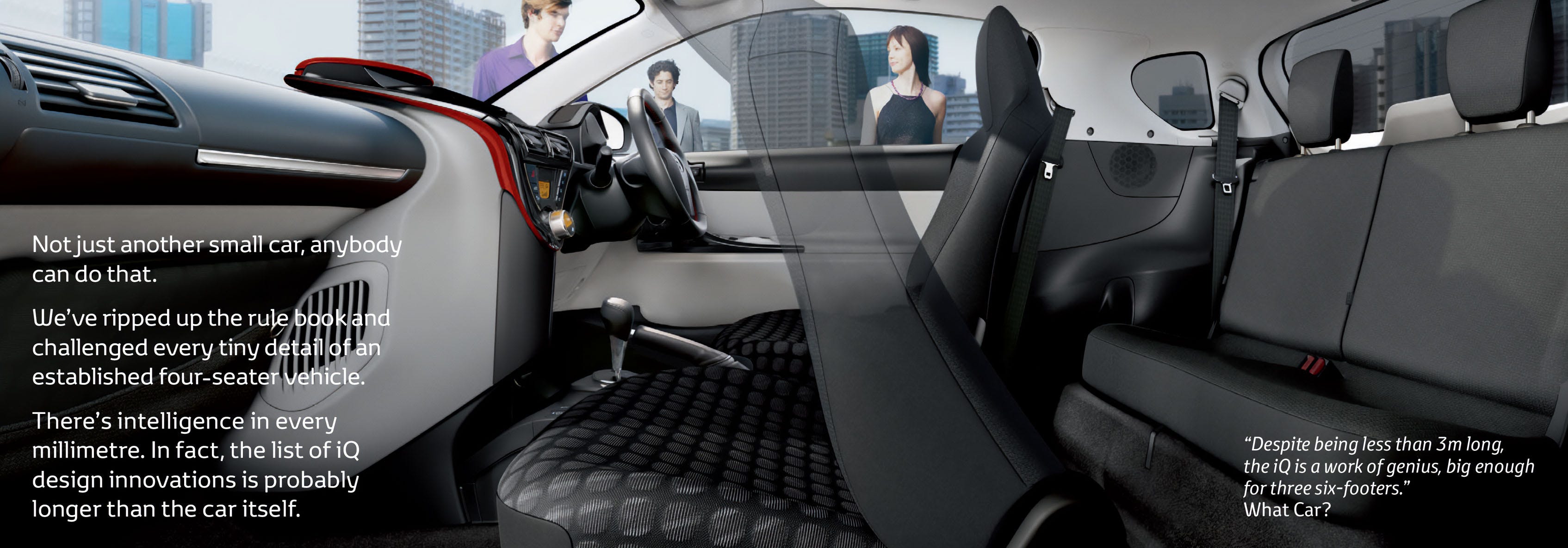
The brochure’s structural argument begins on page 4 and it does not hedge. “Not just another small car,” the copy opens. “Anybody can do that.” The next line is the thesis statement for the entire iQ project: “We’ve ripped up the rule book and challenged every tiny detail of an established four-seater vehicle.”
This is, by the standards of automotive brochure copy, an extraordinary claim. Most small car brochures spend their energy making the best of compromise: emphasising the clever storage solutions, the surprisingly useful boot, the adequate rear legroom. The iQ brochure dismisses compromise as a category. It is not making the best of a small car. It is redefining what a small car is permitted to be.
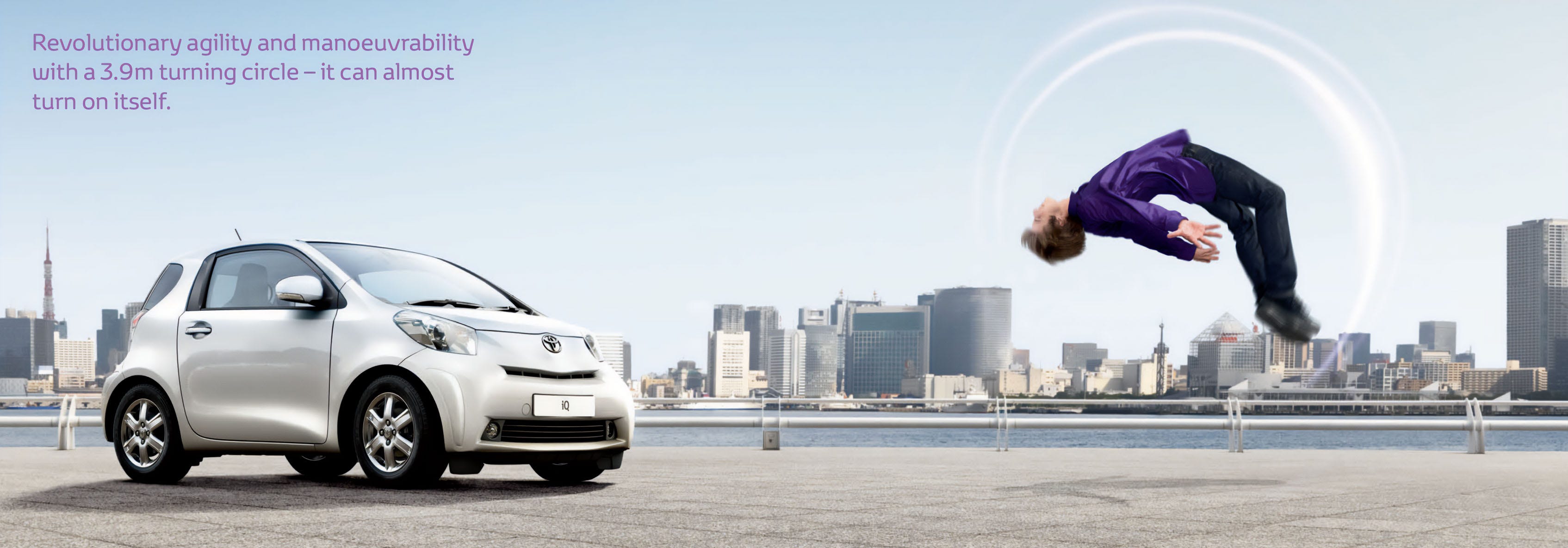
The architectural tour begins properly on page 5. The iQ sits side-on against a city waterfront, the Tokyo Skytree visible on the horizon, while an acrobat performs a backflip in the foreground, his body tracing the arc that the copy makes explicit: a 3.9-metre turning circle. The copy is terse and unapologetic. "Revolutionary agility and manoeuvrability with a 3.9m turning circle", it reads. "It can almost turn on itself."
That turning circle is not marketing hyperbole. A London black cab, the benchmark urban vehicle, turns in approximately 8.5 metres. The iQ, in real urban conditions, can perform manoeuvres that are simply not available to any other four-person vehicle. This is not a feature; it is a different relationship between the driver and the city grid entirely.
The mechanism behind the 3.9-metre circle is worth dwelling on, because it is one of the six specific miniaturisation breakthroughs that the iQ required. Toyota mounted the steering rack above and behind the engine, where most cars position it in front or below. This relocation allowed the front wheels to steer to an angle that conventional front-wheel-drive geometry makes impossible. The brochure does not explain this. It simply presents the number and trusts the reader to understand that turning circles do not achieve 3.9 metres without someone in a Japanese engineering facility spending years on a problem no other manufacturer considered worth solving.
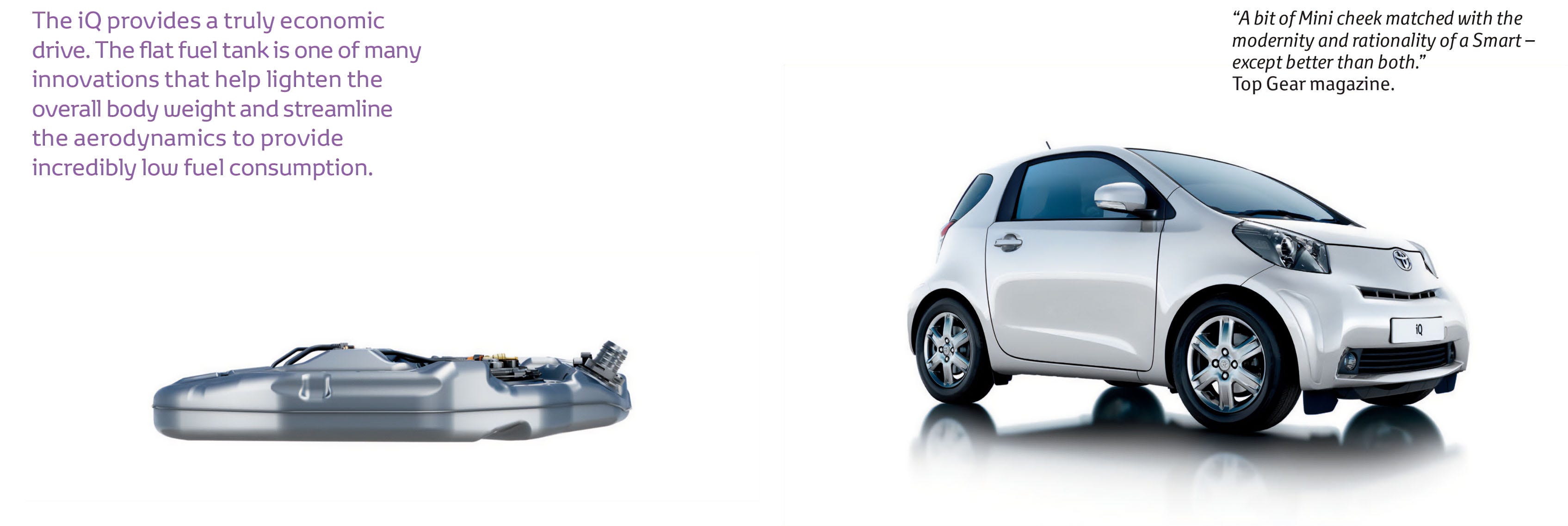
Page 6 shows the flat fuel tank in isolation, floating against white space as though it were a sculptural object. It is, in a way. A conventional saddle-shaped fuel tank sits above the rear axle and dictates a raised floor over that section, compressing rear legroom or forcing a longer body to compensate. Toyota redesigned the tank as a flat slab, dropping it forward and low, liberating the floor plan. The brochure quotes Top Gear magazine: “A bit of Mini cheek matched with the modernity and rationality of a Smart, except better than both.” The magazine’s summary is generous but slightly misses the point. The Mini and Smart are stylistic propositions. The iQ is a structural argument.
Peace of Mind, Multiplied
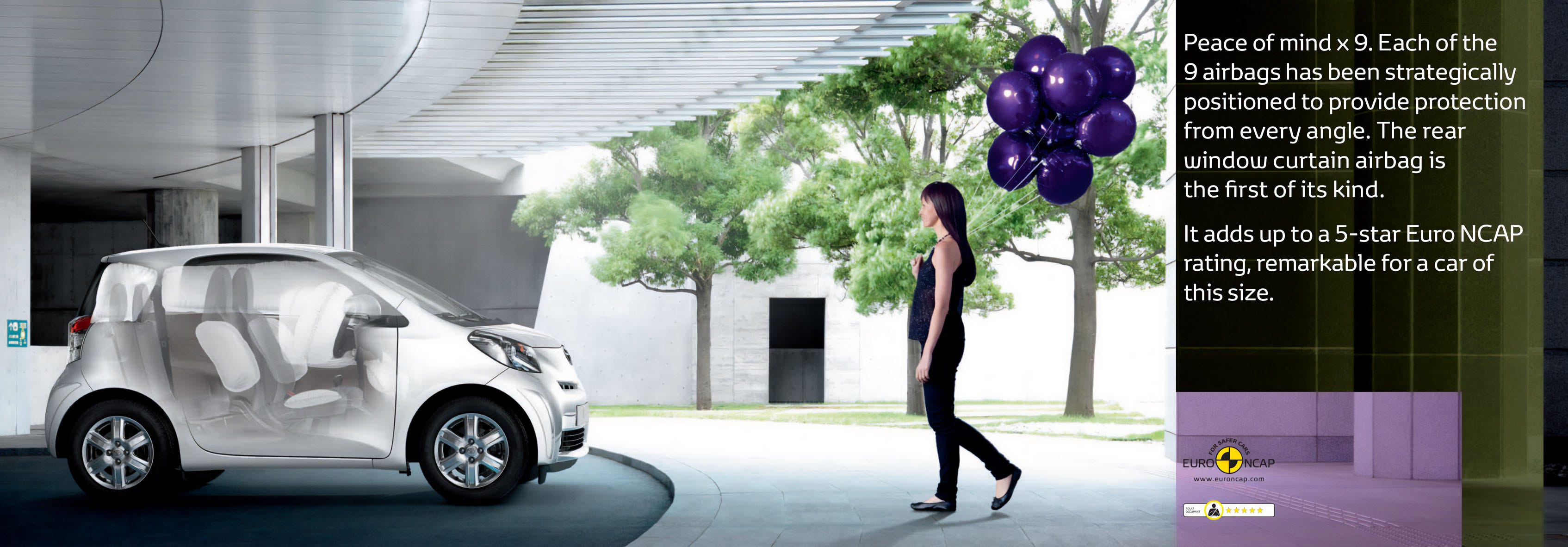
Page 7 is where the brochure addresses the primary anxiety of every potential micro-car buyer, and it addresses it with something close to operational precision. Nine airbags. The copy lists them: front driver and passenger, driver’s knee airbag, passenger seat cushion airbag, front curtain shields, large front side airbags, and then, the anomaly, “The rear window curtain airbag, the first of its kind.”
The brochure presents this without ceremony, though it deserves some. A rear-end collision in a short car is the scenario that most rationally frightens buyers in this segment. The rear of the iQ is, by necessity, close to its rear occupants. The conventional response to this fact would be to accept it as a limitation of the format. Toyota’s response was to engineer a deployable curtain airbag that inflates between the rear passengers and the window glass, a solution so specific and expensive that no other manufacturer in this segment had attempted it.
The brochure notes the consequence: a 5-star Euro NCAP rating. This is the single most commercially important number in the document, though the brochure deploys it with the understatement of something that was always inevitable. The NCAP badge sits small and neat beside the airbag diagram. It does not flash. It does not declare itself. It simply confirms what the engineering already implied.
Toyota refused to release a car this small without the 5-star rating. This is not the statement of an accountant. It is the statement of an institution that had decided, on principle, that the iQ would not be a death trap dressed as urbanity. The cost of that decision, in engineering hours and bespoke R&D for a platform that could not be shared with another Toyota product, was enormous. The brochure wears the result with the quiet authority of someone who has done something difficult and sees no need to explain how difficult it was.
The Interior Masterpiece
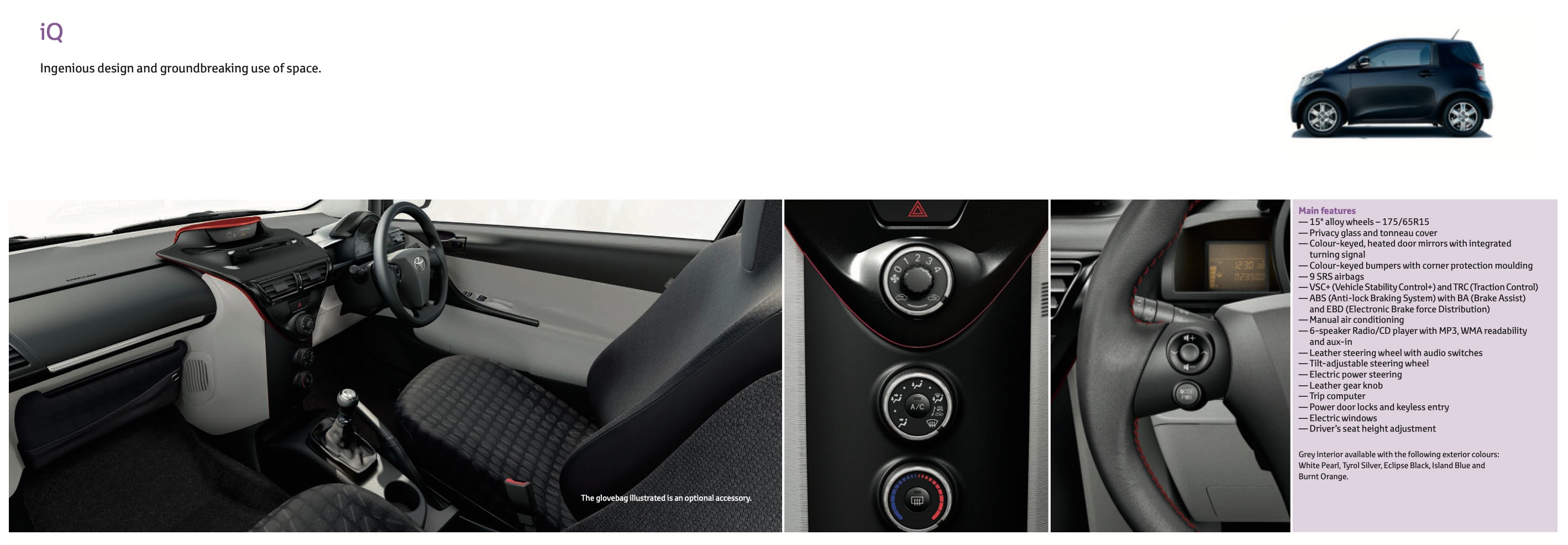
Page 11 is the brochure’s most technically demanding spread, and the brochure navigates it through selective restraint. The header text says simply: “Ingenious design and groundbreaking use of space.” Three photographs follow: a high-angle interior shot, a centre console macro, a steering wheel detail. The copy lists features. What it does not do, because it cannot easily do it in 29 pages, is explain the mechanism that makes the interior possible.
The iQ interior exists because Toyota designed the dashboard to be asymmetric. The driver’s side carries the conventional instrument binnacle and column. The passenger’s side, however, features a deep-scooped recess rather than a conventional glovebox, a hollow that allows the front passenger seat to be positioned further forward than in any comparable vehicle. This forward seat position is the millimetre gain that cascades through the entire packaging equation: it gives enough rear legroom to accommodate a third adult passenger, at the cost of boot space (32 litres with the rear seat up, which requires some creative thinking about luggage) and the loss of a conventional storage solution in the passenger fascia, replaced by the fabric “glovebag” that the brochure sensibly illustrates as an optional accessory.
The list continues. Ultra-slim seat backs, specifically engineered to be thinner than any seat in Toyota’s range, contribute further millimetres to the rear passengers. The air conditioning unit was miniaturised to a dimension no previous Toyota system had achieved. The front differential was relocated to a forward-mounted position, allowing the engine to sit further forward in the bay and giving the front wheels additional steering lock. Every component in the car was interrogated for space debt and then either redesigned or relocated. The brochure’s claim that “the list of iQ design innovations is probably longer than the car itself” is, for once, the kind of corporate boast that happens to be accurate.
The iQ³: The Argument Made Complete
The three-tier lineup is covered in pages 11 to 13, and the hierarchy is clear. The base iQ offers the 1.0-litre three-cylinder engine, manual air conditioning, 15-inch alloys, and enough equipment to make its case. The iQ² adds climate control, darkened bi-halogen headlamps, Smart Entry, rain-sensing wipers, and the electrochromatic mirror that shifts the car unambiguously into a different register of daily refinement.
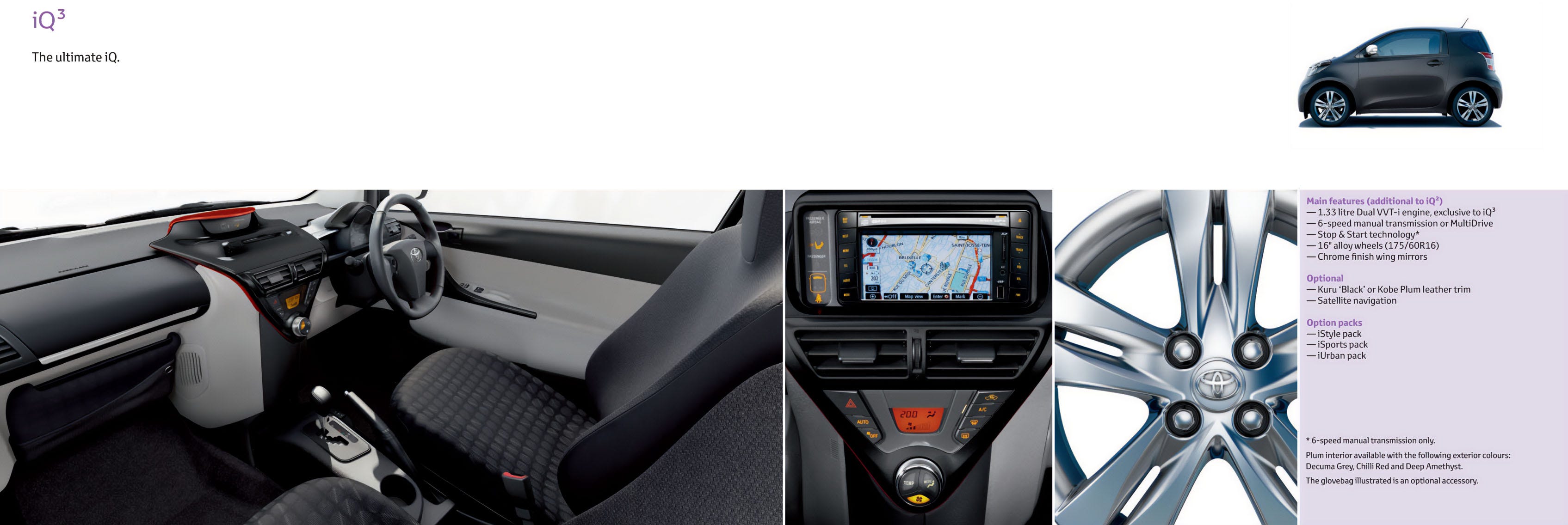
But the iQ³ is where the brochure’s ambition concentrates. The 1.33-litre Dual VVT-i four-cylinder, exclusive to this trim, is the only unit in the range that the iQ’s proportions justify in aspirational terms. At 98bhp, it is not, by any absolute measure, a powerful engine. In a car weighing 930kg, it is sufficient. The 0-62mph figure of 11.8 seconds is honest rather than impressive, but the CVT MultiDrive option returns a 0-62mph time of 11.6 seconds, fractionally quicker, because the transmission’s ability to find the optimal ratio outweighs the mechanical losses in real-world urban conditions.
The iQ³ also introduces, uniquely for 2012 in this segment, Stop and Start technology. The brochure's glossary page explains: "In urban conditions this feature can help reduce fuel consumption by up to 15%." For a car ostensibly designed for urban conditions, this is not a peripheral detail. It is the iQ making its environmental argument at its sharpest angle. CO₂ emissions of 99g/km from the base 1.0-litre engine sat precisely at the threshold for zero VED under the UK tax bands in force at the time, a figure that its most direct rival, the Smart Fortwo, could only match with its most frugal diesel variant. The miniaturisation philosophy, in other words, delivered dividends that extended well beyond the car park.
The Rearview Mirror: The Engineering Triumph That the Market Did Not Want
The Problem: The Technical Tax
The iQ was priced, when new, significantly above its natural segment competitors and closer, in many configurations, to a well-equipped Toyota Yaris. The market's response to this pricing was logical and largely fatal to the car's commercial prospects. The Yaris offered more seats, more boot space, and comparable running costs. The iQ offered a different relationship with the city entirely: an urban footprint that no other four-occupant vehicle could match.
The problem was that the problem the iQ solved, ultra-tight city parking, was not, for most buyers, acute enough to justify the premium. Urban parking is uncomfortable and expensive; it is rarely, for most British city dwellers, genuinely impossible in a Yaris-sized car. The iQ’s “parking cheat code” turned out to be a cheat code for a level that most players found manageable with their existing equipment. The engineering genius arrived at the right address, but the market had already bought a slightly larger solution and found it adequate.
The Tax: What Time Has Revealed
The iQ’s bespoke platform, essential to its packaging triumph, has become its primary maintenance liability. Because so little of the car was shared with other Toyota products at the time, specific body panels and interior components are now increasingly difficult to source. The fabric glovebag, celebrated as a design solution in the brochure, has become a known parts scarcity problem for owners attempting to maintain correct interiors.
The 1.33-litre engine carries a reputation for EGR valve soot accumulation when used exclusively on short cold trips. This is precisely the duty cycle for which the car was designed. An iQ that has spent its life doing exactly what Toyota built it to do, short urban journeys, cold starts, frequent stops, is at elevated risk of the carbon buildup that necessitates either an EGR clean or, if neglected, a significantly more expensive resolution. The brochure’s Stop and Start technology, which shuts the engine at idle, is in this context a minor irony: fuel saved at the lights, carbon accumulating at the valve.
The MultiDrive CVT, presented in the glossary with generous praise for its smooth shifts and optimised ratios, rewards the maintenance schedule that the brochure does not prominently advertise. Transmission fluid changes at the intervals Toyota specifies are not optional if the owner wishes to avoid the juddering that a neglected unit will eventually produce. The CVT is not fragile; it is pedantic.
The Success: The Aston Martin Verdict
The ultimate validation of any engineering thesis is that someone builds on it. In 2011, Aston Martin chose the iQ as the donor platform for the Cygnet, a £30,000 luxury city car that used the iQ’s mechanicals beneath a hand-finished interior of Bridge of Weir leather and machined aluminium switchgear. This was not Aston Martin admitting that small cars were unavoidable under emissions legislation, though that was part of the commercial calculus. It was Aston Martin’s engineers looking at the iQ and concluding that its chassis, its safety architecture, and its fundamental package were of sufficient quality to carry the Aston Martin badge.
The Cygnet was a commercial failure. For the iQ, it was a posthumous vindication of a different kind than sales figures provide. Aston Martin, a company with no particular obligation to Toyota, no shared platform ambitions, and no commercial incentive to overstate the iQ's engineering quality, chose it because nothing else offered the same combination of crash performance, refinement, and packaging resolution. When the manufacturer of the Vanquish calls your city car suitable for their badge, the argument about whether it was over-engineered is settled.
In 2026, the iQ exists in a different kind of afterlife. Used examples are, in congested British cities, genuinely useful objects. The parking problem that was insufficiently acute in 2012 has, in the intervening fourteen years of urban densification, grown more acute for more people. The car that could not find its market whilst in production is finding it now, incrementally, among drivers who have experienced precisely the situation it was designed to resolve. It is a cult object for packaging theorists and a practical tool for city dwellers who have done the arithmetic.
The arithmetic, it turns out, always added up. The market simply needed time to check the sums.
The Fine Print
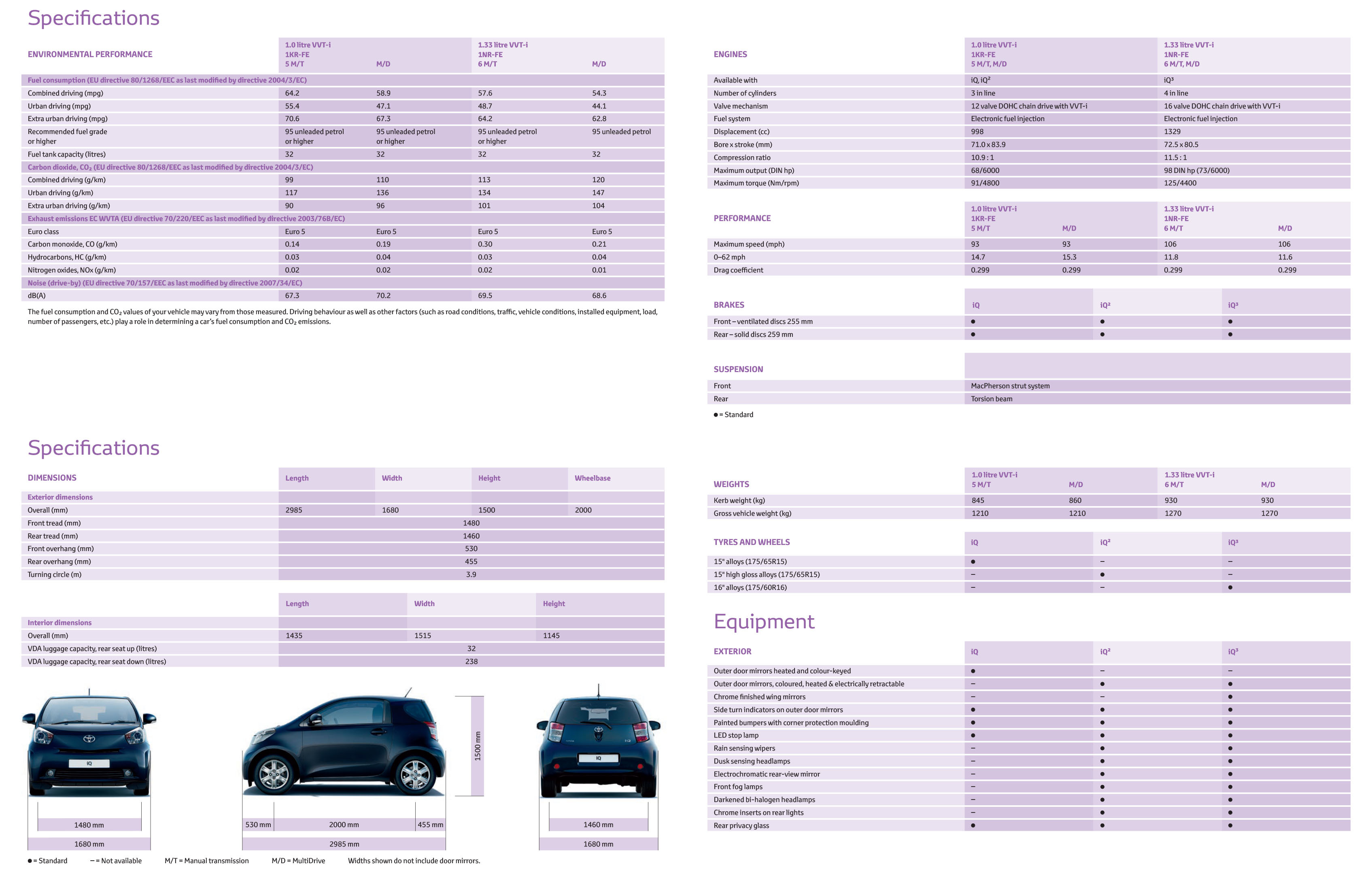
Notable anomalies: The drag coefficient of 0.299 is particularly striking. City cars are generally aerodynamic afterthoughts, their bluff profiles and upright tails giving them Cd figures in the high 0.3 range. The iQ’s 0.299 suggests that Toyota’s engineers attacked the airflow management with the same systematic rigour they applied to every other dimension of the package. The brochure does not mention this number anywhere in its copy. It appears only in the specification table on page 21, unpromoted. This is the iQ’s characteristic move: the most impressive evidence arrives without fanfare.