Urban Armour: The Marketing Genius Behind Nissan’s Crossover Gamble
Or: How the Qashqai Killed the British Hatchback and Made “Command Seating” a Social Necessity


“Why can’t a practical car be inspiring?” – The mission statement that launched a thousand imitators.
The Sales Pitch
Let’s face the city.
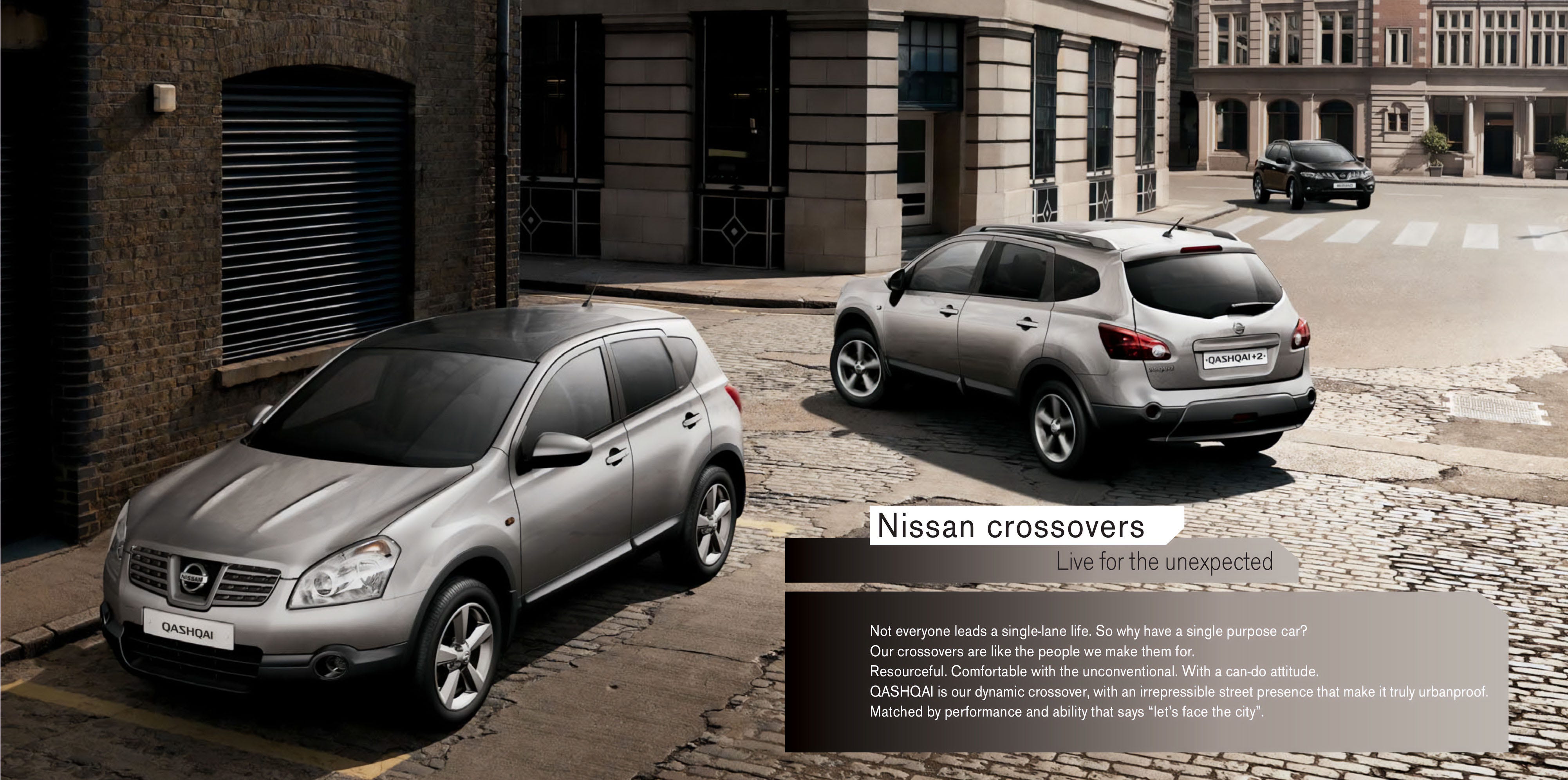
That’s the challenge Nissan threw down in 2007, framing the urban commute not as a tedious parade of speed bumps and roundabouts, but as a hostile theatre of operations. The brochure didn’t sell you a car. It sold you invincibility. “Truly Urbanproof,” they called it: a phrase so brazenly confident it belongs on a Gore-Tex jacket, not a family five-door built in Sunderland.
This wasn’t transport. This was urban gear.
The Qashqai didn't arrive in a vacuum. It was born from the corpse of the Almera, Nissan's failed attempt to beat the Golf at its own game. The Almera was sensible, competent, and utterly forgettable. It sold poorly because it had nothing to say. The Qashqai learned the lesson: if you can't win on merit, change the category entirely.
It arrived at the exact moment when the British hatchback (your Golf, your Focus, your sensible Astra) had become socially insufficient. Parents didn’t want to be seen ferrying children in a car that looked like a car. They wanted attitude. They wanted to sit higher, see further, dominate. Nissan understood this better than anyone: the crossover wasn’t a new category. It was a psychological upgrade.
“Commanding yet compact.” That’s the entire con, distilled. You get the elevated seating position of an SUV (the socially critical “command driving position”) without the guilt of actually buying a Range Rover. You get to feel like an adventurer while doing the school run. You get skateboarding-inspired adjectives (”athletic,” “energetic,” “agile”) applied to a vehicle whose natural habitat is the Waitrose car park.
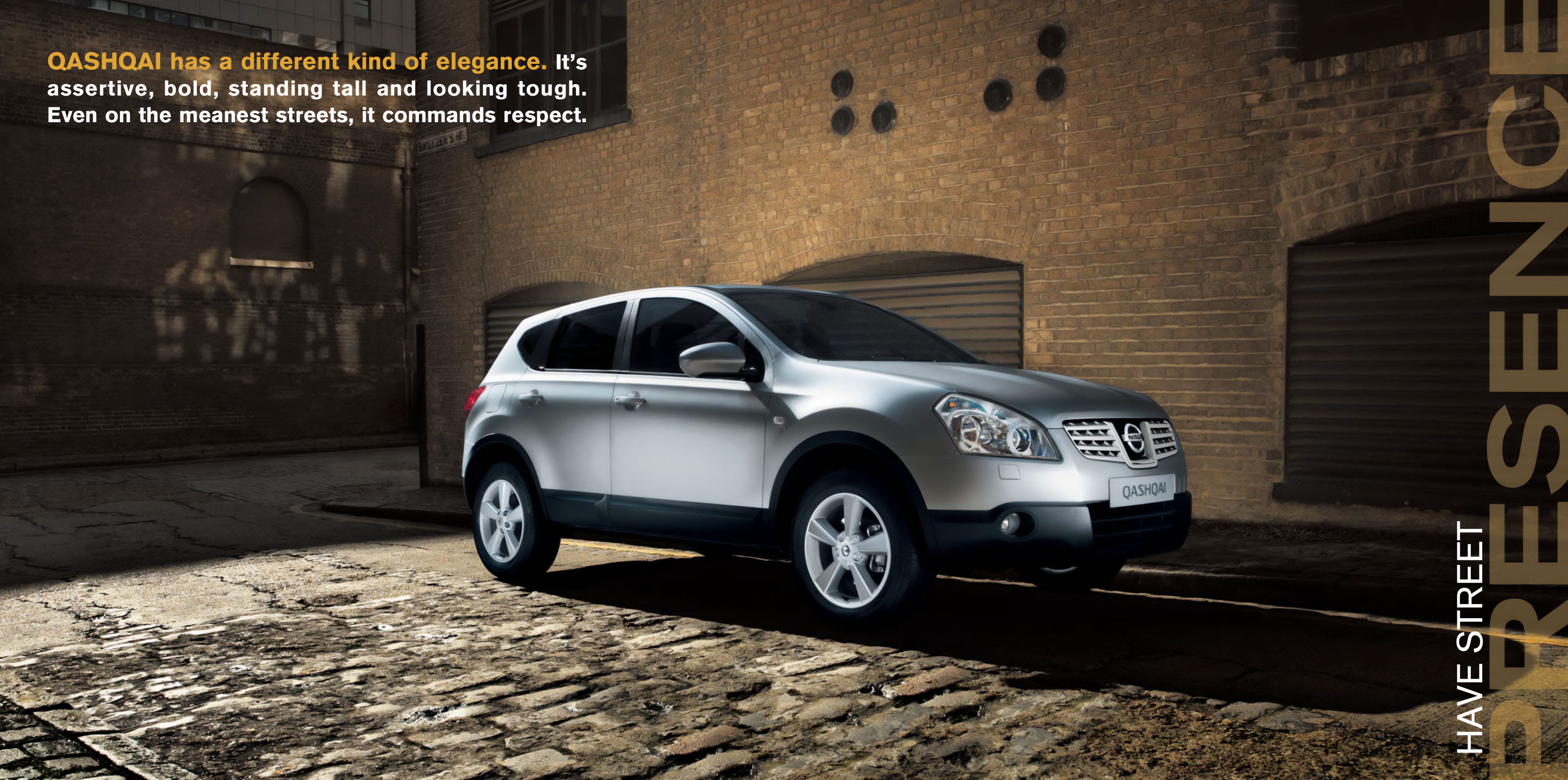
The brochure’s photography is deliberately confrontational. Moody, saturated, high-contrast. The car sits in empty city streets at dusk, backlit like a film noir protagonist. This is street armour. This is a car that “commands respect on the meanest streets.” Never mind that the meanest street most Qashqais would ever see was a slightly aggressive mini-roundabout in Milton Keynes.
There's a delicious irony here. The brochure sold you a moody urbanite stalking the backstreets of Berlin or downtown Manhattan. The reality? This was built in Sunderland. A rugged, northern industrial town that knows more about genuine grit than any marketing department ever will. The Qashqai was a product of North-East pragmatism, designed to survive the school run without breaking a sweat, then wrapped in metropolitan cool for the brochure shoot.
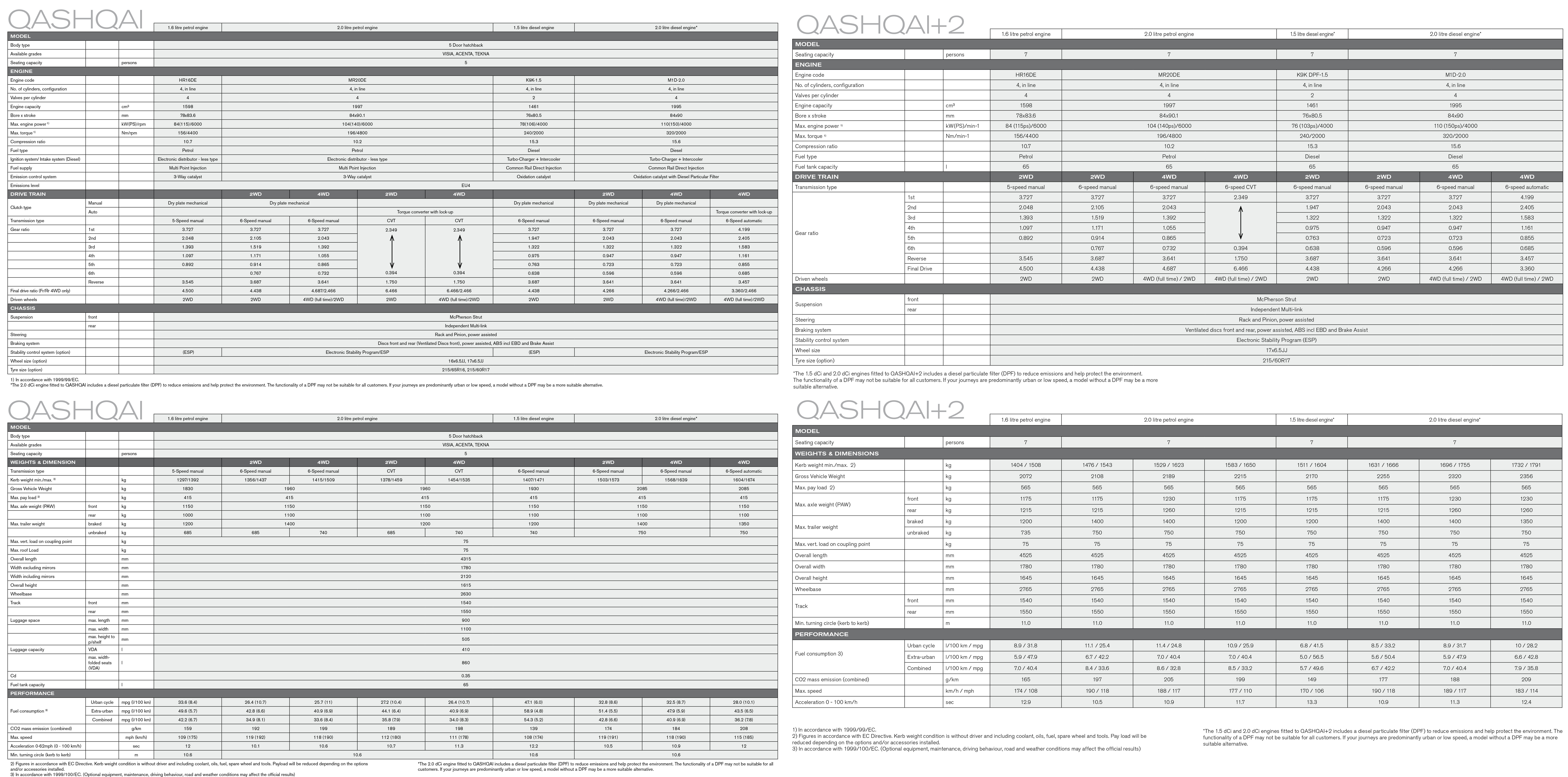
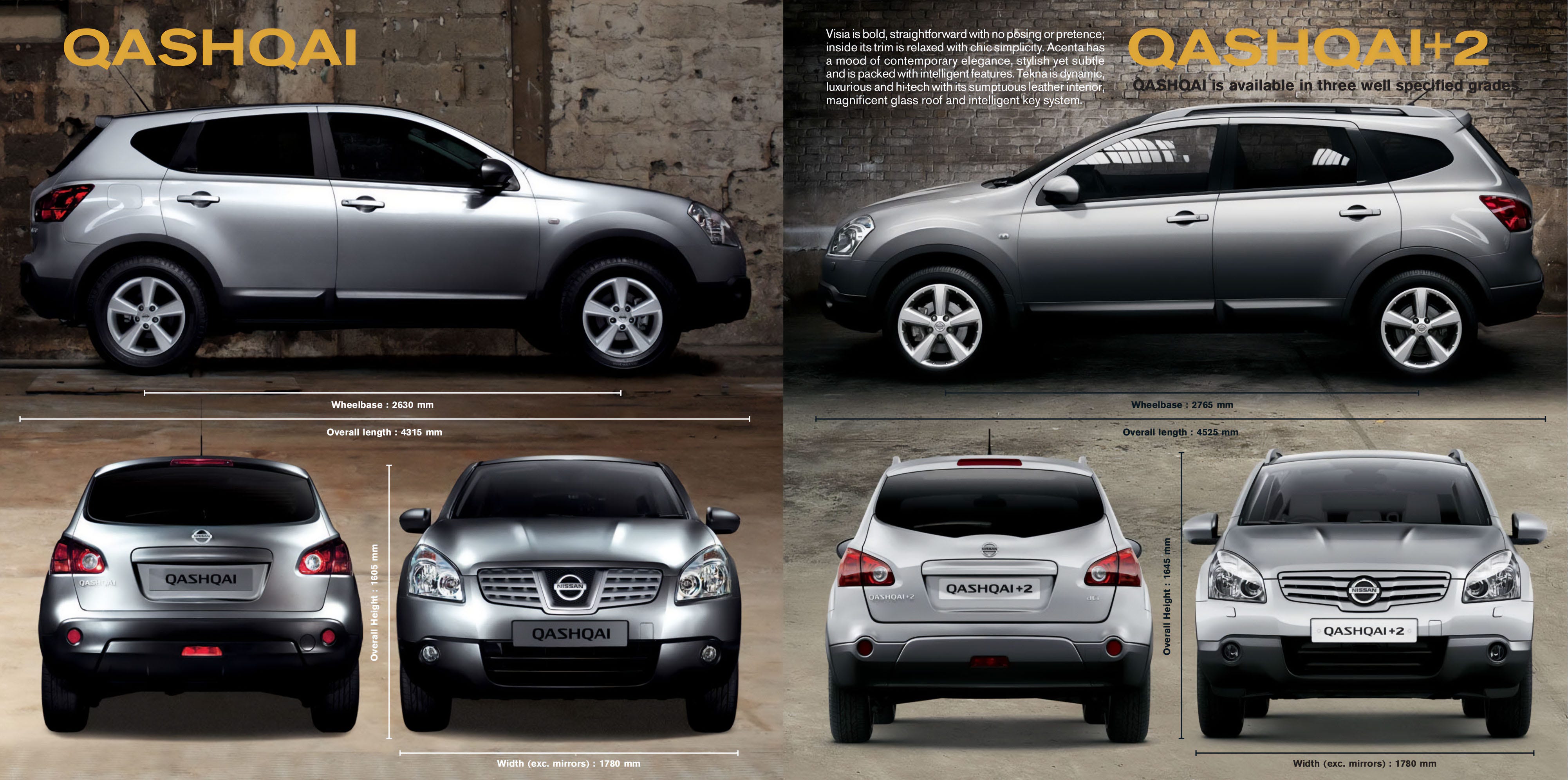
But here’s the genius: Nissan wasn’t lying. They were reframing. The city is hostile, just not in the way action films suggest. It’s hostile because of tight parking, because of cyclists appearing from nowhere, because of speed humps that punish anything with a long wheelbase. The Qashqai promised to solve these problems not with brute force, but with compactness married to height. A 4315mm length (shorter than a Mondeo) and a 1615mm height (taller than anything that wasn’t actually an SUV).
This was the crossover gamble: convince people they were buying capability when what they really wanted was posture.
Strip away the skateboarding vernacular and you’re left with a surprisingly honest piece of engineering. The Qashqai wasn’t revolutionary. It was optimised.
The Chassis: McPherson Front, Multi-Link Rear
Independent front McPherson struts and a fully independent rear multi-link setup. Nothing exotic, nothing cutting-edge, but critically, nothing cheap. The multi-link rear was the tell. Nissan could have saved weight and cost with a torsion beam (perfectly adequate for a family five-door) but they didn’t. They wanted compliance. They wanted the car to feel planted on undulating B-roads, to soak up urban crater-holes without transmitting every jolt through the cabin.
The 2630mm wheelbase was long enough to deliver stability without turning the thing into an oil tanker in multi-storey car parks. The result was a car that rode with a suppleness that belied its 1410kg kerb weight (1.6 petrol, two-wheel drive). It felt, in that critical British sense, sorted.
The Powertrain Menu: Four Engines, No Heroes
Nissan offered four engines, a spectrum from sensible to surprisingly spirited:
1.6 Petrol: 115bhp, 115lb ft. The poverty option. Adequate for dual carriageway merging, underwhelming everywhere else. 0-62mph in 12.0 seconds. This was the engine you bought because you had to, not because you wanted to.
2.0 Petrol: 140bhp, 145lb ft. The sweet spot for buyers who didn’t want diesel guilt. 0-62mph in 10.1 seconds. Smooth, refined, utterly forgettable. The CVT gearbox option marketed as “taking it easy” was, in reality, taking liberties with mechanical longevity.

1.5 dCi Diesel: 106bhp, 177lb ft. The urban paradox. Efficient, torquey, economical, and fitted with a Diesel Particulate Filter (DPF) that the brochure explicitly warned was “not suitable for all customers” on five separate occasions. Specifically, urban drivers doing short journeys. Which was, of course, the entire market. This was a ticking time bomb for anyone who ignored the warning. And most did.
2.0 dCi Diesel: 150bhp, 236lb ft. The grown-up choice. 0-62mph in 10.5 seconds. This was the engine that made the optional ALL-MODE 4x4 system (capable of distributing up to 50% torque rearward) feel like more than a marketing tick-box. This was the engine that justified the “crossover” claim.
But let's talk about that ALL-MODE system. It cost £2,000. It could distribute up to 50% torque to the rear wheels in slippery conditions. Nissan marketed it as "intelligent all-weather capability." In reality, it was a security blanket. A piece of mechanical theatre that most owners never engaged, preferring instead to rely on the "Command Seating" to navigate the hostile terrain of a Waitrose car park. The system existed not to be used, but to be specified. To allow buyers to tell themselves they'd made a practical, capable choice. When really, they'd just paid two grand for permission to feel less guilty about buying a car they didn't need.
All four shared a 0.35Cd drag coefficient. Not exceptional, but honest. This wasn’t a Prius. It was a brick with pretensions.
The Interior: Analogue-Digital Peak
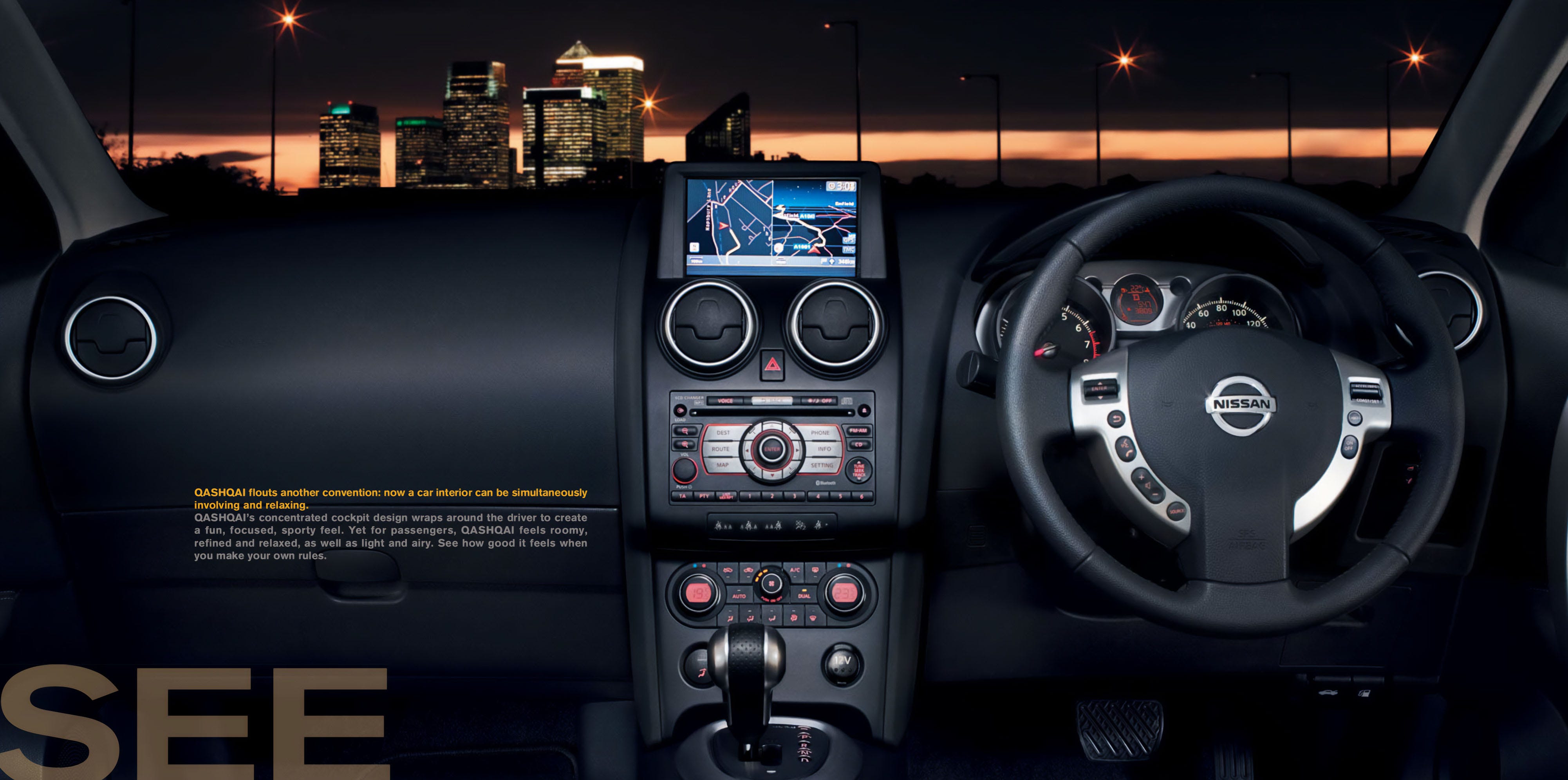
This is where the Qashqai reveals its place in automotive history. It arrived at the exact moment when “Analogue-Digital” integration hit its zenith, before touchscreens colonised every surface, before physical buttons became retro.
The “Concentrated Cockpit” was genuine. The driver sat in a wrapped-around environment: instruments angled slightly toward the driver, gearlever within easy reach (”short precise movement,” they promised, and delivered), steering wheel thick-rimmed and multifunction. The saturated orange instrument lighting was marketed as “hi-tech” but was actually just visible, a virtue that’s become rare in the age of TFT screens that wash out in direct sunlight.
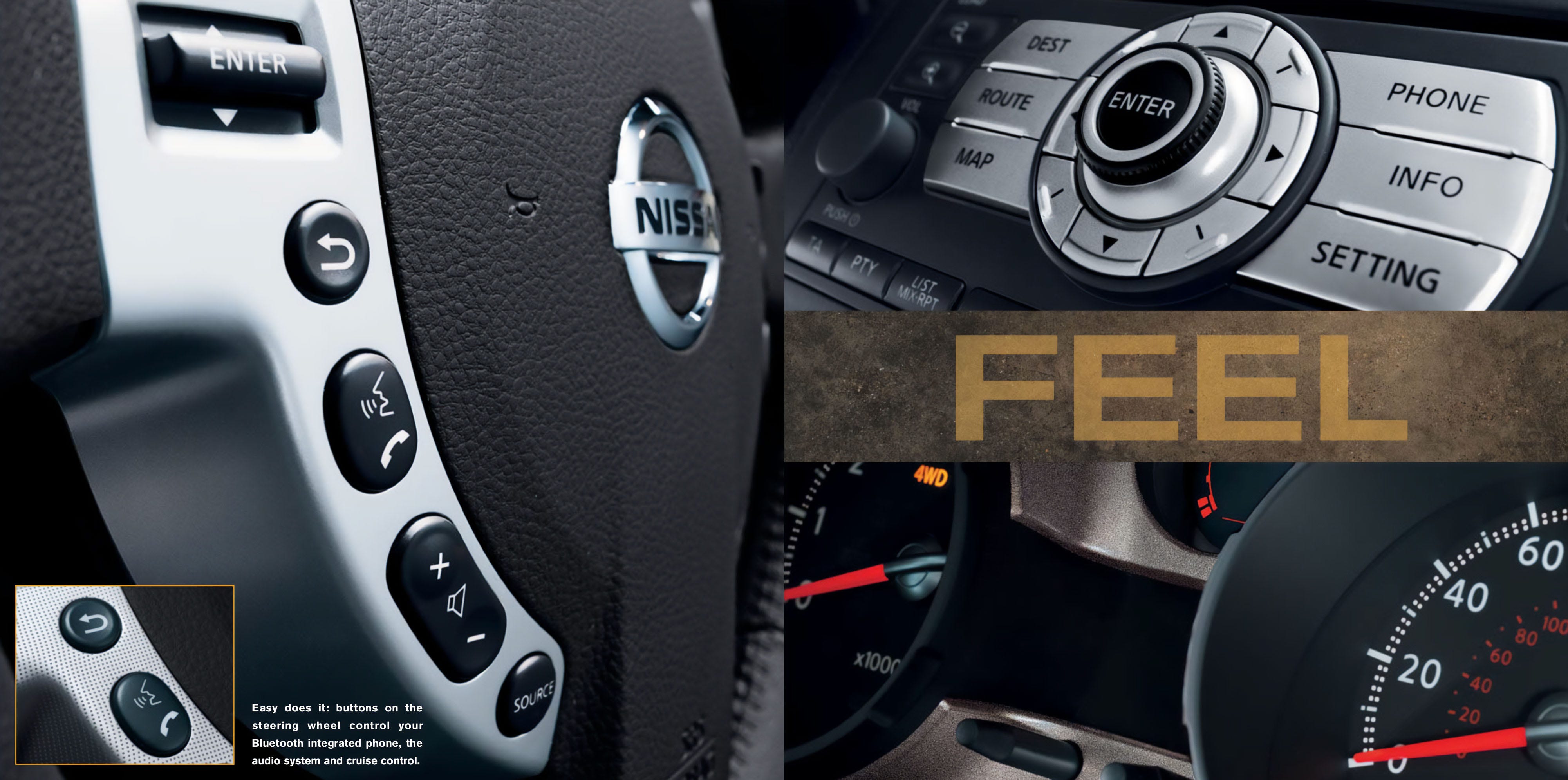
The steering wheel controls were a tactile dream: chunky buttons for Bluetooth, cruise control, audio. You could operate them by feel. No haptic feedback nonsense, no capacitive surfaces that required a blood sacrifice to register input. Just buttons that clicked.
And then, the party trick:

A cooled glovebox. Fourteen litres of low-pressure air-conditioned storage. Nissan marketed it as a place to keep drinks chilled on long journeys. In reality, it became a place to store Capri-Suns that nobody remembered to remove until they fermented. But the intention was there: this was a car designed for families who actually used their cars, not for poseurs who wanted a lifestyle accessory.
The +2 Gambit
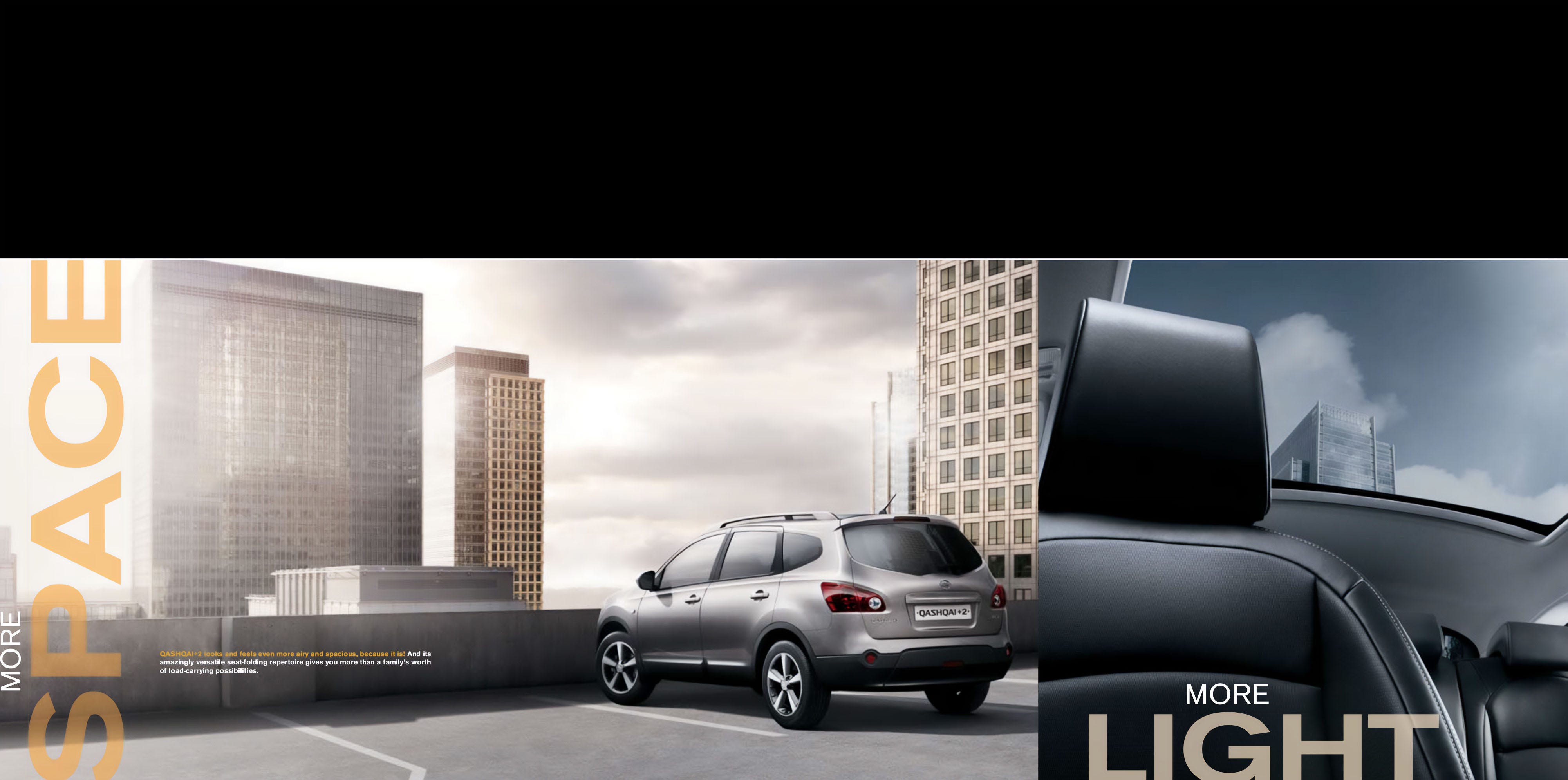
The Qashqai+2 variant stretched the wheelbase and added two occasional seats in the boot. It was marketed as transforming the car from five-seater to seven-seater, with a “long, flat floor” and 1520 litres of cargo capacity with all seats folded.
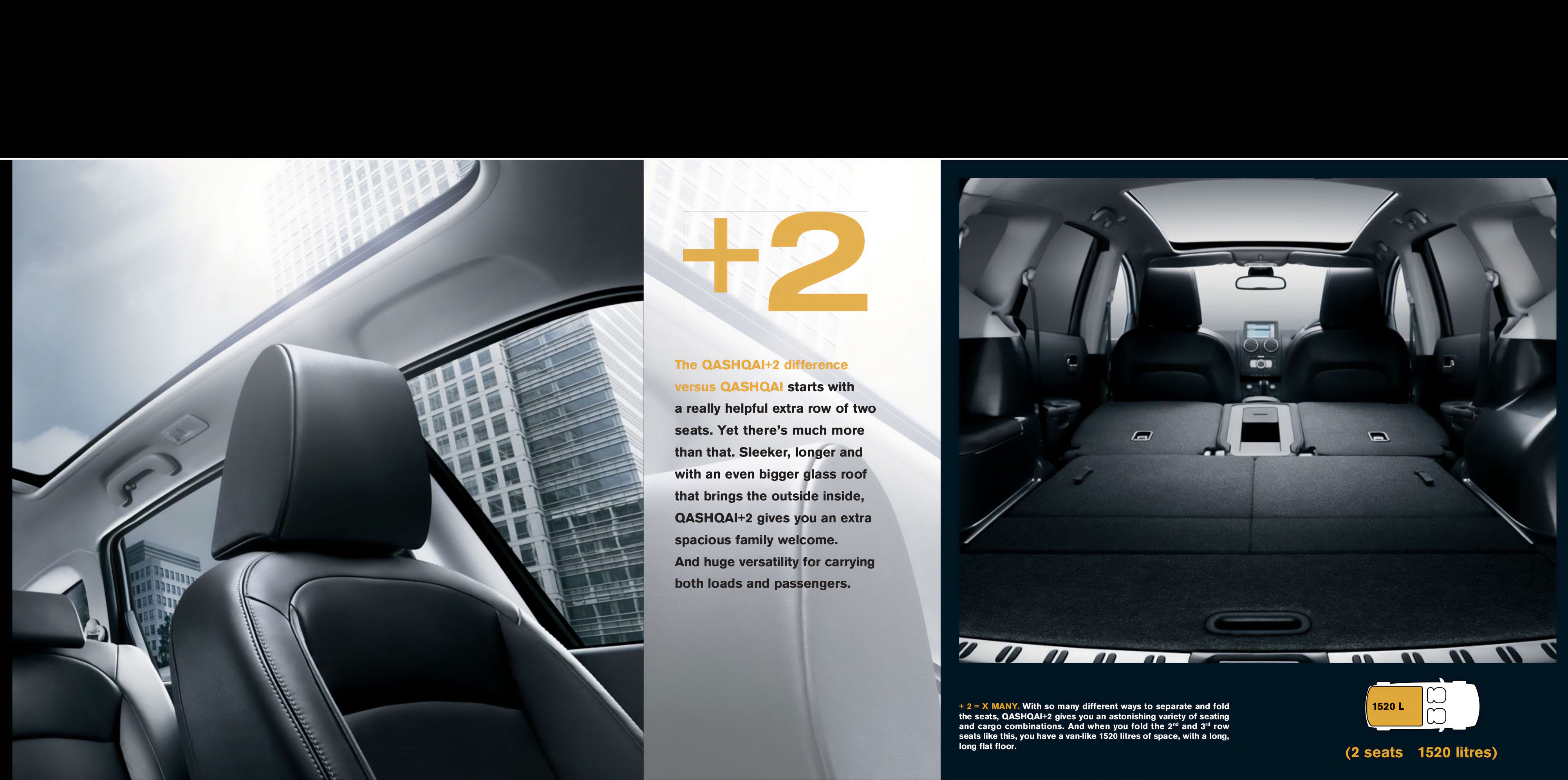
This was Nissan’s attempt to kill the multi-purpose vehicle (MPV) without admitting they were building one. The +2 wasn’t graceful. It looked like someone had stretched a Qashqai on a medieval rack. But it was functional. And functionality, wrapped in the right marketing language, becomes aspiration.
The Safety Cell: Engineering as Marketing
Nissan leaned hard on the Qashqai’s five-star Euro NCAP rating. It was, at launch, one of the highest-scoring cars ever tested. The brochure devoted an entire spread to the “highly protective body rigidity” and the X-ray-style diagram showing six airbags distributed throughout the cabin.
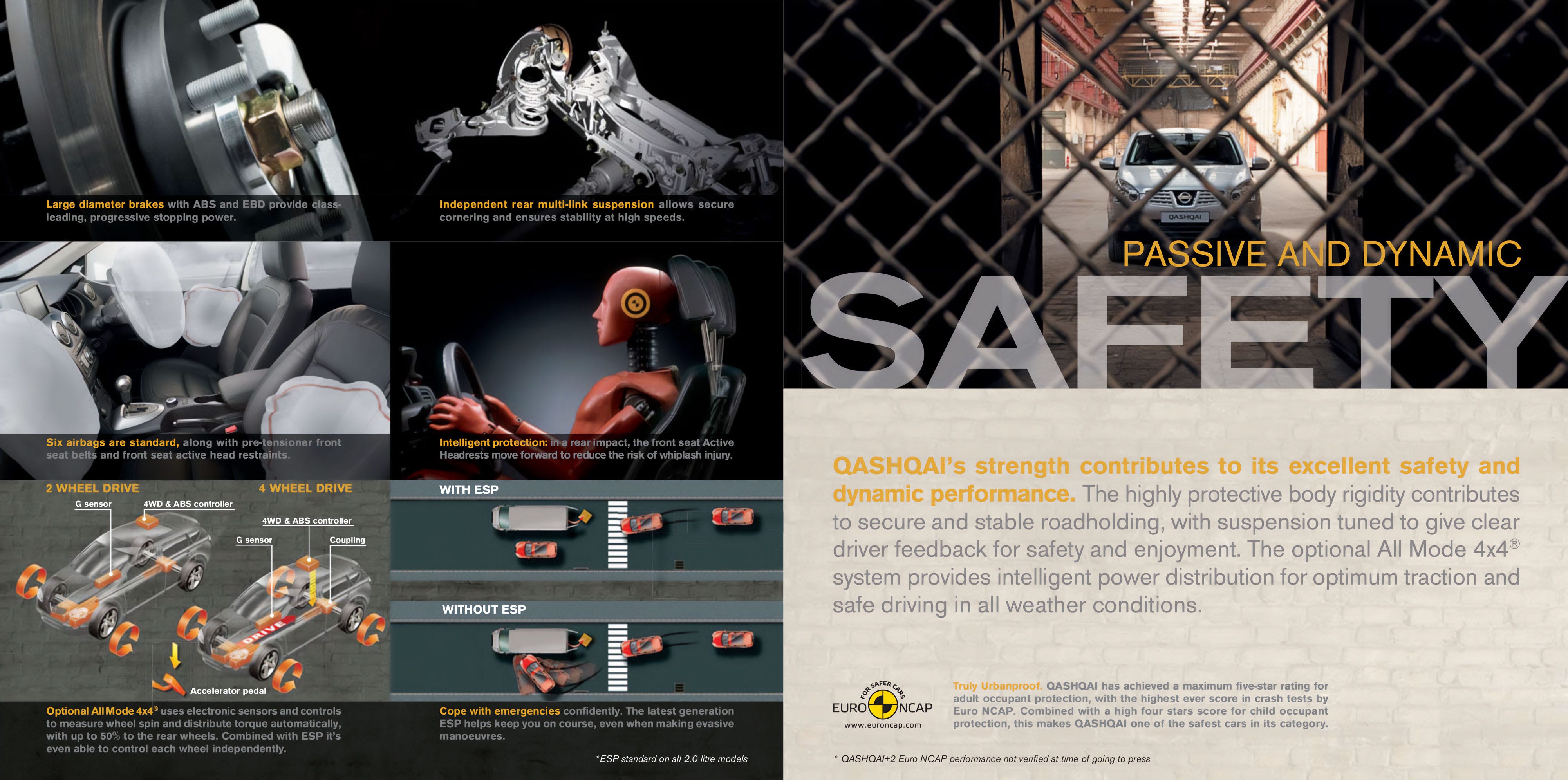
But the detail that betrayed genuine engineering thought? Active headrests. In a rear-end collision, the headrests would pivot forward to reduce whiplash. This wasn’t a headline feature. It was buried in the spec sheet. But it was the kind of thoughtful, unsexy detail that separated the Qashqai from cynical badge-engineered crossovers that would follow.
The body structure itself was described as “highly protective rigidity”: marketing speak, yes, but backed by actual crash-test data. The cabin was a zone of deformation management: crumple zones front and rear, high-strength steel B-pillars, side-impact beams in the doors.
This was a car you could feel solid in. And solidity, in 2007, was a selling point. The doors closed with a satisfying thunk (”solid clunk,” the brochure called it, and for once, the marketing wasn’t overselling). These were heavy, damped doors that felt like they cost money.
The Rearview Mirror
So. Did it work?
Yes. And no. And devastatingly.
The Cultural Victory
The Qashqai didn’t just succeed. It colonised. It became the blueprint for every crossover that followed. Hyundai’s Tucson, Kia’s Sportage, Peugeot’s 3008, Vauxhall’s Mokka: every single one of them traced their lineage back to Sunderland, 2007.
It killed the British hatchback. Not immediately, but inexorably. By 2015, families who would once have bought a Focus or a Golf were buying Qashqais. By 2020, even the diehards had succumbed. “Command seating” became a social necessity. If you couldn’t see over the car in front, you were losing.
Nissan created a category and then watched as everyone else rushed in to dilute it. The Qashqai became a victim of its own success: surrounded by cheaper imitators and more premium alternatives, it lost its unique position. But it had already won. It had already rewritten the rules.
The Mechanical Reality
But did the engineering hold up? Mixed.
The DPF Gremlins: The 1.5 dCi’s Diesel Particulate Filter warning was buried on Page 34 of the brochure. “Not suitable for all customers,” it said, specifically warning urban drivers doing short journeys. Almost nobody read it. By 2012, independent workshops were seeing a steady stream of DPF-clogged Qashqais, their owners baffled that their “economical” diesel was now demanding £1,200 regeneration procedures.
Nissan was honest. The buyers weren’t listening.
The CVT Question: The Continuously Variable Transmission was marketed as smooth, refined, effortless. And it was, for about 60,000 miles. After that, early CVT units developed a tendency toward judder, hesitation, and eventual failure. The manual gearbox (”short precise movement”) was bulletproof. The CVT was a gamble.
Interior Wear: The “irresistibly supple” embossed leather and “technical foil” highlights aged poorly. By 2015, high-mileage Qashqais looked tired. The very family life they were marketed to survive (muddy boots, spilled juice, aggressive sun exposure) destroyed the surfaces. The plastics faded. The leather cracked. The “urbanproof” exterior held up better than the supposedly refined interior.
The Rust Question: Here’s the surprise: it didn’t rust. Not significantly. The body protection was genuinely robust. Fourteen-year-old Qashqais still patrol British streets with unblemished sills and wheel arches. Nissan got this right.
The Legacy
The Qashqai succeeded because it understood something fundamental: people don’t buy cars based on specs. They buy them based on how the car makes them feel about themselves.
Nissan sold posture. They sold the idea that you were too interesting, too urban, too engaged for a boring hatchback. They sold altitude and attitude. They sold the illusion that your commute was an adventure.
And for a few years, before every manufacturer copied the formula, it was.
The Qashqai wasn’t the best car of its era. But it was one of the most important. It proved that you could take utterly conventional engineering, wrap it in the right psychology, and create a market segment from nothing.
That’s not innovation. That’s genius.
The car that killed the hatchback. The car that made “command seating” a social requirement. The car that proved marketing could create a category from nothing.
Truly urbanproof? No. But truly transformative? Absolutely.
The Fine Print