The Teardrop Manifesto: 1984 Vauxhall Astra GTE
Not everything can be measured

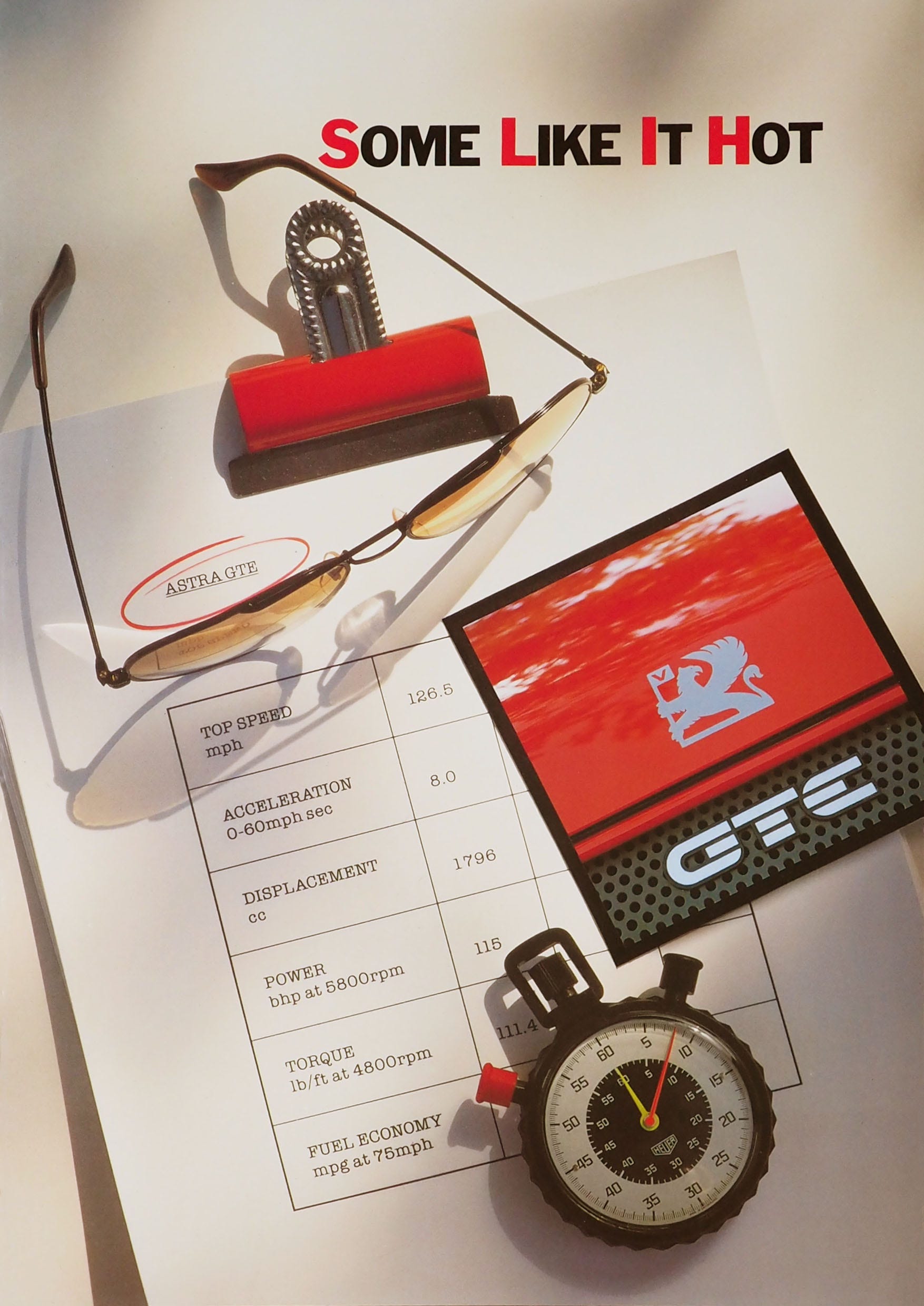
Before we discuss the car, let’s discuss the stopwatch.
It sits on the cover of the brochure, October 1984: a Heuer chronograph, its bezel bevelled with the precision of a surgical instrument, placed atop a specification document, as if submitted for peer review. No driver. No horizon. No suggestion of wind in hair or tyres on apexes. Just the instrument of measurement, and a single declarative sentence printed in bold black sans-serif beneath it: Top Speed mph: 126.5.
Not “a thrilling 126mph.” Not “up to” or “approximately.” One hundred and twenty-six point five. The decimal place is the entire argument. Vauxhall’s copywriters in 1984 understood something that the marketing departments of lesser vehicles had not yet grasped: that the most seductive language available to an engineer is the language of evidence.
This is the central paradox of the Astra GTE, and the reason it remains one of the most interesting objects produced by the British motor industry in the 1980’s. It was, by every external measure, a family hatchback. Five seats. A boot you could lose a labrador in (48.8 cubic feet of cargo space, to be precise). It wore the Griffin badge of Vauxhall of Luton, a marque associated in the popular imagination less with Le Mans glory, than with fleet managers and school run logistics. And yet, inside its unassuming pressed-steel body, concealed behind a drag coefficient that matched the contemporary Porsche 944, it harboured the ambition of a research programme.
In 1984, a drag coefficient of 0.30 in a five-seat production hatchback was not an incremental improvement. It was, to borrow the vocabulary the brochure itself deploys, a penetration of the category’s accepted limits. The Golf GTI (the car Vauxhall most urgently needed to defeat, the benchmark against which all hot hatches were measured as if by constitutional decree) registered a less favourable coefficient. The Ford Escort XR3i, the sales leader, the car that occupied the driveways of aspirational Britain from Guildford to Gateshead, was similarly behind in the aerodynamic ledger.
The body is a teardrop form, not in the romantic sense, not as metaphor for longing, but in the strictly fluid-dynamic sense. The roofline descends in the precise arc that minimises pressure drag. The door mirrors were wind-tunnel tested. The underbody was faired. Every panel shut-line was considered as a potential source of turbulence. The result is a car that, when you understand the provenance of its shape, looks nothing like a boxy family hatchback at all. It looks like the conclusion of a serious European engineering argument, pressed in steel and assembled in Cheshire.
The Technical Ledger
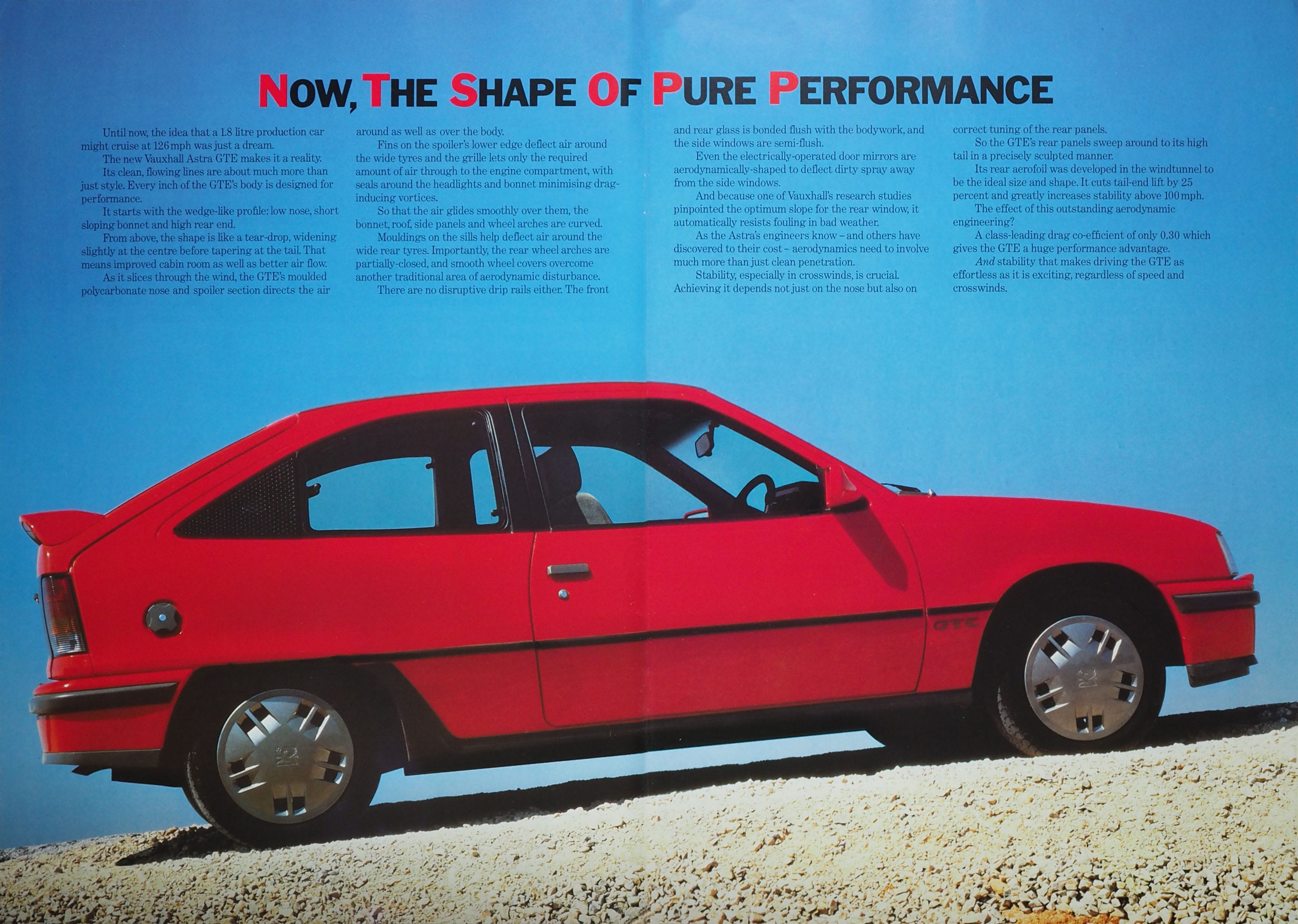
Pages four and five of the brochure place the GTE on a gravel incline, its Carmine Red flanks catching studio light at an angle calculated to emphasise the shoulder’s slope. The copy is characteristic in its refusal of poetry: “A class-leading drag co-efficient of only 0.30 which gives the GTE a huge performance advantage.” The word “huge” is the one concession to enthusiasm in an otherwise clinical document. It stands out like a raised voice in a library.
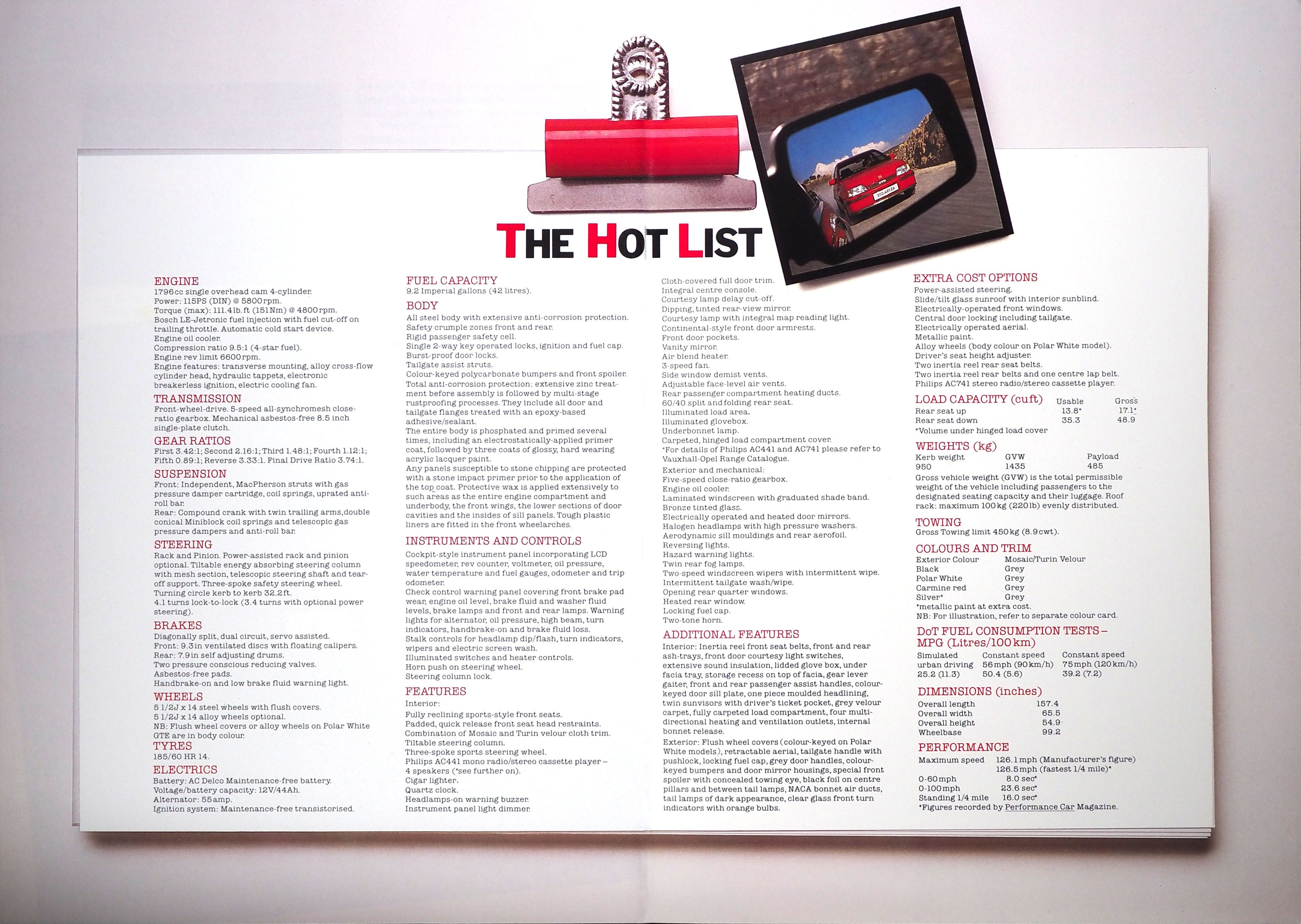
The powertrain that sits behind that aerodynamic coefficient is the 1796cc fuel-injected 1.8-litre four-cylinder, producing 115bhp at 5,800rpm and 111.4lb ft of torque at 4,800 rpm. These are numbers that require context to appreciate. The base Astra 1.2 of the same year (the car from which the GTE’s bodyshell was derived, the car that shared its roofline and its door apertures and its fundamental architecture) produced 60bhp from a 1.2-litre carburettor engine. The GTE’s specific output is not an evolution of that unit. It is, in practical terms, a different proposition in the same clothing.
The 0-60 time of 8.0 seconds flat deserves attention, because in 1984 that decimal place carried psychological weight disproportionate to its objective significance. Eight seconds was the threshold. Below it, you were in the company of sports cars. The Golf GTI of the same period was, depending on the test and the conditions, 8.2 to 8.5 seconds. The GTE, at 8.0 flat, was not merely competitive: it was provocative.
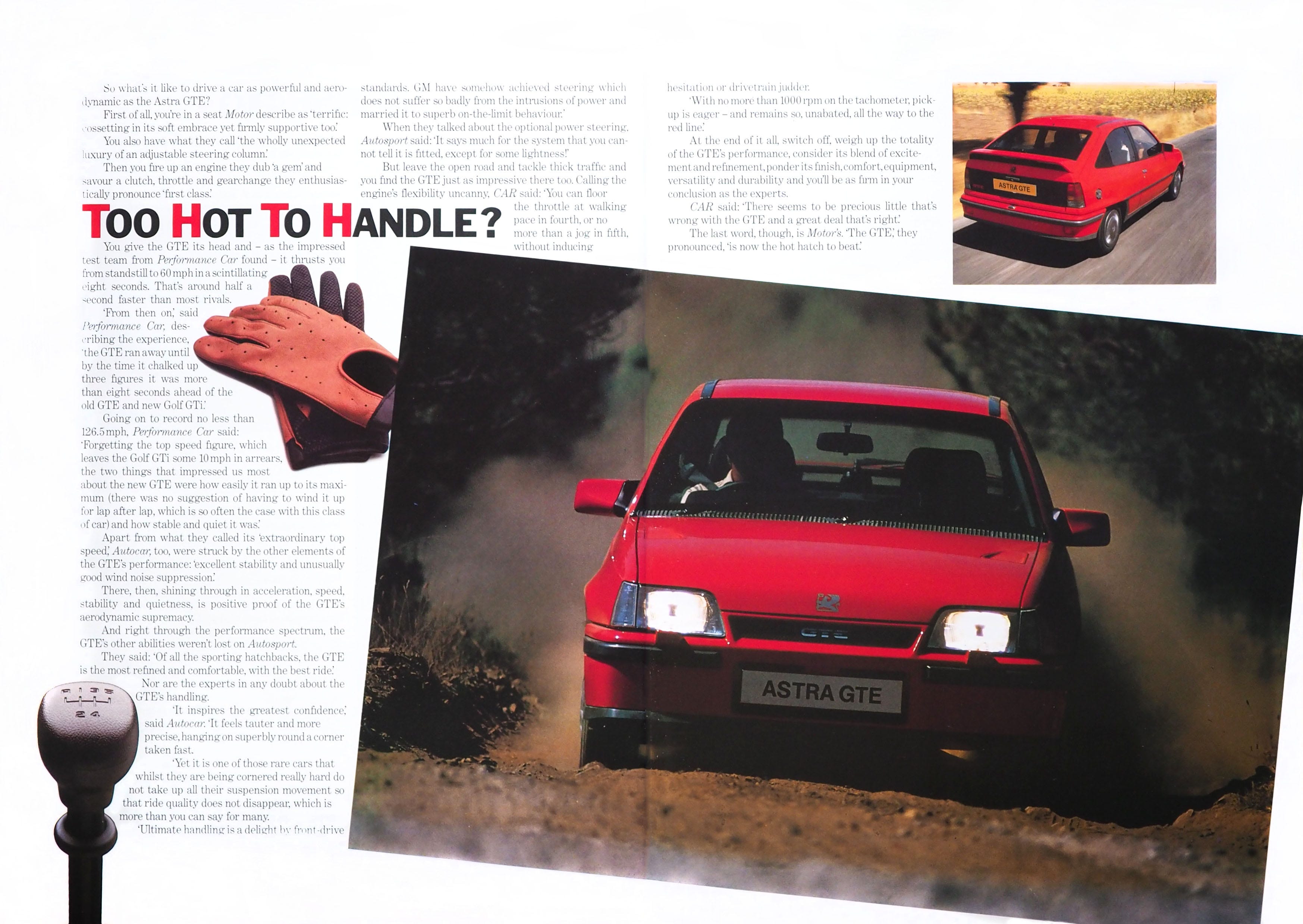
Vauxhall’s engineers had understood that the hot hatch market was won and lost in the pages of CAR magazine and Autocar, and that stopwatch results were the currency of that particular economy. Pages twelve and thirteen of the brochure make this explicit, deploying third-party press quotes with the strategic precision of legal briefs: “The GTE proves to be superior to its toughest competitors in most respects.” The Golf GTI is never named. It doesn’t need to be. Everyone in 1984 knew which competitor was the toughest.
The 940kg kerb weight, modest even by the standards of an era before safety legislation added hundreds of kilograms to every car in the class, combined with the 115bhp output to produce a power-to-weight ratio that was, as the brochure’s curatorial note suggests without quite stating, remarkable for a mass-market family car. This was not raw power. This was efficiency. The distinction mattered to the GTE’s intended buyer: the person who read the decimal places, who understood the difference between horsepower and torque, who wanted performance validated by engineering rather than announced by a body kit.
Aero-Clinical: The Brochure as Evidence
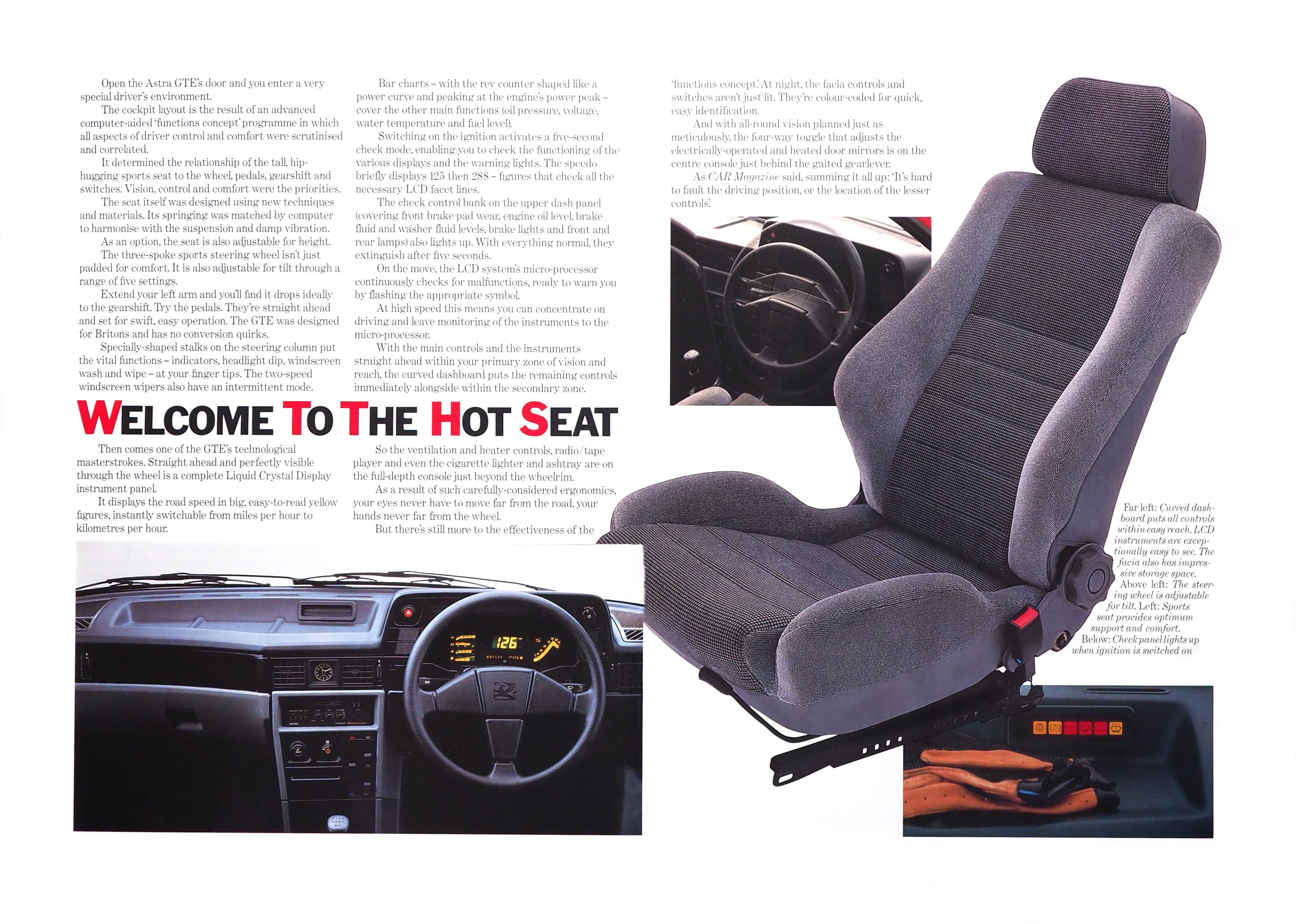
The GTE’s interior presents itself not as a cabin but as an instrument station. The centrepiece (the element around which all other design decisions appear to have been organised) is the Liquid Crystal Display instrument panel, and in October 1984, this required a sentence to itself in every review, every brochure page, and every showroom conversation in Britain.
The LCD dash was the GTE’s declaration of intent. At a time when virtually every other car in its class presented the driver with a traditional analogue cluster (needles, bezels, backlit dials inherited more or less unchanged from the 1960s) the GTE offered a flat, luminescent plane of digits. Speed, fuel, temperature, trip information: all rendered in the precise, unambiguous numerals of the digital age. It was, the brochure noted with the carefully controlled excitement of a scientist announcing results, “instantly switchable from miles per hour to kilometres per hour”. This feature, a single button press that converted the display between imperial and metric, was presented as evidence of global sophistication. Your Golf GTI could not do that. Your Escort XR3i could not do that.
The supporting cast was correspondingly purposeful: sports bucket seats with lateral bolstering designed for the cornering loads the chassis was built to generate, a three-spoke sports steering wheel, and the ergonomic architecture of a car that took the act of driving seriously as a discipline requiring appropriate tools.
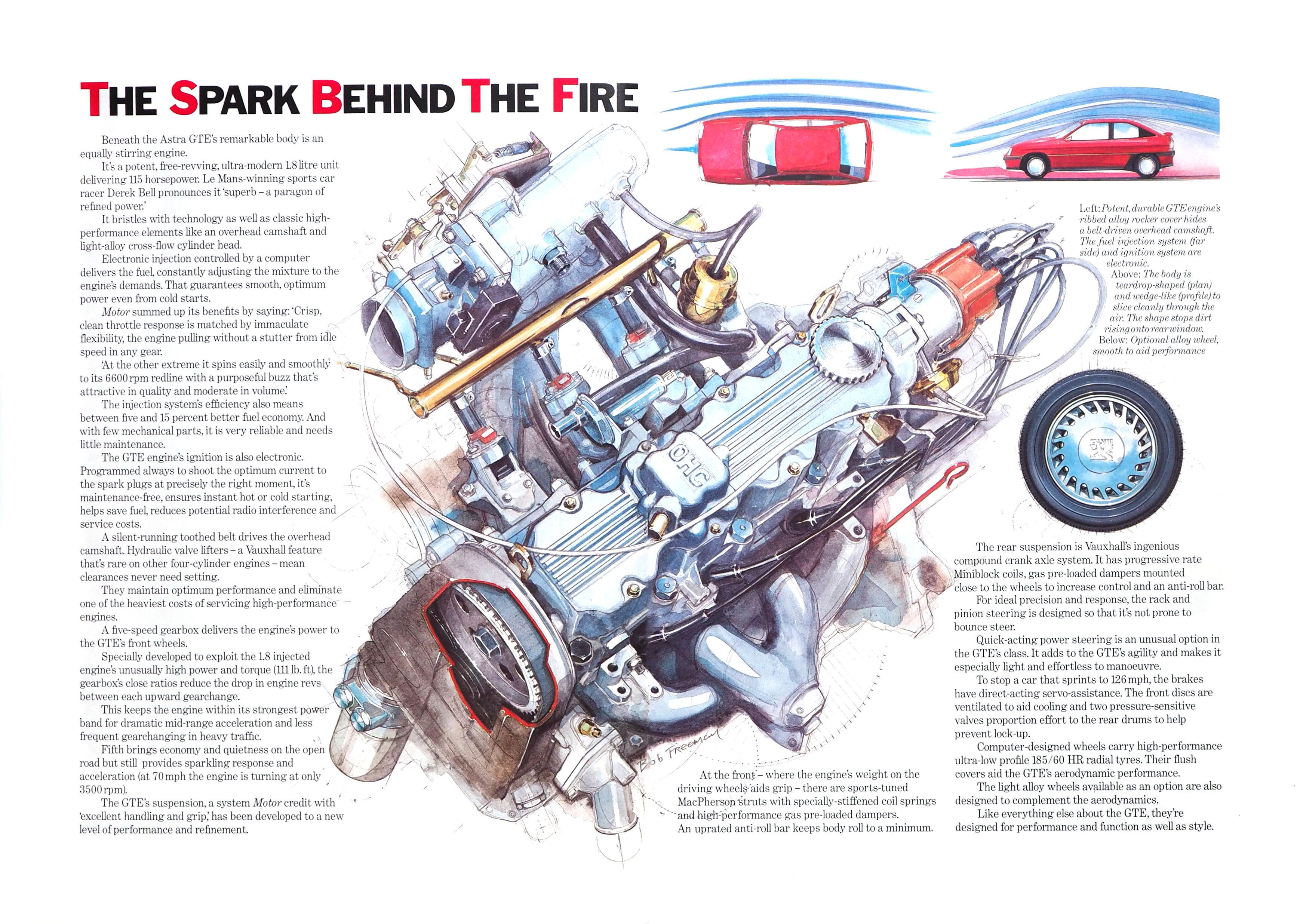
Pages six and seven deploy, with considerable confidence, a watercolour cutaway rendering of the engine (technical illustration as aesthetic object, the mechanical innards depicted with the beauty of botanical drawings). Alongside it, a quote from Derek Bell, Le Mans winner, multiple World Sportscar Champion, a man with no professional obligation to be kind to a 1.8-litre Vauxhall hatchback: “Superb, a paragon of refined power.” The leveraging of Le Mans credibility to validate a mass-market engine was audacious. It was also, given that Bell was a man who had driven machinery of genuine ferocity, a meaningful endorsement rather than an empty celebrity placement. The 1.8-litre injected unit was, genuinely, a fine engine. Bell knew what bad engines felt like. He said it was superb.
The brochure’s physical presence reinforces all of this. Sixteen pages of heavy-gloss stock, landscape-oriented photography within a portrait frame, bold black sans-serif headers with aggressive red accents, and body copy in a Times-style serif that communicated, with every measured syllable, established authority. Vauxhall understood that the document had to perform the same function as the car: to present evidence, arrange it in order, and allow the reader to reach the only rational conclusion available. This was not a brochure that asked you to dream. It asked you to accept the data and act accordingly.
The Rearview Mirror
The Missing Coefficient: The One Thing the Brochure Couldn’t Specify
The GTE’s problem was, at its root, a driving dynamics problem. The hot hatch category has never required prestigious provenance. The Peugeot 205 GTi was a product of a mass-market French family car brand with no meaningful performance heritage in 1984, and it became arguably the defining hot hatch of the era. The Renault 5 GT Turbo wore a diamond badge from a manufacturer better known for the utilitarian Renault 4 than for driver’s cars, and it achieved genuine iconic status. Neither Ford nor Fiat were premium marques. What united the great hot hatches was not the badge on the bonnet but a single shared quality: that when pointed at a B-road, they felt alive.
The GTE, by every contemporary account, did not. The steering was vague on turn-in, with little communication between car and driver. The chassis, optimised for the aerodynamic perfection of its outer surfaces, was less fluent beneath them: prone to understeer when pressed, and to unsettling lift-off oversteer when you thought better of it. The power, peaking hard above 4,000rpm, meant that the B-road experience required commitment and nerve rather than the intuitive, progressive reward that defines a truly great hot hatch. The Golf GTI communicated. It talked to its driver through the steering wheel, through the seat, through the way it loaded up in a corner and told you, with reasonable precision, what it intended to do next. That quality is not in any specification table. It cannot be achieved in a wind tunnel.
None of this appears in the brochure. It could not. The document’s entire argumentative framework is built on the quantifiable: the coefficient, the seconds, the decimal place. There is no specification column for the sensation of a chassis in conversation with its driver. There is no unit of measurement for joy. The brochure presented a complete car on paper and the road revealed the one ingredient missing, the most important one for a hot hatch, and the only one that no engineer had yet found a way to record with a stopwatch. The subtitle of this piece was always going to be true. Sometimes the numbers aren’t enough.
The Electronic Dark Age: When the Future Stops Working
The brochure celebrated the LCD instrument panel as the Space Age made tangible. In 2026, it reads as a forecast written in a medium that did not survive the forecast. The polarising films of those Liquid Crystal Displays have degraded. The liquid crystals themselves have, in many cases, separated. The displays that were the car’s most distinctive interior feature are often now dark rectangles, or partially functioning ghost-screens showing fragments of numerals through a haze of yellowed film. Finding a working unit is a specialist undertaking. Finding someone capable of repairing one (sourcing replacement polarising film of the correct specification, re-sealing the cells, restoring the display to the crisp readability it possessed in October 1984) is harder still. The owners who pursue this describe it in terms closer to archaeological fieldwork than car maintenance.
Meanwhile, the rust works its patient arithmetic in the rear sills and wheel arches. The chassis that was a weapon in 1984 requires vigilance, and in some cases extensive investment, forty years later. The 940kg of pressed steel and injected plastic that achieved 0.30 Cd and 8.0 seconds was, like all pressed steel and injected plastic, subject to the ordinary laws of oxidation. The brochure had no specification column for entropy.
The Redtop Vindication: The Engine That Outlasted the Argument
Here is the thing the sales figures cannot tell you: the GTE was not a failure. It was a proof-of-concept for a powertrain that would go on to dominate. The 1.8-litre injected unit celebrated on pages six and seven did not die with the Series 1. It evolved, by logical and determined engineering steps, into the legendary 2.0-litre “Redtop” that powered Vauxhall and Opel to touring car dominance through the late 1980s and into the 1990s: a decade of motorsport success that the Griffin badge had never previously been able to claim. The aerodynamic philosophy, the “Aero-Clinical” thinking that produced the drag coefficient of 0.30 and structured every panel shut-line and mirror housing as an engineering decision rather than a styling one, established the visual and conceptual grammar that the rest of the hot hatch segment would spend the rest of the decade trying to match. The GTE pioneered the digital cabin, made aerodynamics a mainstream selling point, and produced an engine architecture that became a competition legend. Somewhere, in every Redtop touring car that won a race in the years that followed, the ghost of a brochure that the market didn’t fully appreciate is still, quietly, being vindicated. One hundred and twenty-six point five miles per hour. The decimal place, still doing its work. Still asking to be taken seriously. The least we can do is oblige.
The Fine Print